| Feature | Dulcimer Detail | Why It Matters |
|---|---|---|
| Instrument Family | Zither-type chordophone | The strings run across or along the body, so the instrument does not work like a guitar with a projecting neck. |
| Main Name Confusion | Dulcimer may mean a plucked mountain dulcimer or a struck hammered dulcimer. | They share a name, but the playing motion, body shape, and musical role can be very different. |
| Common Materials | Walnut, cherry, maple, spruce, cedar, metal strings, hardwood bridges, and wooden pegs or geared tuners. | Wood choice changes weight, attack, warmth, sustain, and how the body responds to vibration. |
| Typical Sound | Clear melody, soft ringing sustain, and often a drone-like bed of sound. | The dulcimer can feel intimate, bright, bell-like, or shimmering depending on the type. |
| Regional Forms | Appalachian dulcimer, hammered dulcimer, hackbrett, cimbalom, santur, santouri, yangqin, épinette des Vosges, hummel, langeleik, and scheitholt. | The dulcimer idea traveled through many local craft traditions rather than one fixed factory design. |
| Playing Method | Strummed with a quill or pick, plucked with fingers, fretted with a noter, or struck with small hammers. | The hand technique is one reason regional forms can sound like cousins rather than copies. |
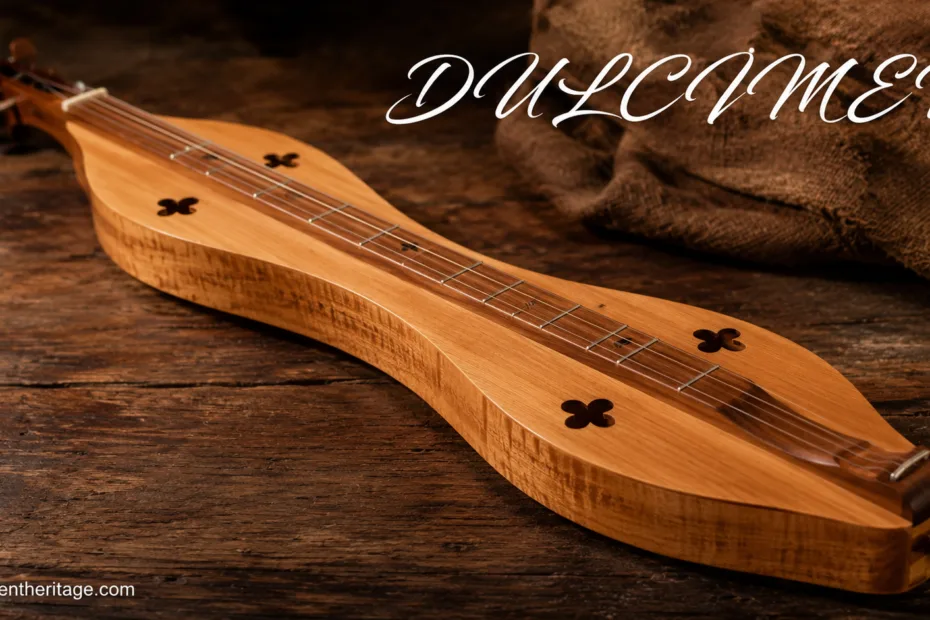
A dulcimer looks simple until you listen closely. A few strings, a wooden body, maybe a row of frets or a set of small bridges. Then the sound opens up: bright notes, gentle drones, little waves of metal string vibration, and a homely sweetness that feels more like a handmade object than a stage machine. The word dulcimer does not point to only one shape. It points to a family of folk zithers, some held on the lap and strummed, others laid flat and played with hammers.
That is why the dulcimer can be both easy to recognize and tricky to define. In one room, it might be a long Appalachian instrument with a raised fingerboard and heart-shaped soundholes. In another, it might be a trapezoid box covered with strings and tapped with curved beaters. Same name. Different hands.
🎵 What Makes a Dulcimer a Dulcimer?
The dulcimer belongs to the broader zither family. In plain language, that means the strings are stretched across a body, frame, or soundboard rather than along a neck like a guitar or violin. Some zithers are plucked, some are bowed, some are struck. The dulcimer sits inside that big family with a strong folk identity and a long habit of local variation.
The old name is often linked with the idea of a sweet sound, which fits the instrument well. A good dulcimer does not need volume to be charming. It wins the ear with ringing overtones, soft sustain, and a kind of musical plain-spokenness. It can play a tune without showing off.
One of the first things to know is this: two different instruments carry the name dulcimer. The Smithsonian notes that one is plucked and the other is struck with small hammers, which explains why old records, museum labels, and casual conversations can become confusing very quickly.Reference-1✅
Simple way to remember it: a mountain dulcimer usually lies across the lap and is strummed or plucked; a hammered dulcimer usually lies on a stand or table and is played by striking strings with light hammers.
Plucked Dulcimer vs. Hammered Dulcimer
The Appalachian dulcimer, also called the mountain dulcimer, is the instrument many people picture when they hear “folk dulcimer.” It has a long narrow body, a fretted fingerboard, and usually three or four strings. The player often strums across all the strings while stopping the melody string with the fingers or a small stick called a noter.
The hammered dulcimer is built more like a table of strings. It often has a trapezoid body, many courses of metal strings, and bridges that divide the speaking lengths of the strings. The player holds a small hammer in each hand. The sound is brighter and more bell-like, with notes that sparkle and decay in little bursts.
Both are folk instruments. Both are zithers. Yet their musical personalities are different enough that calling them “the same instrument” can feel like calling a flute and a harmonica the same because both use air. The family resemblance is real, but the hands tell another story.
🪕 The Dulcimer’s Many Regional Forms
The dulcimer is not a single polished blueprint. It is more like a useful musical idea that local makers kept reshaping. A carpenter, a farmer, a village craftsperson, a trained instrument builder—each could make a version using the woods, tools, tunings, and songs around them.
This is where the instrument becomes especially interesting. The same basic idea—strings stretched over a resonant body—appears in several regional traditions, each with its own sound and playing habit.
| Instrument or Form | Region or Tradition | Playing Method | Sound Character |
|---|---|---|---|
| Appalachian Dulcimer | United States, especially Appalachian folk music | Strummed or plucked, often with drone strings | Warm, direct, gently nasal, and melody-led |
| Hammered Dulcimer | Europe and North America in several folk settings | Struck with small hammers | Bright, ringing, fast-decaying, and harp-like |
| Hackbrett | Alpine and central European traditions | Usually struck with beaters | Crisp, rhythmic, and dance-friendly |
| Cimbalom | Central and eastern European concert and folk use | Struck with padded or unpadded beaters | Wide range, strong projection, expressive sustain control |
| Santur / Santoor / Santouri | West Asian, South Asian, and Mediterranean traditions | Struck with light hammers or mallets | Glassy, shimmering, and ornament-rich |
| Yangqin | Chinese music | Struck with bamboo beaters | Clear, quick, bright, and agile |
| Scheitholt, Hummel, Langeleik | Northern European zither traditions | Plucked, strummed, or played with melody and drone strings | Plain, reedy, droning, and closely tied to modal tunes |
| Épinette des Vosges | French regional zither tradition | Plucked or strummed | Soft, rustic, and intimate |
Britannica describes the hammered dulcimer family alongside forms such as the Alpine hackbrett, Hungarian cimbalom, Greek santouri, Turkish and Persian santur, and Chinese yangqin.Reference-2✅ Those names are not just vocabulary. They show how the dulcimer idea changed when it met different musical languages.
The Appalachian Form
The Appalachian dulcimer is usually narrow, shallow, and easy to hold across the lap. Its body may be hourglass-shaped, teardrop-shaped, elliptical, rectangular, or long and tapered. Some have heart-shaped soundholes. Some have simple round soundholes. Some are plain as a breadboard. That is part of the charm.
Many Appalachian dulcimers use a diatonic fret pattern. That means the fret layout favors a scale rather than every half-step found on a guitar. The result is friendly under the hand. A beginner can find a tune quickly, while a skilled player can add ornaments, drones, chord shapes, and rhythmic lift.
The Hammered Form
The hammered dulcimer feels more like a small string orchestra folded into a wooden box. Its strings are usually arranged in repeated courses, often two, three, or more strings per note. When struck together, the strings make one pitch with extra shimmer. That shimmer is the magic.
Its bridges are not just supports. They divide, organize, and color the scale. On many hammered dulcimers, the player moves across left and right bridge sections to find different notes. A melody can bounce from hand to hand, almost like two little birds trading a tune.
Northern European Relatives
Names such as scheitholt, hummel, langeleik, and épinette des Vosges matter because they help explain why the Appalachian dulcimer looks the way it does. These older fretted zithers share the idea of melody strings paired with drone or accompaniment strings. Britannica’s zither entry also places older forms such as the Scheitholt, hummel, langleik, and épinette des Vosges near the American mountain dulcimer in the broader zither story.Reference-3✅
That does not mean every dulcimer descends from one neat ancestor. Folk instruments rarely behave that neatly. They borrow ideas, keep what works, drop what does not, and change in the hands of makers.
🪵 Build, Materials, and Craft Details
A dulcimer is a lesson in controlled simplicity. The body has to be light enough to vibrate, strong enough to hold string tension, and balanced enough to keep the sound from becoming thin or boxy. Small choices matter: the thickness of the top, the angle of the bridge, the hardness of the fretboard, the string gauges, even the size of the soundholes.
Traditional makers often used woods available nearby. Cherry, walnut, maple, and poplar appear often in American dulcimer making. Modern builders may use spruce or cedar for a more responsive top, while harder woods can help the sides, back, and fingerboard stay stable.
The Met’s collection record for a late nineteenth-century American Appalachian dulcimer lists cherry wood, metal strings, and a length of 38 inches, with the object classified as a plucked zither chordophone.Reference-4✅ That single museum object says a lot: folk instruments may look modest, but they belong in serious instrument history.
Body
The soundbox acts like a small wooden amplifier. A thinner top may speak quickly; a heavier top may sound steadier but less lively. The shape changes comfort and tone, but no single outline owns the dulcimer identity.
Fingerboard
On a mountain dulcimer, the fingerboard often runs down the center of the body. It carries the frets and gives the player a clear path for melody. Older or regional forms may place frets differently.
Strings
Steel strings give brightness and sustain. Courses may be single or doubled. A doubled melody course adds extra ring and helps the melody shine over the drone.
Bridges
Bridges transfer string vibration into the body. On hammered dulcimers, bridge placement also shapes the note layout, so it affects both tone and navigation.
Soundholes Are More Than Decoration
Heart-shaped, round, diamond, leaf, f-hole, or handmade freeform soundholes are part of dulcimer personality. They let air move in and out of the body, but they also carry the maker’s touch. A plain instrument can sound beautiful. A decorated one can sound plain. Looks are not the whole story.
Still, decoration matters in folk craft. A carved heart or simple scroll can turn a dulcimer into something that feels personal before a note is played. It tells you someone made this object to be held, heard, and kept.
Frets, Drones, and the Noter
The classic Appalachian dulcimer often uses a melody string and one or more drone strings. A player may slide a noter along the melody course while strumming across all the strings. The stopped string carries the tune; the unstopped strings hum underneath.
That drone is not background filler. It is a musical floor. It gives the melody a home note to lean against, much like a singer standing near a steady low hum. This is one reason the dulcimer works so well for modal folk tunes. The instrument does not need thick harmony to feel full.
🔔 The Dulcimer Sound: Ring, Drone, and Wood
The dulcimer’s voice depends on its type. A mountain dulcimer is often intimate, nasal in a pleasing way, and warm around the edges. It can sound like a small harp crossed with a quiet fiddle drone. A hammered dulcimer is brighter and more sparkling, with a ringing attack that can fill a room even before amplification enters the picture.
The sound also changes with touch. A stiff pick gives the Appalachian dulcimer a sharper edge. Fingers soften it. A wooden noter gives a smooth sliding feel. On a hammered dulcimer, lighter hammers produce delicate speech; heavier hammers bring more bite. Padding on the hammers can darken the attack.
Listen for this: the dulcimer often blends melody with sustain. Even when the tune is simple, the after-ring of the strings adds a soft halo around each phrase.
Why the Drone Feels So Natural
A drone is one of the oldest musical comforts. It gives the ear a steady point while the melody moves. On the Appalachian dulcimer, drone strings make even a single-note tune feel supported. The player does not have to build chords constantly. The instrument already breathes under the melody.
This is why many dulcimer tunes sound settled, even when the rhythm dances. The drone keeps the floor still while the tune walks around the room.
Modes and Tunings
Dulcimer players often talk about modes because the instrument’s fret layout and drone strings make modal playing feel natural. Common mountain dulcimer tunings include patterns such as D-A-D, D-A-A, or related setups, depending on the tune and the player’s style. The exact tuning is not one universal rule.
On hammered dulcimers, tuning is a larger job. Many strings must be brought into careful relationship, and paired or tripled courses need to match closely. When they do, the sound blooms. When they do not, the shimmer can turn cloudy.
🛠️ How Dulcimers Are Played
Dulcimer technique is easy to begin and surprisingly deep to live with. The first tune may come quickly. The touch takes longer.
- Noter-drone playing: a small stick stops the melody string while the other strings ring openly.
- Finger fretting: players use fingertips to form notes and chords, closer to guitar-like left-hand movement.
- Flatpicking or strumming: a pick drives rhythm across the strings.
- Fingerpicking: softer and more separated, useful for delicate arrangements.
- Hammered playing: two small hammers strike the strings, often with alternating hand patterns.
- Muted or damped playing: hands or hammer control can shorten sustain when the music needs clarity.
A skilled Appalachian dulcimer player can make the drone breathe rather than buzz. A skilled hammered dulcimer player can keep fast passages clear without letting the ringing strings blur every note. Neither skill is loud. It is all in the touch.
The Lap, the Table, and the Stand
Mountain dulcimers are often played across the lap. Some players place them on a table, which can add resonance. Hammered dulcimers usually sit on a stand or table because the player needs full access to the string field.
That physical setup shapes the music. A lap dulcimer feels personal and close. A hammered dulcimer feels like a small landscape in front of the player, with notes arranged across a wooden map.
🌍 Similar Instruments and Close Cousins
The dulcimer sits near many instruments, but it should not be mixed up with all of them. The family lines can overlap. The playing method usually clears things up.
| Instrument | Connection to Dulcimer | Main Difference |
|---|---|---|
| Psaltery | Another stringed box or frame instrument with old European roots. | Often plucked; usually lacks the same fretted Appalachian drone setup. |
| Autoharp | A zither with chord bars that mute unwanted strings. | Chord-button mechanism changes how harmony is produced. |
| Zither | The larger family that includes many dulcimer-like instruments. | “Zither” is broader; dulcimer names a more specific folk branch. |
| Qanun | A plucked trapezoid zither with a strong regional art-music role. | Uses finger plectra and often has levers for pitch adjustment. |
| Santoor / Santur | A struck zither closely related in structure to hammered dulcimer forms. | Regional tuning, mallet style, and repertoire create a distinct voice. |
| Langeleik | A Norwegian fretted drone zither with a strong folk identity. | Its body, tuning habits, and local repertory differ from the Appalachian form. |
These comparisons help keep the dulcimer in focus. It is not just “a small harp” or “a simple guitar.” It is a folk zither with its own body logic, sound logic, and craft memory.
🎶 Why the Dulcimer Still Feels Handmade
Some instruments feel standardized. A dulcimer often feels personal. Two makers can build the same general form and end up with instruments that behave differently under the hand. One may have a dry, woody voice. Another may ring for days. One may love slow modal tunes. Another may wake up under dance rhythm.
That variety is not a flaw. It is part of the instrument’s identity. The dulcimer grew through local making, household music, regional memory, and practical craft. Its beauty is not in perfect uniformity. It is in the way a simple design leaves room for human hands.
For a listener, the dulcimer offers a rare kind of closeness. You hear wood, wire, air, and touch without much distance between them. The sound is honest. Small, sometimes. But never empty.
Common Questions About the Dulcimer
Dulcimer FAQ
Is a dulcimer the same as a zither?
A dulcimer is a type of zither, but the word zither is much broader. Many instruments with strings stretched over a body or frame can be called zithers. The dulcimer is one branch of that larger family.
What is the difference between a mountain dulcimer and a hammered dulcimer?
A mountain dulcimer is usually a fretted lap zither that is strummed or plucked. A hammered dulcimer is usually a many-stringed trapezoid zither played with small hammers. They share a name, but the playing motion and layout are very different.
Why does the Appalachian dulcimer use drone strings?
Drone strings give the melody a steady tonal base. They keep ringing while the melody moves, creating a full sound from a simple setup. This is one reason the instrument works so well with modal folk tunes.
What woods are used for dulcimers?
Common woods include cherry, walnut, maple, poplar, spruce, and cedar. Harder woods are often used for structure and fingerboards, while lighter resonant woods can help the top respond more freely.
Is the dulcimer hard to learn?
The mountain dulcimer is often friendly for beginners because the fret layout and drone strings make simple melodies easy to find. Hammered dulcimer can also be approachable at first, but tuning, note layout, and clean hammer control take patient practice.
Why do dulcimers have so many shapes?
The dulcimer grew through local craft rather than one fixed design. Makers used available woods, familiar tools, and personal taste. That is why you see hourglass, teardrop, rectangular, trapezoid, and other forms.
