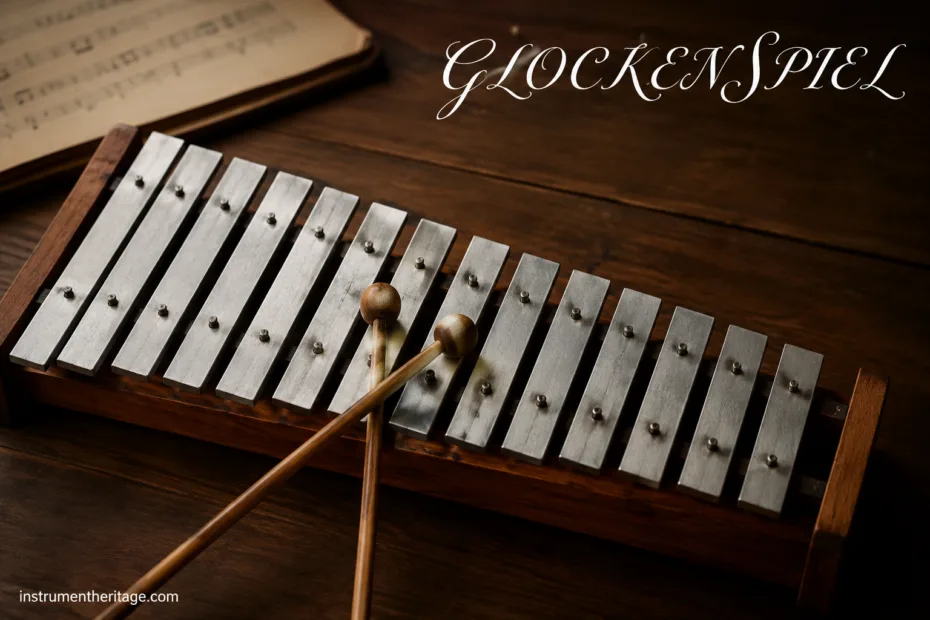
| Feature | Glockenspiel detail |
|---|---|
| Instrument family | Pitched percussion; a struck-bar idiophone and metallophone |
| Sounding material | Usually hardened steel or a steel alloy; some models use other metal formulations |
| Bar layout | Two chromatic rows arranged like the white and black keys of a piano |
| Typical orchestral compass | About 2½ to 3 octaves, depending on the instrument |
| Notation | Treble clef; the mallet-played instrument usually sounds two octaves above written pitch |
| Tone | Bright, clear, bell-like, high, focused, and rich in upper partials |
| Common beaters | Hard plastic, acrylic, phenolic, brass, aluminum, wood, or hard rubber |
| Main forms | Table glockenspiel, pedal glockenspiel, portable bell lyra, educational diatonic model, and historical keyboard glockenspiel |
| Common settings | Orchestra, concert band, percussion ensemble, marching ensemble, classroom music, theatre, film, and studio recording |
A glockenspiel can cut through a full ensemble with only a small stroke. Its bars are compact, its dynamic range is not huge, and yet the sound travels with remarkable clarity because so much energy sits in the upper register. The result is a bright metallic voice that can outline a melody, add a flash to an orchestral chord, or turn a simple repeated note into something instantly recognizable.
The instrument is sometimes described as a small metal xylophone, but that shorthand hides the details that make it special. A glockenspiel has its own bar proportions, tuning method, mallet response, notation practice, sustain behavior, and musical role. It is small, but not simple.
What Makes a Glockenspiel a Glockenspiel? 🔔
The modern glockenspiel is a pitched percussion instrument made from tuned metal bars. Each bar produces one main musical pitch when struck. The bars sit in two rows: the lower row follows the natural notes of a keyboard, while the raised row supplies sharps and flats. This familiar arrangement allows a percussionist to read melodic music and move through chromatic passages much as a pianist reads the keyboard.
In instrument classification, the glockenspiel belongs to the idiophones because the bar itself vibrates to create sound. It is also a metallophone, a broad name for instruments whose tuned sound elements are metal. The bar is not merely a trigger for a string, membrane, or air column. The metal bar is the sounding body.
Name note: the German word Glockenspiel can be understood as “bell play.” In English-speaking orchestras, the same instrument is often called orchestra bells or simply bells. The name can also refer to bell mechanisms in German-speaking contexts, so the surrounding musical setting matters.
Bars, Frame, Supports, and Tuning
Metal bars and pitch
Professional glockenspiel bars are commonly made from high-carbon steel or another carefully chosen steel alloy. Steel provides the hardness, density, and elastic response needed for a clear attack and long, bright ring. Historical instruments can show different construction choices. An early nineteenth-century glockenspiel in the Metropolitan Museum of Art, for example, combines steel bars with a maple case, showing how metal tone elements and woodworking met in compact instrument design.Reference-1✅
Bar length is the most visible pitch control: shorter bars sound higher, longer bars sound lower. Thickness, width, alloy, heat treatment, and the shape of the underside also affect pitch and overtone balance. Makers remove very small amounts of material during final tuning. A little metal taken from the wrong area can alter more than the fundamental note, so the work calls for steady measurement and a practiced ear.
Why the bars do not sit directly on the case
A vibrating bar needs freedom to move. For that reason, glockenspiel bars rest on soft supports or are mounted at points where vibration is naturally reduced. These areas are called nodes. Supporting the bar near its nodal points limits energy loss into the frame and lets the note ring with a cleaner decay.
Felt, rubber, cord, or padded fittings may be used between the bars and their support rails. The exact system varies by maker and model. It also affects handling noise. A well-built instrument keeps screws, washers, rails, and the case from adding buzzes or rattles while the bars are active.
Case and damper system
Small table instruments often place the bars in a shallow wooden or synthetic case. The cavity below them can reinforce the sound, although a glockenspiel does not depend on long resonator tubes in the same way a marimba or vibraphone does. Larger concert models may sit on a wheeled stand and include a pedal-operated damper rail. With the pedal released, felt touches the bars and shortens the notes. Pressing the pedal lifts the felt so the bars can ring.
How the Bright Tone Is Produced
The sound begins with a fast collision between mallet and bar. The bar bends, springs back, and continues vibrating in several modes at once. The lowest strong component gives the ear a sense of pitch, while higher partials add the familiar glittering edge. Steel encourages a dense group of upper frequencies, which is why the instrument remains audible even when the player is not striking with great force.
That projection can be surprising. The glockenspiel is not one of the loudest percussion instruments in raw acoustic output, yet its high register occupies a part of the spectrum where fewer orchestral instruments sustain dense energy. It can therefore sit above strings, winds, and brass without needing a heavy blow. The Vienna Symphonic Library describes standard orchestral models as two-and-a-half or three-octave instruments, usually sounding two octaves above their written notes, and notes how mallet hardness changes the amount of upper-partial energy.Reference-2✅
Attack
The first instant is crisp and easy to locate. Harder mallets make that front edge sharper; softer mallets round it off.
Sustain
Lower bars usually ring longer than the smallest upper bars. Pedals or hand damping shape the decay.
Pitch focus
The ear hears a clear note, though the overtone pattern is more complex than that of a vibrating string.
From Tuned Bells to Metal Bars
The name came before the modern shape. Earlier European glockenspiels used sets of tuned bells, sometimes operated by mechanical or keyboard actions. Bells offered the right kind of brilliance, but they took up space and required a different mounting system. Over time, compact metal bars became a practical substitute. By the late seventeenth century, steel bars were entering the instrument’s design, and the glockenspiel gradually became a distinct bar percussion instrument rather than a small collection of bells.
The keyboard glockenspiel
Before hand-held mallets became the normal orchestral method, some glockenspiels were played from a keyboard. Pressing a key moved a small hammer against a tuned bar or plate. This allowed flowing passages and chords that would have been difficult on early hand-played layouts. Keyboard glockenspiels appeared in theatre and orchestral writing, including the bell-like part associated with Mozart’s The Magic Flute. Surviving examples differ in their materials and mechanisms, which shows that there was never only one fixed recipe for the instrument.Reference-3✅
The keyboard form later became uncommon, while the mallet-played glockenspiel settled into the percussion section. Its exposed bars gave the player direct control over articulation, mallet choice, rolls, glissandos, and hand damping. The mechanism disappeared; touch moved closer to the sound.
The bell lyra
Portable marching versions place metal bars inside a lyre-shaped frame. These instruments are called bell lyras, bell lyres, or lyra glockenspiels. They may be held vertically and played with one mallet, or carried in a support system that allows a more horizontal position. A Smithsonian collection example from the 1940s has two octaves of tuned bars, felt cushioning, note stamps, and a fitting for a carrying pole.Reference-4✅
Main Glockenspiel Forms
- Orchestral table glockenspiel: a compact chromatic set in a case, placed on a table or percussion stand. It is direct, portable, and often damped by hand.
- Pedal glockenspiel: a larger concert model with a stand and damper pedal. It offers cleaner control over connected phrases and sustained notes.
- Bell lyra: a portable form made for movement and outdoor projection, with bars fitted into a lyre-like frame.
- Educational glockenspiel: usually smaller, often diatonic, and sometimes supplied with removable bars. It supports pitch learning, song accompaniment, and ensemble work.
- Keyboard glockenspiel: a rare mechanical form in which keys activate hammers that strike metal sound elements.
These forms share a family resemblance, yet their playing feel can be quite different. A classroom model may have wide bars and a gentle response. A professional pedal instrument may use narrower, heavier bars with a longer ring. A bell lyra asks the player to judge distance on a vertical plane while the instrument is moving. The name stays the same. The physical experience does not.
Mallet Choice and Playing Technique 🎵
Choosing the mallet
Mallet material changes the instrument immediately. Brass and other metal heads produce a sharp, brilliant attack with many upper partials. Hard plastic, acrylic, phenolic, and similar synthetic heads give clarity with less metallic contact noise. Wood can soften the edge. Hard rubber can produce a rounder note, though a head that is too soft may fail to set the smallest bars into clear vibration.
| Mallet head | Typical response | Useful setting |
|---|---|---|
| Brass or metal | Very bright, narrow attack, strong upper partials | Solo accents, exposed high notes, brilliant ensemble color |
| Hard plastic or acrylic | Clear and focused with controlled contact noise | General orchestral and concert-band playing |
| Phenolic or ebonite | Firm attack with a slightly fuller body | Articulated passages that still need tone |
| Wood | Dry, less glassy, softer upper edge | Delicate passages and lighter textures |
| Hard rubber | Rounded and restrained | Quiet practice or passages needing less sparkle |
Stroke, rebound, and striking area
The usual target is near the center of the bar, where the response is full and dependable. The mallet should rebound rather than press into the metal. A tight grip chokes movement in the hand and often creates a harder contact sound than intended. A relaxed grip allows the head to leave the bar quickly, letting the metal speak.
Near a nodal support point, the bar moves less and sounds quieter. Skilled players can use that fact in fast, soft passages, especially when the distance between chromatic rows feels awkward. The tonal change is real, so the choice is musical rather than merely convenient.
Rolls, damping, chords, and glissandos
- Single strokes suit clear melodic lines and doubled orchestral parts.
- Alternating rolls extend notes that would otherwise decay, though the high register can make uneven strokes easy to hear.
- Hand damping stops selected bars cleanly. The hand touches the bar after the attack without adding a second impact.
- Pedal damping controls several bars together on concert models, making phrasing smoother.
- Four-mallet playing allows chords and wider textures, although the small bar spacing demands accuracy.
- Glissandos run across natural notes or raised chromatic bars. Round mallet heads travel more smoothly across the surface.
Listening detail: a glockenspiel roll is not truly seamless. It is a fast chain of attacks that the ear joins into one sustained shimmer. Slower rolls reveal each stroke; faster rolls create a more continuous band of sound.
Range, Written Pitch, and Score Reading
The glockenspiel is usually written in treble clef and normally sounds two octaves higher than written. This keeps the notes inside a readable staff rather than covering the page with ledger lines. A written middle C therefore sounds as a much higher C. Some older scores use different octave conventions, so the instrument range and musical context help resolve uncertainty.
There is no single compass shared by every model. Common professional instruments cover around two-and-a-half or three octaves, while extended models can reach farther. Educational instruments may offer only a diatonic scale or a limited chromatic range. Before assigning a low or very high note, an arranger needs to know the actual instrument available to the player.
- Written register
- Usually treble clef, placed lower than the sounding register for easier reading.
- Sounding register
- Very high; generally two octaves above the written notes on a mallet glockenspiel.
- Common orchestral use
- Melody doubling, isolated color notes, sparkling chord tones, rhythmic signals, and exposed short solos.
- Practical limit
- The exact bottom and top notes depend on the make and model.
What the Glockenspiel Does in an Ensemble
In an orchestra, the glockenspiel often doubles a melody already played by another instrument. Doubling the piccolo or flute adds a hard, luminous outline. Joining a harp or celesta creates a more blended sparkle. Placed over brass, it can define the top of a large chord without making the texture feel heavier.
It also works alone. A short glockenspiel phrase can sound playful, ceremonial, delicate, mechanical, or mysterious depending on tempo, harmony, mallet, and register. The instrument does not carry emotional meaning by itself. Context shapes it. One exposed note over silence feels very different from the same pitch repeated over a busy percussion pattern.
Concert bands use it for melodic reinforcement and color. Percussion ensembles give it more independent material, including interlocking patterns, chordal passages, and mixed-metal textures. In classroom music, diatonic glockenspiels help players see pitch relationships directly. In recorded music, close microphones reveal the contact sound and long decay, while more distant placement blends the instrument into the room.
Glockenspiel and Similar Instruments
| Instrument | Sounding material | Register and sustain | Main difference from glockenspiel |
|---|---|---|---|
| Glockenspiel | Steel or steel alloy bars | Very high, bright, moderate-to-long ring | Compact bars and a focused bell-like attack |
| Xylophone | Wooden or synthetic bars | High, dry, short sustain | Wood gives a warmer, more percussive knock and faster decay |
| Vibraphone | Aluminum bars | Middle register, long sustain | Has resonator tubes, a damper pedal, and usually rotating fans for vibrato |
| Crotales | Small tuned metal discs | Very high, pure, long ring | Disc shape and a more concentrated, singing sustain |
| Tubular bells | Suspended metal tubes | Lower bell register, long decay | Large vertical tubes imitate the character of tower bells |
| Celesta | Metal plates struck by keyboard hammers | High, gentle, sustained | Keyboard action and felt-covered hammers produce a softer attack |
The glockenspiel and xylophone are confused most often because both use a piano-like layout and mallets. The material settles the question quickly: metal bars indicate a glockenspiel; wooden bars indicate a xylophone. The sound confirms it. Glockenspiel notes ring and shine, while xylophone notes speak with a shorter wooden snap.
Craftsmanship, Tuning, and Instrument Quality 🛠️
A good glockenspiel is more than a group of bars cut to approximate lengths. Each bar must be tuned, matched in tone, mounted without unwanted damping, and separated from mechanical noise. The frame must stay rigid enough to hold alignment while remaining quiet. Felt and rubber parts need the right firmness. Even the distance between rows affects technique.
Players often notice quality through consistency. One bar should not feel much harder to activate than its neighbors. The tone should remain centered across the range. Sustain may shorten naturally toward the top, but the change should feel gradual. A poorly seated bar can buzz; a loose fitting can chatter; compressed support material can steal resonance.
Tuning is checked under stable room conditions because metal responds to temperature. Warm bars tend to shift slightly in pitch, while cooler bars move the other way. The change may be small, yet exposed high notes make small differences easy to hear. Professional makers balance exact pitch with the bar’s overtone structure and response, rather than treating tuning as a single number on a meter.
Care, Storage, and Quiet Maintenance
- Lift bars only when the instrument’s design allows it, and keep them in their original order.
- Use a soft, dry cloth for routine cleaning. Moisture left on steel can mark the surface and affect hardware.
- Avoid abrasive polish unless the maker specifically approves it; surface changes can alter appearance and, in extreme cases, mass.
- Check cords, felt, rubber supports, screws, and damper rails for wear or compression.
- Transport the instrument in a fitted case so the bars cannot strike each other.
- Store mallets separately from the bars to prevent dents and scratches.
- Keep the instrument away from rapid temperature changes before tuning checks or performances.
Most routine problems are mechanical rather than mysterious. A buzz may come from a loose screw, a bar touching its neighbor, a worn pad, or an object resting against the case. The cleanest test is to strike one bar at a time at a moderate level, listen through the decay, then inspect the support points before changing anything.
Glockenspiel Questions
Is a glockenspiel the same as a xylophone?
No. A glockenspiel uses tuned metal bars and has a bright, ringing tone. A xylophone uses wooden or synthetic wooden-style bars and produces a drier, shorter sound.
Why does a glockenspiel sound two octaves higher than written?
The octave transposition keeps the part easy to read in treble clef. Writing the actual sounding register would require many ledger lines above the staff.
Are glockenspiel bars made from aluminum?
Most orchestral glockenspiels use steel or a steel alloy. Aluminum is more closely associated with vibraphone bars, though makers may use different metal formulas for particular models.
Can a glockenspiel play chords?
Yes. A player can hold three or four mallets to play chords, intervals, or chord rolls. Two-mallet melody playing remains more common because the bars are small and closely spaced.
What is the difference between a glockenspiel and a celesta?
A glockenspiel is normally struck directly with hand-held mallets. A celesta uses a keyboard mechanism and felt-covered hammers to strike metal plates, producing a gentler and less piercing tone.
What mallets are used on a glockenspiel?
Hard plastic and synthetic mallets are common for general playing. Brass or metal heads add brilliance, while wood or hard rubber can soften the attack. The correct choice depends on the instrument, register, and musical texture.
What is a bell lyra?
A bell lyra is a portable glockenspiel with tuned metal bars mounted in a lyre-shaped frame. It is designed for marching and parade performance and may be played in a vertical or supported horizontal position.
Why can the glockenspiel be heard over a large ensemble?
Its steel bars produce many upper partials, and its notes sit in a very high register. Those frequencies remain easy for the ear to pick out even when the instrument is not producing extreme volume.
