| Feature | Udu drum details |
|---|---|
| Instrument family | Hand percussion; commonly classified as both a vessel idiophone and an implosive or plosive aerophone |
| Cultural origin | Igbo communities of southeastern Nigeria, with well-documented traditions of women shaping and playing pottery instruments |
| Main material | Fired clay or ceramic; contemporary models may be glazed, textured, reinforced, or made from synthetic material |
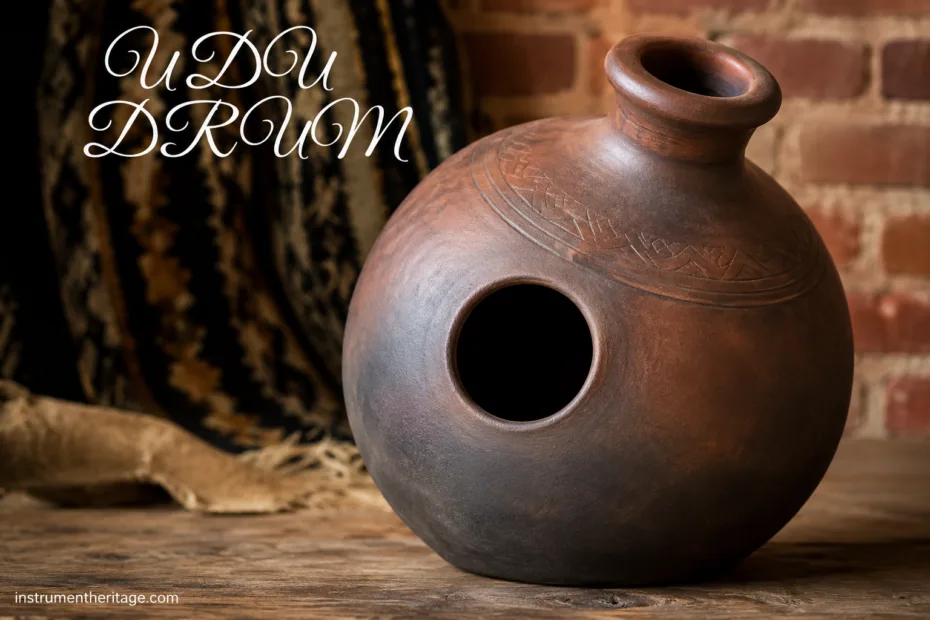
| Basic form | A hollow pot with a neck opening and a second opening cut or formed into the body |
| Primary sound | A rounded, low bass pulse made by slapping an opening, plus dry taps, knocks, muted notes, and ringing shell tones |
| Pitch behavior | Usually indefinite rather than tuned to a fixed scale; pitch changes with cavity size, aperture geometry, hand position, and muting |
| Playing position | Held on the lap, supported between the legs, placed on a padded ring, or mounted on a purpose-made stand |
| Common musical settings | Igbo vocal and ceremonial music, percussion ensembles, jazz, acoustic fusion, studio textures, dance accompaniment, and solo hand percussion |
The udu looks like a clay vessel because that is exactly where its identity begins. A player can touch the shell lightly and hear a compact ceramic click, strike the rounded body for a firmer knock, then slap the side opening and release a deep note that seems much larger than the pot itself. Air, clay, and hand movement work together. No membrane is stretched across the instrument, and no stick is needed. The sound comes from the hollow chamber, the openings, and the fired body.
Its strongest cultural roots lie among the Igbo people of southeastern Nigeria. Museum records connect the instrument with pottery made and played by women, while modern makers have carried the form into concert halls, recording studios, percussion classrooms, and mixed-genre ensembles. The udu has changed shape many times, yet the central idea remains wonderfully plain: a pot becomes a resonator when its air is set in motion.
🏺 A Musical Pot with Igbo Roots
The udu belongs to a family of ideas that grow naturally from pottery. A vessel already has a hollow space, a firm wall, and an opening. Tap it and the clay responds. Cover and uncover the mouth while moving air, and the cavity responds too. Adding a second opening turns those everyday acoustic properties into a flexible musical voice.
Records held by The Metropolitan Museum of Art describe the Nigerian kimkim, also identified as an udu drum, as a pottery instrument played by Igbo women. The same record notes that early forms were undecorated water jugs with an added hole: the side aperture produced low tones, while the vessel wall supplied higher sounds.Reference-1✅
Women are central to the instrument’s documented history. The Spencer Museum of Art credits Igbo women as the originators of the pottery drum and preserves an example made in Nigeria with incised and impressed ceramic decoration.Reference-2✅
The udu is sometimes presented only as a modern “world percussion” sound. Its history is wider than that. It grew from pottery knowledge, song, movement, and the skilled use of clay. Customs differ by place and continue to change, so one fixed ceremonial description cannot cover every community.
Pottery skill is part of the music
An udu maker works as both potter and sound shaper. The vessel must survive drying and firing, sit securely in a playable position, and respond across several striking zones. A body that is visually balanced may still sound uneven. A neck that looks elegant may alter the air resonance. The second opening must be comfortable for the palm, yet its diameter also affects tone.
This is why two handmade udus rarely speak in exactly the same way. Small changes in wall thickness, clay body, firing, cavity volume, and aperture shape leave audible fingerprints. The maker tunes through form, even when the finished instrument is not tuned to a named pitch.
🔥 How an Udu Is Made
Construction methods vary. Many clay udus are hand-built in stages: the potter shapes the body, refines the neck, forms the side opening, dries the vessel, and fires it. Modern workshops may also use molds, wheel-thrown parts, or assembled sections.
Clay body
The clay must be workable enough to shape and stable enough to dry without severe warping. Fine clay can support a smooth finish; grog or other temper may help control shrinkage and add strength. The recipe affects weight, feel, durability, and the brightness of shell strikes.
Wall thickness
Walls need enough strength to survive handling, yet overly heavy construction can reduce sensitivity. Uneven thickness is not always a flaw: selected areas may provide contrasting finger tones. Accidental weak spots, however, can invite cracks.
Openings
The neck opening and body aperture act as acoustic ports. Their diameter, edge profile, and effective length shape the bass response. Rounded rims feel better under repeated palm strokes and reduce sharp contact points.
Firing and finish
Firing turns the dried clay into ceramic. Surface finishes range from unglazed earth tones to slips, burnishing, painted decoration, and glaze. A thick glaze changes the surface mass and feel, while an unglazed shell often gives a drier tactile response.
The side hole is an active playing surface
The player strikes, seals, opens, and shades the aperture. Its rim becomes a playing edge, while the moving air inside supplies the low voice.
Commercial models stretch the form in many directions. Some add several chambers, extra openings, extended necks, ribs, textured strike plates, or fiber reinforcement. Others use synthetic shells for travel. Grinnell College’s instrument collection describes a commercial claytone as a modern adaptation of southeastern Nigerian plosive aerophones and classifies it through both air resonance and direct shell percussion.Reference-3✅
🔊 Why the Udu Makes Such a Deep Sound
The lowest udu tone comes mainly from air, not from the ceramic wall acting like a bell. When the palm quickly closes or strikes an opening, the air at that aperture moves as a small plug. The air trapped inside the vessel compresses and expands. It behaves rather like a spring, pushing the moving air back toward rest.
This behavior is related to a Helmholtz resonator, the same broad acoustic idea heard when air moves across the mouth of a bottle. An udu is more complex because it normally has two openings, and the player changes their condition from moment to moment. A physics study models the instrument as a Helmholtz-type resonator with two apertures, showing why different combinations of open and closed holes produce different resonant responses.Reference-4✅
- Cavity resonance
- The enclosed air produces the rounded bass or “bloom” associated with an aperture slap.
- Shell vibration
- The fired clay produces sharper taps, knocks, rim clicks, and short ringing tones.
- Air release
- Lifting the hand after a sealed slap changes pressure and can create a bending, gulping, or speaking effect.
- Hand damping
- Keeping a palm or fingers against the shell shortens resonance and darkens the attack.
Why opening one hole changes the other
The two apertures share the same cavity. Cover the neck and the side opening works with a different trapped-air condition. Leave both open and the air masses at the openings interact. Half-cover one port and the transition can glide rather than jump. That is where much of the udu’s expressive character lives: the player does not merely strike notes but reshapes the resonator while each note is forming.
The deepest tone has a low-frequency center with a short, breath-like envelope. Its pitch shifts with hand seal, aperture coverage, and room acoustics. It feels pitched without behaving like a fixed keyboard note.
👐 Playing Surfaces and Hand Technique
An udu offers more than one “correct” stroke. Its useful sounds are spread across the openings, neck, shoulder, belly, and lower body. A sensitive player learns the pot as a map. Some areas are dense and dry. Others ring. The side hole gives the broadest bass movement, while the neck can provide a second air tone or a place for muting.
- Open bass slap: Strike across the side aperture with a relaxed palm and release immediately. The seal lasts only an instant.
- Closed bass: Keep the palm over the opening after impact. The tone becomes shorter and more contained.
- Pressure release: Seal the hole, then lift the hand with controlled timing. The changing pressure gives a soft bending effect.
- Finger taps: Use fingertips on thinner or more resonant shell zones for light, articulate notes.
- Knuckle tones: Gentle knuckle contact creates a harder attack, though force must stay controlled on ceramic instruments.
- Heel strokes: The heel of the hand can produce a low shell knock without fully activating the aperture resonance.
- Neck muting: Covering or shading the top opening alters the response of a stroke at the side hole.
Body position changes the instrument
The pot may rest on the lap with the side opening facing upward or outward. It can also sit on a woven or padded ring, which protects the base and lets the shell resonate more freely. Pressing an opening against the thigh introduces another mute. Tilting the vessel changes access to the strike zones and may alter how freely air moves.
A padded ring protects the base without gripping too much of the shell. The setup should keep the aperture easy to reach and the shoulders relaxed.
Force is not the secret. A clean seal and quick release produce more bass than a heavy, uncontrolled hit. The udu rewards timing, hand shape, and listening. Loud playing with stiff fingers usually reduces tonal variety.
Building a playable rhythm
Many patterns alternate a low air note with two or three shell sounds: bass, fingertip, fingertip, mute. Space matters. A single bass pulse can support the beat, while short taps answer voices or other percussion.
🎚️ How Shape, Clay, and Openings Change Tone
Udu design is acoustics made visible. A larger internal volume generally supports a lower air resonance. A wider aperture usually raises the resonant frequency when other measurements remain similar, while a longer or narrower neck can pull it downward. Real instruments do not obey one dimension at a time, though. Changing the body also changes wall area, weight, balance, and the relationship between both openings.
- Large round body: often favors a broad, low air note with more internal volume.
- Small compact body: tends to respond quickly and may feel more articulate.
- Thin responsive wall: can offer lively finger tones but requires careful handling.
- Thick heavy wall: may feel durable and focused, with less delicate shell response.
- Wide side opening: changes the air resonance and makes palm sealing easier for some players.
- Textured surface: adds tactile contrast and can create brighter scraping or brushing sounds.
Glazed and unglazed shells
Glaze seals the surface and can give the shell a smoother feel. Finger slides become easier, and the tone may gain a harder edge where the glaze is thick. Unglazed clay feels warmer and more porous under the hand, with a dry attack that many players enjoy. Neither finish is automatically better. The choice affects touch as much as sound.
Decoration can be structural or purely visual. Incised lines, raised bands, impressed patterns, and attached elements create new contact points. A raised ridge may work like a small strike rail. A carved recess may soften a tap. On some artistic udus, sculpture and instrument design meet so closely that the shape encourages a personal playing language.
🎶 The Udu in Ensemble and Contemporary Music
Within Igbo musical settings, the udu may support singing, movement, handclapping, and other percussion. Its social meaning cannot be separated from the people who make and play it. The low note may ground a pattern, while shell taps add subdivisions or answer a vocal line. Not every community uses the same form or rhythm, and not every pottery drum carries the same name.
Contemporary percussionists use the udu in jazz, acoustic pop, improvised music, film scoring, ambient music, and percussion ensembles. One pot provides a low pulse, midrange knocks, and delicate high attacks without tuning lugs or a drumhead.
Modern performance should still keep the instrument’s Nigerian and Igbo roots visible. Calling every hollow ceramic drum an udu erases useful distinctions. A ghatam, botija, clay darbuka, and Nigerian pottery drum may all involve fired earth, but their construction, technique, history, and musical roles are not interchangeable.
🥁 Udu and Other Clay or Vessel Instruments
| Instrument | Origin and form | Main sound method | How it differs from an udu |
|---|---|---|---|
| Udu | Igbo, Nigeria; hollow pottery vessel with two active openings | Palm slaps over apertures plus finger and hand strikes on the shell | Combines a deep air pulse with ceramic body tones; the player continually opens, closes, and shades the ports |
| Ghatam | South India; thick-walled clay pot with a single mouth | Fingers, palms, wrists, and nails strike the outer body; the mouth may be pressed toward the abdomen | Usually emphasizes fast, articulate shell strokes and rhythmic language rather than a side-hole bass slap |
| Botija | Caribbean and Iberian-linked vessel tradition; storage jar or earthenware container | Air is blown across or into an opening in some musical uses | Commonly functions as a blown bass vessel rather than a hand-slapped two-aperture pot |
| Darbuka | Middle East and nearby regions; goblet body with a membrane head | Hands strike a stretched skin or synthetic head | It is a membranophone with clearer drumhead strokes such as open tones and slaps; the udu has no membrane |
| Ipu or Hawaiian gourd drum | Hawaiian musical practice; hollow gourd, sometimes joined in double form | Hands strike the gourd and the base may be tapped on the ground | Uses a dried plant shell rather than fired clay and does not rely on the udu’s paired aperture action |
Why the udu is sometimes misclassified
The word “drum” often suggests a membrane stretched over a frame or shell. An udu has no membrane, so a strict organological label may place it among idiophones when the ceramic body itself is struck. Yet the low aperture note is produced by vibrating air, which points toward an aerophone classification. Both descriptions capture part of the instrument.
This dual identity is useful rather than confusing. The player hears two linked sound systems: the body of the pot and the air inside it. A shell tap and a bass slap may happen only a few centimeters apart, but their physics and tone are quite different.
Care, Handling, and Long-Term Use
Clay gives the udu its sound and its fragility. Carry it in a fitted padded case, prevent the body from shifting, and protect the neck and aperture rims from direct impact.
- Support a large udu with both hands.
- Use a stable padded ring or stand.
- Avoid sudden temperature changes.
- Keep moisture out unless the maker permits it.
- Clean with a soft dry cloth.
- Check the neck, base, and apertures for cracks before travel.
A surface line may be a firing mark or glaze crazing rather than a structural crack. A true crack may buzz during a tap or spread from an opening. Repair can alter resonance, so valuable instruments belong with an experienced ceramic conservator or instrument maker.
Questions About the Udu Drum
Is the udu a drum if it has no drumhead?
Yes, “drum” is widely used in its common name, though the instrument is not a membranophone. Its shell acts as a struck idiophone, while its enclosed air and openings create an aerophone-like bass response.
Where did the udu originate?
The udu is associated with Igbo communities in southeastern Nigeria. Documented traditions connect its making and performance strongly with women and with local pottery practice.
What produces the deep “booming” note?
A fast palm strike briefly seals or drives air at an opening. The air inside the cavity compresses and rebounds, creating a low resonant pulse. The effect is related to a Helmholtz resonator, though an udu has two interacting openings.
Can an udu be tuned to a musical note?
The maker can shape the general pitch range through cavity volume, neck dimensions, and opening size. Once a ceramic udu is fired, its main resonance is largely fixed. Players can bend or shade the sound with their hands, but most udus are treated as indefinite-pitch percussion rather than precisely tuned instruments.
Is water added to an udu?
Some vessel-instrument traditions use water to alter resonance, and individual performers may experiment with it. Water should not be placed in an udu unless the maker confirms that the clay, glaze, seams, and finish are suitable. Unglazed ceramic can absorb moisture and may be damaged by repeated wetting.
How is an udu different from a ghatam?
A ghatam is a South Indian clay pot played mainly through fast strikes on its thick shell and around its single mouth. An udu usually has a second body opening and is known for the low air note created by palm action over the apertures.
Are all modern udus made from clay?
No. Clay and ceramic remain central to the instrument’s identity, but modern versions may use fiberglass, plastic, composite shells, or hybrid construction. These models can be lighter and less fragile, though their shell tone and tactile response differ from fired clay.
What should a first udu sound like?
A well-made instrument should offer a clear low aperture pulse, several distinct shell taps, comfortable rims, and no loose buzzes. Tone varies widely, so balance matters more than one ideal pitch. The instrument should respond to a relaxed hand rather than demand excessive force.
