
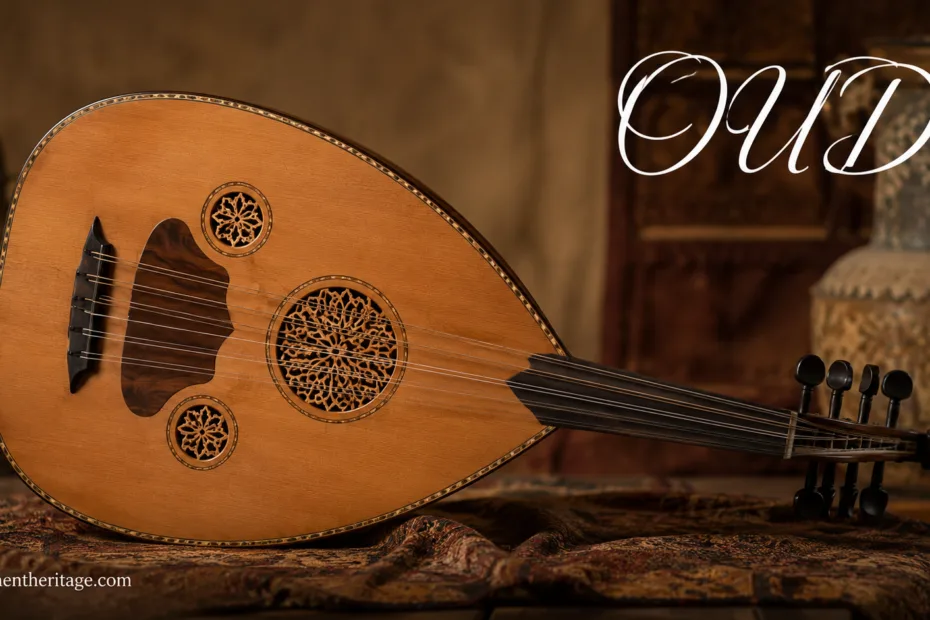
| Feature | What It Means | Why It Matters Musically |
|---|---|---|
| Instrument Family | Short-necked bowl lute, usually fretless, with a rounded wooden body. | The body gives the oud its warm, rounded voice, while the short neck keeps melodies close and fluid. |
| Body Shape | Pear-shaped soundbox made from thin wooden ribs, often built around a mould. | The deep bowl works like a small wooden chamber, giving the sound a soft bloom after each pluck. |
| Strings | Commonly 11 or 12 strings arranged in paired courses, though older and regional models vary. | Courses create a fuller tone than single strings, adding shimmer without making the instrument feel heavy. |
| Fingerboard | Fretless surface, usually smooth and short. | This lets players shape slides, ornaments, and fine pitch shades used in maqam-based music. |
| Soundboard | Thin softwood top, often spruce or cedar, with sound holes and decorative rosettes. | The soundboard is the oud’s breathing surface. A good one feels alive under the hand. |
| Plectrum | Played with a long flexible pick called a risha or mizrab. | The risha controls attack, tremolo, volume, and the oud’s familiar flowing pulse. |
| Main Roles | Solo improvisation, vocal accompaniment, chamber ensembles, classical Arab music, Turkish art music, Persian-related traditions, and modern cross-cultural projects. | The oud can lead a melody, answer a singer, or sit inside an ensemble with a voice-like presence. |
The oud is one of those instruments that sounds older than the room it is played in. One plucked note can feel dry and woody at first, then open into a mellow, human-like tone. It is a Middle Eastern lute, yes, but that label only gets us through the door. The oud also belongs to court music, intimate gatherings, learned theory, family workshops, dance traditions, poetic singing, and the patient craft of bending wood into a resonant bowl.
🎵 Think of the oud as a wooden voice with strings. It does not ring like a steel-string guitar, and it does not sustain like a violin. Its beauty lives in the shape of each note: the pluck, the small bend, the slide, the breath between phrases.
What the Oud Is, Without Making It Complicated
The oud is a plucked chordophone, which simply means its sound comes from strings being plucked. Its body is rounded like half a pear, its neck is short, and its fingerboard normally has no frets. That last detail matters. A fretless oud does not lock the player into fixed guitar-like steps. The hand can glide, lean, and shade the pitch.
Most modern ouds have a broad wooden face, called the soundboard, and a deep back made from many curved strips of wood. These strips are called ribs. They meet at the back like the seams of a carefully made boat. The comparison is not random. A good oud body really does feel a little boat-like: light, curved, hollow, and made to carry motion.
- Body: rounded bowl, usually built from separate wooden ribs.
- Neck: short, smooth, and usually fretless.
- Strings: grouped in courses, often pairs.
- Bridge: fixed to the soundboard, holding the strings under tension.
- Rosettes: carved or inserted ornaments covering the sound holes.
- Risha: long flexible plectrum used for plucking.
The oud is often compared with the lute, and for good reason. The European lute is historically tied to the oud, but the two instruments do not feel the same in the hands. A lute usually has frets and a more delicate, bell-like early music character. The oud is more direct. It speaks quickly, then fades with grace.
Why the Oud Has No Frets
Frets are useful when a player wants fixed pitches. The oud often moves in a different way. In many Arab, Turkish, and related modal traditions, the space between two notes can carry meaning. A tiny lowering of a pitch can make a phrase feel settled, tender, tense, or open. On a fretted instrument, that kind of pitch shading can be harder to reach.
This is where the oud becomes more than a wooden object. It becomes a tool for melodic speech. The player does not just hit notes. They pronounce them.
- Oud or Ud?
- Both spellings are used in English. “Oud” is more common in modern writing, while “ud” appears in some older academic, museum, and record catalog contexts.
- Is It a Guitar?
- No. It has a shorter neck, a bowl-shaped back, paired strings, no standard frets, and a different playing technique.
- Is It Only a Solo Instrument?
- No. The oud can be a solo voice, a singer’s partner, or part of an ensemble with instruments such as qanun, violin, ney, riq, darbuka, and double bass.
The Oud’s Long Path Through Classical Music
The oud’s story is old, but it should not be treated like a museum label frozen in time. It moved through cities, workshops, courts, teaching circles, and family traditions. The instrument is linked with earlier short-necked lutes of West and Central Asia, especially the barbat, and it became one of the defining instruments in medieval and later Middle Eastern art music.
Britannica describes the oud as prominent in medieval and modern Islamic music, notes its deep pear-shaped body and fretless fingerboard, and identifies it as a parent of the European lute. It also connects the instrument’s earlier form with the Persian barbaṭ in the 7th century CE.Reference-1✅
That parent-child link with the European lute is one of the oud’s most fascinating historical trails. The movement was not a simple handoff from one culture to another. Instruments change when players change. Builders adjust necks, bodies, strings, and tunings. Court taste shifts. Singers ask for different support. A plucked lute travels, then returns in a new accent.
From the Barbat to the Oud
The barbat is often described as an ancestor or close relative of the oud. It had a short neck and a rounded body, and it belongs to the same broad family of bowl lutes. The oud gradually took on its familiar form: a wooden belly, a deep soundbox, a bent-back pegbox, and a voice suited to modal melody.
The Arabic word al-ʿūd is commonly linked with “wood” or a piece of wood. That makes sense when you look at the instrument. Earlier lutes in several regions used skin or membrane tops, while the oud’s wooden soundboard became part of its identity. Wood changed the tone. It gave the instrument a different kind of clarity, one that could carry a melodic line without sounding sharp or brittle.
Classical Arab Music and the Oud’s Place
In classical Arab music, the oud has often served as a central melodic instrument. It can introduce a maqam, support a singer, or unfold a free improvisation called taqsim. The oud’s short decay gives taqsim a special quality. Notes appear and vanish. The player has to shape the next note before the previous one fully disappears.
That is why oud playing can feel conversational. It asks and answers. It pauses. It returns to a note like someone returning to a thought.
Ottoman, Persian, Armenian, and Mediterranean Paths
The oud is not owned by one single style. Turkish oud playing often has a bright, agile attack and may use a thinner, more brilliant setup. Arab oud traditions may favor a deeper body and a broad singing tone. In Persian-related settings, the oud overlaps in history and sound with the barbat, with attention to subtle modal movement. Armenian, Greek, North African, and Mediterranean musicians have also carried the instrument into their own repertoires.
Names, tunings, and playing habits shift by region. The instrument stays recognizable, but never flat. That is part of its charm.
How an Oud Is Made: Wood, Curves, and Patience
An oud looks smooth when finished, but its making is full of small decisions. The builder chooses wood not only for beauty, but for weight, stiffness, grain, and how it responds to vibration. The soundboard must be thin enough to speak, yet strong enough to hold string tension. The bowl must be light, but not weak. The neck must feel comfortable, but also stable.
UNESCO’s page for “Crafting and playing the Oud” describes the oud as a traditional lute-type instrument and notes that the soundbox may be made from woods such as walnut, rose, poplar, ebony, or apricot; it also records the craft and playing of the oud on the Representative List of the Intangible Cultural Heritage of Humanity for Iran and Syria in 2022.Reference-2✅
The Bowl: A Curved Wooden Chamber
The back of an oud is usually made from narrow ribs. Each rib is bent, fitted, and glued to the next. This is slow work. A tiny mismatch in one rib can affect the whole curve. The finished bowl should be elegant, but it also has a job: it reflects and shapes the energy coming from the strings and soundboard.
Common bowl woods include:
- Walnut: balanced, attractive, often used for a grounded tone.
- Maple: clear and bright, with a clean visual grain.
- Rosewood: dense and reflective, often linked with a darker visual look.
- Mahogany: warm, stable, and familiar to many instrument makers.
- Apricot or mulberry: used in some regional traditions and valued for local character.
The bowl wood matters, but not by itself. A beautiful back cannot rescue a poor soundboard. The oud is a conversation between parts.
The Soundboard: Where the Oud Really Wakes Up
The soundboard is usually softwood: spruce or cedar are common choices. Tap a raw soundboard blank and you can already hear hints of what it might become. Builders listen for stiffness, lightness, and a dry, ringing response. Then comes thicknessing, bracing, rosette work, bridge placement, and finishing.
Too thick, and the oud may sound stiff. Too thin, and it may lose focus or strength. The best makers do not follow numbers blindly. They read the wood.
Rosettes and Sound Holes
Many ouds have one large central sound hole and two smaller ones, often covered by decorative rosettes. These rosettes are not just pretty trim. They protect the opening, shape the visual identity of the instrument, and show the maker’s hand. Some are carved from wood. Some use layered patterns. Some are simple and quiet.
A decorated oud can look ornate, but the decoration should never fight the sound. Fine craftsmanship knows when to stop.
The Neck, Pegbox, and Pegs
The neck is short, and the pegbox bends back at an angle. Friction pegs hold the strings, much like violin-family pegs. Good pegs must turn smoothly, hold pitch, and not slip. Anyone who has tuned an oud knows the small ritual: turn, listen, adjust, breathe, adjust again.
Modern makers sometimes use geared pegs or mechanical solutions, but many players still prefer traditional pegs because they keep the instrument light and visually balanced.
The Oud’s Sound: Warm, Dry, and Very Human
The oud does not try to impress with long sustain. It gives you a note, lets it bloom, then lets it go. That quick fading sound is not a weakness. It leaves space for ornament, rhythm, and breath. A skilled player can make the oud sound gentle in one phrase and percussive in the next.
Smithsonian Folkways describes the classical oud as a pear-shaped instrument with 11 or 12 strings in 5 or 6 double-stringed courses, and notes that its unfretted fingerboard allows quarter-tone scales; the same recording page also refers to slow, free-rhythm improvisation known as “Taksimes.”Reference-3✅
Attack and Decay
Every oud note has a clear beginning. The risha strikes the course, the soundboard reacts, and the bowl gives the note body. Then the tone fades. This creates a rhythm inside the melody itself. Even a slow phrase can feel alive because each pluck has its own little arc.
That arc is why tremolo matters so much. Rapid repeated strokes can make a note feel sustained, almost like a singer holding a vowel. But oud tremolo is not just a trick for length. It can add emotion, pressure, and direction.
Maqam and Pitch Color
Maqam is often translated as mode, but it is more than a scale. It is a melodic path, a set of habits, a mood, and a way of moving from one pitch area to another. The oud fits maqam beautifully because it can bend, slide, and settle into notes that do not sit neatly on a piano keyboard.
Microtonal pitch is sometimes explained with too much mystery. The simple version: some musical traditions use pitch shades smaller or different from the equal steps common on modern pianos. The oud can reach those shades because the fingerboard is smooth. The player’s ear becomes the map.
The Risha: Small Tool, Big Personality
The risha is longer and more flexible than a typical guitar pick. Traditional materials once included feather quill or horn-like materials; modern players often use plastic, nylon, or other flexible synthetics. A soft risha can make the tone rounder. A stiffer one can give more bite.
The right hand is the oud player’s engine. Downstrokes, upstrokes, tremolo, accents, and sweeping motions all change the instrument’s voice. A beginner may think the left hand does the “music” and the right hand just plucks. Oud players learn quickly that the right hand has its own grammar.
Strings, Courses, and Tuning Habits
Oud tuning is not one single worldwide system. Players tune according to region, repertoire, teacher, instrument size, and personal taste. Many Arab ouds use 11 strings: five paired courses plus one low single bass string. Some use 12 strings in six paired courses. Turkish ouds may be tuned higher and feel tighter under the fingers.
The terms can feel messy at first. Do not worry. Even experienced players ask, “Which tuning are you using?” before playing together.
| Tradition or Setup | Typical Feel | Common Musical Effect |
|---|---|---|
| Arabic Oud | Often deeper-bodied, with a warm and rounded response. | Strong for vocal accompaniment, taqsim, and broad melodic phrasing. |
| Turkish Oud | Often brighter, lighter, and tuned higher than many Arabic setups. | Good for agile ornament, fast passages, and crisp articulation. |
| Iraqi School Influence | Often linked with concert solo oud playing and refined right-hand control. | Creates a clear solo voice with careful melodic development. |
| Barbat-Related Use | Close to Persian modal aesthetics, sometimes with a slightly different body and stringing approach. | Supports gentle phrasing, modal nuance, and intimate ensemble textures. |
Why Paired Strings Matter
A course is a group of strings played as one. On the oud, courses are usually pairs. The two strings vibrate together, creating a slight natural shimmer. It is not chorus in the electronic sense. It is more organic than that, like two voices singing the same line very close together.
When the pairs are tuned cleanly, the oud sounds focused. When they are slightly off, the sound can wobble in a way that bothers the ear. Tuning is part of the daily discipline.
Gut, Nylon, and Modern Strings
Older ouds used gut strings, as did many historical lutes. Modern players often use nylon, rectified nylon, PVF, silver-wound strings, or mixed sets depending on tone and tension. String choice changes more than volume. It changes the feel of the risha, the left-hand pressure, and the way the oud responds to ornaments.
A low-tension setup can feel soft and expressive. A higher-tension setup can give more projection. Neither is automatically better. The instrument decides part of it. The player decides the rest.
How Oud Players Shape Melody
Oud playing is built from touch. The left hand stops the strings without frets, while the right hand brings the note to life. A clean note is only the start. Players add slides, turns, mordents, repeated strokes, and delicate pitch bends. The goal is not to decorate every inch of the melody. Too much ornament can blur the line.
Good oud playing often sounds effortless because the hard work is hidden. The player knows where the phrase is going before the hand gets there.
🎼 Melodic Tools
- Slides between close pitches
- Microtonal pitch shading
- Short ornaments around resting notes
- Call-and-response phrasing
- Taqsim-style free rhythm
🪕 Rhythmic Tools
- Downstroke accents
- Fast tremolo
- Muted percussive touches
- Course-to-course sweeps
- Pulse changes inside a phrase
Taqsim: The Oud Thinking Out Loud
A taqsim is a solo improvisation, often free in rhythm. It introduces or explores a maqam. The player may begin with a simple phrase, circle around a central note, climb gradually, touch a neighboring maqam, and return home. When done well, it does not feel random. It feels like a story told without hurrying.
The oud is especially suited to taqsim because its notes fade quickly. Silence becomes part of the line. A phrase can hang in the air for a second, and the listener leans in.
Accompanying the Voice
The oud is a natural partner for singing. Its tone sits below and around the human voice without covering it. A player may double the melody, answer the singer between lines, or provide small rhythmic pushes. In many traditions, the oud is less like a background chord machine and more like a second singer with wooden lungs.
This is one reason the oud appears so often in poetry-based music. It respects words.
How the Oud Shaped Classical Music Traditions
The phrase “classical music” can mean different things depending on where you stand. With the oud, it points toward classical Arab music, Ottoman art music, Persian-related modal art, and later concert traditions that brought the instrument onto international stages. It also points toward the older European lute family, which helped shape early Western chamber and court music.
The oud’s influence is not only about instrument design. It helped carry ideas: modal thinking, improvisation, ornament, plucked accompaniment, and the idea of a lute as both a singer’s companion and a solo instrument.
In Ensembles
In a classical Arab ensemble, the oud may sit with qanun, violin, ney, riq, and other instruments. It can lead the melody, reinforce the modal center, or add rhythmic lift. Because it is plucked, it gives definition to lines that might otherwise blend too smoothly.
Its tone is soft enough to mix, but clear enough to guide.
As a Solo Concert Instrument
Modern concert oud playing grew through performers who treated the instrument as a full solo voice. Instead of only accompanying songs or playing inside ensembles, they brought the oud forward. Longer taqsim forms, composed pieces, technical studies, and recital-style performance all helped expand how audiences heard the instrument.
The Musical Instruments Museum in Brussels notes that its oud inventory no. 0164 is the oldest known oud preserved in a public collection, a 19th-century Egyptian oud that arrived in Brussels from Alexandria in 1839.Reference-4✅
That preserved instrument matters because ouds are made from delicate materials. Wood moves. Glue ages. Soundboards crack. Strings pull. A surviving oud is not just an object; it is evidence of a maker’s choices, a player’s needs, and a musical taste from another time.
In Modern Cross-Cultural Music
The oud now appears in jazz projects, film scores, chamber works, singer-songwriter recordings, and experimental settings. It can blend beautifully with cello, clarinet, hand percussion, piano, or guitar. Still, the oud keeps its own accent. Even in a modern arrangement, one phrase can reveal its modal roots.
The best cross-cultural use does not treat the oud as exotic decoration. It gives the instrument space to speak in its own grammar.
Oud, Lute, Barbat, Qanun, and Similar Instruments
The oud belongs to a large family of plucked instruments, but not every plucked instrument is close to it. A guitar, for example, shares strings and a soundboard, yet the playing logic is different. The barbat, lute, lavta, and some regional bowl lutes are much closer relatives.
| Instrument | Shared Features with the Oud | Main Difference |
|---|---|---|
| European Lute | Bowl back, plucked strings, historical connection to oud-like instruments. | Usually fretted, often with a different tone suited to European early music styles. |
| Barbat | Short-necked lute linked with Persian musical history. | Modern barbat designs may differ in body shape, setup, and repertoire focus. |
| Lavta | Plucked lute used in Ottoman and Greek-related contexts. | Has frets and a longer neck, giving it a different pitch layout. |
| Qanun | Used in many of the same ensembles and modal traditions. | It is a plucked zither, not a lute; it lies flat and uses many strings. |
| Bouzouki | Plucked string instrument with strong regional identities. | Long neck, frets, brighter metallic sound, and different repertoire habits. |
Oud vs Lute
The oud and lute are close enough that people often compare them, but the feel is not the same. The lute’s frets create a neat pitch grid. The oud’s fretless board lets the hand decide exact pitch. The lute often has a lighter, more delicate sustain. The oud has a thicker attack and a darker center.
If the lute is lace, the oud is carved wood.
Oud vs Barbat
The barbat is not just “another oud.” It has its own identity, especially in Persian musical contexts. Some modern builders and players use the terms with care, while others use them more loosely depending on local tradition. The overlap is real, but the names carry different histories.
Oud vs Qanun
The qanun is sometimes heard beside the oud in ensembles, but it works differently. It rests flat, has many strings, and can use small levers or tuning devices to manage modal pitch changes. The oud is more handheld and voice-like. The qanun sparkles. The oud speaks.
Materials, Climate, and Everyday Care
An oud is sensitive. It is lightly built, and that is part of why it sounds alive. Dry air can shrink wood. Humidity can swell it. Sudden changes can stress the soundboard, seams, pegs, and bridge. A player does not need to panic over every weather shift, but the instrument should not be treated like furniture.
- Keep the oud away from heaters, direct sun, and damp corners.
- Use a proper case, especially during travel.
- Loosen strings slightly for long storage if advised by a trusted maker or repairer.
- Wipe the strings and soundboard area gently after playing.
- Do not force stuck pegs; peg compound or careful fitting may be needed.
- Have cracks, buzzing, or bridge lifting checked by someone who understands ouds.
The most common mistake is treating the oud like a guitar. It is not built for the same tension, repair habits, or hardware choices. A guitar shop may be excellent with guitars and still not know what an oud needs. The safest route is a luthier familiar with bowl lutes, oud construction, or related traditional instruments.
🪵 The oud’s light build is not a flaw. It is the reason the instrument responds so quickly. Care is not about being precious; it is about protecting that fast, open response.
How to Listen to an Oud More Closely
Listening to the oud becomes easier when you stop waiting for guitar habits. Do not listen only for chords. Listen for the shape of single notes. Notice how a player approaches a pitch from below, pauses on a resting tone, or changes the pressure of the risha to make one note softer than the next.
Pay attention to three things:
- The first touch: Is the note round, sharp, dry, or soft?
- The pitch movement: Does the player slide, bend, or settle directly?
- The silence: How much space appears between phrases?
After a while, the oud stops sounding like an unfamiliar lute and starts sounding like a person speaking in a calm room. That is when the details open up.
What Makes a Fine Oud Sound Fine?
A fine oud does not have to be loud. Volume helps on stage, but sweetness, balance, and response matter more. The bass courses should feel full without swallowing the treble. The high courses should speak clearly without becoming thin. Across the fingerboard, the instrument should feel even.
Players often describe a good oud with words like open, sweet, dry, old, or singing. These words are not scientific, but they point toward real listening habits. The oud lives in touch and response.
Oud FAQ
Common Questions About the Oud
Is the oud hard to learn?
The oud is friendly at the beginning because a single plucked note sounds beautiful right away. The harder part comes later: fretless intonation, risha control, maqam phrasing, and tuning. A guitarist may adapt quickly to plucking patterns, but the left-hand pitch work feels very different.
Why does the oud have no frets?
The fretless fingerboard lets players shape pitch with more freedom. This is useful for maqam-based music, where small pitch shades, slides, and ornaments carry musical meaning. Frets would make some of those movements harder to play naturally.
How many strings does an oud have?
Many modern ouds have 11 strings, often arranged as five paired courses plus one low single bass string. Some have 12 strings in six pairs. Older and regional instruments may use other setups, so string count is not completely fixed.
What is the difference between Arabic and Turkish oud?
Arabic ouds are often associated with a deeper, warmer sound and a slightly larger body, while Turkish ouds are often brighter, lighter, and tuned higher. These are broad tendencies, not strict rules. Makers and players vary a lot.
What is a risha?
A risha is the long flexible pick used to play the oud. It shapes the attack, tremolo, rhythm, and overall tone. A small change in risha stiffness can make the same oud feel softer, sharper, warmer, or more percussive.
Is the oud related to the European lute?
Yes. The oud and the European lute are historically linked, and both belong to the wider lute family. The oud is usually fretless and has a short neck, while the European lute is commonly fretted and developed its own repertoire in European early music.
Can the oud play chords?
It can play chords and double-stops, but the oud is mainly a melodic instrument. Its strongest voice is heard in flowing lines, ornaments, taqsim, and close interaction with singers or other melody instruments.
What wood is best for an oud?
There is no single best wood. Spruce or cedar is often used for the soundboard, while walnut, maple, rosewood, mahogany, apricot, and other woods may be used for the bowl. The maker’s skill, the soundboard, bracing, string tension, and setup matter as much as the wood name.
