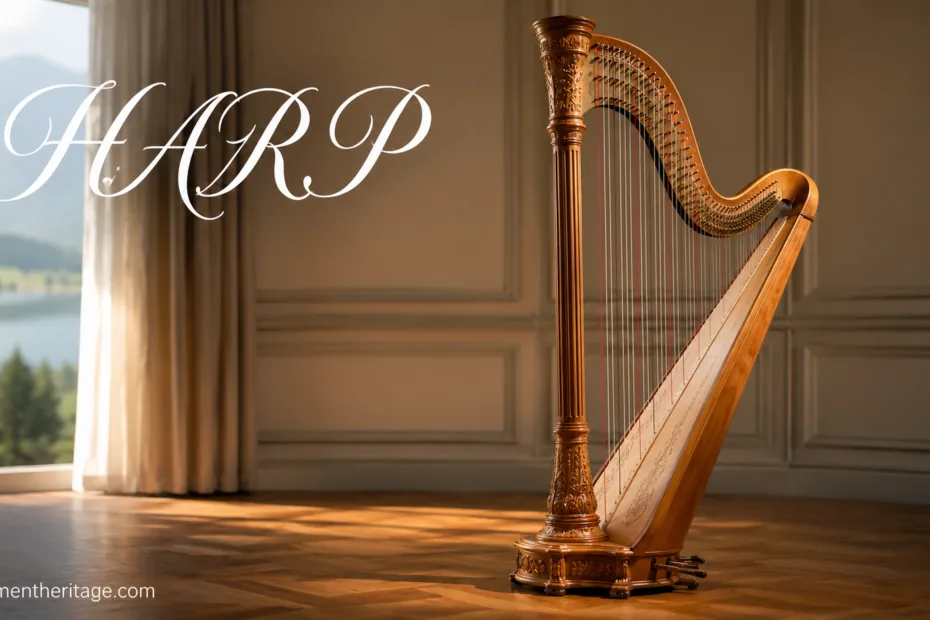
| Feature | Details |
|---|---|
| Instrument family | String instrument; more precisely, a plucked chordophone with strings running from a neck or frame to a resonating body. |
| Basic sound source | The player plucks strings with the fingers. The string vibrates, the soundboard amplifies it, and the body gives the note its warmth. |
| Common modern forms | Pedal harp, lever harp, Celtic harp, lap harp, Paraguayan harp, wire-strung harp, and historical arched harps. |
| Typical concert range | A modern orchestral pedal harp commonly has 47 strings and 7 pedals, giving it a wide pitch range and chromatic control.Reference-1✅ |
| Traditional materials | Wood for the body and frame, gut or nylon for many strings, metal for some bass strings and mechanisms, and sometimes wire strings in older folk harps. |
| Ancient evidence | Ancient Egyptian arched harps are known from tomb art and surviving objects, including a decorated New Kingdom harp from the Tomb of Ani at Thebes.Reference-2✅ |
| Sound character | Clear attack, ringing decay, soft bloom, and a naturally open tone. It can sound delicate, bright, glassy, warm, or deep depending on size, strings, and playing touch. |
The harp looks simple from a distance: a graceful frame, a row of strings, two hands moving with calm confidence. Then you get closer. Suddenly it becomes a small piece of architecture. There is a pillar taking tension, a curved neck holding tuning pins, a hollow body breathing under the strings, and a soundboard that turns finger pressure into color. The harp is ancient, yes, but it has never felt frozen in the past. It still speaks in orchestras, folk rooms, film scores, sacred music, therapy spaces, and quiet bedrooms where someone is learning their first clean arpeggio.
That is part of its charm. The harp is not only an old instrument. It is a living design idea: stretch strings across a resonant body, pluck them, and let the air carry the rest.
- 🎵 Plucked string instrument
- 🪵 Wooden resonating body
- 🎚️ Pedals or levers on many modern types
- 🏛️ Deep roots in ancient cultures
- ✨ Bright attack, long resonance
What Is a Harp?
A harp is a string instrument played by plucking. Unlike a guitar or lute, the strings are not pressed against a fingerboard to change pitch. Each string normally gives one pitch, so the player shapes music by choosing strings, changing hand position, using pedals or levers when available, and controlling touch.
The easiest way to picture it is this: a harp is like a set of open musical lines stretched across a wooden body. You do not “stop” the string with one hand and pluck with the other, as on many necked instruments. You pluck the string directly. That gives the harp its clear beginning and floating decay.
Simple idea: a harp string is already tuned to a note. The player wakes it up with the fingers. The body then gives that note volume, warmth, and length.
Most harps share a few family traits:
- The strings usually run at an angle from the neck to the body.
- The instrument has a resonating chamber or soundbox.
- The player plucks with the fingertips rather than a bow.
- The tone often has a ringing, open quality.
- Many harps are diatonic by default, meaning their basic string layout follows a scale pattern.
Still, not all harps look alike. A small lap harp can sit against the body. A Celtic harp may have levers at the top of its strings. A modern concert pedal harp stands tall, with a strong column and a hidden mechanical system inside. Historical arched harps may not even have the triangular frame many people imagine today.
Main Parts of the Harp
The harp’s beauty is not only visual. Its shape is doing real work. Every curve and joint has a job, because a harp holds a lot of string tension. On a large pedal harp, that tension is serious. The instrument must be elegant and strong at the same time.
🎵 Strings
The strings are the voice of the harp. Shorter strings give higher notes; longer strings give lower notes. Materials vary: gut, nylon, fluorocarbon, wire, and metal-wound bass strings all appear in different harp traditions.
🪵 Soundboard
The soundboard is the thin wooden surface that receives vibration from the strings. It is one of the most sensitive parts of the instrument. A good soundboard can make the note feel alive rather than flat.
🏛️ Pillar
The pillar supports the frame on many triangular harps. It helps resist the pull of the strings. Without it, a large modern harp would struggle to hold its shape.
🎚️ Neck and Mechanism
The neck holds tuning pins, and on some harps it also carries levers or pedal-linked discs. This is where pitch control becomes more mechanical and more precise.
Why the Shape Matters
A harp is not shaped like a triangle just because it looks graceful. The geometry solves a practical problem. The strings need different lengths for different pitches, and the frame must hold them under tension. The curved neck allows those string lengths to change smoothly from low to high.
On many older arched harps, the design is more like a bow. On modern frame harps, the pillar closes the structure, making it stronger. That one change opened the door to larger instruments, more strings, and later, pedal systems.
- Neck
- The upper part of the harp where tuning pins, levers, or discs may be placed.
- Soundbox
- The hollow body that helps amplify the strings.
- Soundboard
- The vibrating wooden face that gives the harp much of its tone.
- Pedals or levers
- Devices used to raise or lower string pitch on many modern harps.
A Long History Without Losing Its Voice
The harp is one of the oldest recognizable string instrument ideas. People discovered very early that a stretched string could sing. Add a resonator, and that sound becomes fuller. Add more strings, and suddenly melody and harmony begin to appear under the hands.
Early harps appeared in several regions, with different shapes and uses. Some were arched. Some were angular. Some were small enough to carry. Others were built for court, ceremony, storytelling, or ensemble playing. The harp did not travel through history as one single object. It changed its clothes many times.
Ancient Arched Harps
Ancient Egyptian harps are among the best-known early examples because they appear in art and museum collections. Some had elegant arched necks and boat-like soundboxes. One decorated New Kingdom example from the Tomb of Ani includes wood, bone, glazed composition, plaster, reed, and hippopotamus ivory, showing that harp making could involve careful craft as well as decoration.
These early harps were not primitive in spirit. They were thoughtful instruments made by people who understood sound, materials, and visual beauty. A carved neck, a painted soundbox, a carefully placed string rod — all of this tells us that the harp had a respected place in musical life.
Useful detail: old arched harps often did not have the front pillar seen on modern concert harps. That makes them visually different, but the musical idea is still familiar: open strings, plucked by hand, amplified by wood.
Celtic and Wire-Strung Harps
The Celtic harp has its own identity. It is usually smaller than the orchestral pedal harp and is often linked with Irish, Scottish, Welsh, Breton, and related musical traditions. Traditional Celtic harps could use metal strings, giving them a bright, ringing, almost bell-like sound.Reference-3✅
Wire strings behave differently from gut or nylon. They can feel firmer under the fingers, and the tone can shimmer for a long time. The decay hangs in the air. It is not a blurry sound; it has edges. That is why wire-strung harp music often uses damping, where the player stops strings from ringing too long.
Modern lever harps are often used for folk music, early music, singer-songwriter work, therapy settings, and home playing. They are easier to move than pedal harps and still offer a broad musical range.
The Pedal Harp and the Rise of Chromatic Playing
The pedal harp changed what the instrument could do in Western art music. Instead of using hand levers at the top of individual strings, the player uses foot pedals. Each pedal controls all strings of the same note name across the harp. For example, one pedal affects all C strings, another affects all D strings, and so on.
A pedal harp held in The Met’s collection from around 1800 shows how the instrument had become a refined European object, with a tall frame, large soundboard, and a form close to what many listeners now associate with the classical harp.Reference-4✅
The modern concert harp uses seven pedals, one for each note name: C, D, E, F, G, A, and B. Each pedal usually has three positions: flat, natural, and sharp. It is a clever system. Very clever. The player’s feet quietly reshape the scale while the hands keep playing.
How the Harp Makes Sound
A harp note begins with a pluck. The finger pulls the string slightly away from rest and releases it. The string vibrates back and forth, but by itself it would not sound very large. The vibration needs help. That help comes from the soundboard and soundbox.
The soundboard takes the string’s energy and spreads it across a larger wooden surface. The hollow body supports and colors the vibration. This is why two harps with similar string counts can still sound different. Wood choice, body shape, string material, tension, age, and build quality all matter.
Attack, Bloom, and Decay
The harp has a clear attack. You hear the note begin right away. Then it blooms. After that, it decays, sometimes slowly, sometimes quickly. This gives the harp a natural sense of space.
- Attack: the first moment after the string is plucked.
- Bloom: the note opening through the body of the instrument.
- Decay: the way the note fades after the pluck.
- Damping: stopping a string with the hand so the sound does not continue ringing.
Damping is part of real harp playing. Beginners often imagine the harp as endless floating sound. Beautiful, yes — but too much ringing can turn harmony cloudy. Skilled harpists know when to let sound hang and when to stop it cleanly. Silence is part of the instrument.
Why Harp Glissandos Sound So Recognizable
A glissando is the sweeping sound many people associate with the harp. The player runs fingers across many strings in a smooth motion. Because harp strings are tuned in a scale layout, a glissando can sound bright, dreamy, mysterious, or bold depending on the pedal or lever settings.
That is the trick: a harp glissando is not just “all the notes.” The tuning setup decides the color. Change the pedals, and the same hand sweep turns into a different harmonic flavor.
🎵 Harp tone in plain words
A small harp may sound intimate and woody. A wire-strung harp may sparkle. A large pedal harp can move from soft silver notes to deep bass resonance. The shared thread is plucked clarity followed by open vibration.
Materials Used in Harp Making
Harp making is a balancing act between strength and resonance. Too heavy, and the sound can feel trapped. Too fragile, and the instrument cannot handle string tension. Good harp builders think like woodworkers, engineers, and musicians at the same time.
Wood
Wood is central to most harps. Spruce is often valued for soundboards because it can be light, stiff, and responsive. Maple, beech, walnut, cherry, mahogany, and other woods may appear in bodies, necks, pillars, and decorative parts. The exact choice depends on the maker, harp type, tradition, and price range.
The soundboard is especially important. It must vibrate freely but stay stable under tension. That is a demanding job. A fine soundboard is thin enough to speak, yet strong enough to endure years of string pull.
Strings
String material changes both tone and feel. Nylon strings are common on many beginner and lever harps because they are stable and easier on the fingers. Gut strings can offer a warmer, more complex tone, often used on pedal harps and some lever harps. Wire strings ring with a bright metallic voice. Bass strings are often wound to produce low notes without becoming impossibly long.
| String Material | Typical Use | Sound and Feel |
|---|---|---|
| Nylon | Beginner harps, many lever harps, therapy harps | Clear, stable, lighter touch, often easier for new players. |
| Gut | Pedal harps, higher-end lever harps, classical playing | Warm, rounded, responsive, with a traditional concert-harp feel. |
| Wire | Celtic wire-strung harps and historical styles | Bright, ringing, bell-like, with long sustain and firm tension. |
| Wound bass strings | Lower register on many harps | Deeper tone without needing extremely long plain strings. |
Metal, Pins, Levers, and Pedal Parts
The hidden hardware matters more than most listeners realize. Tuning pins hold string tension. Bridge pins guide strings. Levers raise pitch on lever harps. Pedal rods and discs work inside concert harps. These parts must be accurate, smooth, and durable.
A harp can look delicate, but it is under constant pressure. The best instruments feel calm because the engineering is doing its work quietly.
Types of Harps
There is no single harp for every player. Size, range, tuning system, string tension, weight, and repertoire all shape the choice. A harp used in an orchestra is not built for the same life as a small lap harp used for simple melodies at home.
Pedal Harp
The pedal harp is the large concert instrument often seen in orchestras. It has a tall frame, many strings, and seven pedals. Its pitch-changing system lets a harpist play in many keys and handle complex harmonic writing.
This harp can sound huge when needed. It can also whisper. The bass strings have depth, while the upper strings can sparkle like small glass bells. It is a serious instrument to move, tune, maintain, and study, but its range is hard to match.
Lever Harp
The lever harp is smaller and lighter than a pedal harp. Instead of pedals, it has small levers near the top of the strings. Raising a lever usually lifts a string by a semitone. Lever harps are common in folk music, Celtic music, teaching, home practice, and smaller performance settings.
A lever harp asks the player to plan changes by hand. That gives it a different rhythm of playing. You do not have the same instant foot control as on a pedal harp, but you gain portability and a more direct relationship with the tuning system.
Celtic Harp
The Celtic harp is often a lever harp today, though historical versions could be wire-strung. It has a strong connection with regional music traditions and song accompaniment. Its sound may be gentle and lyrical on nylon or gut, or bright and ringing on wire.
Many players love it because it feels close to the body. Less like a grand machine. More like a companion.
Lap Harp and Small Harps
Small harps are built for portability. They have fewer strings and a limited range, but they are friendly for beginners, travelers, and simple melodic playing. They can be charming, though they are not miniature pedal harps. Their musical role is different.
Paraguayan Harp
The Paraguayan harp is known for its light build, bright tone, and fast, rhythmic playing style. It often has a wide spacing and a strong melodic presence. In the hands of a skilled player, it can sound lively, crisp, and full of motion.
How the Harp Is Played
Harp playing looks effortless when done well, but the technique is very exact. The fingers must place, pluck, close, and release with control. The body posture matters. The arms must stay relaxed. The feet may need to manage pedals. The ears must track resonance.
Most harpists use the thumb, index, middle, and ring fingers. The little finger is generally not used in standard classical harp technique because it is shorter and less suited to the hand shapes needed on the instrument. Different traditions may have their own habits, especially on folk and historical harps.
Placing and Closing
Many harp techniques involve placing the fingers on strings before playing. This gives control and accuracy. After plucking, the fingers close into the palm. That closing motion helps produce a clean tone and keeps the hand relaxed.
Good harp tone is not made by grabbing. It is made by controlled release. A harsh pull can make the sound thin or noisy. A clean pluck lets the string speak fully.
Chords, Arpeggios, and Harmonics
The harp is naturally suited to broken chords, also called arpeggios. The hand can roll through notes smoothly, making harmony feel fluid. Chords can be played together or spread. Harmonics, made by lightly touching a string at a special point while plucking, create a pale, bell-like note.
- Arpeggio: notes of a chord played one after another.
- Glissando: a sweep across several strings.
- Harmonic: a high, clear tone made by touching and plucking in a special way.
- Bisbigliando: a soft trembling effect created by alternating notes between the hands.
The Harp in Different Musical Settings
The harp is flexible, but it is not used the same way everywhere. In an orchestra, it may add color, support harmony, create glissandos, or bring a glowing texture under woodwinds and strings. In folk music, it can carry melody and accompaniment together. In solo music, it becomes a full landscape under two hands.
In Classical Music
In classical settings, the pedal harp is often valued for color. Composers use it for rolled chords, shimmering figures, delicate punctuation, and special effects. It can blend with flute, strings, voice, and even brass when written carefully.
The harp is not simply decorative. It can carry structure, rhythm, and harmonic motion. It just does it with a different kind of touch. A piano can strike; a harp releases.
In Folk and Traditional Music
Folk harp playing often feels more direct. The instrument may accompany singing, dance tunes, slow airs, storytelling, or devotional music. Lever changes are used, but the music often stays close to the natural voice of the instrument.
This is where smaller harps shine. They do not need a concert hall. A wooden room is enough.
In Film, Games, and Recorded Sound
Modern listeners often meet the harp through recordings. It appears in film scores, game soundtracks, ambient music, pop arrangements, and meditation tracks. Sometimes it suggests mystery. Sometimes water. Sometimes memory. Sometimes just a very beautiful chord.
Its recorded sound can be close and intimate or wide and cinematic. Microphone placement changes everything. Place the mic near the soundboard, and the listener hears fingers and wood. Move it back, and the harp becomes airier.
Harp Compared with Similar String Instruments
The harp is sometimes grouped loosely with lyres, zithers, psalteries, lutes, and hammered dulcimers. That makes sense because they all use strings. Still, their playing logic is different. The harp’s open-string layout gives it a special identity.
| Instrument | How It Differs from the Harp | Shared Connection |
|---|---|---|
| Lyre | Usually has strings stretched across a yoke-like frame; often more compact and historically linked with song and recitation. | Both are ancient plucked string instruments with open strings. |
| Zither | Strings run across a flat body rather than rising from a neck to a resonating body at an angle. | Both can use open strings and create ringing textures. |
| Psaltery | Often box-shaped and may be plucked or bowed depending on type. | Both value resonance and clear string tone. |
| Lute | Has a neck and fingerboard; the player changes pitch by stopping strings with the fingers. | Both are plucked and can accompany voice or melody. |
| Hammered dulcimer | Strings are struck with small hammers instead of plucked directly by the fingers. | Both can produce bright, ringing patterns. |
The main difference is touch. A lute player presses and plucks. A dulcimer player strikes. A harpist plucks open strings and then manages their resonance. That changes how melodies move, how harmony is shaped, and how silence is controlled.
Why the Harp Feels So Different to Hear
The harp has a strange kind of clarity. A note starts cleanly, then fades in a way that feels less like a line and more like a small ring of light spreading outward. That is why the instrument can feel calm even when the music is busy.
Part of this comes from the open strings. They do not need to be pressed against a fingerboard, so the tone can begin without the small friction noises common on many necked instruments. Another part comes from the soundboard, which gives the pluck more body.
There is also the visual side. People hear with their eyes more than they admit. Watching both hands move across vertical strings changes how the sound feels. The motion is visible. The instrument seems to breathe.
Plain listening tip: when you hear a harp, notice whether the player lets strings ring or stops them quickly. That one detail can change the whole mood from misty and open to clean and rhythmic.
What Makes a Good Harp?
A good harp does not need to be large or expensive. It needs balance. The strings should respond evenly. The tuning should hold reasonably well. The soundboard should speak without buzzing. The levers or pedals, if present, should move cleanly and change pitch accurately.
For a player, comfort matters too. String spacing, tension, height, weight, and tone all affect the relationship with the instrument. A harp that sounds lovely but feels awkward may not invite practice. A modest harp that feels friendly can become part of daily life.
Good Signs in a Harp
- Even tone: no register should feel strangely weak or dull.
- Stable tuning: all harps need tuning, but the instrument should not drift wildly without reason.
- Clean hardware: levers, pins, and pedals should work without rattles or rough movement.
- Comfortable tension: the strings should match the player’s hands and musical goals.
- Responsive soundboard: the notes should bloom naturally after the pluck.
Older harps can be wonderful, but condition matters. Cracks, neck movement, loose pins, damaged soundboards, and worn mechanisms can turn a beautiful object into a difficult instrument. With harps, looks can fool you. Listen and inspect.
Common Misunderstandings About the Harp
The harp carries many assumptions. Some are harmless. Some are just incomplete.
“The harp only plays soft music.”
Not true. The harp can be gentle, but it can also play rhythmic patterns, strong bass notes, sharp accents, and bold chords. It depends on the instrument and the player.
“All harps are huge.”
No. Pedal harps are large, but lever harps, lap harps, and folk harps come in many sizes. Some are built for travel and small rooms.
“The harp is easy because you just pluck strings.”
The first sound may come quickly. Clean technique takes time. Damping, fingering, tuning changes, posture, and tone control all need careful practice.
“Harps are all tuned the same way.”
Different harps use different ranges, string materials, tensions, lever systems, pedal systems, and tuning habits. A wire-strung harp is not the same experience as a concert pedal harp.
The Harp as Craft and Culture
The harp is not only an instrument category. It is a meeting point between craft and culture. A builder chooses wood, shapes the neck, sets the string angle, fits pins, voices the soundboard, and thinks about how the player’s hands will meet the strings. A musician then brings touch, timing, and taste.
Across different traditions, the harp has been used for court music, folk song, religious settings, dance, poetry, chamber music, healing environments, and solo performance. It adapts because the basic idea is strong. A human hand, a stretched string, a resonant body. That is enough to start.
And yet the details never stop mattering.
Harp FAQ
Questions People Often Ask About the Harp
Is the harp one of the oldest string instruments?
Yes, the harp belongs to a very old family of plucked string instruments. Early harp-like instruments appear in ancient art and surviving objects, especially in regions where wood, gut, fiber, and other string-making materials were available.
What is the difference between a harp and a lyre?
A harp usually has strings running from a neck or frame down to a resonating body at an angle. A lyre typically has a yoke-like frame with strings running across it. Both are plucked string instruments, but their shapes, playing positions, and musical traditions differ.
Why do some harps have pedals?
Pedals allow a harpist to change pitch while playing. On a modern pedal harp, each pedal controls all strings of one note name, such as all C strings or all F strings. This lets the instrument move through different keys and more complex harmonies.
Are lever harps easier than pedal harps?
Lever harps are usually smaller, lighter, and simpler mechanically, so they can be more approachable for many beginners. That does not mean the music is always easy. Good tone, rhythm, damping, and hand control still take practice.
What are harp strings made of?
Harp strings may be made from nylon, gut, wire, fluorocarbon, or metal-wound materials. The choice affects tone, tension, durability, price, and playing feel. Nylon often feels lighter; gut is warm and traditional; wire rings with a bright, long sustain.
Why are harp strings different colors?
Colored strings help players find notes quickly. On many modern harps, C strings are red and F strings are black or blue. This visual pattern is important because the harp has many strings arranged side by side.
Can the harp play melody and harmony at the same time?
Yes. A harpist can play melody with one hand and accompaniment with the other, or divide musical roles between both hands. The open strings make arpeggios, rolled chords, and layered textures especially natural.
Is the harp used outside classical music?
Very much so. Harps appear in folk music, Celtic traditions, Latin American styles, pop recordings, film music, ambient music, therapy settings, and experimental projects. The instrument changes character depending on size, tuning, strings, and playing style.
