
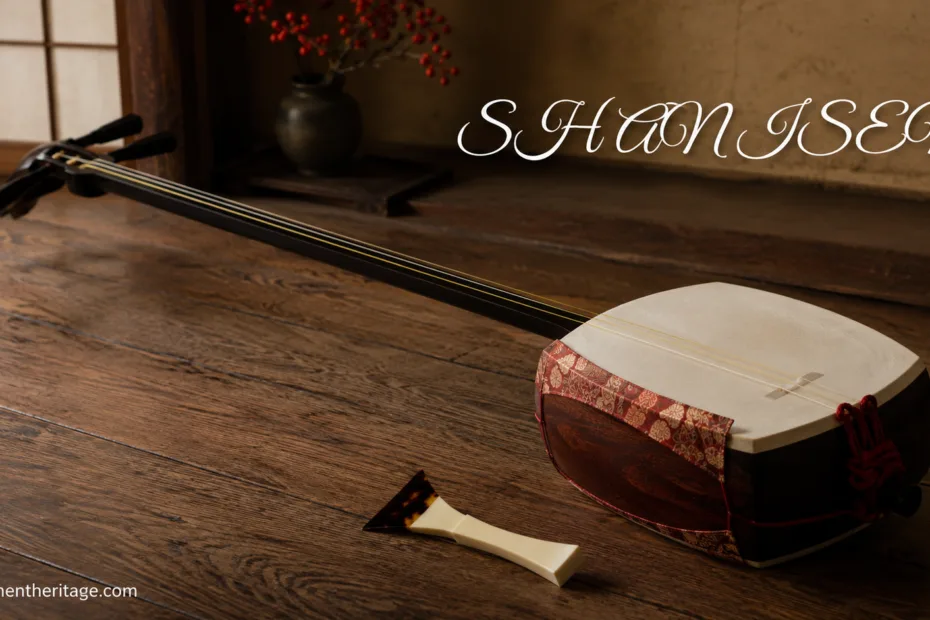
| Feature | Detail | Why It Matters |
|---|---|---|
| Instrument Family | Three-stringed Japanese lute, often classed as a plucked spike lute | The neck runs through the body, giving the shamisen a firm, direct attack rather than a soft harp-like response. |
| Japanese Names | Shamisen, samisen, sangen | “Shamisen” is common in the Tokyo area; “samisen” appears often in Kansai usage, and “sangen” is used in some chamber music settings. |
| Strings | Three strings, traditionally twisted silk; modern instruments may use synthetic strings | The string set keeps the instrument lean, vocal, and rhythmically sharp. |
| Body | Square wooden resonator called the dō, covered with a stretched membrane | The skin or synthetic head gives the shamisen its dry snap and quick decay. |
| Neck | Long, fretless neck called the sao | Without frets, the player can slide, bend, and shade pitch with a voice-like feel. |
| Plectrum | Large triangular plectrum called the bachi | The bachi strikes the string and often the body skin, creating a bright percussive bite. |
| Signature Sound | Buzzing resonance known as sawari | This controlled buzz is not a flaw. It is part of the instrument’s character. |
| Main Settings | Kabuki, Bunraku, nagauta, jiuta, min’yō, kouta, Tsugaru-jamisen | The shamisen is not one fixed sound; each style shapes the instrument differently. |
The shamisen looks simple at first: three strings, a long neck, a square body, and a big pick. Then it speaks. A dry snap, a quick metallic buzz, a little growl under the note. It can sound bright and playful in one phrase, then lean and dramatic in the next. That is why the shamisen has stayed close to song, theater, storytelling, dance, and folk music across Japan. It is not a quiet museum piece. It is a working instrument with a voice that cuts through a room.
What Is a Shamisen?
The shamisen is a three-stringed Japanese lute with a long fretless neck and a square resonating body. It is usually played with a large plectrum called a bachi, which can pluck, strike, scrape, and snap against the strings and skin. That mix of string sound and body percussion is a big part of its charm.
Organologically, the shamisen is often described as a plucked spike lute. The phrase sounds technical, but the idea is simple: the neck continues through the body rather than stopping at the body joint. The Metropolitan Museum of Art classifies a 19th-century Japanese shamisen as a “Chordophone-Lute-plucked-unfretted,” with wood, cloth, and skin listed among its materials.Reference-1✅
Unlike the guitar, the shamisen has no frets. The player’s left hand finds the notes directly on the smooth neck. This makes the instrument flexible. Notes can slide into place, lean slightly sharp or flat for expression, and bend in a way that feels closer to singing than to pressing a piano key.
🎵 The Shamisen in One Sentence
The shamisen is a fretless three-stringed Japanese lute with a skin-covered body, a large bachi plectrum, and a lively buzzing tone called sawari.
How the Shamisen Reached Japan and Found Its Own Voice
The shamisen did not appear out of nowhere. Its family trail runs through East Asia. Many scholars connect it to the Chinese sanxian, a three-stringed lute with a skin-covered body. A related form moved through the Ryukyu Islands, where the sanshin developed with its rounded body and snakeskin covering. From there, the instrument reached mainland Japan around the mid-16th century and began to change.
Britannica notes that the three-stringed plucked lute is known as shamisen in the Tokyo area and samisen around Kyoto, and connects its arrival in Japan to the Ryukyu Islands in the mid-16th century.Reference-2✅ Once the instrument entered Japan, it was not merely copied. It was reshaped.
The body became more rectangular. The plectrum grew into the wide bachi. The sound gained the rough-edged buzz of sawari, a feature that links the shamisen’s personality with the older Japanese biwa tradition. The result was neither sanxian nor sanshin. It became a new Japanese instrument with its own grammar.
The Edo-Period Boom
By the Edo period, the shamisen had moved deeply into urban music culture. It fitted the mood of busy cities: sharp, flexible, portable, and perfect for accompanying the human voice. A singer could stretch a phrase; the shamisen could follow. A dancer could shift weight; the bachi could answer with a clean rhythmic strike.
The instrument became tied to narrative song, Kabuki theater, Bunraku puppet theater, chamber music, folk song, and intimate song forms. It was not locked into one class of music. That is one reason the shamisen feels so alive. It grew by adapting.
Why the Shamisen Worked So Well for Storytelling
Storytelling needs more than melody. It needs timing, accent, breath, and dramatic space. The shamisen can do all of that with only three strings. A single pluck can mark a character’s entrance. A scratchy buzz can add tension. A short slide can soften a phrase. Then the instrument can go silent and let the voice carry the room.
That give-and-take made the shamisen a natural partner for jōruri, gidayū, and other sung narrative forms. In Bunraku, the shamisen does not simply decorate the narration. It helps shape the emotional pacing of the story.
Anatomy and Materials of the Shamisen
A shamisen is built from a small number of parts, but each one changes the sound. A millimeter in bridge height, a different skin tension, or a heavier bachi can make the instrument feel like a new animal in the hands.
🪵 Main Wooden Parts
- Sao: the long fretless neck
- Dō: the square resonator body
- Itomaki: the side-mounted tuning pegs
- Itogura: the pegbox at the top of the neck
- Nakago: the inner neck extension running through the body
🎶 Sound-Making Parts
- Ito: the three strings
- Koma: the small bridge on the body membrane
- Kawa: the stretched skin or synthetic head
- Bachi: the large plectrum
- Sawari: the buzzing contact area near the upper neck
The Body: Dō and Kawa
The shamisen body, or dō, is a wooden frame covered on the front and back with a tight membrane called kawa. Traditional instruments used animal skin, while many present-day instruments use synthetic or alternative heads for durability, climate stability, and personal preference.
This membrane is one reason the shamisen sounds so different from a wooden-top lute. A guitar top breathes and blooms. A shamisen skin answers fast. It gives a dry, clean attack, then lets the note fall away quickly. That short decay leaves space for the singer, dancer, or next bachi stroke.
Grinnell College’s Musical Instrument Collection describes the shamisen as a spike lute with a square wooden resonator, a fretless neck, three strings, a movable bridge, and a skin-covered body, while also noting traditional and modern material changes.Reference-3✅
The Neck: Sao
The sao is smooth and fretless. Many shamisen necks are made in joined sections so the instrument can be taken apart for transport. Better instruments often use dense hardwoods, chosen not only for beauty but for stability under string tension.
Neck thickness matters. A thin neck feels quick and elegant. A thick neck can handle heavier strings and harder striking. This is why shamisen types are often described by neck size:
- Hosozao: a thinner neck, often linked with lighter lyrical styles such as nagauta and kouta.
- Chūzao: a medium neck, common in jiuta and some folk settings.
- Futozao: a thicker neck, used for stronger narrative and percussive styles such as gidayū and Tsugaru-jamisen.
The Strings: Ito
The shamisen has three strings, usually named by position rather than Western pitch. Traditional strings were made of silk. Many players today use nylon, tetron, or other synthetic materials, especially when stability and cost matter.
Silk has a warm, slightly grainy feel. Synthetic strings can be stronger and more predictable. Neither choice is automatically “better.” A player choosing strings is really choosing a response: soft and old-style, bright and clear, or tough enough for hard bachi work.
The Bridge: Koma
The koma is a small removable bridge placed on the skin head. It may look tiny, but it has a large effect. A light bridge can make the tone quicker and brighter. A heavier bridge can add firmness and body. Bridge height also changes string action, playing feel, and attack.
This is where the shamisen becomes very hands-on. Players often learn that tone is not only in the instrument. It is in the small setup choices, the room, the humidity, the bachi angle, and the way the bridge sits that day.
The Bachi: More Than a Pick
The bachi is not like a small guitar pick. It is larger, often fan-shaped or triangular, and used with a striking motion. Depending on the style, it may be made from wood, plastic, resin, or other materials. Older high-end traditions used luxury materials that are now often avoided or replaced by modern alternatives.
A bachi can pluck the string cleanly. It can also hit the skin after the string, adding a little “tak” sound. In stronger styles, that strike is not accidental. It is part of the rhythm. The shamisen becomes half string instrument, half drum.
The Sound: Buzz, Snap, Slide, and Space
The shamisen’s tone is built around contrast. It has a bright attack, a fast decay, and a buzzing shadow around the note. That shadow is called sawari. For a new listener, it may sound like a string is rattling. For shamisen music, it is part of the beauty.
Sawari comes from the way the lowest string interacts with a small area near the upper neck. The string lightly touches or grazes a surface as it vibrates, creating a controlled buzz. Think of it as a halo of grit around the note. Not messy. Alive.
Sawari is intentional. A clean Western-style note is not always the goal here. The shamisen often wants a note with texture, a little breath, and a small edge of noise.
Why the Shamisen Can Feel Vocal
The fretless neck lets the player move between pitches without the hard steps of frets. A note can slide upward, lean downward, or arrive with a small delay. This makes the shamisen a good partner for sung Japanese music, where syllable, pitch, and gesture often move together.
The left hand can also add ornaments: a quick pull, a snap, a slide, a pressed note, or a small vibrato-like motion. The right hand controls attack. Together they make the instrument speak in short, expressive gestures.
Why It Can Cut Through an Ensemble
The shamisen does not need huge volume to be heard. Its attack is sharp. The bachi gives the sound a clear front edge, and the skin-covered body keeps the note from getting too cloudy. In theater and song, that is useful. The instrument can mark rhythm without burying the voice.
A soft shamisen phrase can feel intimate. A hard strike can feel almost percussive. That range is one of its great strengths. Three strings. Many colors.
Common Tunings and Musical Logic
Shamisen tuning is usually relative rather than fixed to one concert pitch. The singer’s range matters. The piece matters. The style matters. Still, several tuning patterns appear again and again.
| Tuning Name | Example Pitch Pattern | Musical Feel |
|---|---|---|
| Hon-chōshi | C–F–C | Balanced and stable; often treated as a central tuning pattern. |
| Ni-agari | C–G–C | Brighter, more open, with a wider middle interval. |
| San-sagari | C–F–B♭ | Softer and slightly darker, useful for lyrical shading. |
The three strings are not there to build thick chords like a guitar. Shamisen music often works through melody, rhythm, drone-like relationships, gesture, and vocal support. The tuning gives the player a tonal home, but the real interest comes from timing, attack, and expressive pitch movement.
Main Shamisen Styles and Playing Contexts
There is no single shamisen style. A shamisen used for Kabuki does not behave exactly like one used for Tsugaru-jamisen. A chamber music player and a folk musician may share the same instrument family, yet their sound ideals can be far apart.
Kabuki and Nagauta
In Kabuki, the shamisen often appears in nagauta, meaning “long song.” This music supports dance scenes, vocal lines, and stage movement. The sound tends to be refined, clear, and rhythmically alert. It does not need to be heavy. It needs to move with the stage.
Nagauta shamisen often uses a thinner-necked instrument. The tone can be bright and agile, with crisp bachi articulation. It is not only accompaniment in the plain sense. It helps the whole stage breathe.
Bunraku and Gidayū
Bunraku puppet theater uses the shamisen in a very different way. Here, the instrument works closely with the narrator. The music supports spoken-sung storytelling, character shifts, and emotional pacing. UNESCO describes Ningyo Johruri Bunraku puppet theatre as a form in which a musician provides accompaniment on the three-stringed shamisen while the tayū voices the characters.Reference-4✅
The gidayū shamisen is usually larger and more forceful. It needs weight. It must answer a narrator who may move from quiet reflection to strong dramatic delivery within a few lines.
Jiuta and Sankyoku
Jiuta is closely tied to chamber music and vocal-instrumental tradition. In sankyoku, the shamisen may join koto and shakuhachi, forming a trio where each instrument has a different texture: plucked string brightness, zither resonance, and bamboo breath.
In this setting, the shamisen can be more inward. It still has bite, but the playing often values subtle timing and graceful phrasing. The sound does not rush toward spectacle. It listens.
Min’yō and Folk Settings
In min’yō, or Japanese folk song, the shamisen can be direct and lively. It may support regional singing, dance rhythm, or festival-like energy. Folk shamisen playing often feels close to the body: pulse, voice, movement, and local flavor.
Different regions favor different touches. Some folk styles want light accompaniment; others want strong rhythmic drive. The shamisen adapts well because it is portable, responsive, and clear.
Tsugaru-Jamisen
Tsugaru-jamisen is one of the most recognizable modern shamisen styles for global listeners. It comes from the Tsugaru region in northern Japan and is known for fast passages, heavy bachi attack, improvisatory energy, and a strong futozao instrument.
The sound can be fierce, but not in a noisy way. It is controlled force. The player strikes, snaps, slides, and answers phrases with quick rhythmic turns. For many listeners outside Japan, Tsugaru-jamisen is the style that first makes the shamisen feel almost like a lead instrument in a band.
Related Instruments and Easy Comparisons
The shamisen is easier to understand when placed beside its relatives and neighbors. It shares traits with several instruments, but it is not the same as any of them.
| Instrument | Shared Trait | Main Difference |
|---|---|---|
| Sanshin | Three strings and a skin-covered body | The Okinawan sanshin usually has a smaller rounded body and a softer plectrum style. |
| Sanxian | Three-stringed lute ancestry | The Chinese sanxian has its own body shape, technique, and musical language. |
| Biwa | Japanese plucked lute tradition and narrative links | The biwa has a wooden soundboard, frets, and a very different body shape. |
| Koto | Appears with shamisen in chamber music | The koto is a long zither played with finger picks, not a necked lute. |
| Banjo | Membrane body and bright attack | The shamisen is fretless, has three strings, and uses a large bachi with Japanese playing techniques. |
The banjo comparison can help a new listener, but only up to a point. Both instruments have a membrane soundboard and a sharp attack. Yet the shamisen’s fretless neck, sawari buzz, bachi technique, and vocal role give it a very different personality.
Craftsmanship: Where Small Details Change Everything
A shamisen maker works with tension. Wood tension. Skin tension. String tension. Even the player’s hand pressure becomes part of that chain. The finished instrument may look clean and spare, but it is full of tiny decisions.
Wood Choice
Traditional shamisen bodies and necks may use dense hardwoods such as karin, kōki, or shitan, depending on instrument grade, style, and availability. Dense woods can support a clear attack and stable neck feel. Lighter or more affordable woods may be used for student instruments.
The best choice depends on purpose. A beginner needs an instrument that stays in tune and survives practice. A stage player may care more about projection, response, and the exact feel of the neck under the hand.
Skin and Synthetic Heads
The membrane is one of the most sensitive parts of the instrument. Traditional skin heads are valued for tone, but they can react to humidity and temperature. Synthetic heads are often chosen for durability and easier care. Many modern players move between these options without treating one as the only valid path.
A tight head gives a crisp attack. A slightly different tension can warm or soften the response. Too loose, and the sound loses focus. Too tight, and the instrument may feel brittle. Balance matters.
Setup Choices
The koma, string gauge, bachi weight, and neck style all shape the final voice. Two shamisen can share the same tuning and still sound different because one bridge is lighter, one skin is tighter, or one player strikes closer to the bridge.
- Higher bridge: more clearance and often a stronger feel under the bachi.
- Lower bridge: easier action, sometimes a softer touch.
- Heavier bachi: more punch and body impact.
- Lighter bachi: quicker handling and finer articulation.
- Thicker strings: more weight and resistance.
- Thinner strings: quicker response and easier ornamentation.
How the Shamisen Is Played
A seated shamisen player usually rests the body near the right thigh, with the neck angled upward. The right hand holds the bachi. The left hand stops the strings directly on the neck. There are no frets to guide the fingers, so listening becomes part of the hand.
The bachi stroke can be delicate or strong. In some phrases, it plucks the string cleanly. In others, it strikes through the string and touches the skin. That gives the rhythm a little wooden snap, almost like a small drum hidden inside the instrument.
Common Playing Gestures
- Sliding: the left hand moves smoothly between notes, giving the phrase a vocal curve.
- Hajiki-like plucks: the left hand can pull or flick a string for a quick ornament.
- Strong bachi attack: the right hand creates a clear rhythmic accent.
- Muted touches: the player can control decay and shape short notes.
- Sawari control: the buzz can be encouraged, balanced, or kept subtle through setup and touch.
Good shamisen playing is not only speed. It is timing. A phrase may need a tiny pause before the strike, or a note may need to land just behind the voice. That is where the instrument starts to feel conversational.
What to Listen for as a New Listener
When hearing the shamisen for the first time, do not listen only for melody. Listen for texture. The beauty often sits in the edge of the note.
- Listen to the attack
- The bachi gives each note a clear front edge. Some strokes feel like a pluck; others feel like a strike.
- Listen to the buzz
- The sawari adds a rough shimmer under the pitch. It is part of the voice, not background noise.
- Listen to the space
- Many shamisen phrases leave room between notes. Silence is not empty here.
- Listen to the voice connection
- In song and theater, the shamisen often bends around the singer’s timing rather than forcing a strict grid.
A Tsugaru-jamisen solo may show speed and force. A jiuta performance may reveal smaller details: a sliding note, a brushed attack, a quiet answer to the voice. Both are shamisen, but they show different faces of the same instrument.
The Shamisen Today
The shamisen still belongs to traditional settings, but it also appears in new music, stage collaborations, film scoring, fusion projects, and solo performance. Electric shamisen models exist. Some players use amplification while keeping traditional technique. Others blend shamisen with jazz harmony, rock rhythm, electronic textures, or orchestral writing.
That modern use does not erase the older forms. It shows how practical the instrument is. Three strings, a strong attack, and a flexible pitch system can fit many musical spaces when handled with care.
For a listener, the safest way to approach the shamisen is not to ask whether it is “old” or “modern.” Ask what role it is playing: storyteller, rhythm maker, singer’s partner, chamber voice, folk pulse, or solo lead. The answer changes the sound.
Shamisen FAQ
Common Questions About the Shamisen
Is the shamisen the same as the samisen?
They refer to the same instrument family. Shamisen is the common Tokyo-area form, while samisen appears often in Kansai-related usage and older English writing. You may also see sangen in some chamber music contexts.
How many strings does a shamisen have?
A shamisen has three strings. Traditional strings were made from silk, while many modern players use synthetic strings for strength, tuning stability, or cost.
Why does the shamisen have a buzzing sound?
That buzz is called sawari. It comes from the way the lowest string interacts with a small area near the upper neck. The effect gives the shamisen its textured, slightly gritty tone.
Is the shamisen played like a guitar?
Not really. Both are plucked string instruments, but the shamisen has no frets, only three strings, a skin-covered body, and a large bachi plectrum. Its playing style is closer to a mix of plucking, striking, sliding, and vocal accompaniment.
What is the difference between shamisen and sanshin?
The sanshin is an Okinawan three-stringed instrument with a rounded body and a softer sound. The shamisen developed on mainland Japan with a more rectangular body, a larger bachi, and style-specific forms used in theater, folk song, and chamber music.
What is Tsugaru-jamisen?
Tsugaru-jamisen is a strong, fast, and percussive shamisen style associated with northern Japan. It commonly uses a thick-necked futozao shamisen and a bold bachi attack.
What materials are used to make a shamisen?
A shamisen usually has a wooden neck and body, three strings, a movable bridge, tuning pegs, a body membrane, and a bachi. Traditional instruments used silk strings and natural skin heads; modern instruments may use synthetic strings and synthetic heads.
Can the shamisen play chords?
It can strike more than one string, but shamisen music is usually not chord-based in the guitar sense. Its strength is melody, rhythm, texture, sliding pitch, and vocal support.
