
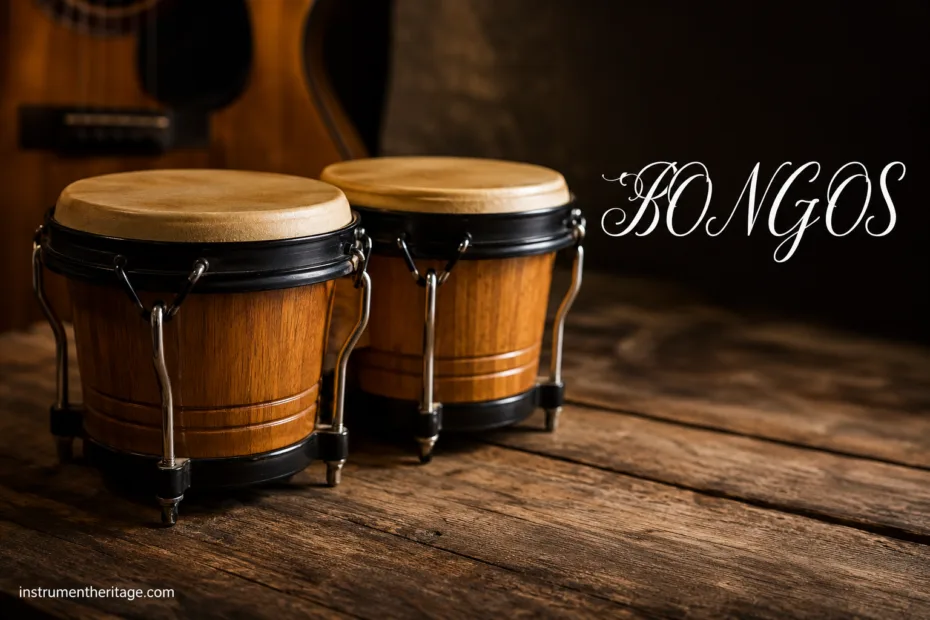
| Feature | Typical form | What it means in sound and use |
|---|---|---|
| Instrument family | Hand-played membranophone | Sound begins with vibrating drumheads rather than strings, reeds, or metal bars. |
| Basic form | Two small, single-headed, open-bottomed drums joined by a bridge | The paired layout gives the player two related pitches within a compact playing area. |
| Drum names | Macho (smaller) and hembra (larger) | The macho carries the higher voice; the hembra answers with a lower, fuller tone. |
| Cultural origin | Eastern Cuba, closely linked with early son traditions | Bongos grew inside dance music where pulse, conversation, and improvisation meet. |
| Common head range | About 6.5–7.5 inches for the macho and 7.5–9 inches for the hembra | Exact sizes vary by maker, but the contrast must remain easy to hear. |
| Shell materials | Staved hardwood, layered wood, or fiberglass | Shell shape and stiffness affect projection, though head choice and tuning usually make the larger audible difference. |
| Head materials | Natural hide or synthetic membrane | Natural skin often feels lively and nuanced; synthetic heads tend to stay steadier when temperature and humidity shift. |
| Tuning system | Metal hoops, tension lugs, nuts, and a tuning wrench | Modern hardware permits even tension and a much wider tuning range than older fixed-head designs. |
| Core rhythmic language | Martillo, accents, muted strokes, open tones, slaps, and short improvised phrases | The instrument can hold a repeating groove while still reacting to singers, dancers, and the rest of the percussion section. |
| Usual position | Held between the knees or mounted on a stand | Knee position favors traditional control; a stand can improve visibility, posture, and access in larger percussion setups. |
Bongos look modest: two little drums, one wooden bridge, a pair of skins. Then the first clean slap cuts through a room and the scale of the instrument suddenly makes sense. These Cuban hand drums speak with a bright attack, a dry whisper, a rounded open tone, or a sharp accent that can sit above guitars and voices without needing the low weight of a conga. In Spanish, bongó often names the paired instrument as a single unit; English speakers usually call the pair bongos.
The pair is small enough to rest between the knees, yet its musical job is not small. A skilled bongosero keeps time, shapes phrases, leaves space, answers the singer, and may switch to a hand-held cowbell when the arrangement opens into a louder section. That balance between repetition and quick response gives bongos their unmistakable character.
🥁 Cuban Roots and the Rise of the Bongó
The bongó developed in eastern Cuba from African-derived drum traditions and became closely tied to son, a dance-music form that took shape in the same broad region near the end of the nineteenth century. The Smithsonian’s Latin jazz glossary describes the instrument as two connected, single-headed drums developed in eastern Cuba from African predecessors.Reference-1✅
Early son groups were lean and portable. Guitar, tres, voices, maracas, claves, bass support, and bongó could create a complete dance texture without a large drum section. By the 1920s, the sexteto format placed bongó beside guitar, tres, marímbula, maracas, and claves. When ensembles expanded into septetos and later conjuntos, the small paired drums kept their place because their tone occupied a useful band register: higher than the bass and conga voices, more rounded than claves, and less metallic than timbales.
The instrument’s name carries a useful language detail. The smaller drum is called macho, while the larger drum is called hembra. These terms describe the paired voices; they do not dictate which hand plays each drum.
As Cuban music circulated through recordings, touring bands, dance halls, and radio, bongos traveled with it. They became familiar in son-derived styles, mambo-era orchestras, salsa, and Latin jazz. The Library of Congress notes how bongos, congas, and timbales became part of the percussion sound used to support horns, piano, guitar, voices, and jazz improvisation.Reference-2✅
From tacked skins to tuneable hardware
Older bongos could use drumheads fixed directly to the shell, with pitch adjusted by warming the skin. Modern designs usually place the head beneath a metal rim pulled downward by tension lugs. This change did more than make tuning convenient. It allowed higher, more repeatable tension, easier head replacement, and better adjustment when the weather changed.
Museum examples also show the instrument’s familiar material logic: wooden strips form the shells, a bridge joins the pair, and the hembra is visibly larger than the macho. A Smithsonian object record for Roland Kavé’s bongo documents these features and the customary position between the player’s legs.Reference-3✅
🪵 How Bongos Are Built
A bongo pair is a compact acoustic system. Each drum has a shell, an upper bearing edge, a membrane, a rim, and tension hardware. The shells remain open at the bottom. Between them sits the bridge, which must be sturdy enough to hold both drums in alignment while leaving enough room for the hands and knees.
Staved wood, layered wood, and fiberglass
Traditional-looking shells are often made from narrow wooden staves joined into a rounded body, much like a tiny barrel. Other models use layered wood formed under pressure. Fiberglass shells trade some of the tactile warmth of wood for resistance to knocks and climate shifts. The difference is real, but it is easy to exaggerate. On bongos, head material, head thickness, tuning, bearing-edge shape, and touch usually alter the heard result more plainly than the species name printed on the shell.
Two instruments made from the same wood can still sound unlike each other when bearing edges, skin weight, hardware, or bridge stiffness differ.
Natural hide and synthetic heads
Natural hide remains common because it offers a varied feel under the hand. A light touch can produce a soft, woody note; a firmer stroke releases a bright ring. Since hide is organic, thickness and density vary across the surface.
Synthetic membranes are more predictable. They resist humidity changes and suit outdoor stages or players who need repeatable pitch. Their attack may sound cleaner and more uniform. Some musicians prefer that precision; others prefer the tonal variation of hide.
- Bearing edge
- The upper rim of the shell that supports the head. A smooth, level edge helps the membrane tension evenly.
- Crown
- The depth of the formed head where it drops from the playing surface toward the hoop. Correct crown height keeps tuning hardware in a workable range.
- Bridge
- The connector between the drums. Its width affects comfort, drum spacing, and how naturally the pair sits between the knees.
- Tension lug
- A threaded metal part that raises or lowers head tension through the rim. Even movement across all lugs protects tone and hardware.
🎵 Why Two Small Drums Produce So Many Colors
The macho and hembra are not simply “high” and “low” versions of one sound. Their different diameters change how much membrane moves, how quickly the vibration develops, and which overtones dominate. The smaller macho usually feels tighter and more pointed. The larger hembra carries a broader body beneath the attack. Together they form a two-voice conversation.
Strike position matters just as much. Near the center, the membrane gives a rounder note with fewer bright overtones. Closer to the edge, the tone becomes thinner, sharper, and easier to mute. A relaxed finger that rebounds immediately lets the head ring. A finger left on the surface stops the vibration almost at once. Same drum. Different sentence.
The main stroke colors
- Open tone: a rebounding finger stroke that allows the head to speak clearly.
- Muted tone: a controlled note stopped by a finger or hand remaining in contact with the skin.
- Slap: a brighter, more explosive articulation shaped by hand angle, speed, and immediate release.
- Heel-toe motion: a rocking hand action that alternates the base of the palm and fingers, often creating the steady inner motion of martillo.
- Fingertip accent: a short, precise note used to outline phrasing without adding much volume.
- Touch or ghost note: a very soft stroke that keeps the groove alive between louder accents.
The open bottoms help the drums project without the long low bloom of a tall conga shell. Bongos favor definition. Their notes arrive fast.
✋ Martillo, Clave, and the Bongosero’s Musical Role
Martillo means “hammer,” but a good martillo pattern should not feel stiff or heavy. It is a repeating bongo rhythm, commonly played with a flowing heel-toe motion on the macho while the other hand places open and accented tones around it. The exact orchestration changes with tempo, regional style, and the player’s approach.
The pattern has an internal bounce. Soft strokes fill space, stronger notes mark the groove, and two pitches keep repetition from becoming flat. Experienced players hear a small dynamic map: whisper, touch, tone, accent. Loud notes work because quiet notes surround them.
How martillo sits with clave
Clave is both a pair of wooden sticks and a repeating rhythmic timeline used through much Cuban music. Martillo does not merely duplicate the clave strokes. It fits around that timeline, reinforcing motion without confusing the direction of the phrase. The Library of Congress describes clave as a central feature of Afro-Cuban music and explains how it remains present even when musicians reshape the surrounding patterns.Reference-4✅
A bongosero listens beyond the drum pair. Bass, tres, piano guajeo, vocals, maracas, and clave reveal where the music is leaning. A clever fill still feels misplaced if it blocks a vocal entrance.
From bongó to campana
In many son and salsa arrangements, the bongosero plays the drum pair during the quieter opening sections, then changes to a campana or hand-held cowbell when the music reaches the montuno. The bell’s hard metallic voice suits the denser texture, louder chorus responses, and repeated instrumental figures. This is not an abandonment of the bongos. It is a change of orchestral color by the same musician.
Improvisation on bongos is usually conversational. Short responses, displaced accents, rolls, and compact fills follow the ensemble. Constant soloing can blur the groove; silence can sharpen the next phrase.
Traditional position and modern setups
The customary seated position holds the pair between the knees, with the open bottoms angled away from the body. Many right-handed players place the macho on the left and the hembra on the right, though hand preference and instrument orientation can vary. The knees stabilize the bridge, but squeezing too hard may restrict movement and create fatigue.
A stand helps when the player moves among congas, timbales, bells, or electronic pads. Height matters: the forearms should stay relaxed and the wrists should not bend sharply.
🔧 Tuning, Climate, and Long-Term Care
Bongos do not have one universal pair of concert pitches. Players tune for response, musical setting, head type, and personal touch. The macho should clearly sit above the hembra, but the exact interval can be narrow or wide. What matters most is that the two voices remain distinct and that neither head feels choked.
An even tuning sequence
- Place the pair on a stable surface and check that the rim sits level.
- Turn each lug by a small, equal amount rather than finishing one lug before touching the others.
- Move across the head in an opposing pattern so tension spreads around the rim.
- Tap near every lug and listen for areas that are markedly higher or lower.
- Bring the hembra to a clear, open voice first, then tune the macho above it.
- Play normal strokes at full hand pressure before making the final small adjustments.
A very high macho can sound exciting, but excessive tension shortens head life, strains hardware, and may make the drum feel hard under the fingers. If the tone has plenty of pitch but little body, the head may be pulled beyond its useful range. Tension is not the same as clarity.
Why natural heads change with the room
Natural skin absorbs and releases moisture. In humid air it often relaxes, lowering pitch and softening attack. In dry heat it may tighten and rise in pitch. A drum carried from a cold vehicle into a warm venue needs time to settle before final tuning. Rapid heating is risky; a lamp, heater, or hot car can dry one area faster than another and encourage splitting.
Synthetic heads move less with the weather, though a few minutes of playing can still change tension as the membrane warms beneath the hands.
Care that protects tone
- Wipe sweat and dust from the heads, rims, and hardware after playing.
- Keep the drums away from radiators, direct sun, damp storage, and sealed hot vehicles.
- Use a properly fitting wrench; rounded nuts are difficult to tune evenly.
- Check lug plates, bridge joints, and rim alignment before a loose part begins to rattle.
- Do not apply household oils or cleaners to a drumhead unless the maker recommends a specific product.
- For long storage in a changing climate, avoid leaving natural heads at extreme tension.
🎙️ Bongos on Stage and in the Studio
Bongos can sound louder to a nearby listener than they do inside a full amplified band. Their slap cuts well, but soft heel-toe notes may disappear beneath keyboards, bass, guitars, and brass. Microphone placement should preserve both sides of that dynamic range rather than capture only the sharpest attack.
A single microphone positioned above the bridge can hear both drums with a natural stereo-like balance in mono. Moving it toward the macho emphasizes definition; moving toward the hembra adds body. Very close placement brings isolation but may exaggerate finger noise, rim clicks, and pitch differences across the skin. A little distance lets the pair blend. The room matters.
Two microphones offer more control but also introduce phase concerns. The capsules should be placed with similar distance to the heads, then checked in mono. On stage, a compact condenser or clip system can reduce spill, provided the mount does not choke the shell or rattle against the hardware.
🪘 Bongos Beside Other Hand and Latin Percussion
Bongos share stages with many percussion instruments, but each one occupies a different physical and musical space. Size alone does not explain the difference. Shell depth, head loading, playing method, and ensemble role shape the identity of each drum.
| Instrument | Construction and technique | Typical musical character |
|---|---|---|
| Bongos | Small joined pair, open bottoms, played mainly with fingers and hands | Bright, agile, and articulate; suited to martillo, accents, and short fills |
| Congas or tumbadoras | Tall single-headed drums with deeper shells, often played as a set | Broader low and middle tones, stronger bass presence, open tones, slaps, and tumbao patterns |
| Timbales | Shallow metal drums played with sticks, commonly paired with bells | Metallic attack, cutting rim and shell patterns, sharp ensemble cues |
| Batá | Double-headed hourglass drums played as a family of three | Interlocking two-headed language with a distinct cultural repertoire and tonal system |
| Tabla | Two separate Indian drums with tuned heads and central loading | Highly defined pitch, long vocabulary of finger strokes, and a very different rhythmic grammar |
| Djembe | Single goblet-shaped drum with a broad head, commonly rope- or mechanically tuned | Wide dynamic spread from deep bass to ringing tone and forceful slap |
Bongos and congas are partners, not substitutes
A conga can produce high slaps, and a hembra can offer a full note, yet their centers of gravity differ. Congas carry more air and low-mid weight. Bongos deliver faster syllables. A conguero may hold tumbao while the bongosero places martillo above it, then moves to bell as the arrangement grows.
What separates a responsive pair from a frustrating one
Good bongos do not need ornate decoration. They need round shells, level bearing edges, smooth rims, steady hardware, a secure bridge, and heads that respond across a useful tension range. The hembra should open without a dull thud. The macho should rise in pitch without becoming thin and lifeless. Both drums should speak under a light touch.
Comfort deserves equal attention. A bridge that is too wide can spread the knees awkwardly. Sharp rim profiles punish the hands. Oversized hardware may interfere with finger placement. Small details decide whether an instrument invites relaxed playing or turns every session into a wrestling match.
Bongo Drum FAQ
Are bongos originally Cuban?
Yes. The modern paired bongó developed in eastern Cuba and became closely associated with son and related ensemble traditions. Its design and playing language reflect African-derived drum practices shaped within Cuban music.
Which drum is the macho and which is the hembra?
The macho is the smaller, higher-pitched drum. The hembra is the larger, lower-pitched drum. Many right-handed setups place the macho to the player’s left, but orientation can be changed for comfort and technique.
Do bongos have to be tuned to exact notes?
No fixed pair of notes is required for most playing. The drums are commonly tuned by response and interval: the macho clearly higher, the hembra lower and more open. Some studio or arranged settings may call for pitches that avoid clashing with the music.
What is the martillo rhythm?
Martillo is a repeating bongo pattern used in son-related music and many later styles. It often combines a heel-toe motion on the macho with open, muted, and accented notes distributed across both drums.
Why does a bongosero switch to cowbell?
During a louder montuno section, the bongosero may move from the drum pair to a hand-held campana. The bell projects through the denser ensemble and reinforces the repeated dance pulse while singers and instruments trade phrases.
Can bongos be played with sticks?
They are primarily hand drums. Sticks appear in some orchestral, experimental, or mounted-percussion settings, but ordinary drumsticks can damage heads and rims if used without care. The instrument’s traditional tone vocabulary comes from fingers, palms, and controlled hand contact.
Why do natural bongo heads lose pitch?
Natural hide responds to moisture and temperature. Humidity often relaxes the skin and lowers pitch; dry warmth can tighten it. Letting the instrument adjust to the room before final tuning produces a more stable result.
Are bongos easier to learn than congas?
The small layout makes the first sounds easy to reach, but clean martillo, balanced hand motion, controlled slaps, and ensemble awareness take time. Congas and bongos demand different coordination rather than different levels of musical seriousness.
