
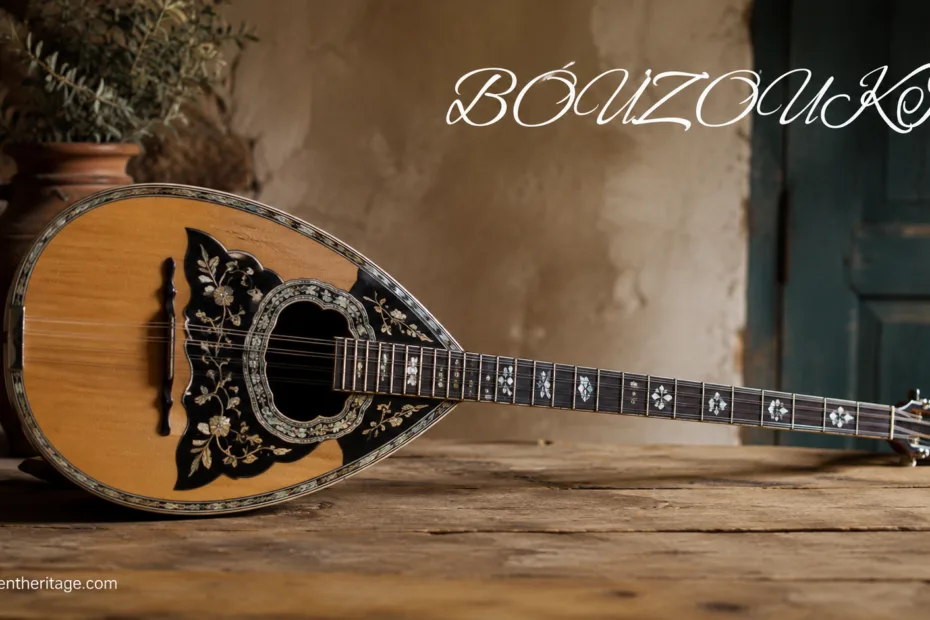
| Feature | Bouzouki Details |
|---|---|
| Instrument Family | Long-necked plucked lute, part of the wider lute and chordophone family Reference-1✅ |
| Greek Name | Bouzouki, also written as buzuki in some English sources |
| Body Shape | Usually a rounded, bowl-like wooden body with a flat or slightly arched soundboard |
| Neck | Long fretted neck, made for fast melodic runs, ornamentation, and bright chord voicings |
| Strings | Most Greek bouzoukis have three or four double courses, meaning pairs of metal strings |
| Common Types | Trichordo with 3 courses and tetrachordo with 4 courses |
| Playing Method | Played with a plectrum, often with tremolo, slides, hammer-ons, and small melodic ornaments |
| Sound Character | Bright, metallic, ringing, and slightly nasal in a pleasing way — like silver wire stretched over wood |
| Main Musical Home | Greek urban folk music, rebetiko, laïko, dance songs, and modern Greek popular music |
| Close Relatives | Tzouras, baglamas, tambouras, mandolin, saz/bağlama, buzuq, and Irish bouzouki |
The bouzouki is one of those instruments you recognize before you can name it. A few bright notes, a small burst of tremolo, and the sound seems to carry sunlight, street corners, tavern tables, dance steps, and late-night singing all at once. It is a long-necked Greek lute with metal strings, a rounded body, and a voice that cuts through a room without shouting.
It looks delicate, but it is not a shy instrument. The Greek bouzouki can play melody, rhythm, drones, ornamental fills, and full chord shapes. In a small group, it can lead. In a larger ensemble, it can sparkle above guitars, voices, percussion, violin, accordion, or baglamas. That bright edge is part of its charm.
For many listeners, the bouzouki is tied to Greek music through rebetiko and laïko. For players, it is also a beautifully logical instrument: paired strings, clear fret layout, strong projection, and a tone that responds quickly to the hand. It rewards touch. Press too hard and it can bark. Relax, and it sings.
🎶 What Is a Bouzouki?
The bouzouki is a fretted plucked string instrument from Greece. It belongs to the lute family, but it does not sound like the soft, round European lute many people imagine. Its metal strings give it a sharper edge. Its long neck gives it range. Its paired strings create that shimmering double-note effect that feels alive even on a simple melody.
A standard bouzouki is played with a plectrum, not with bare fingers. The right hand strikes or tremolos the strings near the soundhole, while the left hand moves along the fretted neck. The result is a tone that can be clean and bell-like, then suddenly fiery when the player digs in.
Why the Bouzouki Sounds So Recognizable
The magic comes from the meeting of metal strings, double courses, a resonant wooden bowl, and fast plectrum movement. A single note often carries a slight natural shimmer because two strings are speaking together. It is not a flat sound. It has movement inside it.
The instrument is strongly linked with Greek musical identity, yet it also belongs to a larger family of Mediterranean and West Asian long-necked lutes. That is why the bouzouki can feel familiar to people who know the saz, buzuq, tambouras, or mandolin. They are not the same instrument, but they share old ideas about strings, wood, frets, and melody.
🪵 Anatomy of the Bouzouki
A bouzouki is not just “a Greek mandolin,” even though the comparison is easy to understand at first glance. The mandolin is shorter, higher, and usually more compact. The bouzouki has a longer neck, a different musical role, and a deeper relationship with Greek urban folk sound.
The Body
The body is often rounded at the back, made from thin wooden ribs called staves. These staves are bent and joined into a bowl shape. A good bowl is light, stable, and lively. It should not feel like dead furniture. It should feel like a small wooden room built for strings.
The soundboard, or top, is usually made from a resonant softwood such as spruce or cedar. This is the part that wakes up when the strings vibrate. The bowl gives depth; the top gives breath. Together, they shape the bright but woody bouzouki tone.
The Neck and Frets
The neck is long and usually fitted with metal frets. Older lute relatives sometimes used movable tied frets, but the modern Greek bouzouki normally has fixed frets. This allows clean chromatic playing, clear chords, and the fast melodic passages heard in Greek popular styles.
The fingerboard must be stable because metal strings place real tension on the instrument. Many modern bouzoukis use a reinforced neck, sometimes with an adjustable rod, to keep the action playable over time. A neck that moves too much makes the instrument feel stiff. A good neck lets the hand glide.
Strings and Courses
The word course simply means a string pair or string group played as one. A 3-course bouzouki has three pairs of strings. A 4-course bouzouki has four pairs. These paired strings give the instrument its ringing, slightly chorus-like voice.
- Trichordo bouzouki: 3 double courses, usually 6 strings total.
- Tetrachordo bouzouki: 4 double courses, usually 8 strings total.
- Paired sound: two strings vibrate together, adding brightness and thickness.
- Metal string tension: helps create projection, sustain, and that crisp attack.
Small detail, big result: the bouzouki’s paired strings are part of why it feels so alive. Even a single note has a faint glitter around it, especially when played with tremolo.
🏛️ A Short History of the Bouzouki
The bouzouki belongs to a long line of necked lutes around the eastern Mediterranean. Greek musical history includes older lute forms such as the pandoura and tambouras, while neighboring traditions have their own related instruments with long necks, frets, and plucked strings. The modern bouzouki did not appear from nowhere. It grew from shared craft ideas, local playing habits, and the needs of musicians in real social spaces.
The name is often connected with bozuk, a term found in the vocabulary of related long-necked lutes and tunings. In everyday English, the safest way to understand the word is simple: bouzouki became the Greek name for a specific kind of plucked lute with its own body shape, tuning habits, and musical voice.
From Folk Instrument to Urban Voice
By the early 20th century, the bouzouki had become closely tied to Greek urban music. It found a strong place in rebetiko, a song tradition linked with city life, dance, personal feeling, and small-group performance. UNESCO lists rebetiko as intangible cultural heritage, describing it as a musical and cultural expression connected with song and dance. Reference-2✅
In that setting, the bouzouki was not just decoration. It carried introductions, answered singers, filled pauses, and shaped the emotional color of a song. A player could bend the mood with a short phrase. Two notes could say plenty.
The Move from Trichordo to Tetrachordo
The older Greek bouzouki style is usually linked with the trichordo, the 3-course instrument. It has a direct, lean sound. Many players love it because it leaves space. It is not overloaded with chord shapes, and its tuning encourages modal melodies.
The tetrachordo, or 4-course bouzouki, became widely used later. It offers more chord possibilities and feels more familiar to players coming from guitar. Its extra course makes harmony easier, especially in modern Greek popular music. Some players prefer the older bite of the trichordo. Others want the wider chord vocabulary of the tetrachordo. Both have their own beauty.
Trichordo Feel
Lean, direct, modal. Often loved for older rebetiko phrasing, open drones, and a rawer melodic voice.
Tetrachordo Feel
Broader, chord-friendly, flexible. Often used in laïko, stage settings, and modern Greek arrangements.
🔊 The Sound: Bright, Metallic, and Human
The bouzouki sound is often described as bright or metallic, but those words can be a little cold. A better way to hear it: imagine a mandolin with more body, a sharper pick attack, and a voice that can lean into both joy and ache without changing instruments.
The first thing you hear is the attack. The plectrum touches metal, and the note jumps out quickly. Then comes the shimmer of the paired strings. Then the wooden body adds a shorter, warmer tail behind the note. The sound does not float forever like a piano chord with a pedal. It flashes, rings, and moves on.
Common Bouzouki Techniques
- Tremolo: fast repeated picking that makes a note feel sustained and emotional.
- Slides: moving between notes without fully breaking the sound.
- Hammer-ons and pull-offs: left-hand ornaments that add flow to a phrase.
- Drone notes: open strings that keep ringing under a melody.
- Chord stabs: short rhythmic hits used in dance-like accompaniment.
- Taximi-style phrasing: free melodic exploration before or between songs.
Good bouzouki playing is not only fast. Speed helps, yes, but tone matters more. A careful player can make one phrase feel conversational. A heavy hand can turn the same phrase into noise. The instrument is honest that way.
Listening note: when hearing a bouzouki recording, pay attention to the start of each note. That bright front edge is where much of the instrument’s character lives.
🎼 Trichordo and Tetrachordo Tunings
Tuning is one of the easiest ways to understand why bouzoukis do not all feel the same. The number of courses changes the logic of the instrument. A trichordo player often thinks in drones, melodic shapes, and compact harmony. A tetrachordo player may move more easily through fuller chords and guitar-like patterns.
| Type | Courses and Strings | Common Tuning Idea | Typical Feel |
|---|---|---|---|
| Trichordo | 3 courses, 6 strings | Often built around D–A–D relationships, though player habits vary | Open, modal, older-style sound; strong for rebetiko phrasing |
| Tetrachordo | 4 courses, 8 strings | Often tuned in a C–F–A–D layout, close in logic to part of the guitar | Chord-rich and flexible; strong for modern Greek styles |
The trichordo can feel like a narrow road with a clear destination. Fewer courses mean fewer distractions. The tetrachordo feels more like a wider street: more turns, more chords, more harmonic choices. Neither is “better.” The right choice depends on the sound a player wants under the fingers.
Why Courses Matter More Than String Count
People sometimes ask whether a bouzouki has six or eight strings. That is useful, but the better question is: how many courses does it have? Since the strings are paired, players think in groups. When you strike one course, you usually hear two strings together. This is why the bouzouki feels different from a guitar, even when a tetrachordo tuning makes certain chord shapes feel familiar.
🎵 The Bouzouki in Greek Music
The bouzouki sits naturally in Greek music because it can do several jobs at once. It can introduce a song with a short solo phrase. It can support a singer. It can decorate a melody. It can drive dance rhythm. In the hands of a strong player, it can even suggest harmony without filling every space.
Rebetiko
In rebetiko, the bouzouki often feels close to the voice. It does not simply accompany. It answers. It comments. It bends around the singer’s line and creates small instrumental statements that feel almost spoken.
The older rebetiko sound often leaves room for baglamas, guitar, and voice. The bouzouki may play a phrase, then step back. Silence matters. A good pause can make the next tremolo feel warmer.
Laïko and Stage Performance
In laïko and later Greek popular settings, the bouzouki often becomes brighter, faster, and more virtuosic. The tetrachordo is especially useful here because it allows richer chords and quick shifts through different harmonic areas. The instrument can sound polished on a stage, but it still keeps that metal-string Greek color.
Dance and Social Music
The bouzouki is also tied to rhythm. Even when it plays melody, the right hand gives pulse. In dance settings, short chord strokes and repeated figures can help lock the group together. The instrument’s bright attack makes the beat easy to feel, even without heavy percussion.
Where You May Hear It
- Small Greek ensembles with voice, guitar, and baglamas
- Rebetiko recordings and live tavern-style sets
- Laïko songs and modern Greek popular music
- Instrumental solos, dance pieces, and festive gatherings
- World music, folk fusion, jazz, and acoustic crossover projects
🪚 Materials and Craftsmanship
A bouzouki is a craft object before it is a stage instrument. The choice of wood, the thickness of the soundboard, the bowl construction, the fretwork, the bridge, and the neck angle all change how it responds.
Common body woods include maple, walnut, mahogany, rosewood, mulberry, or other stable tonewoods, depending on the maker and region. Spruce and cedar are often used for tops because they respond well to string vibration. The fingerboard may use a hard dark wood that can handle constant contact from strings and fingers.
The Bowl Back
The bowl back is more than a pretty shape. Thin wooden ribs create a resonating chamber that helps project sound forward. If the bowl is too heavy, the tone can feel stiff. If it is too fragile, the instrument may lack stability. Good builders search for that middle point: light enough to speak, strong enough to last.
The Soundboard
The soundboard is where much of the voice is born. A responsive top can make the bouzouki feel open under the pick. A tight top may need stronger playing before it wakes up. This is why two bouzoukis with the same tuning can feel very different in the hands.
Decoration
Many bouzoukis have decorative pickguards, rosettes, purfling, or mother-of-pearl-style inlay. Decoration can be beautiful, but it should not bury the instrument. The best examples let the craft shine while keeping the soundboard free enough to vibrate.
- Soundboard
- Usually the most sensitive sound-producing wooden surface.
- Bridge
- Transfers string vibration into the top; small changes can alter tone and action.
- Nut
- Guides the strings at the headstock end and affects tuning feel.
- Frets
- Allow clear pitch placement and fast melodic playing.
- Bowl
- Shapes resonance, projection, and physical comfort against the body.
🪕 Similar Instruments and Close Relatives
The bouzouki is easier to understand when placed beside its relatives. Not as a family tree with neat straight lines — instruments rarely behave that neatly — but as a group of cousins sharing ideas: long necks, frets, plucked strings, drones, paired courses, and melodic ornament.
| Instrument | Main Connection to Bouzouki | Main Difference |
|---|---|---|
| Tzouras | A smaller Greek long-necked lute with a related musical role | Usually smaller body and a more intimate sound |
| Baglamas | Small Greek lute often used with bouzouki in rebetiko settings | Much smaller, higher, and more compact in tone |
| Tambouras | Older Greek long-necked lute tradition connected to the bouzouki’s background | Often has a different body, stringing, and historical playing context |
| Mandolin | Shares metal strings, paired courses, and bright plectrum attack | Shorter neck, higher pitch, different repertoire and technique |
| Saz / Bağlama | Another long-necked lute with deep regional roots and modal playing | Different body construction, tuning systems, frets, and musical language |
| Irish Bouzouki | Developed after Greek bouzouki models entered Irish folk music | Often has a flatter back, different tuning, and a strong accompaniment role |
The Irish bouzouki deserves a special note. It borrowed the name and part of the concept from the Greek instrument, then changed shape and musical purpose. In Irish traditional music, it often supports tunes with ringing chords and drones. The Greek bouzouki, by contrast, is more strongly known as a melodic lead instrument, especially in rebetiko and laïko.
The Museum of Greek Folk Musical Instruments “Fivos Anoyanakis” in Athens presents Greek instruments within families such as chordophones, aerophones, membranophones, and idiophones, helping visitors hear instruments as part of a living musical culture rather than isolated objects. Reference-3✅
🎯 What Makes Bouzouki Playing Feel Different?
A guitarist picking up a tetrachordo bouzouki may recognize some tuning logic, but the feel is still different. The courses are doubled. The scale can feel long. The pick response is sharper. Chords need careful pressure, and ornaments often speak better when the left hand stays light.
The Right Hand
The right hand is the engine. Bouzouki players often use a flexible but controlled plectrum movement. Too stiff, and the sound becomes harsh. Too soft, and the note loses shape. The sweet spot is a relaxed wrist with enough bite to make the strings speak clearly.
The Left Hand
The left hand handles fretted notes, slides, ornaments, and chord shapes. On a good setup, the hand should not fight the instrument. High action can make fast playing tiring. Very low action can buzz. The bouzouki needs balance, like a door that closes cleanly without being slammed.
Melody Before Flash
Bouzouki music can be fast, but speed is not the soul of the instrument. The most memorable phrases often have a vocal quality. They breathe. They lean into notes. They leave small spaces. That is where the instrument becomes more than bright strings and polished wood.
- Start with clean single-note tone.
- Add slow tremolo only after the note sounds steady.
- Use open strings to understand resonance.
- Practice short phrases before long runs.
- Listen to how the instrument answers the voice in Greek recordings.
🧰 Care, Setup, and Everyday Handling
A bouzouki is sturdy enough for regular playing, but it still needs gentle habits. Metal strings, a long neck, and a resonant wooden body all respond to temperature, humidity, and setup changes.
- Keep it in a stable room: sudden dryness or heat can bother the wood.
- Change strings when the tone becomes dull: old strings lose brightness and tuning stability.
- Check the bridge position: a movable bridge must sit correctly for clean intonation.
- Watch the action: if strings feel too high, the neck or bridge may need attention.
- Use a proper case: bowl-backed instruments do not love careless storage.
Players should also clean the strings after practice. It sounds boring. It helps. Sweat and dust shorten string life and can make the instrument feel rough under the hand.
Player-friendly habit: tune slowly and listen closely. Paired strings must agree with each other. If one string in a course is slightly off, the whole instrument can sound restless.
🧭 Choosing Between Trichordo and Tetrachordo
Someone drawn to older rebetiko sound may feel at home with a trichordo bouzouki. It has a direct voice and encourages melodic thinking. Someone who wants chord range, modern arrangements, or a smoother move from guitar may prefer the tetrachordo.
Choose Trichordo If You Like
- Older rebetiko color
- Modal phrasing
- Open-string drones
- A leaner sound
- Melody-first playing
Choose Tetrachordo If You Like
- Fuller chord shapes
- Modern Greek popular styles
- Guitar-friendly logic
- Wider harmonic movement
- Stage-ready brightness
For a first instrument, comfort matters as much as tradition. A well-set-up bouzouki with clear intonation will teach better habits than a prettier instrument that fights the hand. Listen for even volume across courses, clean frets, stable tuning, and a tone that makes you want to keep playing.
Bouzouki FAQ
Common Questions About the Bouzouki
Is the bouzouki Greek or Irish?
The bouzouki is strongly associated with Greek music. The Irish bouzouki is a later adaptation inspired by Greek bouzouki models, but it usually has different tuning, body design, and musical use.
What is the difference between a trichordo and a tetrachordo bouzouki?
A trichordo has 3 courses, usually 6 strings total. A tetrachordo has 4 courses, usually 8 strings total. The trichordo is often linked with older rebetiko playing, while the tetrachordo gives more chord options for modern Greek styles.
Is the bouzouki hard to learn?
It is friendly enough to begin, but it takes patience to sound natural. The paired strings, plectrum control, tremolo, and ornamented phrasing all need time. A good setup makes learning much easier.
Does the bouzouki sound like a mandolin?
It can remind listeners of a mandolin because both use metal strings, paired courses, and a plectrum. The bouzouki usually has a longer neck, lower range, different tuning habits, and a more Greek musical character.
What wood is used for bouzoukis?
Many makers use spruce or cedar for the top and harder woods such as maple, walnut, rosewood, mahogany, or similar tonewoods for the body, neck, and fingerboard. The exact choice depends on the builder and the sound goal.
Why are bouzouki strings paired?
Paired strings create a brighter, fuller sound. When two strings in one course vibrate together, the note gains shimmer and projection. That paired-string voice is one of the easiest bouzouki traits to hear.
Can guitar players learn bouzouki easily?
Guitar players may find the tetrachordo bouzouki more familiar because some chord logic feels closer to guitar. Still, the doubled strings, plectrum feel, scale length, and Greek ornamentation make it a separate instrument with its own habits.
What music is the bouzouki used for?
It is used in rebetiko, laïko, Greek folk and popular music, dance songs, instrumental solos, and many acoustic fusion settings. Its bright tone also helps it stand out in mixed ensembles.
