
| Feature | Timpani detail |
|---|---|
| Instrument family | Definite-pitch membranophone; a large orchestral kettledrum |
| Main sound source | A single tensioned head vibrating above a bowl-shaped kettle |
| Common bowl materials | Copper, fiberglass, and sometimes aluminum |
| Head materials | Calfskin or synthetic plastic film |
| Pitch control | Foot pedal, hand crank, or individual tuning screws, depending on the design |
| Typical modern set | Four drums, often around 23, 26, 29, and 32 inches in diameter |
| Written register | Usually notated in bass clef at sounding pitch |
| Playing tools | Timpani mallets with wood, bamboo, carbon-fiber, or composite shafts and felt, flannel, cork, or wood heads |
| Characteristic sound | Rounded attack, clear low pitch, controlled resonance, and a wide dynamic range |
| Common settings | Symphony orchestra, opera orchestra, concert band, chamber music, film scoring, and selected popular music |
Timpani can shake a concert hall without turning into noise. A single stroke may settle beneath the orchestra like a low foundation note, while a roll can grow from a distant murmur into a broad, ringing wave. These drums are large, but their real identity comes from something more precise: each timpano is tuned to a definite pitch. That places the instrument between rhythm and harmony, giving the timpanist a role that is part percussionist, part bass player, and part careful tuner.
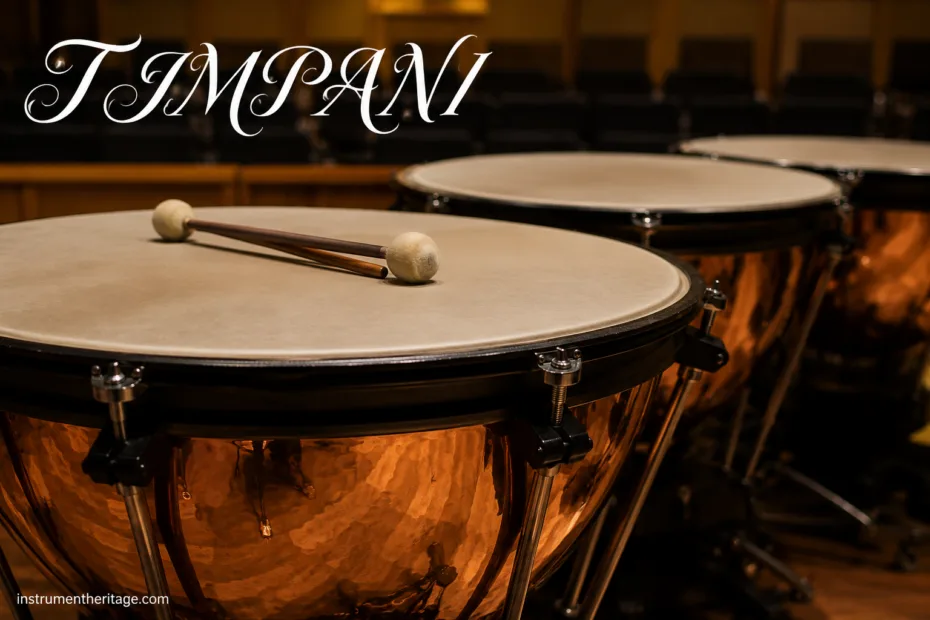
The familiar copper bowls and broad drumheads suggest a simple design. The mechanism underneath tells a different story. A modern pedal timpano must pull the head evenly, hold a chosen note, respond smoothly beneath the foot, and let the bowl vibrate without unwanted contact. Small changes in head seating, pedal balance, mallet hardness, room temperature, or striking position can alter the result. Timpani playing is an art of controlled vibration.
- Orchestral percussion
- Tuned drum
- Copper kettle
- Pedal tuning
- Bass-clef notation
🥁 What Makes Timpani Different from Other Drums?
A timpano has one drumhead stretched over a deep bowl. Most familiar drums use a cylindrical shell, and many have a second head underneath. The timpani kettle is closer to a rounded vessel. Its enclosed air and curved interior work with the membrane, helping certain vibration patterns stand out strongly enough for the ear to hear a stable note.
This is why timpani belong to the group of pitched percussion instruments. A snare drum may have a general high or low character, yet it is not normally asked to produce an exact F or B-flat. A timpano is. The player checks pitches before and during a performance, often tuning silently by touch and pedal movement while another passage is underway.
Timpani and kettledrum are closely related terms. “Kettledrum” describes the bowl-shaped drum family. “Timpani” usually refers to the tuned orchestral form, especially when several drums are played as a set. The Italian singular is timpano; the plural is timpani.
The instrument also behaves differently across its range. Near the middle of a drum’s usable range, the pitch usually speaks openly and the pedal feels settled. At the very bottom, the head can become loose and broad sounding. At the top, it grows tight, bright, and less generous. Skilled players choose which drum will carry a note based not only on whether the pitch is possible, but on where that pitch sounds healthiest.
🏛️ From Ceremonial Kettledrums to the Orchestra
Bowl-shaped drums have appeared in several musical cultures for many centuries. Small paired kettledrums travelled across regions through trade, court exchange, and the movement of musicians. In Europe, larger forms became linked with trumpets, formal outdoor display, and mounted ceremony. Their paired high-and-low voices were already part of the instrument’s identity.
One surviving pair in the Metropolitan Museum of Art was made in Hanover in 1779 by the court goldsmith Frantz Peter Bunsen. The drums use silver, iron, calfskin, and textile elements, with decorative metalwork built directly into the kettles. They show how a drum could be both a working sound tool and an object of high craft. Reference-1✅
The move into the orchestra changed the musical job. Early orchestral timpani often reinforced trumpets and supported two central notes of the key, commonly the tonic and dominant. The Philharmonia notes that orchestral scoring for timpani dates to 1675, a point often associated with Jean-Baptiste Lully’s stage work Thésée. Reference-2✅
The drum begins to speak as an individual voice
Classical and early Romantic composers gave the timpani more independence. Haydn used them for wit, surprise, and structural punctuation. Mozart let them brighten ceremonial passages and deepen harmonic arrivals. Beethoven pushed farther, writing exposed strokes, unusual tuning relationships, sustained rolls, and rhythmic figures that could challenge the full orchestra rather than merely underline it.
🔧 Anatomy of a Modern Timpano
Every visible part affects the instrument, yet the main pieces are easy to identify: head, counterhoop, tension system, kettle, suspension ring, frame, pedal, and tuning gauge. The player strikes the head. The hoop pulls it tight. The pedal and linkage alter that tension. The kettle shapes the vibrating air beneath it.
The head and hoop
The head sits over the rim of the kettle and is held by a metal counterhoop. Tension must be even around the circumference. If one tuning point is sharper than the others, the note can wobble, decay unevenly, or resist clean pedal movement.
The kettle and suspension
The bowl is often supported by a suspension ring rather than resting tightly against the frame. This limits unwanted contact and lets the kettle respond more freely. Bowl depth, contour, wall thickness, and rim design all influence tone.
The pedal mechanism
Pressing the toe usually raises the pitch by increasing head tension; moving toward the heel lowers it. Linkages distribute that force around the hoop. A clutch, ratchet, or balanced-action spring keeps the chosen position.
The tuning gauge
A gauge shows note names as a reference. It does not replace listening. Head stretch, room conditions, setup, and transport can shift the true pitch, so the player still checks with the ear.
Copper, fiberglass, and the character of the bowl
Copper is the traditional orchestral choice. It is workable enough to form into a deep bowl, yet firm enough to hold its shape. Smooth copper kettles are commonly made by spinning a flat sheet over a mold. During forming, the metal hardens and may need to be annealed, then polished and coated. Some kettles are hammered after shaping, which changes the stiffness of the metal and can sharpen the sense of pitch. Yamaha’s manufacturing account describes metal spinning, annealing, interior polishing, assembly, and final balancing around the tuning points. Reference-3✅
Fiberglass bowls are lighter, durable, and less costly to produce. They are common in schools, rehearsal rooms, touring groups, and outdoor performance settings. Aluminum appears in some designs as well. Material matters, but it does not act alone. A well-shaped fiberglass bowl with a carefully seated head may speak more clearly than a neglected copper drum. Head condition, tuning balance, bearing edge, suspension, mallet, and player touch remain part of the same acoustic system.
Calfskin and synthetic heads
Natural calfskin can produce a supple attack, layered overtones, and a warm decay that many orchestral players value. It also responds to humidity and temperature. The head may tighten in a dry hall or relax as moisture rises, making frequent pitch correction part of the performance.
Synthetic heads, usually made from plastic film, are more stable and predictable. They tolerate transport and changing conditions well. Their attack can feel cleaner and more immediate, though the exact result depends on film thickness, collar shape, surface treatment, bowl, and mallet. Neither material has one fixed sound. Two calf heads can differ from each other, and synthetic models vary widely.
🎧 How Timpani Produce a Recognizable Pitch
A circular membrane naturally produces many vibration modes. On an ordinary drum, those modes are not arranged like the neat harmonic series of a string or air column, so the ear hears a complex drum tone rather than a sharply defined note. The timpani bowl changes the relationship between the membrane and the enclosed air. Certain modes are shifted toward more orderly frequency relationships, and the lowest strong components gather into a pitch the ear can follow.
Yamaha describes the kettle and head as a coupled system: the air inside the bowl interacts with the membrane, helping the drum produce a stronger sense of pitch than a typical double-headed drum. The same source explains how pedal mechanisms raise or lower that pitch by changing head tension across the whole hoop. Reference-4✅
Why the player strikes near the edge
The usual playing area lies partway between the rim and center, often a few inches inside the edge. A stroke in this zone excites the useful resonances while keeping the attack clear. The center tends to produce a short, blunt sound with less stable pitch. Too close to the rim, the head feels hard and the tone becomes thin.
The exact spot moves with drum size, head tension, and musical need. A soft roll may sit slightly farther from the rim to gather warmth. A firm rhythmic passage may move outward for definition. Timpanists do not aim at a painted dot; they listen for the place where attack and resonance meet cleanly.
Mallets change the front edge of the sound
A timpani mallet is not simply “soft” or “hard.” The core may be wood, cork, felt, or another material, wrapped in layers of felt or flannel. A large soft mallet spreads contact over more of the head and produces a broad entrance. A smaller, harder mallet speaks faster and reveals rhythm clearly. Bare wooden heads create a dry, pointed articulation used for special colors.
- Soft mallets: rounded rolls, quiet entrances, and blended bass support.
- Medium mallets: the everyday orchestral choice for clear notes with body.
- Hard mallets: exact rhythm, bright articulation, and dense orchestral textures.
- Wood mallets: short, direct attacks when the score asks for a dry color.
Timpani Sizes and Practical Pitch Ranges
Diameter and pitch are linked. A larger head can carry lower notes; a smaller head works more comfortably higher. The ranges below are common working areas for modern orchestral drums, not universal limits. Different models, head types, and setups may extend slightly beyond them.
| Nominal diameter | Approximate comfortable range | Typical use |
|---|---|---|
| 32 in. / 81 cm | D2–A2 | Lowest bass notes, broad rolls, deep harmonic support |
| 29 in. / 74 cm | F2–C3 | Low and middle orchestral register |
| 26 in. / 66 cm | B♭2–F3 | Central register and many common tuning pairs |
| 23 in. / 58 cm | D3–A3 | Upper register, clear rhythmic writing |
| 20–21 in. / 51–53 cm | F3–C4 | Piccolo timpani range and high chromatic parts |
A four-drum set can cover much of the normal orchestral register, yet note placement still requires planning. Suppose a passage asks for F2, C3, D3, and A3. The player may distribute those notes so each drum stays near its best response and pedal travel remains manageable. The most obvious size choice is not always the most musical one.
🎼 What the Timpanist Actually Does
The timpanist reads rhythm, pitch, dynamics, articulation, and harmony at once. Before the first note, the heads are checked around their tuning points, the pedals are tested across their usable ranges, and the opening pitches are set. During the piece, feet move between pedals while hands prepare mallets, damp resonance, count rests, and watch the conductor.
Tuning by ear
Pitch gauges are useful maps, not final judges. A timpanist often takes a reference note from the orchestra, tuning fork, piano, or electronic tuner before playing. Once the performance begins, pitch memory becomes central. The player may hum internally, compare a target note with a bass line, or feel the pedal distance between familiar intervals.
Silent tuning is a learned physical skill. The player can place light pressure on the head with a finger, move the pedal, and feel changes in tension without producing an audible stroke. In a busy passage, the foot may retune one drum while the hands play another. It looks calm from the audience. Underneath, several jobs are happening together.
Rolls, damping, and note length
Timpani rolls are normally made from alternating single strokes. A buzz roll, familiar on snare drum, presses multiple rebounds into the head and often clouds the timpani’s pitch. The speed of an alternating roll changes with register and acoustics: low, loose heads need more space between strokes, while higher notes often need a faster roll to sound continuous.
Damping is equally musical. After a note, fingertips or the side of the hand touch the head gently to stop the vibration. The motion must be clean enough to end the sound without adding a tap. Scores do not mark every release, so the player follows harmony, articulation, room resonance, and the conductor’s phrasing. Silence is part of the stroke.
Pedal changes and glissando
A pedal change made after the sound has stopped is simply retuning. A pedal change made while the head continues vibrating creates a glissando. The effect is clearest when the drum begins in its lower range, where the head has room to tighten and the resonance lasts long enough for the pitch to travel.
Not every written glissando speaks equally well. Drum size, starting pitch, ending pitch, dynamic, mallet, and head condition all matter. A strong opening stroke gives the moving pitch more energy, but too hard an attack can dominate the effect. The foot must move evenly. Jerky pedal motion turns a sweep into steps.
The Timpani’s Place Inside an Ensemble
The timpani often sit at the back of the orchestra near brass and other percussion, with a clear view of the conductor. Their sound carries through the ensemble because the attack is focused and the pitch often matches the harmonic bass. Loud playing can reinforce a full chord. Quiet playing can color a single low note without drawing attention to itself.
The instrument does not merely make climaxes louder. It can clarify form, connect distant sections, add pulse beneath soft strings, shadow a bassoon or horn line, and give a cadence physical weight. In chamber-sized writing, one restrained stroke may change the balance of the entire group.
Concert bands use timpani in much the same harmonic and rhythmic way, though the surrounding blend differs because wind instruments sustain sound without bows. Opera orchestras often ask for quick response and careful control beneath voices. Film scores may combine acoustic timpani with close microphones, room microphones, layered percussion, and electronic reinforcement, yet the recognizable rounded attack remains easy to hear.
🔔 Timpani and Related Percussion Instruments
Timpani share features with several drums, though no close relative combines the same bowl, pedal tuning, orchestral range, and sustained low pitch in quite the same way.
| Instrument | Pitch behavior | Construction | Main difference from timpani |
|---|---|---|---|
| Orchestral bass drum | Broad, usually indefinite pitch | Large cylindrical shell with two heads | Deeper impact and longer noise-rich decay, but no pedal-selected notes |
| Concert tom | Can be tuned to a chosen register | Cylindrical shell, usually one head | Shorter, drier tone with less harmonic pitch focus |
| Rototom | Continuously adjustable | Head and metal frame without a conventional shell | Brighter, more exposed pitch and far less low resonance |
| Naqareh and related kettledrums | Often played as paired high and low drums | Small bowl bodies with skin heads | Hand or stick traditions, smaller scale, and no orchestral pedal system |
| Tabla | Strong pitch center with flexible inflection | Paired hand drums with loaded central tuning areas | Finger-and-palm technique, different acoustic design, and much finer articulation |
The comparison with tabla is especially useful. Both instruments can make a drum sound clearly pitched, yet they reach that result differently. Timpani use a bowl of air, a broad membrane, and adjustable overall tension. Tabla use layered heads with a dense central loading that reorganizes the membrane’s vibration. Similar goal. Different engineering.
Timpani questions
Is timpani singular or plural?
Timpani is the Italian plural and is commonly used in English for a set of drums or for the instrument type. The singular Italian form is timpano. English speakers also use “timpani drum” informally, though “timpano” is more exact for one drum.
Can timpani play a melody?
Yes, within a limited register. A set of four or five drums can play short melodic lines, arpeggios, bass patterns, and chromatic passages. Fast melodies require careful drum assignment and pedal movement because each drum covers only part of the total range.
Why are timpani usually made of copper?
Copper can be formed into a smooth, deep kettle and provides a responsive, stable bowl. It also has a long connection with orchestral instrument making. Fiberglass and aluminum can work well too; the finished sound depends on bowl shape, head, suspension, tuning balance, mallet, and touch.
How many timpani does an orchestra use?
Two drums were once the common orchestral setup. Modern parts often use four, usually around 23, 26, 29, and 32 inches. A fifth piccolo drum may be added for higher notes, while some works ask for extra drums or more than one player.
Are timpani tuned before every performance?
Yes. The player checks head balance and sets the opening pitches before playing. Tuning continues during the piece whenever the score changes notes or room conditions shift the heads.
Why do timpani rolls use alternating strokes?
Alternating single strokes let the head resonate between impacts and preserve the pitch. A pressed buzz roll can choke the membrane and add an unfocused rattle-like texture that suits snare drum better than timpani.
Can one timpano play every note?
No. Each size has a limited useful range. Pushing too far down leaves the head loose; pushing too far up makes it tight and thin. A set of different diameters divides the register so each note can be played on a responsive part of a drum’s range.
What creates a timpani glissando?
The player strikes the head and moves the pedal while the sound continues. The pedal changes membrane tension, so the ringing pitch slides upward or downward. Lower starting notes usually give the effect more room and resonance.
