
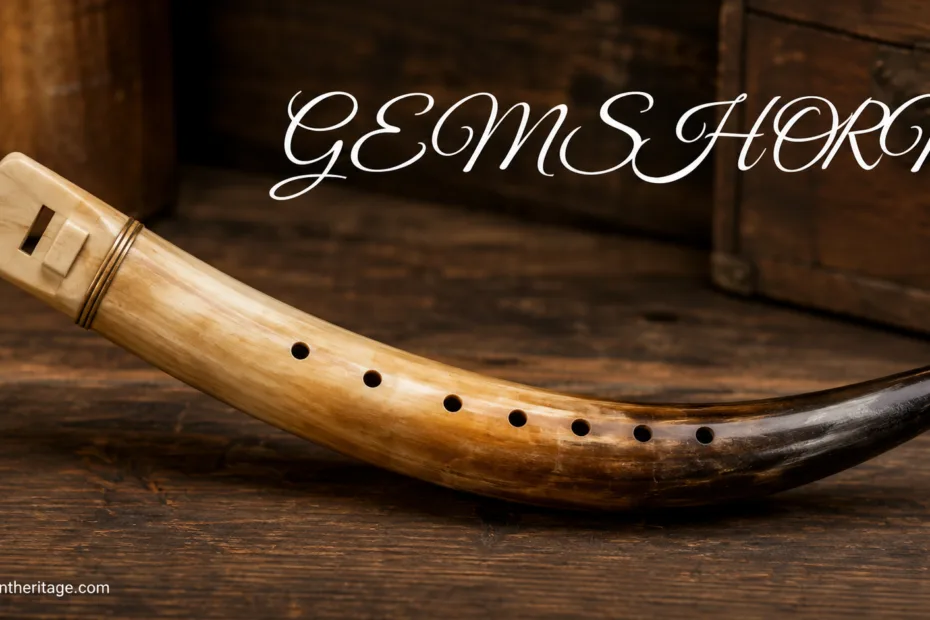
| Feature | Gemshorn detail | Why it matters |
|---|---|---|
| Instrument family | Wind instrument; listed in museum terminology under flutes and specifically as a gemshorn.Reference-1✅ | It looks like a horn, but it behaves more like a duct flute. |
| Main material | Usually animal horn, often cattle, ox, goat, or chamois horn depending on maker and region. | The natural curve and taper shape the tone chamber. |
| Sound type | Soft, rounded, breathy, and close to the ear; often compared with a quiet recorder and an ocarina. | Its voice is small, but very personal. It does not shout. |
| Construction | Closed horn body, windway or fipple, labium edge, finger holes, often one thumb hole on modern reconstructions. | The closed body gives the gemshorn its gentle covered sound. |
| Historical trace | A clear early image appears in Sebastian Virdung’s Musica Getutscht from 1511.Reference-2✅ | This makes it one of the best-known small horn flutes in early European instrument studies. |
| Modern examples | Some museum records describe twentieth-century gemshorns made from cow or animal horn with wooden or plaster blocks and seven finger holes.Reference-3✅ | Modern players mostly meet the gemshorn through careful reconstructions rather than untouched medieval survivors. |
The gemshorn is a small medieval flute made from horn, and that simple sentence already feels a little strange. A flute is usually imagined as a straight tube of wood, bone, metal, cane, or plastic. The gemshorn is different. It keeps the curve of the animal horn, uses that hollow body as a sound chamber, and turns a plain natural material into a soft musical voice. It is not loud. It is not flashy. Its charm sits in the middle of craft, breath, and warm horn resonance.
A good gemshorn sounds as if someone placed a recorder inside a small clay ocarina and wrapped the result in polished horn. The tone is round, slightly veiled, and close. You do not play it to fill a large hall. You play it because the sound has a handmade edge, like a wooden spoon, a linen bag, or a candle flame. Plain things can have a voice.
What Is a Gemshorn? 🎵
A gemshorn is a duct flute made from animal horn. The player blows into a shaped mouthpiece, the air is guided through a narrow windway, and the stream meets a sharp edge called the labium. That edge splits the air and starts the vibration. The horn body then colors the sound.
The name comes from German: Gemse means chamois, and Horn means horn. Early descriptions connect the instrument with chamois or ox horn, though modern makers may use cattle, goat, or other suitable horn. The exact animal matters less than the shape, thickness, inner cavity, and the way the maker closes and voices the instrument.
Here is the useful way to think about it: the gemshorn is not a horn in the brass-instrument sense. It has no buzzing lips, no bell flare designed for projection, and no trumpet-like attack. It is a horn-shaped flute. That single difference clears up most confusion.
Simple picture: a gemshorn is closer to a recorder than to a hunting horn, but its closed horn body gives it a softer, more enclosed sound than a recorder. Think of a whisper with pitch.
The body is the instrument
Many flutes begin as a tube. A gemshorn begins as a horn. That changes everything. The bore is naturally tapered, often sharply so, and the wide end is stopped. The outer curve is not decoration; it is part of the object’s identity. A maker does not force the material into a perfect factory shape. The maker listens to it, trims it, drills it, blocks it, and brings it into tune as far as the horn will allow.
This is why two gemshorns may feel like cousins rather than twins. One may sound mellow and woolly. Another may speak faster, with a clearer edge. A small soprano gemshorn can feel birdlike. A lower one can feel calm and almost vocal. The material memory of horn stays in the sound.
The Sound: Soft, Hollow, and Close to the Ear 🎶
The gemshorn’s tone is often described as sweet, delicate, and covered. That last word matters. A covered sound feels shaded rather than bright. It does not sparkle like a modern metal flute. It does not cut through a room like a shawm. It sits low in the texture, almost like a small voice coming from behind a wooden door.
Players often compare it with the recorder and the ocarina. The recorder comparison comes from the fipple mouthpiece and the familiar finger-hole logic. The ocarina comparison comes from the closed vessel-like behavior: the sound has a rounded center and less of the long, open-tube brightness found in many flutes.
- Attack: gentle and clean when the windway is well made.
- Volume: usually quiet, best for small rooms or close listening.
- Tone color: warm, breathy, and slightly nasal in a pleasant way.
- Range: limited compared with many modern flutes, though reconstructions vary.
- Blend: good with soft voices, small strings, harp, psaltery, portative organ, and quiet recorders.
The gemshorn does not reward heavy blowing. Push too hard and the tone can lose its center. It wants measured air. Steady breath, light fingers, patient ears. That is the whole mood of the instrument.
Why the sound feels so enclosed
A gemshorn is stopped at the wide end, so the air does not travel through an open tube in the same way it does in a recorder. The horn acts more like a small sound vessel. The result is rounded resonance, short projection, and a tone that feels compact rather than long and piercing.
How a Gemshorn Is Made 🌿
The making of a gemshorn sits somewhere between instrument building and careful problem-solving. Horn is beautiful, but it is not an obedient material. It varies in wall thickness, curve, density, taper, and inner shape. That means a maker must work with the horn, not against it.
1. Choosing the horn
The horn needs enough length for the intended pitch, enough inner volume for a stable tone, and a curve that will sit comfortably in the player’s hands. A tiny horn may become a high instrument. A larger horn may become an alto or tenor voice. The shape sets limits before the first hole is drilled.
2. Cleaning and preparing the cavity
The horn is cleaned, hollowed where needed, smoothed, and sometimes softened or polished. Natural horn can smell strong during preparation, and it must be handled with patience. A clean inner cavity helps the air speak clearly. A rough or uneven cavity can make the sound unstable.
3. Making the plug and windway
The wide end is closed with a block or filling material. Modern museum descriptions include examples with wooden or plaster-like blocks, and this detail tells us something useful: the gemshorn is not just a hollow horn with holes. The block, windway, and voicing edge are the heart of the instrument. Without them, there is no flute tone.
4. Cutting the labium
The labium is the little edge where sound begins. Too blunt, and the tone is weak. Too sharp or badly placed, and the instrument may hiss or overreact. This small cut is like the mouth of the gemshorn. It decides whether the instrument speaks clearly or mumbles.
5. Drilling and tuning the holes
Finger holes are placed along the horn body. A thumb hole is common in many modern reconstructions. Hole size, distance, and undercutting all affect tuning. Since the bore is not a perfect cylinder, tuning can be fussy. Some notes may need cross-fingering, small breath changes, or a gentle shading of a hole.
Maker’s reality: a gemshorn is not tuned by theory alone. The horn has its own shape, and the maker has to listen. That is why handmade gemshorns can feel so individual.
History: A Small Horn Flute with a Thin Paper Trail
The gemshorn is usually discussed as a medieval and Renaissance European instrument, but its history has a quiet problem: horn does not survive as reliably as metal, fired clay, or some dense woods. Old horn can split, decay, delaminate, or simply disappear. So the history of the gemshorn is built from images, written references, organological comparison, later reconstructions, and surviving related traditions.
The most famous early reference is the illustration in Sebastian Virdung’s Musica Getutscht, printed in 1511. Iowa State University’s Musica Antiqua page also notes that the instrument had dropped from normal use by the middle of the sixteenth century, while the name survived in the organ stop called gemshorn.Reference-4✅
That timeline is short on paper, but not empty. It suggests an instrument with a practical life before it became an object of study. It may have belonged to pastoral music, domestic music, or small informal ensembles. Its soft tone fits that kind of setting. It feels made for rooms, courtyards, teaching, dancing at a gentle pace, or simply playing alone.
There is also a useful caution here. Modern gemshorns are often reconstructions. That does not make them fake. It means they are informed instruments: built from old images, descriptions, musical logic, craft knowledge, and comparison with other duct flutes. The old trail is narrow. The sound, though, is very real.
The organ stop that kept the name alive
In pipe organs, “Gemshorn” became the name of a stop with a tapered shape and a particular tone color. An organ stop is not the same object as the handheld gemshorn, but the shared name matters. It tells us that musicians remembered a certain kind of tone: narrow, tapered, somewhat flute-like, and gently colored. A name can carry a sound long after the original instrument becomes rare.
Why Horn Changes the Music
Horn is not just a decorative shell. It is hard, organic, slightly flexible compared with metal, and naturally tapered. It can be polished until it glows, but it keeps tiny irregularities inside. Those irregularities are not always a flaw. They help give the gemshorn its earthy softness.
A wooden recorder has a planned bore. A clay ocarina has a shaped chamber. A gemshorn begins with a living curve. That is why the instrument feels so tied to material culture. It belongs to the same family of ideas as bone flutes, reed pipes, shell trumpets, and carved whistles: sound made from what the maker had nearby.
For a musician, this changes the playing attitude. The gemshorn is not a machine for perfect volume and wide range. It is a small craft object with a voice. You meet it halfway.
Playing Technique: Breath, Holes, and Small Adjustments 🪈
Playing a gemshorn feels familiar if you have played recorder, tin whistle, or ocarina, but it has its own manners. The breath must be focused but not forceful. The fingers need to seal cleanly, especially because horn curves can place holes at slightly unusual angles. A careless leak can turn a clear note into a cloudy one.
Most players begin with simple scales and short modal melodies. That suits the instrument. Medieval-style melodies, early dance tunes, drone-based pieces, and soft ensemble lines all work well. Fast decorative playing is possible on good instruments, but the gemshorn usually speaks best when the music has room to breathe.
- Use a relaxed mouth and let the air enter the windway without biting the mouthpiece.
- Keep the breath stable; sudden pressure changes can bend the pitch more than expected.
- Cover the holes fully, especially on curved bodies where finger angle matters.
- Learn the strongest notes first, then add cross-fingered notes slowly.
- Listen for blend rather than volume. The gemshorn is a close-range instrument.
The gemshorn is forgiving in one way and strict in another. It does not demand athletic breath. Good. But it does ask for careful listening. Very careful.
Musical Uses: Where the Gemshorn Feels at Home
The gemshorn fits music that values color over force. It can carry a simple melody, double a soft vocal line, support a drone texture, or sit inside a small early-music ensemble. It also works beautifully for teaching historical sound worlds because the object itself is so easy to understand: horn, holes, breath, tone.
Good musical settings
- Small early-music groups
- Medieval dance arrangements
- Gentle Renaissance consort textures
- Solo modal melodies
- Educational demonstrations
- Quiet folk-inspired pieces
Natural musical partners
- Recorder
- Harp
- Psaltery
- Hurdy-gurdy played softly
- Portative organ
- Frame drum used lightly
Because the gemshorn is quiet, balance matters. Put it beside loud reeds or strong percussion and it may vanish. Put it beside harp, soft strings, and a small drum, and the horn flute color becomes easy to hear.
Similar Instruments and Easy Mix-Ups
The gemshorn sits near several other instruments, but it is not quite the same as any of them. It borrows the duct-flute idea from the recorder, the closed-chamber feeling from the ocarina, and the curved animal material from horn instruments. That mix is the point.
| Instrument | How it is similar | Main difference | Sound impression |
|---|---|---|---|
| Recorder | Both use a fipple or duct-style mouthpiece and finger holes. | The recorder has a more regular tube; the gemshorn has a closed, curved horn body. | Recorder: clearer and more direct. Gemshorn: softer and more covered. |
| Ocarina | Both can have a rounded, enclosed tone. | The ocarina is usually a vessel flute made from clay or similar material; the gemshorn is made from horn. | Ocarina-like warmth, but with a horn-made texture. |
| Crumhorn | Both are linked with early European music and curved shapes. | The crumhorn is a capped reed instrument; the gemshorn is a flute. | Crumhorn is reedy and buzzing; gemshorn is smooth and breathy. |
| Cornett | Both may appear in early music discussions and can be curved. | The cornett is lip-blown with finger holes; the gemshorn is windway-blown. | Cornett is flexible and bright; gemshorn is gentle and compact. |
| Animal horn whistle | Both may use horn as the main material. | A gemshorn is usually more carefully voiced and fingered for melody. | Less signal-like, more musical and melodic. |
Gemshorn Sizes, Ranges, and Ensemble Roles
Modern makers often build gemshorns in different sizes so they can play together as a small consort. You may see soprano, alto, tenor, or bass-style naming, although exact pitch systems vary by maker. This is one reason buyers and players should read the maker’s fingering chart carefully. A gemshorn is not always standardized like a school recorder.
The smaller instruments speak more quickly and sound brighter. Larger gemshorns have a slower, darker tone and may feel especially calm. A low gemshorn can be lovely, but it needs room for the fingers and a well-made windway. The bigger the horn, the more the maker’s choices matter.
- Soprano-style gemshorn
- Small, bright, and useful for clear melody lines.
- Alto-style gemshorn
- A balanced middle voice, often warm and easy to blend.
- Tenor-style gemshorn
- Lower, rounder, and more relaxed in tone.
- Bass-style gemshorn
- Less common, often more demanding to build and play well.
What Makes a Good Gemshorn?
A good gemshorn does not need to be fancy. It needs to speak clearly, tune honestly, and feel comfortable in the hand. The mouthpiece should guide air cleanly. The labium should respond without hissing. The holes should be placed where real fingers can reach them. Sounds obvious. It is not always easy.
- Clear response: notes should start without too much breath pressure.
- Stable tuning: the scale should make musical sense across the instrument’s range.
- Comfortable hole layout: the natural horn curve should not force painful hand positions.
- Smooth finish: the mouthpiece and finger holes should feel clean, not sharp.
- Balanced tone: the lowest and highest notes should still sound like the same instrument.
Some players enjoy rustic instruments with a little unevenness. That can be part of the gemshorn’s charm. But rustic should not mean careless. Handmade and hard to control are not the same thing.
Care, Handling, and Storage
Horn is a natural material, so it needs basic care. Keep a gemshorn away from harsh heat, damp storage, and sudden dryness. Do not leave it on a sunny windowsill or near a heater. After playing, let it air gently before storing it. Moisture is normal in wind instruments, but trapped moisture is not a friend.
The mouthpiece should be kept clean with careful, dry wiping. Avoid strong chemicals unless the maker specifically recommends them. Horn can be polished, but too much polishing near the mouthpiece or labium can cause problems. The voicing area is small and sensitive. Treat it like the edge of a reed or the lip of a flute: small damage can make a big difference.
Care note: if a gemshorn stops speaking well, check for moisture, blocked windway, or finger-hole leaks before assuming it is badly made. Small things can silence small instruments.
Why the Gemshorn Still Attracts Players
The gemshorn has a modest voice, but that is exactly why people remember it. It gives players a way to touch early instrument craft without needing a huge setup. One horn, a few holes, a shaped windway, and a quiet room. That is enough.
It also reminds us that music history is not only about grand instruments and famous stages. Some instruments were small, local, practical, and intimate. The gemshorn belongs to that softer side of musical culture. It is a pocket-sized sound object with a story carved into its material.
For a modern player, the appeal is simple: the gemshorn feels old without feeling distant. Its shape is easy to read. Its sound is easy to like. And when it speaks well, the tone has that lovely handmade quality—slightly uneven, gently warm, and alive.
Gemshorn FAQ
Is the gemshorn really a flute?
Yes. The gemshorn is best understood as a duct flute made from horn. It may look like a horn, but it does not use buzzing lips like a brass or signal horn.
What does a gemshorn sound like?
It sounds soft, rounded, breathy, and slightly covered. Many listeners hear a blend of recorder and ocarina, but the horn body gives it its own warm, enclosed tone.
Was the gemshorn used in medieval music?
It is commonly connected with medieval and early Renaissance music. A well-known early visual reference appears in Sebastian Virdung’s 1511 Musica Getutscht, and modern knowledge also comes from reconstruction and instrument study.
Is a gemshorn the same as an ocarina?
No. They share a rounded, enclosed sound character, but an ocarina is usually a vessel flute made from clay or similar material. A gemshorn is made from animal horn and keeps the horn’s natural curve.
Is the gemshorn hard to play?
The basic blowing method is not difficult, especially for someone who has played recorder. The harder part is playing in tune, sealing the holes cleanly, and using gentle breath instead of forcing the sound.
What kind of music suits the gemshorn?
It suits soft early-music textures, modal melodies, small consorts, quiet folk-style arrangements, and educational demonstrations. It blends best with instruments that do not overpower it.
Are modern gemshorns exact copies of medieval instruments?
Usually not exact copies. Many are informed reconstructions based on early images, descriptions, craft knowledge, and the behavior of related duct flutes. That is normal for instruments with few surviving early examples.
