
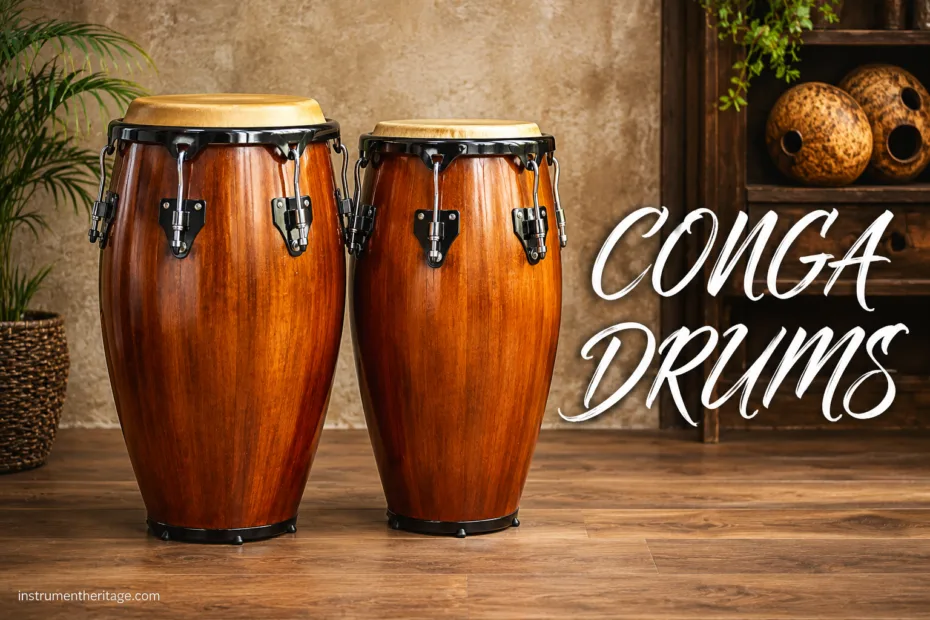
A conga drum can sound round and warm one moment, then cut through an ensemble with a dry slap the next. That range comes from a simple-looking design: one skin stretched over a tall shell, played directly with the hands. The instrument’s real identity, though, is tied to Afro-Cuban rhythm, community dance, skilled drum making, and the conversational logic of percussion parts that fit together rather than compete for space.
The common English name is conga, while Cuban musicians often use tumbadora. The word can also refer to a carnival-linked rhythm and dance, so context matters. A player may perform on one drum, but two or three drums are common in stage music, and larger setups allow one percussionist to shape bass movement, open tones, muted notes, and improvised phrases across several pitches.
🪘 What Makes a Conga a Conga?
The conga is a tall, single-headed drum with no lower membrane. Air moves through the open base as the head vibrates, giving the instrument more projection and tonal bloom than its narrow body might suggest. Its shell is usually wider around the upper-middle area and tapers toward the floor. That shape helps support a low central bass tone while keeping edge strokes clear.
In instrument classification, the conga belongs to the membranophones: sound begins with a stretched membrane. A museum entry from Grinnell College describes congas as single-head drums linked with Afro-Cuban and Afro-Caribbean dance music and notes their use in paired or three-drum sets. The same record places wooden-shell forms in Cuba before 1900 and identifies rumba as an early setting for the instrument. Reference-1✅
The names are flexible
Drum-size labels are useful but not standardized. Makers and players may use the same name for slightly different diameters. A common modern sequence runs from high to low:
- Requinto: a very small, bright voice used for sharp lead phrases and added color.
- Quinto: the familiar high drum, closely tied to improvisation in rumba.
- Conga, segundo, or tres dos: a middle register that carries many standard patterns.
- Tumba or salidor: a larger drum with a deeper open tone and broad bass response.
- Supertumba: an extra-low modern size used when a wide pitch spread is wanted.
Tumbadora can describe the instrument generally, while tumba often points to a larger size. In rumba, names may describe musical function rather than factory diameter. Two drums marked “conga” may therefore differ noticeably.
Useful distinction: Conga may mean the drum, a rhythm, or a dance-related form. Tumbadora is the clearer Cuban instrument name when the surrounding context could cause confusion.
🌿 Afro-Cuban Roots and the Rise of the Modern Drum
The conga developed in Cuba through African-derived drum knowledge, local materials, urban craft, and participatory music. It does not descend from one exact African model. Several Central and West African musical streams helped shape its contrasting pitches, layered patterns, timelines, and improvising roles.
Rumba offered a fertile home for that design. In its community forms, rumba joins singing, handclaps, dance, and percussion in a tightly responsive exchange. The drums do not merely mark beats. One part steadies the cycle, another fills the middle, and the lead drum follows movement, phrasing, and changes in energy. The Smithsonian’s Latin jazz glossary defines rumba as a Cuban secular form involving song, dance, and varied percussion, and it identifies the quinto as the highest drum in a three-drum rumba set. Reference-2✅
From local drum to professional instrument
Early conga-type drums could use nailed heads or other fixed mounting methods. Those systems produced a direct, earthy voice, but tuning was limited. Metal hoops and adjustable tension rods changed the instrument’s working life. A player could raise or lower pitch, balance several drums, replace a head more predictably, and prepare the set for recording studios or touring stages.
By the middle of the twentieth century, makers were refining shell profiles, rims, lug placement, and hardware strength. The Metropolitan Museum of Art notes that the modern form grew from earlier Afro-Cuban instruments and that professional players commonly use two- or three-drum sets. Its Jay Bereck set also shows how New York became a major center for Latin music and specialist percussion craft. Reference-3✅
Builders also had to make shells that stayed round, bearing edges that supported clean vibration, comfortable hoops, and hardware able to hold high tension. Modern wooden congas still carry traces of barrel making in their vertical staves.
Conga in jazz, mambo, and salsa
As Cuban musicians worked in New York, the conga entered new ensemble sizes and new acoustic situations. Chano Pozo’s work with Dizzy Gillespie in 1947 is one of the clearest meeting points between Afro-Cuban percussion and bebop-era jazz. Their recording of “Manteca” placed conga language inside a large jazz orchestra without turning the drum into decoration. The Library of Congress describes Latin jazz as a meeting of jazz improvisation and Cuban rhythm, with congas, timbales, and bongos forming a central percussion layer. Reference-4✅
Mongo Santamaría, Candido Camero, Carlos “Patato” Valdés, Armando Peraza, Tata Güines, and later Giovanni Hidalgo each expanded what listeners expected from the instrument. Some brought folkloric phrasing into jazz settings. Others developed multi-drum independence, fast melodic runs, refined slaps, and solo language suited to microphones and concert halls. Their approaches differ, yet all treat rhythm as speech: accents have grammar, silence has weight, and repetition can shift its meaning through touch.
🪵 Shell, Skin, Bearing Edge, and Hardware
Staved wooden shells
Many wooden congas are made from narrow vertical pieces called staves. Their edges are cut at matching angles, glued into a many-sided tube, then shaped into a smooth curve. The builder may add internal reinforcement rings near the top or base. After sanding, the shell can be sealed with lacquer, oil, or another protective finish.
Wood choice affects weight, stiffness, appearance, and response, though shell geometry and head selection matter just as much. Ash can offer a clear attack and lively projection. Oak-family woods are common because they are strong and readily shaped into staves. Denser shells often feel focused; lighter shells may respond quickly under softer hands. These are tendencies, not fixed rules (two drums made from the same species can still sound quite different).
Fiberglass and molded bodies
Fiberglass congas offer stability, projection, and resistance to seasonal movement. Their tone is often bright and direct, though head type, tuning, rim design, and touch still shape the final sound.
Natural and synthetic heads
A natural hide head is never perfectly uniform. Thickness changes across the surface, and those small differences contribute texture. Thicker hide usually supports a strong low register and a rounded open tone, while thinner hide can speak quickly and produce an easier high slap. Cowhide is common. Buffalo hide is also used, especially where a dense, durable head is wanted.
Synthetic heads trade some of that organic variation for stability. They are less affected by damp air and temperature changes, making them useful under stage lights or in shifting weather. Some players prefer natural hide for its feel under the fingers; others value the repeatability of a manufactured membrane. Neither choice is automatically superior.
Why the bearing edge matters
The bearing edge is the narrow upper rim where the head meets the shell. A clean, even edge lets the skin seat properly and vibrate without unwanted choking. Its contour influences contact area: a sharper profile can emphasize attack and sensitivity, while a rounder profile may spread pressure and soften the initial bite. Poorly shaped or damaged edges can make tuning uneven no matter how carefully the lugs are adjusted.
✋ The Sound Vocabulary of the Hands
Conga technique is not a collection of random hits. Each stroke places a different part of the hand on a different zone of the head, then controls how quickly contact is released. A small change in finger angle can turn a full note into a dry one. Good tone comes from relaxed motion and clean rebound, not from forcing the drum.
Open tone
The fingers strike near the edge and leave the head freely. The result is a clear, ringing pitch with a visible tonal center.
Slap
A fast, controlled stroke creates a bright burst rich in upper frequencies. Open and muted slaps serve different musical purposes.
Bass tone
The full hand lands near the center and rebounds. On a well-tuned drum, the note is low, soft-edged, and surprisingly deep.
Muffled tone
One hand or part of the striking hand stays in contact with the skin, shortening the vibration into a compact note.
Heel and toe motions create the quieter engine behind many patterns. The heel is the fleshy base of the palm; the toe is the finger area. Alternating them produces soft pulses and prepares the hand for louder notes. These touches may seem minor when heard alone, yet they give a pattern motion between the accents. The spaces become playable.
Players also change pitch by pressing the head with a wrist, palm, or elbow while striking with the other hand. Pressure tightens part of the vibrating surface, bending the note upward. On multiple drums, open tones can be arranged into short melodic cells. This is one reason a tuned conga set can function like a small drum choir rather than a single repeated voice.
How the shell and head shape the tone
- Larger diameter: generally lowers the main pitch and broadens the bass response.
- Higher head tension: raises pitch, sharpens articulation, and can make slaps more immediate.
- Thicker hide: often adds body and durability but may need more energy to speak.
- Shell stiffness: influences projection, sustain, and how much energy remains in the head.
- Playing height: lifting the open base from the floor lets air move more freely and prevents the low tone from being blocked.
🎶 Conga Parts Inside Afro-Cuban Music
The conga is often heard through interlocking rhythm. A part may look sparse on paper because it is designed to sit beside clave, bell, bongo, timbales, bass, piano, voices, and dance. Filling every gap can blur the groove. Experienced playing leaves room for the other parts to finish the sentence.
Rumba: support, conversation, and lead voice
Traditional rumba drum roles vary by style and locality, but a common three-drum idea includes a low supporting drum, a middle drum, and the higher quinto. The lower parts establish recurring phrases. The quinto responds more freely, marking dance gestures, vocal cues, and structural changes. Its improvisation is not detached from the cycle; it depends on knowing exactly where the cycle sits.
In guaguancó, yambú, and columbia, rhythmic character changes with tempo, dance, and phrase shape. The drum set may also be replaced or joined by box-like instruments, sticks, claves, or other percussion. What remains is the social design of the music: repeated parts create a shared floor, and improvisation moves across it.
Tumbao in son-based music
Tumbao is a repeating conga pattern used in many Cuban-derived popular styles. A basic form often combines soft heel-toe motion with open tones near the end of the measure. The recognizable open notes may be the part listeners notice first, yet the quiet strokes keep the pattern balanced and connected to the pulse.
In mambo, salsa, and related ensemble music, one player may use two congas tuned apart. The lower drum adds weight; the higher drum clarifies accents and variations. During a song’s more open montuno section, the player may add fills, answer the singer, follow horn figures, or move toward a bell pattern. The groove stays grounded. Flash only works when the time remains clear.
Clave awareness
Clave is both a five-stroke timeline and a broader sense of rhythmic alignment. Conga parts do not always copy its notes, but their accents relate to its direction. A phrase that feels natural in one clave orientation can feel awkward when turned around. Players learn this relationship by singing parts, clapping timelines, listening to bass and piano patterns, and noticing where musical phrases resolve.
Rhythmic detail: a tumbao is not simply “four beats on a drum.” Its character comes from touch, placement, tone contrast, and relation to clave. Two players can strike the same written notes and produce very different motion.
🔎 Conga, Bongo, Batá, Djembe, and Related Drums
Several hand drums may share skin heads and wooden shells, but their construction and musical grammar are not interchangeable. The table below places the conga beside instruments that listeners often compare with it.
| Instrument | Structure | Typical playing role | Main contrast with conga |
|---|---|---|---|
| Bongo | Two small connected single-headed drums | Martillo patterns, improvisation, and bell changes in son and salsa | Higher, shorter, and more compact in tone |
| Batá | Hourglass-shaped, double-headed drums played as a set of three | Interlocking speech-like parts in Yoruba-derived Cuban traditions | Two heads per drum and a different playing system |
| Djembe | Goblet-shaped West African drum with one head and rope or mechanical tuning | Bass, tone, and slap patterns in ensemble and solo roles | Wider pitch sweep from one head and a different cultural lineage |
| Bomba barrel drum | Puerto Rican barrel-form drum, usually single-headed | Dialogue with dancers in bomba performance | Distinct repertoire, tuning traditions, and dance relationship |
| Cajón | Wooden box idiophone struck on a thin faceplate | Bass and snare-like textures in several popular and folk settings | No skin membrane; sound comes from vibrating wood |
| Ashiko | Tapered single-headed hand drum | Hand-drum ensemble patterns and accompaniment | More conical body and different regional histories |
The djembe and conga both produce bass, open, and slap families of sound, yet the hand positions, tuning response, repertoire, and ensemble expectations differ. Bongos belong closer to the conga within Cuban popular music, but their smaller heads encourage fingertip articulation and a brighter, more agile voice. Batá drums stand apart through their double-headed construction and tightly organized three-drum language.
🔧 Tuning, Setup, and Long-Term Care
A conga head should rise evenly as the nuts are tightened. Players usually move around the drum in small steps rather than pulling one lug far ahead of the others. The goal is equal tension near every lug and a clean pitch around the edge. If one zone sounds noticeably lower, the nearest hardware may need a small adjustment.
- Seat the head and hoop so the rim sits level around the shell.
- Tighten each nut by a small, similar amount, moving across the drum rather than around it in one direction.
- Check pitch near each lug using light open taps.
- Play the drum briefly, then recheck after the head settles.
- Release some tension for long storage when the instrument will not be played for an extended period.
Natural hide reacts to humidity. Damp air can lower pitch and soften attack; dry heat can raise tension. Sudden heating is risky because it can dry the skin unevenly. A stable room, moderate temperature, and gradual adjustment are kinder to both head and shell.
Threads should remain clean, and a small amount of suitable lubricant can prevent rough turning (kept away from the head and finished wood). Loose plates, bent hooks, distorted hoops, and opening shell seams deserve early attention.
Playing comfort matters too. The hoop should sit low enough that the hand reaches the head without repeatedly striking metal. The drum should be high enough for relaxed wrists, whether the player sits or uses a stand. A blocked base weakens the low note, so small rubber feet or a stand help the shell breathe.
Questions About Conga Drums
Is tumbadora the same instrument as a conga?
Yes. Tumbadora is the standard Cuban name for the tall single-headed hand drum widely called a conga in English. Size labels such as quinto and tumba describe members of the family or their roles.
Why are several conga drums tuned to different pitches?
Different pitches let one player separate bass support, main pattern tones, accents, and improvised phrases. The tuning is usually relative rather than tied to one universal set of notes, though some players match drums to musical intervals or song harmony.
What is the difference between a quinto and a tumba?
A quinto is smaller and higher in pitch,, often taking a lead or improvising role in rumba. A tumba is larger and lower, supplying a broad open tone and deeper support. Exact diameters vary among builders.
Can one conga drum be played by itself?
Yes. One drum can carry accompaniment patterns, tonal studies, solo phrases, or classroom parts. Multiple drums widen the pitch range, but musical control begins with clear sounds and steady time on a single instrument.
Are conga heads made only from animal hide?
No. Natural cowhide and buffalo hide are common, while synthetic heads offer more stable tuning in changing humidity. The two types differ in feel, overtone texture, and response under the hands.
Why does a conga sound weak when placed flat on the floor?
The shell is open at the bottom. When that opening is blocked, air movement is restricted and the bass response loses depth. Feet, a stand, or a slight tilt leaves room for the sound to escape.
Is the conga mainly a salsa instrument?
No. Salsa made the conga widely familiar, but the instrument is also tied to Cuban rumba and appears in son-based music, mambo, Latin jazz, timba, popular recordings, percussion ensembles, and solo performance.
