
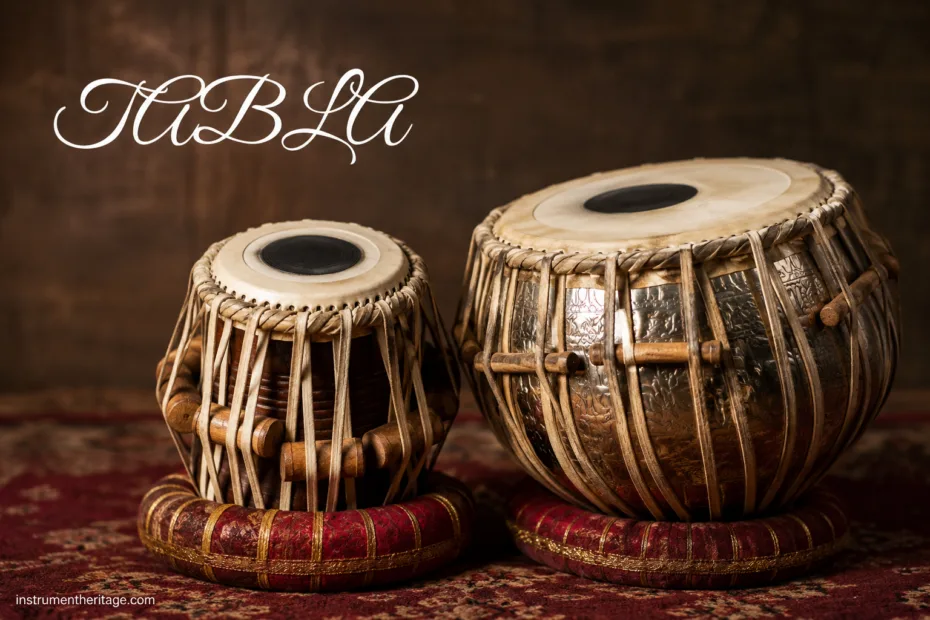
Tabla is often described as a pair of Indian hand drums, yet that label hides how carefully the instruments divide their work. The smaller wooden drum carries a clear, tuned voice. The broader drum answers with bass, bend, and motion. Together they can mark a pulse, shadow a melody, support dance, or unfold as a solo language. Every stroke has a shape; a small change in finger position can turn a dry tap into a ringing note.
| Feature | Dayan | Bayan | How the pair works |
|---|---|---|---|
| Usual playing side | Right hand for most players | Left hand for most players | The hands trade separate sounds and combine them into compound strokes. |
| Body form | Small, upright, cylindrical or slightly tapered wooden shell | Broader kettle-shaped shell, often metal and sometimes clay | Treble clarity meets rounded bass. |
| Common names | Dayan, dahina, tabla | Bayan, baya, duggi, dagga | Regional usage and teaching lineages affect the terms heard in practice. |
| Pitch role | Tuned to a stable note related to the soloist’s tonic or another useful pitch | Lower and less fixed; pitch can be bent while the head vibrates | One drum anchors pitch while the other shapes bass movement. |
| Main materials | Hardwood shell, hide head, leather braces, wooden tuning blocks | Copper, brass, steel, aluminium, or clay shell with a hide head | Material changes affect weight, projection, decay, and playing feel. |
| Black loading | Usually centred | Usually set away from the centre | The loading helps produce the tabla pair’s recognisable tuned tone. |
| Musical jobs | Articulation, pitch, bright resonance, fast finger patterns | Bass accents, glides, pressure bends, low punctuation | The pair can state a repeating theka or develop a full solo. |
🥁 Two Drums, Two Different Voices
The name tabla is commonly used for the full pair. In stricter instrument terminology, it may refer to the smaller right-hand drum, while the larger left-hand drum is the bayan or bhaya. The Metropolitan Museum of Art describes this distinction directly and classifies the pair as single-headed membranophones. Reference-1✅
The dayan: a tuned wooden drum
The dayan is usually carved from dense wood. Sheesham is widely associated with tabla making, while neem, mango, jackwood, and other suitable timbers are also used. Makers hollow the body while leaving enough strength around the rim. The outside may be plain, ribbed, polished, painted, or decorated.
A smaller dayan head usually reaches higher notes; a wider head tends to sit lower. Players commonly tune it near the tonic of a singer or instrumentalist, depending on register and the drum available. Its voice includes a clear centre, a bright rim, dry closed strokes, and long open notes.
The bayan: bass that can move
The bayan has a wider mouth and rounded shell. Copper is familiar, but brass, steel, aluminium, and clay versions are also found. Metal bodies often project strongly and travel well. Clay can sound warm but needs careful handling.
The left hand does more than strike. By resting its heel on the skin and changing pressure, the player can pull the bass pitch downward or let it rise. A single stroke may swell, dip, and settle rather than behaving like a fixed thump.
The pair is asymmetrical by design. The dayan supplies a more stable pitch centre; the bayan supplies low-frequency shape. Their difference is the reason the instrument can sound both exact and elastic.
The Drumhead Is a Layered Piece of Craft
A tabla head, often called the pudi or puri, is a fitted assembly with several working zones. Its layered design supports sharp attacks, muted consonants, singing tones, and bass colour on a compact surface.
Kinar or chat
The outer ring is firm and relatively dry. Rim strokes made here can sound crisp and cutting, especially when another finger lightly controls vibration.
Maidan or lav
The open field between the rim and black loading carries many resonant strokes. Small shifts in the strike point change brightness and sustain.
Syahi
The dark loaded area adds mass to the membrane. On the dayan it is generally centred; on the bayan it is commonly offset to support bass character and pressure bending.
Gajara and braces
The braided rim and leather straps hold the head to the body. On the dayan, wooden blocks called gatta sit beneath the straps and help with tuning tension.
How the head is built
- Selected hide is cleaned, cut, and prepared in pieces of suitable thickness.
- The main membrane and outer ring are joined into a fitted head assembly.
- The head is attached to a braided hoop that spreads tension around the rim.
- The syahi is formed in repeated thin applications, with drying and shaping between stages.
- The completed head is mounted, stretched, checked, and adjusted until its response suits the shell.
The black area is sometimes called paint or a dot. It is neither. Workshop recipes vary, but the maker creates a graded mass, commonly using starch-based paste with finely prepared mineral or iron-rich material. Thickness, diameter, profile, and placement all matter. Too much can choke response; too little may leave the tone weak or unstable.
🔊 Why Tabla Can Sound Pitched
A plain circular membrane produces vibration modes that do not line up like the harmonic series of a string. Tabla makers change this by loading the head. The uneven mass shifts several modes into relationships the ear hears as more pitch-focused. Research on Indian drums has modelled how the non-uniform membrane can produce low modes approaching harmonic spacing. Reference-2✅
The attack remains percussive, and every stroke carries many frequencies. Yet an open dayan stroke such as tun or tin has a recognisable pitch centre. The ear catches both drum and note.
- Attack
- The first burst created when finger meets skin; its hardness and angle affect brightness.
- Sustain
- The time a stroke continues after impact. Open strokes ring; closed strokes stop quickly.
- Pitch focus
- The sense that one frequency area stands out strongly enough to tune and recognise.
- Timbre
- The colour of the stroke, shaped by strike position, pressure, membrane zone, shell, and room.
- Coupling
- The way the vibrating head excites the air inside the shell and sends sound outward.
The player becomes part of the acoustic system. Fingers may rebound, remain in contact, or damp another zone. On the bayan, the heel changes tension while the head is ringing. Tabla tone comes from contact, release, and controlled pressure, not impact alone.
Tuning the Pair
The dayan is tuned around its rim. A small hammer taps the braided ring or wooden blocks, changing local tension. The player listens around the circumference and evens out sharp or flat spots. Reaching the note is only part of the job; the head should respond evenly.
- Coarse adjustment: moving the gatta changes the pull of the vertical leather straps.
- Fine adjustment: tapping the upper or lower rim area raises or lowers tension in a smaller zone.
- Pitch matching: the open dayan tone is compared with the tonic, dominant, or another chosen reference.
- Final check: repeated strokes around the head reveal uneven tension that one centre strike may hide.
The bayan is not usually tuned to the same precise note. Its rim still needs balanced tension because a loose area can weaken bass response. Many players keep dayans in different pitch ranges.
Weather changes the instrument
Hide reacts to moisture and temperature. Damp air may lower pitch and soften articulation; dry conditions can make the head tighter. Players often let the drums settle before final tuning (especially after moving between cool rooms and humid outdoor air).
🗣️ Bols: A Spoken Vocabulary for the Hands
Tabla strokes are taught through spoken syllables called bols. They name gestures, tone families, and combinations, allowing music to be remembered without relying only on staff notation. A teacher may recite a phrase, shape its accents by voice, then transfer it to the drums.
| Bol | Typical drum use | General sound character | Technical idea |
|---|---|---|---|
| Na or Ta | Dayan | Bright, rim-centred, ringing or lightly controlled | Index finger strikes near the outer playing zone while other fingers manage resonance. |
| Tin | Dayan | Clear, pitched, open | A carefully placed finger stroke brings out the tuned voice of the head. |
| Tun | Dayan | Open and full | The hand leaves the membrane freely so the head can ring. |
| Te or Ti | Dayan | Short, dry, central | Contact is controlled to limit sustain and sharpen rhythmic detail. |
| Ge or Ghe | Bayan | Open bass, often bendable | The fingers activate the head while heel pressure shapes pitch movement. |
| Ke or Ka | Bayan | Closed bass consonant | The hand damps the head so the sound ends quickly. |
| Dha | Both drums | Full compound stroke | A dayan stroke and bayan stroke sound together. |
| Dhin | Both drums | Resonant compound tone | Open elements on both sides combine into one broad syllable. |
Names and techniques vary between teachers and lineages. The same written bol may be voiced differently, and two similar sounds can require distinct finger actions. A stroke inside a fast phrase may also be lighter than the same bol played slowly.
Smithsonian Folkways preserves an instructional recording in which Ustad Keramatullah Khan presents tabla basics across forty-two lessons, showing how strongly oral recitation, repeated hand movement, and listening are tied together in tabla study. Reference-3✅
Tala, Theka, and the Shape of Time
Tabla does not simply count beats. Hindustani rhythm is organised through tala: repeating cycles with named sections and a returning first beat called sam. The tabla often presents a recognisable theka, making the cycle audible while leaving room for melodic phrasing.
In a sixteen-beat cycle such as tintal, the beats are grouped 4 + 4 + 4 + 4. The third group begins with khali, a lighter “empty” division often shown by a wave during counting. The cycle still moves forward, but its weight changes.
A skilled accompanist keeps the cycle readable without making every beat heavy. During vocal music, tabla may sit beneath a long line, then clarify the approach to sam. In instrumental music, it may answer rapid passages. With Kathak, footwork and drum phrases meet in rhythmic dialogue.
Common rhythmic ideas
- Lay: the underlying tempo
- Matra: one beat of the cycle
- Vibhag: a section within the cycle
- Sam: the first beat and main point of return
- Khali: a lighter division marked without a clap
- Theka: the identifying drum pattern of a tala
- Tihai: a phrase repeated three times to reach a chosen point
- Layakari: rhythmic play against or within the pulse
The Tabla’s Historical Path
The precise origin of tabla remains debated. Stories that credit one named inventor are popular, but firm documentary proof is limited. What can be said more safely is that the recognisable paired instrument developed within North Indian musical life and became well established during the eighteenth and nineteenth centuries. Museum records also show that nineteenth-century tabla and bayan could be closer in size than many present-day sets. Reference-4✅
Its rise belongs beside the growth of khayal singing, Kathak, and the expanding roles of sitar, sarod, and sarangi. The compact pair offered clarity at soft dynamics, followed subtle vocal phrasing, and carried enough vocabulary for solo performance.
The tradition grew through close teacher–student transmission. Compositions were memorised, recited, corrected, and polished. Musical circles developed recognisable approaches to touch, fingering, tone, and repertoire; these streams became known as gharanas.
Gharanas and Solo Repertoire
Widely named tabla gharanas include Delhi, Ajrara, Lucknow, Farrukhabad, Benares, and Punjab. They are not rigid boxes; musicians learn across lineages and repertoire travels. Gharana identity may still be heard in stroke production, phrase shape, tonal balance, and inherited compositions.
Peshkar
An opening form that develops gradually through variation. It often reveals touch, tone, pacing, and control before denser material arrives.
Kayda
A theme governed by a defined bol structure, followed by variations that respect the material of that theme.
Rela
A flowing, often rapid form whose repeated stroke streams can create the impression of a rolling current.
Tukra and chakradar
Set pieces shaped for clear arrival. A chakradar uses a threefold design, often with another repeated figure nested inside it.
Gat
A composed phrase valued for contour, sound pattern, and rhythmic character. Many gats carry a strongly recognisable sonic profile.
Tihai
A phrase arranged in three statements so its final point lands on sam or another intended beat.
A tabla solo is usually supported by a melodic instrument repeating a short phrase called lehara or nagma. That loop keeps the tala and tonal setting present while the drummer develops longer rhythmic forms. The solo is therefore not rhythm floating without reference. It is rhythm measured against a returning melodic line.
Where Tabla Is Heard
Tabla is linked with Hindustani vocal and instrumental music, yet its use is wider. It accompanies khayal, thumri, ghazal, bhajan, kirtan, Kathak, regional song, film music, and cross-genre work. Its articulation can sit beside strings, keyboards, drum kit, electronic textures, and other percussion.
The instrument changes with each setting. A vocalist needs room to breathe. Sitar or sarod may invite long exchanges. Dance calls for patterns that meet footwork. A close studio microphone reveals tiny finger noises and long decays, often favouring a lighter touch.
Accompaniment is a listening art
The accompanist watches melodic shape, tempo, gesture, and the approach to sam. Good support is not constant decoration. A plain theka may be enough; a short reply may open space. The tabla player carries time while reacting in real time.
Tabla Beside Related Drums
| Instrument | Construction | Pitch treatment | Playing character |
|---|---|---|---|
| Tabla | Two separate single-headed drums; loaded drumheads | Dayan is tuned; bayan offers flexible bass | Finger-led articulation, bol vocabulary, detailed solo and accompaniment roles |
| Pakhawaj | One barrel body with a head at each end | Treble head is pitch-focused; bass head uses a temporary or prepared loading in many practices | Broad, weighty strokes; strongly linked with dhrupad and older dance traditions |
| Mridangam | Double-headed barrel drum from South Indian classical music | Loaded heads support defined pitch and layered tone | Complex finger and palm language within Carnatic rhythmic practice |
| Dholak | Double-headed barrel or cylindrical folk drum | Less finely tuned to one melodic pitch | Direct, lively accompaniment for song, celebration, theatre, and popular music |
| Bongos | Two small single-headed drums joined as a set | Relative high and low tuning without syahi loading | Open tones, slaps, muted strokes, and repeating patterns in Afro-Cuban music |
Tabla and bongos may look alike because both use two hand drums, but their acoustic design differs. Tabla heads are layered and loaded, the dayan has a pronounced pitch centre, and the bayan bends. Bongos use more uniform heads. Pakhawaj and mridangam are closer in acoustic thinking because their loaded membranes also organise partials, though each has its own technique and repertoire.
Materials, Age, and Playing Condition
A tabla set changes with use. Leather settles, straps stretch, and syahi wears. A played-in head may feel responsive, while cracked loading, torn skin, loose braiding, or unstable pitch call for repair.
- Store the drums upright on padded rings and keep the heads dry.
- Keep oils, polish, and household cleaners away from the playing surfaces.
- Use a cover against dust and accidental contact.
- Avoid direct sun, heaters, damp floors, and sealed hot vehicles.
- Leave syahi repair and head replacement to an experienced maker.
Padded rings hold each shell at a useful angle and stop it rocking. Players adjust them until both wrists remain free and the hands can reach rim, field, and centre without strain.
What to Listen for in a Tabla Performance
Start with the contrast between dry and ringing strokes. Follow the bass: does it stay still, answer the melody, or bend into the next beat? Hear theka return after variation and notice how a phrase approaches sam. In solo playing, listen for the spoken shape behind the hands.
Tone reveals control. Speed matters less if bols lose identity, the dayan drifts from its pitch centre, or the bayan covers detail. Clarity at low volume can be especially revealing.
Questions About Tabla
Is tabla one drum or two?
In everyday usage, tabla means the pair. The smaller wooden drum is the dayan and may itself be called tabla; the larger bass drum is the bayan.
Why is there a black circle on each drumhead?
The black area is the syahi, a carefully built loading that adds mass to the membrane. It helps organise the drum’s vibration and gives tabla its focused, tuned sound. Its position differs between dayan and bayan.
Can a tabla play melody?
A standard pair is mainly rhythmic, but the tuned dayan has a clear pitch and the bayan can bend its bass note. A separate setup called tabla tarang uses many tuned dayans arranged to play melodies.
What does a tabla player say while reciting rhythm?
The spoken syllables are bols. Words such as dha, dhin, na, tin, tun, te, ge, and ke represent strokes or stroke combinations, though pronunciation and technique vary by teaching lineage.
What note is the dayan tuned to?
It is commonly tuned to the tonic of the main performer or to another useful note such as the dominant. The playable range depends on the diameter, head, shell, and current tension of that particular drum.
Why does the bayan pitch bend?
The player presses and releases the heel of the left hand while the membrane vibrates. This changes effective tension and produces a low glide that can rise, fall, or swell around a stroke.
Is tabla used only in classical music?
No. It is heard in Hindustani classical music, Kathak, devotional song, ghazal, film music, studio recordings, popular styles, and many cross-genre projects.
How is tabla different from mridangam?
Tabla uses two separate single-headed drums and is closely tied to Hindustani music. Mridangam is one double-headed barrel drum central to Carnatic music. Both use loaded membranes, but their construction, posture, stroke language, repertoire, and rhythmic systems differ.
Can a damaged syahi be repaired at home?
Minor dust does not require intervention, but cracked, flaking, or badly worn syahi should be handled by an experienced tabla maker or repairer. The loading must be matched to the head and shell; an uneven patch can disturb pitch and response.
