
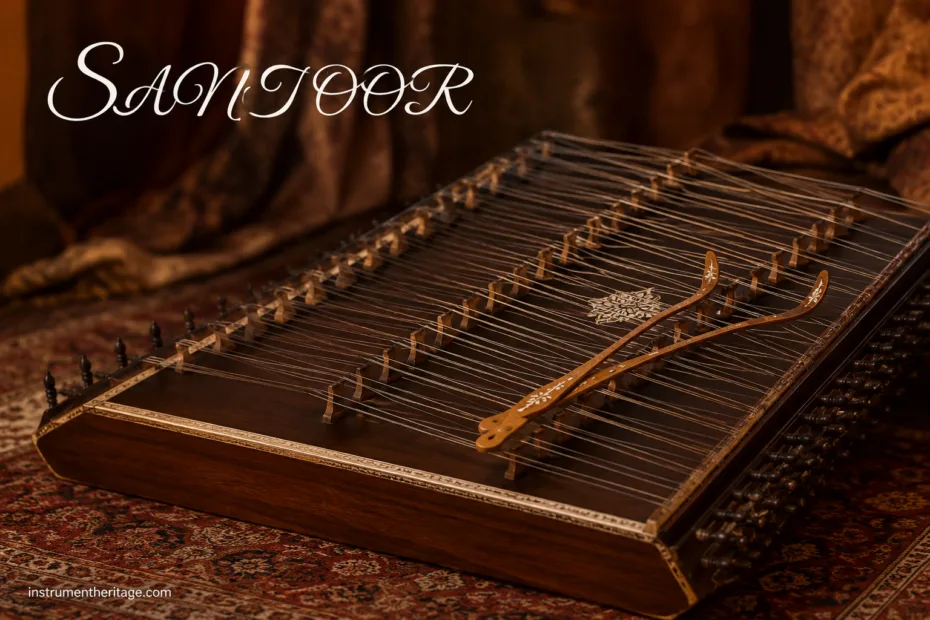
| Feature | Santoor Details | Why It Matters |
|---|---|---|
| Instrument Family | Hammered dulcimer, struck zither, box zither, chordophone | The strings are not plucked with fingers; they are touched with light wooden hammers, giving the instrument its bright, rippling voice. |
| Main Cultural Homes | Persian santur, Kashmiri santoor, Hindustani classical santoor | The same broad instrument idea grew into related but different musical languages, each with its own tuning habits and playing touch. |
| Typical Shape | Flat trapezoidal wooden box with metal strings stretched across the soundboard | The wide body lets many string courses sit side by side, while the soundboard spreads the vibration like a thin wooden speaker. |
| Strings and Courses | Often grouped in sets of three, four, or five strings; many models range from about 72 to more than 100 strings | Several strings tuned together make one note sound fuller, brighter, and more bell-like. |
| Playing Tools | Small wooden hammers, often called mezrab or mallets | The player shapes rhythm, attack, softness, and tremolo through the bounce of the hammers. |
| Common Materials | Walnut or other resonant hardwoods, metal strings, wooden bridges, tuning pins | Wood choice affects warmth and sustain; string metal affects brightness and weight. |
| Sound Character | Shimmering, ringing, clear, fast-decaying yet resonant | Its sound can feel like many tiny bells speaking at once, especially during fast repeated strokes. |
| Musical Roles | Solo performance, classical ensemble, devotional and regional traditions, film music, fusion settings | The santoor can carry melody, rhythm, and texture at the same time, which is rare for such a compact instrument. |
The santoor is a string instrument that behaves a little like rain on polished wood. Each note is struck, not plucked. A pair of light hammers touches the strings, the sound opens for a moment, and then it glows into the next note. That is why a good santoor can feel both rhythmic and delicate: it has the sparkle of percussion, yet it sings through metal strings stretched over a wooden body.
Across Persian and Indian music, the instrument appears under related names: santur, santour, santoor, and sometimes regional spellings shaped by language and tradition. The family link is clear. It belongs to the hammered dulcimer family, where sound is produced by striking strings with small beaters rather than bowing or plucking them.
The santoor is not just a “many-stringed instrument.” Its personality comes from the full design: the shallow wooden box, the bridge rows, the grouped strings, the precise tuning pins, the player’s seated posture, and the soft but controlled rebound of the hammers. Change one of these details, and the voice changes.
- 🎶 Hammered dulcimer family
- 🪵 Wooden resonator box
- 🔨 Played with light hammers
- 🎼 Persian and Indian traditions
- ✨ Bright, ringing tone
What Is a Santoor?
The santoor is a struck string instrument. That may sound like a small detail, but it explains nearly everything about its voice. A violin string is bowed. A guitar string is plucked. A santoor string is tapped by a small hammer, so each note begins with a clean, bright attack and then fades into a soft metallic ring.
In organology, it sits among zithers because the strings run across a body rather than along a neck. More precisely, it is linked to the hammered dulcimer and struck zither family, a group found in several forms across South Asia, the Middle East, East Asia, and parts of Europe. Britannica describes the santoor as a stringed instrument of the hammered dulcimer or struck zither family, with related instruments such as the Chinese yangqin and the Hungarian cimbalom appearing in other regions.Reference-1✅
The Persian santur and the Indian santoor share a family resemblance, yet they are not identical twins. The Persian instrument is closely tied to Persian classical music and modal practice. The Indian santoor, especially the Kashmiri and Hindustani classical form, often has a wider body and is widely associated with a hundred-string layout. One family. Several accents.
Simple way to picture it: imagine a shallow wooden box with many metal strings stretched across it. The player sits behind the instrument and strikes the strings with two light hammers. The result is clear, ringing, and fast-moving, almost like a harp made of tiny bells.
How the Santoor Is Built
The santoor’s body is usually a flat wooden box, broad near the player and narrower toward the far side. This trapezoidal shape is not just for looks. It helps accommodate strings of different lengths, bridge positions, and pitch ranges inside one compact frame.
The top board is the soundboard. It receives the vibration from the strings through the bridges. When the hammers strike, the metal strings vibrate first, then the bridge passes that energy into the wood. The wood answers. That answer is the body of the sound.
Wooden Body and Soundboard 🪵
Traditional instruments are often made with walnut or other resonant hardwoods. Walnut is loved because it can be strong without feeling dead. It holds tuning pins, supports string tension, and still gives warmth to the tone. A very hard, heavy body may sound tight. A weak or poorly seasoned body may lose clarity. The maker is always balancing strength and resonance.
On many santur-style instruments, the top board may include small rosette openings or sound holes. These help air move inside the box and also give the instrument its crafted visual identity. Good rosettes are not decoration alone; they are part of the breathing body of the instrument.
Strings, Courses, and Bridges
The santoor does not usually give one string to one note. Instead, several strings are grouped together in a course. A course may contain three, four, or sometimes five strings tuned to the same pitch or related pitches. When the hammer strikes that group, the sound becomes wider and brighter than a single string could produce on its own.
A detailed Grinnell College Musical Instrument Collection record describes a Persian santur example with 72 strings, grouped into eighteen courses of four strings, with brass-wire and steel-wire courses used in the instrument’s layout.Reference-2✅ This is a good reminder that “santoor” is not one fixed factory object. The details shift by region, maker, tuning system, and musical use.
The bridges are small but mighty. They lift the strings above the soundboard and divide the vibrating length of the strings. Move a bridge even slightly, and the pitch relationship changes. This is why santoor setup is a serious craft. The instrument may look calm on the floor, but under the strings there is a careful map of tension, spacing, and scale.
Hammers, Mezrab, and Touch
The hammers are usually light pieces of wood. In Persian playing, they are often called mezrab. Some are bare wood; others may be wrapped or softened with felt, cotton, or another light covering. A bare hammer gives a sharper, more glassy attack. A padded hammer softens the edge and can make the tone rounder.
Here is the part that surprises many listeners: the hammers do not simply “hit” the strings. A fine player uses them like tiny dancers. The wrist stays relaxed, the hammer rebounds, and repeated strokes can make one note shimmer. Too much force, and the sound becomes hard. Too little control, and the note loses shape.
| Part | Common Material | Musical Function |
|---|---|---|
| Soundboard | Walnut, maple, or other resonant wood | Amplifies string vibration and gives the tone warmth or brightness. |
| String Courses | Steel, brass, bronze, or related metal wire | Create the pitched sound; grouped strings add fullness and shimmer. |
| Bridges | Wood with a hard contact surface on many instruments | Set string height, divide string length, and transfer vibration to the body. |
| Tuning Pins | Metal | Hold string tension and allow fine pitch adjustment. |
| Hammers | Light wood, sometimes padded | Strike the strings and shape attack, softness, tremolo, and rhythm. |
The Sound: Bright, Flowing, and Bell-Like
The santoor’s sound is easy to recognize once you know it. It has a silver-edged clarity, but it is not cold. A single note can flash like a small spark; a run of notes can sound like water moving over smooth stones.
Because the strings are struck, each note has a clear beginning. Because the strings keep ringing after the strike, the notes overlap slightly. This creates one of the santoor’s most loved qualities: a soft cloud around fast melodic passages. The player must manage that cloud carefully. Too much resonance can blur the line. Just enough resonance makes the instrument glow.
Why the Santoor Sounds So Shimmery
- Grouped strings make one note sound wider than a single string.
- Metal strings create a bright upper tone with plenty of sparkle.
- Wooden resonance adds body beneath the metallic ring.
- Fast hammer strokes can create tremolo, rolls, and rippling patterns.
- The bridge layout lets the player move between registers with quick hand motion.
In slow music, the santoor can feel meditative without becoming heavy. In fast music, it becomes lively and almost percussive. That dual nature is part of its charm. It can sing, but it never hides the fact that it is struck. The little tap remains in the sound, like a fingerprint.
Melody, Rhythm, and Texture at Once
A santoor player often has to think in layers. One hand may carry a melodic phrase while the other fills rhythm, repeats a note, or answers with a small pattern. The instrument does not sustain like a bowed sarangi or violin, so players use repeated strokes, ornaments, and careful pacing to keep a phrase alive.
What Listeners Usually Notice First
The first impression is usually brightness. The second is motion. Even when the melody is slow, the vibrating strings give the feeling that the sound is gently moving in the air. This is why the santoor works so well in reflective ragas, Persian modal pieces, ensemble textures, and film music where a luminous sound is needed without using a large orchestra.
Persian Santur and Indian Santoor: A Shared Family with Local Voices
The history of the santoor family is not a neat straight line. Instruments with struck strings and box-like bodies appear in several regions, and names changed as they moved through languages. What can be said with care is that the Persian santur is one of the central forms of this family, and the Indian santoor developed its own identity, especially through Kashmir and later through Hindustani classical performance.
The Persian Santur
In Persian music, the santur has long been valued for its connection to modal melody, delicate rhythmic figures, and bright resonance. It is often tuned to suit a specific mode, which means tuning is not just maintenance; it is part of preparing the musical language of the piece.
The Persian santur often uses rows of movable bridges and string courses that create a span of registers across the body. A performer may move through low, middle, and high areas while keeping both hands close to the instrument. The tone can be crisp and precise, yet the decay of the strings gives it a floating edge.
The Kashmiri and Indian Santoor
In South Asia, the santoor is strongly associated with Kashmir. The Indian form is often described as having around a hundred strings, commonly arranged across a larger, more rectangular body than many Persian examples. It has been used in regional music and later became strongly linked with the Hindustani classical stage.
One name is especially tied to that shift: Shiv Kumar Sharma. Britannica notes that Sharma is credited with moving the instrument from an accompanimental and ensemble role in Kashmiri Sufi music into a solo role within Hindustani classical music.Reference-3✅ That change was not only about fame. It required musical problem-solving: how to make a struck, fixed-pitch instrument speak in a tradition that often loves sliding notes, vocal-style phrases, and slow melodic expansion.
Players developed ways to suggest sustain through tremolo, to shape phrases through touch, and to adapt raga performance to the instrument’s strengths. The result is a santoor style that does not pretend to be a sitar, sarod, or sarangi. It speaks in its own grammar.
How the Santoor Is Played
The player usually sits with the instrument placed flat in front, either on the lap, on the floor, or on a low stand depending on the tradition. The wider side often faces the performer. Both hands hold hammers, and the playing surface becomes a map of notes.
Posture and Hand Movement
Good posture matters because the instrument asks for balance. The player must reach across many strings without stiffness. The wrists need freedom, but the fingers must keep the hammers under control. It is a small motion instrument. Big gestures are not needed.
Unlike a piano, where keys help separate pitches clearly, the santoor presents many strings directly in front of the musician. Muscle memory becomes essential. A player learns the geography of the bridges: where each note sits, how far the next register lies, and how to avoid unwanted strings while moving fast.
Common Techniques
- Single strokes: clean notes used for melody and clear rhythmic shapes.
- Alternating strokes: left-right hammer patterns that create speed and flow.
- Tremolo: rapid repeated strokes that make a note feel sustained.
- Grace notes: small touches before or after a main note to add expression.
- Register movement: shifting between low, middle, and high areas for color.
- Controlled damping: lightly stopping or reducing resonance when clarity is needed.
The hardest part is not always speed. Often it is restraint. The santoor can become very busy very quickly. A mature player knows when to let the wood and strings breathe.
Tuning and Pitch: The Hidden Work Behind the Glow
A santoor has many strings, and many of them must agree with each other. If four strings belong to one course, those four need to speak as one note. Even a tiny mismatch can create a wobble. Sometimes that shimmer is pleasant. Too much of it sounds unsettled.
Tuning is done with metal pins. The player or maker turns them carefully to adjust tension. The process takes patience, especially before performance or recording. Temperature, humidity, string age, and transport can all affect pitch. The instrument is beautiful, but it asks for care.
Modal Tuning
Both Persian and Indian traditions often treat tuning as part of the musical setting. The instrument may be prepared for a mode, dastgah, maqam-related environment, or raga-based performance. This means the santoor is not always tuned like a Western chromatic keyboard.
This is one reason the instrument can sound so natural inside its own tradition. The tuning is not only a technical grid. It is a musical landscape. Notes have jobs, colors, and relationships.
Worth knowing: the santoor’s beauty depends on both tuning and touch. A well-built instrument with poor tuning sounds confused. A well-tuned instrument with a harsh hand sounds stiff. The magic lives between the two.
How Musicologists Classify the Santoor
For a listener, “hammered dulcimer” is usually enough. For instrument scholars, the santoor is also a chordophone, meaning its primary sound comes from vibrating strings. In the Hornbostel-Sachs system revised through MIMO, struck box zithers are classed under true board zithers with resonator box sounded by hammers or beaters.Reference-4✅
That label may look dry, but it is useful. It tells us the santoor is not a lute like the oud, not a harp, not a keyboard instrument in its traditional form, and not a percussion instrument in the same sense as a drum. It is a string instrument that borrows the striking action of percussion.
| Category | Santoor Placement | Plain-English Meaning |
|---|---|---|
| Chordophone | Yes | The sound comes mainly from vibrating strings. |
| Zither | Yes | The strings run across a body, not along a neck. |
| Box Zither | Yes | The body is a resonating wooden box. |
| Hammered Dulcimer Type | Yes | The strings are struck with hammers or beaters. |
| Necked Lute | No | It has no long neck like a sitar, tar, or oud. |
Similar Instruments and Close Relatives
The santoor belongs to a large family of struck string instruments. These relatives are not copies of one another. They are cousins shaped by local music, tuning systems, construction choices, and performance habits.
| Instrument | Region or Tradition | How It Relates to the Santoor |
|---|---|---|
| Santur | Persian music, also wider West Asian contexts | A central Persian form of the hammered dulcimer family, closely related in name and construction. |
| Yangqin | Chinese music | A hammered dulcimer with its own tuning layout, bridges, and ensemble role. |
| Cimbalom | Central and Eastern European traditions | Larger hammered dulcimer, often with extended range and a concert version used in classical settings. |
| Hammered Dulcimer | Europe and North America | A broad family name for instruments with struck strings over a soundbox. |
| Khim | Thai and Cambodian traditions | A regional hammered dulcimer relative with a bright tone and local repertoire. |
What makes the santoor special is not that it is the only hammered dulcimer. It is the way this instrument family was shaped by Persian modal music, Kashmiri tradition, and Hindustani classical performance. Same basic idea. Different musical soul.
Materials and Craft: Why the Maker’s Hand Matters
A santoor may look simple at first: wood, strings, pins, bridges, hammers. In reality, each part has to cooperate under tension. The body must be strong enough to hold many strings, but lively enough to respond. The bridges must be stable, but movable or adjustable where the tradition requires it. The strings must ring clearly, but not overpower the musical line.
Wood Selection
Walnut is common in many traditional instruments because it gives a pleasing mix of firmness and warmth. The wood must be seasoned. Fresh or unstable wood can move with humidity, and movement is the enemy of tuning stability. A good maker listens to wood before the instrument is even strung.
String Metal
Different metals shape the sound. Steel can give a bright, clear ring. Brass or bronze may add a warmer, heavier color in lower or middle areas. Makers and players choose string types based on the layout, desired tone, and tradition.
Bridge Shape and Contact
The bridge is the handshake between string and soundboard. If that contact is poor, the note may lose focus. If it is too rigid, the tone may become narrow. The best bridges do their work quietly: they transfer energy, define pitch, and let the wood speak.
How to Listen to the Santoor
When hearing the santoor, try not to listen only for melody. Listen for layers. There is the main note, the slight ring around it, the echo of the previous note, and the rhythm of the hammer itself. The instrument rewards close listening.
- Notice the attack: is the note sharp, soft, glassy, or warm?
- Listen to the decay: does the sound vanish quickly, or does it hover?
- Follow the register changes between low, middle, and high areas.
- Pay attention to repeated strokes, especially when they imitate sustain.
- Notice how the player leaves space. Silence is part of the instrument’s phrasing.
A slow santoor passage may seem simple, yet a lot is happening under the surface. The player is balancing resonance, tuning, touch, and phrasing with every stroke. The instrument has no frets to press, no bow to drag, no breath to extend a note. Its expression comes from contact and release.
FAQ About the Santoor
Common Questions
Is the santoor the same as the santur?
They are closely related names and forms within the hammered dulcimer family, but usage differs by region. Santur often refers to the Persian form, while santoor is widely used for the Indian form, especially in Kashmiri and Hindustani classical contexts.
How many strings does a santoor have?
It depends on the model and tradition. Persian santur examples may have around 72 strings, while Indian santoor instruments are often associated with about 100 strings. The strings are usually grouped into courses, so several strings may sound together as one note.
Is the santoor hard to tune?
Yes, it can be demanding because there are many strings, and grouped strings must agree with each other. Tuning also depends on the musical mode, humidity, string condition, and the stability of the wooden body.
Why does the santoor sound so bright?
The brightness comes from metal strings, grouped courses, a wooden resonator, and the direct strike of light hammers. The note starts clearly, then rings for a short time, creating the instrument’s sparkling tone.
Can the santoor play Indian classical ragas?
Yes. The Indian santoor is now part of Hindustani classical performance. Players use tuning choices, repeated strokes, ornaments, and phrasing methods to adapt raga music to a struck string instrument.
What is the difference between a santoor and a hammered dulcimer?
Hammered dulcimer is the wider family name. The santoor is a culturally specific member of that family, shaped by Persian, Kashmiri, and Indian musical traditions. Its tuning, playing style, body design, and repertoire give it a distinct identity.
What materials are used to make a santoor?
Many traditional instruments use a wooden body, often walnut or another resonant hardwood, with metal strings, wooden bridges, metal tuning pins, and light wooden hammers. The exact materials vary by maker and regional style.
