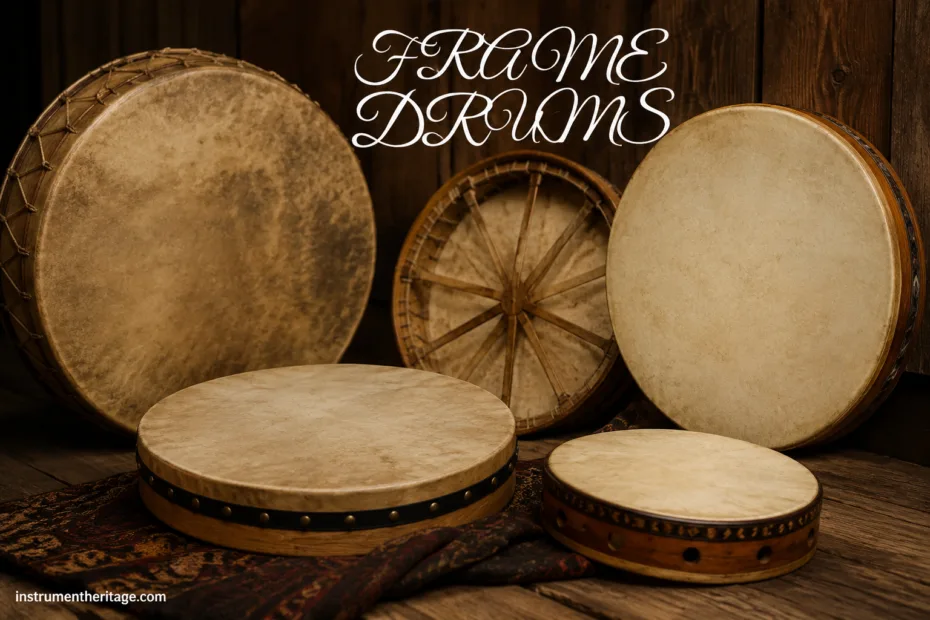
| Feature | Frame drum characteristics |
|---|---|
| Instrument family | Membranophone; usually a directly struck, single-headed drum with a shallow body |
| Basic form | A circular, square, or occasionally polygonal frame carrying a stretched membrane |
| Typical frame | Bent, laminated, carved, or joined wood; some traditions also use clay, metal, or composite shells |
| Playing surface | Goat, calf, sheep, deer, fish, or other prepared skin; many current instruments use synthetic film |
| Sound range | Low open bass, dry edge tones, finger taps, muted strokes, snaps, rolls, rattles, and pitch bends |
| Sound modifiers | Metal jingles, internal rings, gut snares, thumb holes, tuning screws, crossbars, or hand pressure |
| Common playing position | Held upright or slightly angled in one hand; some large forms rest against the body, knee, or forearm |
| Named traditions | Daf, bendir, riqq, tar, dayereh, doira, dap, kanjira, khanjari, tamburello, pandereta, adufe, bodhrán, and many locally named drums |
| Musical settings | Dance, song accompaniment, chamber music, devotional practice, procession, storytelling, community gathering, and solo percussion |
| Classification | Hornbostel–Sachs 211.3 defines frame drums by a body depth that does not exceed the membrane radius Reference-1✅ |
Frame drums look almost too simple: a skin stretched over a shallow rim, held in one hand and struck with the other. That plain outline hides an unusually broad range of sounds. A soft touch near the center can make a warm pulse, while a finger at the edge can produce a dry click, a ringing tone, or a fast flutter. Add metal rings, paired jingles, internal snares, or a flexible membrane and the same basic form becomes a very different instrument.
The term frame drum names an instrument family rather than one fixed design. A large Kurdish daf, an Irish bodhrán, a South Indian kanjira, an Egyptian riqq, and an Inuit frame drum share structural ideas, yet their technique, tone, materials, and cultural use are not interchangeable. Each belongs to a local musical language.
🥁 What Makes a Drum a Frame Drum?
A frame drum has a shallow shell compared with the width of its head. In formal instrument classification, the body depth does not exceed the radius of the membrane. That measurement separates it from deeper cylindrical, barrel-shaped, and goblet-shaped drums, though real instruments sometimes sit close to the boundary.
Most examples have one playable head. The opposite side remains open, allowing the holding hand to support the rim and sometimes touch the membrane from behind. Double-headed frame drums also exist, as do drums with handles, square frames, internal crosspieces, or shells made from materials other than wood.
- Frame
- The shallow body that supports the membrane. Its weight, stiffness, diameter, and depth affect comfort and resonance.
- Membrane
- The vibrating skin or synthetic head. Thickness and tension shape pitch, response, sustain, and sensitivity.
- Bearing edge
- The rim surface under the head. A rounded edge often feels softer and supports a broad vibration; a sharper edge can give a more focused response.
- Sound modifiers
- Jingles, rings, snares, and other fittings that add metallic wash, buzz, or rhythmic detail.
The open back gives the player direct control over damping and tension. A palm against the inner head shortens the note; fingers pushing from behind can raise pitch for a moment. Flexible skins therefore offer moving tones rather than one fixed note.
🪨 The Historical Record
Frame drums appear in carvings, figurines, painted scenes, manuscripts, and museum objects across several regions. They show that shallow hand drums were used long before modern names became fixed, but they do not prove one secure birthplace. Organic parts decay, names shift, and an image cannot always reveal jingles, snares, or a second head.
A South Arabian calcite stela dated to around the first century BCE or first century CE shows a figure holding what British Museum curators identify as a probable skin stretched over a wooden frame. It is a useful piece of visual evidence because the drum is shown in a musical scene rather than found as an isolated ring Reference-2✅.
Other early depictions from the eastern Mediterranean, Mesopotamia, North Africa, and parts of Asia show circular hand drums in social, ceremonial, and performance settings. The safest reading is simple: shallow skin drums were widely understood and repeatedly adapted. Claims that one named present-day drum is the unchanged ancestor of every other frame drum usually stretch the evidence too far.
Names need care. Words such as daf, duff, daira, dayereh, tar, and tambourine have changed spelling and meaning across place and time. Two makers may use the same name for different builds, while two nearly identical drums may carry different local names.
🌍 Frame Drum Traditions Across Cultures
Daf, Bendir, Tar, and Riqq
Across West Asia and North Africa, frame drums range from large, ring-filled instruments to compact drums with paired cymbals. The daf often has a broad wooden frame and chains or linked metal rings fixed inside. When tilted, struck, or shaken, those rings create a dense rushing layer around the membrane tone. The Smithsonian describes the daf as related in form to the Italian tamburello and Arabian bendir, while its rows of linked rings give it a distinct voice Reference-3✅.
The bendir is often deeper and may carry one or more snare strings touching the underside of the head. These strings add a grainy hum to bass strokes and a short buzz to sharper attacks. The tar and dayereh cover several related regional forms; some are plain, some have rings or jingles, and some are built for lighter finger articulation.
The Egyptian and Levantine riqq is smaller, with paired metal cymbals set into frame slots. Players alternate open strokes, edge taps, muted touches, shakes, and controlled jingle rolls, making the instrument speak as a drum, a metallic shaker, or both.
Mediterranean Europe
Italian tamburello traditions use jingled frame drums for dance, song accompaniment, and solo playing. Thumb rolls, finger rebounds, wrist turns, and slaps create a continuous exchange between membrane and metal disks.
Spanish pandereta forms also combine a skin head with metal jingles, while the Portuguese adufe stands apart through its square or rectangular frame and double head. Small objects placed inside some adufes may add a soft rattle. The Irish bodhrán is usually round and single-headed, commonly played with a short beater while the rear hand changes damping and pitch. Modern bodhráns may include mechanical tuning systems, but the hand behind the head remains central to the instrument’s phrasing.
South Asia
The South Indian kanjira is a small frame drum with a deep, flexible voice. Traditional examples used a thin animal-skin membrane and a small set of metal jingles; current makers also work with legally and ethically sourced alternatives and synthetic materials. The left hand supports the shell and changes head tension, while the right hand uses fingers and palm to produce bass strokes, sharp attacks, muted syllables, and rapid ornament.
The Metropolitan Museum of Art describes the kanjira as a South Indian frame drum with jingle disks and notes that players vary skin tension with the holding hand; moisture has also been used to alter pitch on traditional heads Reference-4✅.
Related names such as khanjari, khañjari, and dafli refer to several regional instruments used in devotional song, folk performance, dance, and popular music. Their diameter, shell depth, number of jingles, and membrane attachment can differ greatly.
Central and Inner Asia
The doira, daira, qaval, and Uyghur dap belong to overlapping circles of shallow drums with rings or jingles. Players often hold them vertically and combine finger strokes with sweeping wrist movement. The metal elements can mark subdivisions, fill the gaps between accents, or form long shimmering rolls beneath a melody.
Inlaid wood, painted rims, carved shells, and patterned skins make the frame part of the craft. Decoration alone cannot identify a tradition; instruments travel, makers borrow methods, and museum labels may use broad geographic categories.
Northern Regions and the Americas
Inuit frame drums are often large in relation to their shallow rims and may be played by striking the frame or membrane with a beater, depending on local practice. The drum can accompany singing, movement, and community performance. The holding method differs from finger-heavy riqq or kanjira technique: leverage, rebound, and the relationship between beater and rim become more prominent.
Many Indigenous peoples of North America have their own frame-drum forms, including single- and double-headed instruments made with bent wooden hoops and hide. Some are hand-played; many are struck with beaters. Size, painted imagery, handle construction, and performance setting carry meanings that belong to the specific community. Calling all of them simply “Native drums” removes useful information. The local name and community context matter.
The frame-drum idea also appears in parts of Africa, sometimes in forms that challenge tidy textbook categories. The Yoruba sakara, for example, may use a shallow clay body with a skin head rather than the familiar bent wooden hoop. Such instruments show why physical classification and cultural naming should sit beside each other, not compete.
🪵 How Frame Drums Are Built
Shaping the Shell
A wooden frame may be steam-bent, laminated around a form, carved from thicker stock, or assembled from shaped sections. Each method changes stiffness, weight, and grain direction. A light shell reacts quickly; a heavier one often feels steadier, though head material and tension still shape most of the sound.
The joint deserves attention. Traditional scarf joints spread the join over a long diagonal area, while modern laminated shells may hide their seams almost completely. On jingle drums, slots must be cut without weakening the rim. Large daf frames also need enough strength to hold both membrane tension and the pull of internal ring chains.
Preparing and Mounting the Head
Natural membranes are cleaned, thinned, stretched, and dried under tension. Goat and calf skins are common because they can offer a useful blend of strength and sensitivity, but local makers have used many available materials. Fish skin can be thin and lively. Deer skin may give a broader, softer response. No species produces one guaranteed tone; thickness, treatment, mounting, humidity, and the individual hide all matter.
Heads may be glued, tacked, sewn, laced, tucked beneath a retaining ring, or mounted on a separate hoop. Fixed heads keep the shell uncluttered but depend heavily on weather. Mechanical tuners add weight and hardware, yet they let players adjust tension before a performance. Synthetic films offer greater climate stability and repeatability, though some players prefer the feel and changing color of natural skin.
Humidity is part of the instrument. Natural skin absorbs moisture and relaxes, lowering pitch and softening attack. Dry air pulls it tighter, often raising pitch and making the surface quicker. Excessive dryness can strain the head or frame (especially on fixed, high-tension builds).
Rings, Jingles, and Snares
Metal additions are tuned by material, size, number, spacing, and freedom of movement. Thin paired cymbals can answer a finger stroke with a bright splash. Loose internal rings produce a rougher, longer wash. A snare string against the membrane adds buzz without the obvious shimmer of metal disks.
These parts also change technique. A riqq player learns how to open or choke the cymbals. A daf player controls the fall and rebound of long ring chains through angle and rotation. A bendir player balances head tone against snare response. The hardware is not decoration. It is another voice.
✋ Sound, Touch, and Playing Technique
A membrane does not vibrate like a string with a neat harmonic ladder. The frame, open air space, hand contact, and attached metal reshape its complex vibration patterns, so two drums of the same diameter can feel unrelated.
Where the Hand Lands
- Center strokes move a broad area of the head and usually bring out the lowest, roundest sound.
- Edge strokes excite smaller areas and often sound higher, shorter, and more defined.
- Muted strokes use another finger or part of the hand to stop vibration immediately.
- Snaps and slaps create a sharp attack through speed, angle, and controlled rebound.
- Finger rolls join many small impacts into an even stream.
- Pressure bends alter membrane tension from behind, making the pitch rise or fall during the note.
Good frame-drum playing uses rebound rather than force. The hand touches and leaves. Strong accents come from timing and relaxed speed, and a few millimeters of placement can separate a low pulse from a dry click.
The Holding Hand Is an Active Hand
The support hand carries weight, changes angle, damps the membrane, manages pitch, and controls metal fittings. On a large frame drum, small wrist rotations determine whether rings fall together or scatter. On a bodhrán, the rear hand shapes the note after the beater lands. On a kanjira, pressure from the holding hand can turn a low stroke into a bent, speech-like phrase.
This two-handed coordination gives frame drums their flexible phrasing. One hand begins the sound. The other edits it in real time.
🎶 Musical Roles Beyond Keeping Time
Frame drums can hold a steady pulse, but their role often reaches further. Bass and edge strokes can outline a rhythmic cycle. Jingles can fill subdivisions. Muted taps can answer a singer. Rolls can lengthen a phrase or support a dancer’s turn. In small ensembles, one player may provide pulse, texture, accents, and transitions at once.
Some traditions organize strokes as spoken syllables. The syllables differ by teaching line and language, yet the idea is practical: a rhythm becomes easier to remember when its low, high, open, and muted sounds have names. This also reveals that rhythm is not only a grid of durations. Tone color is part of the pattern.
Solo playing brings another side forward. A player can move from bass-led grooves to dry finger passages, then introduce rolls, shakes, pitch bends, and silence. The frame drum’s limited-looking body encourages close attention to touch. Small changes become musical events.
🔔 Related Drums and Useful Distinctions
| Instrument or family | Body shape | Typical sound feature | How it relates |
|---|---|---|---|
| Tambourine | Shallow frame, usually round | Paired metal jingles | A jingle-equipped type of frame drum; some modern headless tambourines are idiophones rather than drums |
| Bodhrán | Round, single-headed frame | Beater strokes with rear-hand pitch shaping | A frame drum with a distinct Irish playing tradition |
| Goblet drum | Deep bowl or goblet shell | Focused bass and bright rim articulation | Shares hand techniques with some frame drums but belongs to a different body form |
| Barrel drum | Deeper body, often two-headed | Strong projection and a larger enclosed air volume | Structurally deeper than a frame drum |
| Snare drum | Cylindrical, double-headed | Wire snares against the lower head | Shares the use of buzzing elements with the bendir, but construction and technique differ |
| Handheld rattle | No stretched membrane | Sound comes from moving objects | May resemble the shaking motion of a jingle drum, yet it is an idiophone |
The word tambourine causes the most confusion. In everyday English it can mean a frame drum with a head and jingles, or a headless ring carrying jingles. The first is both a membranophone and an idiophone because the skin and metal produce sound. The second has no membrane, so its sound comes only from the jingles.
🧭 Why One Shape Produces So Many Instruments
A shallow hoop is economical, portable, and large enough to support a useful membrane. The geometry can emerge in many places without one path of invention. Local makers then add snare cords, cymbals, rings, square frames, thin heads, or beaters to suit their music.
Travel also moves instruments, materials, and playing ideas. A name may cross a language boundary while the design changes, or a familiar frame may receive new jingles. The family grows through both independent craft knowledge and cultural exchange.
That is why “frame drum sound” is not one sound. It can be a whisper of fingertips, a dry wooden knock, a dark bass pulse, a snare-like buzz, or a sheet of metal shimmer. The common structure gives these instruments a family resemblance. The hands, materials, and musical setting give each one its accent.
Frame Drum Questions
Is every tambourine a frame drum?
A tambourine with a stretched head is a frame drum with jingles. A headless tambourine has no membrane, so it is classed as an idiophone rather than a drum.
What is the difference between a daf and a bendir?
A daf often uses internal chains or linked rings that create a broad metallic wash. A bendir commonly uses snare strings under the head, giving it a dry buzz. Names and construction vary by region, so individual instruments should be examined rather than identified by name alone.
Why do natural-skin frame drums change pitch?
Natural skin exchanges moisture with the air. Humid conditions usually relax the membrane and lower the pitch; dry conditions tighten it and raise the pitch. Hand pressure and gentle warming can also change tension, though excessive heat may damage the head.
Can a frame drum play more than one pitch?
Yes. Different striking zones produce different tone colors and pitch impressions, while pressure from the rear hand can bend the head tension. The result is not a chromatic keyboard of notes, but it can be highly melodic in skilled hands.
Are frame drums always played with the hands?
No. Many are finger- or palm-played, while others use beaters or short sticks. Some traditions strike the membrane, some emphasize the rim, and some combine both.
What materials are used for modern frame-drum heads?
Makers use prepared natural skins, synthetic films, and composite membranes. Natural heads often offer lively tonal variation; synthetic heads are usually more stable across changing temperature and humidity.
Is the bodhrán part of the frame-drum family?
Yes. Its shallow circular shell and broad membrane place it within the frame-drum family. Its beater technique, rear-hand control, repertoire, and making traditions give it a clearly defined identity.
Why do museum labels sometimes use several names for similar drums?
Instrument names move across languages and may refer to a family, a regional variant, or a particular construction. Transliteration also creates alternate spellings. Reliable identification considers the name, place, materials, structure, playing method, and local musical use together.
