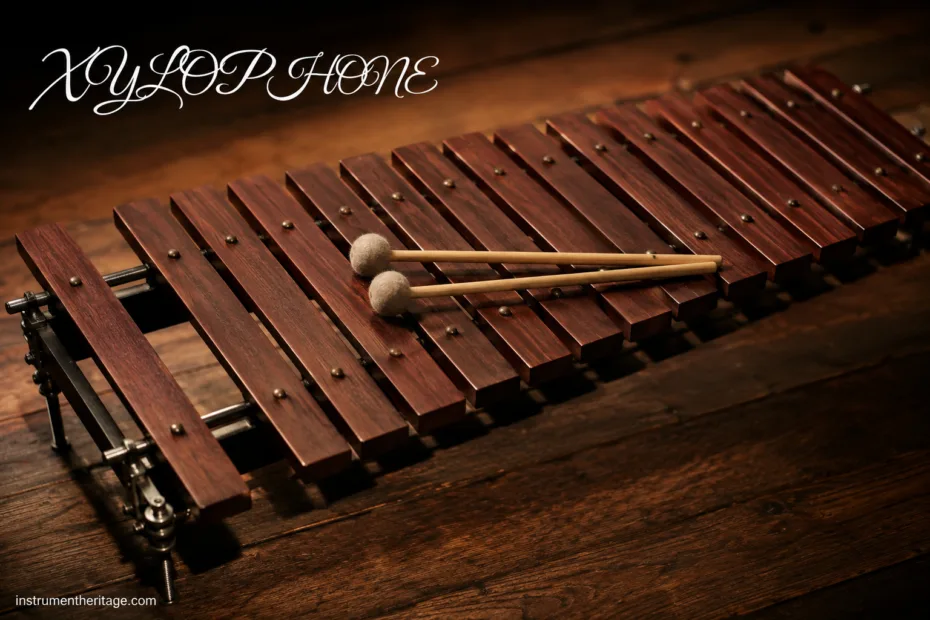
| Feature | Orchestral xylophone | Wider xylophone family |
|---|---|---|
| Instrument class | Struck-bar idiophone with chromatically tuned bars | Struck-bar idiophones arranged in regional scales and layouts |
| Sounding material | Rosewood, padauk, birch, or synthetic composite | Hardwood, softer local woods, bamboo, and occasionally other resonant materials |
| Typical range | About three to four octaves; common concert ranges include F4–C8 and C4–C8 | Varies from a small set of bars to large ensemble instruments |
| Pitch layout | Piano-style chromatic keyboard in two rows | Pentatonic, heptatonic, equidistant, modal, or locally defined tuning systems |
| Resonance | One tuned tube beneath many or all bars | Gourds, troughs, pits, boxes, banana-stem supports, or no added resonator |
| Mallets | Usually hard rubber, plastic, wood, or related materials | Wooden beaters, rubber-tipped beaters, wrapped heads, and region-specific designs |
| Tone | Bright, dry, focused, and fast-speaking | Ranges from soft and woody to ringing, buzzing, or sharply percussive |
| Notation | Normally written in treble clef and sounding one octave higher | Often learned through oral practice, pattern systems, or local notation |
| Common settings | Orchestra, concert band, chamber music, solo percussion, film and theatre scoring | Dance, storytelling, ceremony, social music, court ensembles, teaching, and community performance |
A xylophone begins with a plain physical idea: place tuned bars where they can vibrate freely, then strike them. The result can be a compact classroom instrument, a gourd-resonated bala, a bamboo instrument in a village ensemble, or the high, cutting voice heard above a full orchestra. These instruments share a family resemblance, yet their tuning, construction, playing methods, and social roles can be very different.
The name comes from Greek roots meaning wood and sound, but “xylophone” is both a precise label and a broad umbrella. In orchestral language it usually means one particular chromatic keyboard percussion instrument. In organology, the term may describe many forms of tuned wooden bars. Local names such as bala, balafon, timbila, amadinda, ranat ek, pattala, gambang, and rindik point to distinct musical traditions rather than decorative variations of one standard design.
🌍 One instrument name, many musical lineages
No single origin story accounts for every xylophone. Tuned-bar instruments developed across parts of Africa and Asia, while related forms also appeared in Europe, Oceania, and the Americas. The useful way to understand this history is not as a straight line leading toward the concert hall, but as several long-running traditions built around the same acoustic discovery: a free wooden bar produces a clear pitch when its length, thickness, shape, and support are carefully controlled.
Gourd-resonated instruments of Africa
Across West, Central, East, and Southern Africa, xylophones differ in scale, number of bars, resonator design, ensemble role, and performance technique. The Mandé bala or balafon places tuned wooden slats above individual gourds. Small membranes fitted over openings in the gourds add a controlled buzz, so the note contains both a wooden pitch and a textured edge. In Mandé performance, repeating patterns can support singing, storytelling, and improvisation; one hand may hold a steady figure while the other reshapes it through accents and interlocking lines.
A nineteenth-century Malinke bala in The Metropolitan Museum of Art shows smoked and tuned slats, hide-rope suspension, fourteen gourd resonators, and vibrating membranes that color the sound. The object record also describes how a rubber-tipped mallet activates the bar, resonator air, and membrane as one coupled system. Reference-1✅
Other African designs solve the same problem differently. Ugandan amadinda bars may rest across soft supports and are famous for tightly interlocked parts. Chopi timbila traditions use families of instruments in ensemble, creating layered melodic and rhythmic writing. Ground or pit xylophones use the earth itself as a resonating cavity. Portable instruments favor frames and gourds. Each layout follows the music it serves.
Southeast Asian keyboards of wood and bamboo
Southeast Asian xylophones often place bars over a boat-shaped trough or suspend them on cords. The Thai ranat ek uses a curved row of hardwood bars and plays an agile melodic role in a piphat ensemble. Myanmar’s pattala also suspends tuned bars above a resonant body. In Java and Bali, the gambang uses wooden bars within gamelan, while bamboo instruments such as the Balinese rindik have a lighter, airy attack.
These instruments do not always follow Western equal temperament. Their intervals belong to local ensemble tuning, and two sets made for different groups may not match exactly. That is not faulty tuning. It is ensemble-specific tuning, shaped by musical practice, regional taste, and the other instruments sounding alongside the bars.
European stages and the road toward a keyboard layout
Wooden-bar instruments circulated in Europe under several names and layouts, including portable rows of bars supported on straw or cords. Traveling players helped turn the xylophone into a public concert instrument during the nineteenth century. Makers gradually favored chromatic arrangements that resembled a piano keyboard, which made the instrument easier to place inside orchestral notation and rehearsal systems.
A useful distinction: the modern orchestral xylophone was standardized for concert use, but it did not replace the many older regional instruments. Folk, court, community, educational, and orchestral xylophones continue to follow different musical logics.
🪵 How a xylophone is built
Bars: the vibrating heart of the instrument
Each bar is a tuned beam. Longer and thinner bars tend to sound lower; shorter and thicker bars tend to sound higher. Density and elasticity matter too, which is why two pieces cut to the same dimensions may not produce the same pitch. Makers select stock with care, cut each blank, allow for seasoning, then tune the bar by removing small amounts of material.
The underside usually carries the tuning work. Removing material near the center makes the bar more flexible and generally lowers the fundamental pitch. Removing material nearer the ends can raise it. A skilled tuner listens not only to the named note but also to the partial structure above it, because those upper vibrations decide whether the bar sounds round, nasal, glassy, dry, or unusually hard.
Concert bars are drilled or supported near points that move very little while the bar vibrates. Cord suspension lets the main vibrating area remain free. Small posts keep neighboring bars apart. A bar that touches a post, cord knot, frame part, or another bar may buzz or lose sustain, so good frame geometry is part of good tone.
Wood, composite bars, and material choices
Rosewood has long been prized for projection, clean response, and a strong upper spectrum. Padauk and selected birch are also used. Synthetic bars offer steadier tuning under changing humidity and temperature, and they can be practical for touring, schools, outdoor events, and rehearsal spaces with uneven climate control. Wood often has more subtle variation from bar to bar. Composite material is usually more uniform.
Material alone does not decide quality. Grain direction, moisture content, bar shape, finish, suspension, and resonator matching all affect the result. The maker’s voicing work matters as much as the species name printed in a catalogue.
Frames, cords, and resonators
The concert xylophone places natural notes in the lower row and accidentals in a raised row, mirroring the black-and-white pattern of a piano. Beneath the bars, metal tubes reinforce selected frequencies. Each resonator acts like an air column; its effective length is matched to the bar above. Some instruments use adjustable stoppers in lower tubes because air resonance shifts with temperature.
A modern frame must be quiet, rigid, height-adjustable, and movable. Loose crossbars, worn wheels, twisted rails, or tired suspension cord can add mechanical noise that microphones reveal immediately. Vienna Symphonic Library’s profile describes two-row construction, nodal suspension, common ranges, resonators, bar materials, mallets, and octave-transposing notation. Reference-2✅
🔨 Why the xylophone sounds bright and short
A string vibrates mainly along its length. A xylophone bar bends. When the mallet strikes, the bar flexes rapidly and produces a fundamental pitch with several upper partials that do not line up like the harmonics of a string or open pipe. Makers reshape the underside to bring chosen partials into a useful relationship.
The orchestral xylophone often emphasizes a partial near an octave plus a fifth above the fundamental, giving the note its familiar pointed, woody brilliance. The marimba is normally voiced around a different set of partial relationships, which helps explain its darker and more blended tone. Yamaha’s comparison notes that xylophone and marimba bars are carved and tuned differently, while also warning that manufacturer practice is not identical across all instruments. Reference-3✅
The attack is immediate. Sustain is brief. That short decay lets fast passages remain clear, even when the orchestra is busy. It also means a player cannot hold a note in the way a violinist or wind player can. To create duration, the xylophonist uses a measured roll, alternating mallets fast enough for the ear to connect separate impacts into one continuing sound.
Harder mallet
Brings out more upper partials, gives a clearer front edge, and can project through dense scoring. Excess force may make the sound thin or produce bar noise.
Softer mallet
Reduces the sharpest overtones and rounds the attack. On the highest bars, a very soft head may produce more contact noise than usable pitch.
Where the mallet meets the bar
Most full notes are produced near the center of the bar, where bending movement is strong. Striking close to a suspension point gives a thinner response because that area barely moves. Accidentals are often played near their forward ends during fast passages, allowing the hands to travel in a straighter line between the two rows. The tone changes slightly, but clean rhythm may matter more than perfect center contact at speed.
Common techniques include single strokes, alternating strokes, rolls, double stops, chords, tremolos, glissandos, and dead strokes. A dead stroke keeps the mallet in contact with the bar after impact, stopping the vibration and creating a clipped effect. Four-mallet playing is possible, though the xylophone’s narrow bars, hard heads, and quick rebound make grip control especially demanding.
🎼 The xylophone enters the orchestra
The xylophone reached the modern orchestral percussion section during the nineteenth century. Its dry attack gave composers a color that strings, winds, brass, and drums could not copy. It could double a melody for extra definition, cut a narrow rhythmic line through thick scoring, imitate a mechanical motion, or give a dance passage a lean, quick-footed character.
Camille Saint-Saëns used the instrument memorably in Danse macabre in 1874. Later orchestral writing treated it as more than a novelty. Gustav Mahler placed it inside a large symphonic sound field, and Igor Stravinsky used its hard articulation with remarkable rhythmic precision in The Firebird. Philharmonia’s percussion overview dates its orchestral arrival to the 1860s and identifies the Saint-Saëns score as an early major appearance. Reference-4✅
Range and written pitch
Concert instruments commonly span three, three and a half, or four octaves. A three-and-a-half-octave model often runs from F4 to C8; a four-octave model may run from C4 to C8. The part is normally written one octave lower than it sounds. This keeps the notation on a readable treble-clef staff rather than filling the page with many ledger lines.
That transposition matters in arranging. A written middle-register line becomes a much higher acoustic line, where the xylophone can be heard clearly. The lowest bars are broader and fuller, yet they still do not behave like marimba bass notes. The top octave can become very dry and piercing, so orchestration, mallet hardness, hall acoustics, and dynamic marking must work together.
What orchestral percussionists manage
A xylophone passage may look like piano writing, but every pitch needs a separate impact. Fast leaps require distance judgment, while rolls demand even spacing. The player may also switch immediately to glockenspiel, cymbals, snare drum, or another instrument, so mallet placement and stage layout become part of technique.
- Projection: choosing a mallet that speaks through the ensemble without making the tone harsh.
- Balance: matching a doubled woodwind, string pizzicato, or brass articulation rather than simply playing louder.
- Accuracy: landing cleanly on narrow upper bars during rapid chromatic writing.
- Decay control: using rolls, damped strokes, and phrase spacing to shape notes that naturally disappear quickly.
- Instrument changes: arranging mallets and nearby instruments so transitions remain silent and efficient.
Xylophone, marimba, glockenspiel, and vibraphone
These instruments share a keyboard-like arrangement, which is why they are often confused. The easiest first check is the bar material. Wood or composite points toward xylophone or marimba; metal points toward glockenspiel or vibraphone. Then listen to decay, register, and attack.
| Instrument | Bars | Typical sound | Range and notation | Common mallet approach |
|---|---|---|---|---|
| Xylophone | Wood or synthetic composite | Bright, dry, sharply defined | Usually 3–4 octaves; sounds one octave above written pitch | Hard rubber, plastic, or wood |
| Marimba | Wood or synthetic composite | Warm, rounded, longer decay | Often 4–5 octaves; generally written at sounding pitch | Yarn- or cord-wrapped heads, from soft to hard |
| Glockenspiel | Steel or related metal alloy | Bell-like, brilliant, long-ringing | High register; commonly sounds two octaves above written pitch | Hard plastic, brass, or metal |
| Vibraphone | Aluminum | Smooth, sustained, with optional motor vibrato | Usually around three octaves at sounding pitch | Yarn- or cord-wrapped mallets; pedal controls damping |
The marimba’s wider bars and deeper resonators support a fuller lower register. The glockenspiel’s metal bars ring much longer and sit higher. The vibraphone adds a damper pedal and rotating resonator fans, allowing connected phrasing and tremolo-like modulation. The xylophone remains the driest member of this group. Its clarity is the point.
How tuning connects craft and musical culture
Tuning is never only a number on a meter. A concert xylophone must match an orchestra’s pitch standard and equal-tempered layout. A regional instrument may use intervals learned by ear, inherited through maker lineages, or matched to one ensemble. Its resonators belong to that tuning too: a gourd may support one bar and add a buzzing membrane, a trough blends several bars, and a metal tube reinforces a narrower region. The bar creates the pitch, but the whole structure creates the voice.
Names carry context. Treating every wooden-bar instrument as an early version of the concert xylophone erases design knowledge and musical identity. Terms such as bala, timbila, ranat ek, pattala, and gambang are useful because they identify particular instruments, repertoires, and communities.
What players and makers listen for
A good xylophone does not need every bar to sound identical. Lower notes carry more body; upper notes speak faster and decay sooner. What matters is an even progression without sudden changes in loudness, pitch center, attack noise, or sustain.
- Pitch stability: each bar should settle on a clear center without a distracting wobble.
- Even response: neighboring notes should require roughly comparable effort.
- Clean suspension: cords and posts should allow vibration without rattles.
- Resonator match: tubes or gourds should support the note rather than adding a hollow boom or weak response.
- Useful dynamic range: soft strokes should still speak, while loud strokes should not collapse into contact noise.
- Frame silence: pedals, wheels, braces, and rails should remain quiet under normal playing force.
Care is gentle and preventive. Bars should stay dry, away from sudden climate changes, heaters, and strong sunlight, and they should be cleaned only with maker-approved methods. Suspension cord, resonator mounts, and frame fasteners also need inspection, because many apparent “bar problems” begin elsewhere.
Mallet choice deserves the same care. Players often compare pairs at one dynamic while listening from a few metres away; the audience hears a less immediate, often more balanced tone than the player hears above the bars.
The xylophone in teaching, ensemble work, and solo music
Small removable-bar xylophones are central to many music classrooms. Their layout makes pitch visible, and bars can be removed to create a limited scale for improvisation. This educational design is related to the concert instrument but built for a different task. Softer bars, wider spacing, simplified ranges, and resonator boxes make group playing more manageable.
In percussion ensembles, the xylophone can carry melody, provide counterpoint, or double another mallet instrument. Solo writing often uses rapid scales, wide leaps, repeated notes, and sudden register changes. The instrument rewards relaxed rebound. Forcing every stroke wastes motion and hardens the sound.
Folk and community traditions may ask for a different kind of mastery: interlocking patterns, shared instruments, memorized cycles, speech-like phrasing, dance coordination, or the ability to vary a repeating pattern without losing its pulse. Technique grows from context. A concert-hall roll and a Mandé kumbengo are both skilled uses of wooden bars, but they organize time, melody, and ensemble responsibility in different ways.
Questions about the xylophone
Is a xylophone always made of wood?
Traditional definitions point to wooden bars, and the name itself means “wood sound.” Many modern concert and school instruments use synthetic composite bars for durability and climate stability. They are still called xylophones because they follow the same struck-bar design and tonal role.
Why does a xylophone sound higher than the written notes?
Orchestral xylophone music is normally written one octave below sounding pitch. The transposition keeps the part easier to read in treble clef. A written C therefore sounds as the C one octave above.
What is the main difference between a xylophone and a marimba?
The xylophone usually has a higher range, narrower bars, harder mallets, and a shorter, brighter note. The marimba extends lower, uses wider bars and larger resonators, and is commonly played with wrapped mallets for a warmer tone and longer decay.
Do all xylophones use the same scale?
No. The concert xylophone uses a chromatic, equal-tempered keyboard. Other instruments may use five-note, seven-note, modal, equidistant, or ensemble-specific tunings. The scale belongs to the repertoire and musical culture for which the instrument was made.
Why are resonator tubes placed under the bars?
The tubes reinforce the air vibration associated with each note, making the sound fuller and more audible. They do not create the original pitch; the bar does. Their tuning changes the strength, color, and decay of the finished note.
Can a xylophone sustain a note?
A single xylophone stroke fades quickly. Players create the impression of sustain with a roll, alternating strokes evenly on the same bar. The result is a chain of attacks heard as one continuing tone.
Which mallets are used on a concert xylophone?
Hard rubber, plastic, and wooden heads are common. Medium-hard mallets soften the edge, while very hard heads increase brilliance and projection. The suitable choice depends on register, dynamic, hall, bar material, and the sound requested in the score.
