
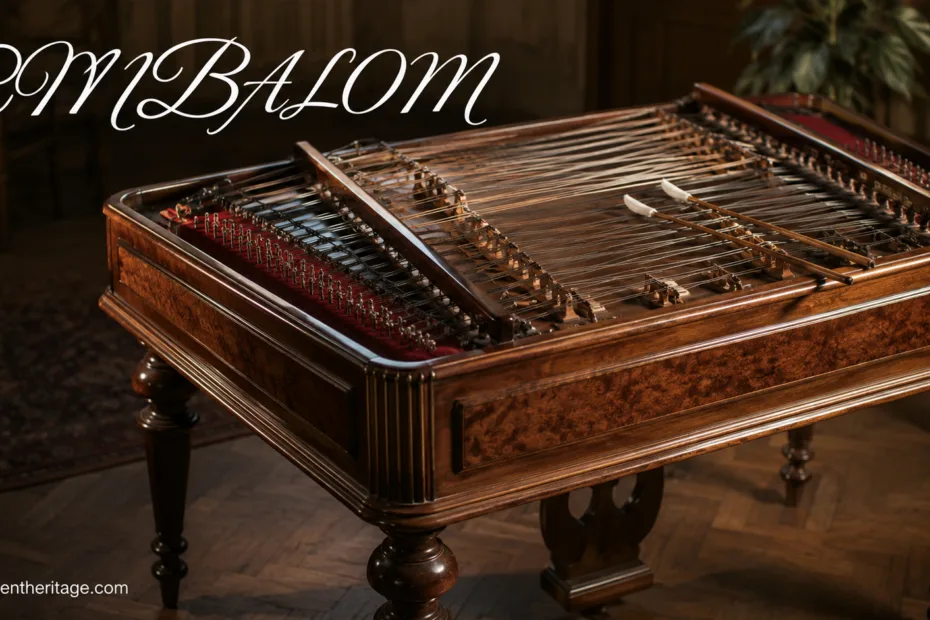
The cimbalom looks like a table covered in strings, yet it behaves like a small orchestra when the hammers touch it. One note can sparkle like glass, another can hum with a warm wooden body underneath. This is why the cimbalom often feels both familiar and strange: it belongs to the hammered dulcimer family, but the concert form has its own Central European voice, its own layout, and its own way of filling a room.
| Feature | What It Means | Why It Matters |
|---|---|---|
| Instrument Family | Struck chordophone, part of the hammered dulcimer family | The sound comes from strings struck with small hand-held hammers, not from plucking or bowing. |
| Body Shape | Trapezoidal wooden soundbox, usually set on legs in the concert form | The wide top gives space for many string courses, bridges, and resonant air inside the body. |
| Typical Concert Range | Often described as a chromatic range of around four octaves in standard references | It can play melody, harmony, bass figures, runs, tremolos, and bright ornamental passages. |
| Strings | Many metal strings, commonly grouped in courses of several strings per note | Multiple strings per pitch give the cimbalom its wide, shimmering attack. |
| Playing Tools | Two small hammers, often wooden, sometimes padded or wrapped | Hammer covering changes the tone from crisp and ringing to softer and rounder. |
| Damper System | Pedal damping on the concert cimbalom | The player can control sustain, making the instrument clearer in fast music and richer in lyrical passages. |
| Main Regions | Hungary, Slovakia, Romania, Moldova, Moravia, Ukraine, Belarus, and nearby traditions | The cimbalom is tied to village music, café ensembles, conservatory study, and concert composition. |
| Related Instruments | Santur, santoor, hackbrett, yangqin, tsymbaly, hammered dulcimer | These relatives share the struck-string idea, but differ in tuning, layout, damping, tone, and musical use. |
🎵 What Is a Cimbalom?
The cimbalom is a large hammered dulcimer with metal strings stretched over a wooden soundbox. The player sits or stands at the instrument and strikes the strings with two small hammers. In its best-known concert form, it has a wide trapezoid shape, four legs, many string courses, and a pedal that helps stop the sound from ringing too long.
That last detail matters. Many hammered dulcimers ring freely until the sound fades on its own. The concert cimbalom can be more controlled because the player can use a damper pedal, a bit like a pianist managing sustain. This makes the instrument useful not only in folk bands, but also in chamber music, orchestras, film scores, and carefully written solo pieces.
Simple way to picture it: imagine the brightness of a hammered dulcimer, the layout challenge of a strange keyboard, and the resonance of a small piano body. The cimbalom sits somewhere between those ideas, but it is not a piano and not just a “big dulcimer.” It has its own hands, habits, and accent.
Standard descriptions often mention a four-octave chromatic range, a trapezoidal body on legs, a pedal mechanism, and around 125 metal strings grouped several to a note.Reference-1✅ These details explain why the instrument can sound so full even when the player strikes only a single written pitch.
🔨 How the Cimbalom Is Built
A cimbalom begins with a wooden resonating body. The body is broad, shallow, and trapezoidal. This shape is not just for looks. It gives the maker room to organize long bass strings on one side, shorter treble strings on another, and bridges in patterns that help the instrument fit a chromatic scale.
The top is not a blank board. It is a busy little landscape: bridges, pins, metal strings, tuning points, damper parts, and open areas where the player aims the hammers. A newcomer may see a confusing web of metal. A cimbalom player sees a map.
Wood, Metal, and Tension
The soundbox has to do two jobs at once. It must be alive enough to resonate, yet stable enough to hold the pull of many strings. That tension is not gentle. The instrument needs a strong frame, careful bracing, and solid workmanship so the tuning does not wander too easily.
- Wooden body: gives warmth, projection, and a resonant base for the strings.
- Metal strings: create the bright, ringing attack that makes the instrument instantly recognizable.
- Bridges: divide string lengths and shape pitch layout across the top.
- Tuning pins: allow each string course to be brought into tune.
- Damper parts: help control sustain on many concert instruments.
A Schunda cimbalom in The Met collection is listed as wood and various materials, with a long edge of about 142 cm, a short edge of about 97 cm, and a height from the floor of about 75 cm.Reference-2✅ Those measurements give a useful sense of scale: this is a serious furniture-sized instrument, not a small lap dulcimer.
Strings and Courses
On many cimbaloms, one written note is not just one string. It may be a course of two, three, four, or even more strings tuned together. When the hammer hits them, the note has width. Tiny differences in vibration make the tone shimmer.
This is one reason the cimbalom can feel so present in a room. A single note is not thin. It blooms.
Bridges and Note Layout
The bridges on a cimbalom are part of the instrument’s personality. They do not simply hold strings up. They divide strings into playable speaking lengths and help create the instrument’s pitch arrangement. On some notes, a string may pass over more than one bridge area, creating different usable sections.
For a pianist, the cimbalom layout can feel odd at first. The notes are not lined up in a neat black-and-white row. The hands learn patterns by distance, angle, and muscle memory. A good player looks relaxed, but there is a lot going on.
🥢 The Hammers: Small Tools, Big Difference
The hammers are small, but they decide much of the voice. A cimbalom hammer can be bare, leather-covered, cotton-wrapped, or padded in another way depending on the tradition and the sound the player wants. The difference is not small.
Harder Hammers
Harder hammers give a cleaner, brighter attack. The note speaks fast. This suits dance rhythms, sharp ornaments, and passages where the cimbalom needs to cut through an ensemble.
Softer Hammers
Softer hammers give a rounder tone. The attack is gentler, and the body of the sound feels warmer. This can make lyrical lines feel more vocal and less percussive.
A player can also change tone by striking closer to or farther from the bridge. Near the bridge, the sound becomes thinner, brighter, and more pointed. Farther away, it opens up. This is where the instrument starts to feel like a painter’s brush: same note, different color.
🔊 What Does the Cimbalom Sound Like?
The cimbalom has a bright metallic shimmer, but that description only covers the first flash of the sound. Under the sparkle, there is a woody resonance from the body and a soft cloud of sympathetic vibration from nearby strings.
It can sound delicate. It can also sound surprisingly strong.
Fast repeated notes create a tremolo that seems to hover in the air. Rolled chords can feel like a shower of tiny bells. Bass notes have a darker, more grounded color, especially when wound strings are used. In the middle range, the cimbalom often has its most human voice: clear enough for melody, warm enough for expression.
Why It Rings So Much
When a hammer hits a course of strings, the strings do not vibrate alone. Other strings nearby may wake up a little too. This is called sympathetic resonance. It is one reason the cimbalom sounds larger than the number of notes being played.
The damper pedal gives the player a way to manage that ring. Without damping, fast passages can blur. With too much damping, the instrument loses some of its glow. Skilled playing lives between those two extremes.
Listening clue: if you hear a sparkling struck-string sound that is more metallic than a harp, more ringing than a piano, and more controlled than a small folk dulcimer, you may be hearing a cimbalom.
🏛️ A Short History of the Cimbalom
The cimbalom belongs to a broad family of struck zithers and hammered dulcimers found across Europe and Asia. In Central and Eastern Europe, portable folk forms were known long before the modern concert instrument became common. These smaller instruments could be played on a table, barrel, stand, or even carried in some regional styles.
The modern concert cimbalom is strongly tied to Vencel József Schunda, a Budapest maker who developed a larger, more stable, more concert-ready form in the late 19th century. His work helped turn the cimbalom from a mainly folk and social-music instrument into one that could sit on formal stages as well.
From Portable Folk Instrument to Concert Cimbalom
Older cimbaloms were often more portable. They suited dance music, local ensembles, and practical playing situations where musicians needed to move from place to place. They could be lively, direct, and bright.
The concert cimbalom changed the scale. It added more range, more weight, more control, and a stronger stage presence. Legs became part of the design. Damping became more refined. The instrument could now handle a wider musical language: folk melodies, café music, classical textures, solo repertoire, and ensemble writing.
The Schunda Influence
Schunda’s larger cimbalom did not erase older forms. It gave the family a concert branch. That branch became especially linked with Hungarian musical life, conservatory teaching, and written repertoire. The instrument also crossed into works by composers who wanted a sound that no ordinary keyboard or harp could provide.
That is the charm of the cimbalom. It is old in spirit, but not frozen in a museum case.
🌍 Where the Cimbalom Is Played
The cimbalom is often connected with Hungary, but its wider family has many regional names and traditions. You may meet related instruments as cimbal, țambal, tsymbaly, cymbaly, or other local forms depending on language and region.
It appears in village bands, urban café music, conservatory settings, folk orchestras, chamber groups, and modern composition. The exact instrument may change. The musical idea remains: metal strings, wooden body, struck sound, living rhythm.
- Hungary
- The concert cimbalom is strongly associated with Hungarian instrument making, teaching, and ensemble practice.
- Romania and Moldova
- Related țambal traditions are heard in folk and professional ensemble settings.
- Slovakia and Moravia
- Cimbalom bands remain part of regional music culture, especially in traditional dance and song settings.
- Ukraine and Belarus
- Tsymbaly and cymbaly traditions show how the hammered dulcimer idea adapts to local music and teaching systems.
The Cimbalom World Association, founded in Hungary in 1991, describes its work as bringing together players of cimbalom and related instruments such as yangqin, santur, hackbrett, hammered dulcimer, tympanon, qanun, and kantele, with members and activities across many countries.Reference-3✅
✋ How Players Use the Instrument
Playing the cimbalom is not just “hitting the right strings.” The hands must learn distance, rebound, dampening, tone color, and balance. Because the notes are arranged across bridges and string groups, the player develops a physical map that can look mysterious from the outside.
Melody
Melodies on the cimbalom can sing beautifully. The player may use tremolo to sustain a note, since a struck string naturally fades after impact. A soft tremolo can make the line feel almost vocal. Too much, and it becomes busy. Good players know when to let silence do some of the work.
Harmony
Chords can be sharp and rhythmic or broad and glowing. Because the instrument rings, harmony has to be handled with care. Dense chords may become cloudy if the pedal is left open for too long. Clear voicing matters.
Rhythm
In dance music, the cimbalom can act like a rhythmic engine. It can mark pulse, answer melodic instruments, decorate cadences, and push the music forward with crisp repeated figures. This is where the percussive side of the instrument comes forward.
🎼 Cimbalom in Folk, Classical, and Screen Music
The cimbalom has a rare gift: it can sound traditional without being limited to tradition. In folk bands, it adds rhythm, sparkle, harmony, and ornament. In classical music, it adds a color that feels bright but not ordinary. In screen music, it can suggest memory, movement, mystery, or a very specific Central European flavor without needing many notes.
Composers have used it because it does not blend like a standard orchestral section. A cimbalom line can step forward immediately. It has an edge, but not a harsh one. It can be delicate, nervous, playful, or solemn depending on touch and register.
Why Composers Like It
- Clear attack: every note begins with a defined strike.
- Long resonance: open strings can leave a glowing trail.
- Unusual color: it is neither piano, harp, celesta, nor guitar.
- Flexible role: it can play melody, rhythm, texture, or decorative figures.
Film and television composers often use cimbalom when they want a sound that feels handmade and slightly unexpected. A few notes can change the whole shade of a scene. No big gesture needed.
🧭 Cimbalom and Similar Instruments
The cimbalom is part of a large struck-string family, but “related” does not mean “same.” The differences are found in tuning, size, playing position, bridge layout, string courses, damping, local repertoire, and tone.
| Instrument | Main Connection | How It Differs from the Cimbalom |
|---|---|---|
| Santur / Santoor | Struck-string dulcimer family, with deep roots in West and South Asian music cultures | Usually lighter in construction, different tuning systems, no concert cimbalom-style pedal damping in many traditions. |
| Hackbrett | Alpine and German-speaking hammered dulcimer relative | Often smaller or regionally tuned; its repertoire and playing styles follow different local traditions. |
| Yangqin | Chinese hammered dulcimer with metal strings and bamboo beaters | Different bridge layout, tone, repertoire, and hammer technique; often brighter and more agile in its own idiom. |
| Tsymbaly / Cymbaly | Eastern European relatives with local folk and concert forms | May vary in size, damping, range, and educational tradition depending on region. |
| Hammered Dulcimer | General English name for struck dulcimers | Many hammered dulcimers are diatonic or semi-chromatic; the concert cimbalom is usually larger and more chromatic. |
| Qanun | Flat zither with many strings, visually easy to compare at first glance | The qanun is plucked with plectra, not struck with hammers; its technique and sound production are different. |
This comparison helps clear up a common confusion. The cimbalom is sometimes described as “like a santur” or “like a hammered dulcimer.” Fair enough as a doorway. But once you hear the pedaled concert cimbalom in full voice, the difference becomes obvious.
🪵 Materials and Craftsmanship
Good cimbalom making is a quiet craft. The instrument must be strong, but not dead. If the body is too stiff, the sound can feel choked. If it is too unstable, tuning and tone suffer. The maker has to balance wood, metal, air, tension, and touch.
Players also care about hammers. A tiny change in hammer weight, shaft flexibility, head shape, or covering can alter the feel. The hammer is the player’s fingertip. It must bounce, speak, and obey.
Tuning and Maintenance
A cimbalom has many strings, so tuning takes patience. Small changes in room temperature and humidity can affect the wood and metal. Concert players often tune carefully before rehearsals and performances, especially when the instrument has traveled.
- Keep the instrument away from harsh humidity swings.
- Protect the top from dust, knocks, and loose objects.
- Check hammers for worn covering or uneven response.
- Let a skilled technician handle deeper mechanical or structural work.
- Use careful, calm tuning habits; rushed tuning can become messy fast.
The cimbalom rewards care. It also reveals neglect rather quickly.
📖 Reading and Learning the Cimbalom
Learning cimbalom can be exciting and humbling. A musician who already reads piano music may recognize the notes on the staff, yet the hands still have to learn a new geography. The instrument does not place pitches in a straight line. It asks the player to think in patterns, jumps, bridge areas, and hammer movement.
Beginners usually start with simple melodies, slow scales, clear hand alternation, and basic damping. After that, the real fun begins: ornaments, tremolo, arpeggios, broken chords, dance rhythms, and expressive pedal control.
What Feels Natural Early
Repeated notes, open ringing tones, simple two-hand alternation, and short melodic patterns can feel friendly once the hands relax.
What Takes Time
Fast chromatic lines, wide jumps, clean damping, and thick harmony need slow practice because the layout is not keyboard-like.
A good cimbalom player does not just hit notes. They shape decay. That is a big part of the instrument’s beauty.
👂 How to Listen to the Cimbalom
When listening, try to separate three layers: the strike, the ring, and the body resonance. The strike is the first tiny spark. The ring is the metal string continuing after impact. The body resonance is the wooden warmth that gives the sound depth.
In a fast folk ensemble, listen for how the cimbalom supports the rhythm without swallowing the melody. In a chamber piece, notice how it can sit beside strings, woodwinds, or percussion and still keep its own color. In a solo performance, follow how the player uses silence. Silence is part of the phrase.
Small listening exercise: pick one cimbalom recording and focus only on the decay of each note. You will hear how much of the instrument’s character happens after the hammer has already left the string.
Cimbalom FAQ
Common Questions About the Cimbalom
Is the cimbalom the same as a hammered dulcimer?
It is a type of hammered dulcimer, but the concert cimbalom is usually larger, chromatic, set on legs, and fitted with a damper pedal. Many smaller hammered dulcimers do not have the same layout, range, or pedal system.
Why does the cimbalom have so many strings?
Many pitches use more than one string tuned together. These string groups, often called courses, make each note wider and more resonant. That is a big reason the instrument has its famous shimmer.
Is the cimbalom hard to learn?
The basic idea is simple: strike the strings with two hammers. The harder part is learning the note layout, clean damping, tuning awareness, and touch. Musicians with rhythm and ear training may feel comfortable early, but the instrument still needs patient practice.
What is the difference between cimbalom and santur?
Both are struck-string instruments, but they come from different musical traditions and usually have different tunings, layouts, sizes, hammers, and playing techniques. The modern concert cimbalom is especially known for its large body and pedal damping.
Does the cimbalom sound like a piano?
Only in a loose family sense. Both involve hammers striking strings, but the cimbalom is played directly with hand-held hammers. It has a more open metallic ring, a different attack, and a less keyboard-like layout.
Where is the cimbalom most often heard?
It is strongly associated with Central and Eastern European music, especially Hungarian and neighboring traditions. You can also hear it in classical works, contemporary chamber music, folk orchestras, and screen scores.
What are cimbalom hammers made from?
They are usually small wooden beaters. The heads may be bare, leather-covered, cotton-wrapped, or padded depending on the sound the player wants. Harder hammers sound brighter; softer hammers sound warmer.
Can the cimbalom play chords?
Yes. It can play chords, arpeggios, tremolos, bass figures, and melody lines. Because the strings ring strongly, players use damping and careful spacing to keep harmony clear.
