| Feature | Description |
|---|---|
| Instrument type | Orchestral instrument set built around tuned gongs, gong-chimes, metallophones, drums, and selected melodic instruments |
| Main traditions | Javanese, Balinese, and Sundanese, with many regional ensemble forms |
| Primary sound material | Bronze is closely associated with many court and ceremonial sets; iron, brass, bamboo, wood, hide, string, and cane are also used |
| Core tuning concepts | Sléndro and pélog, shaped by local practice and the tuning of each complete set rather than one universal pitch standard |
| Main playing actions | Striking, damping, rolling, bowing, plucking, blowing, and coordinated interlocking |
| Musical structure | Layered melody, repeating gong cycles, drum-led changes, melodic ornament, and carefully balanced ensemble roles |
| Common settings | Dance, theatre, ceremony, court and community events, concerts, education, and new composition |
| Sound character | Bright attacks, long gong decays, soft metallic bloom, woody pulse, vocal lines, and—especially in many Balinese sets—a living acoustic shimmer |
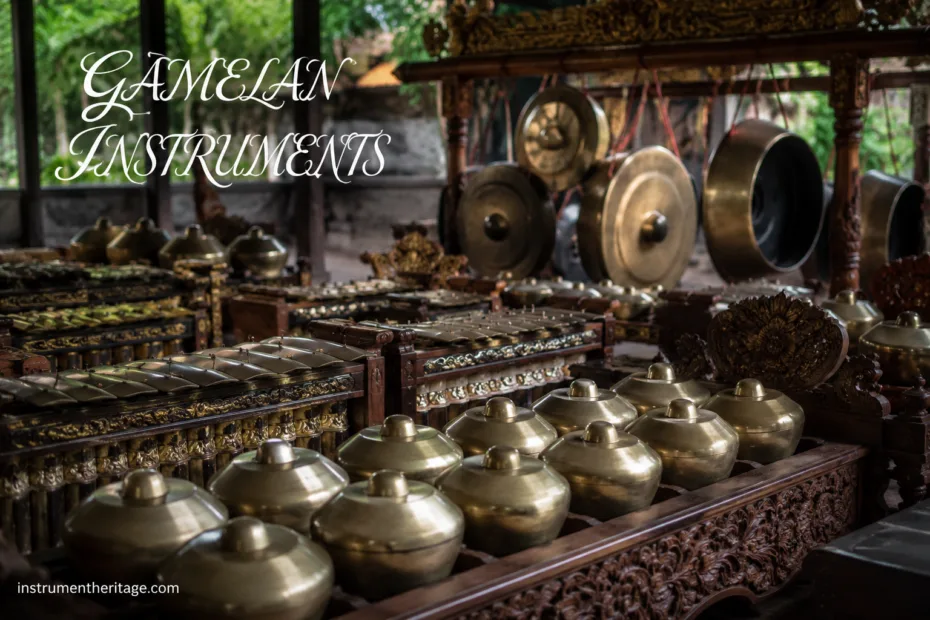
Gamelan is often described as an Indonesian orchestra, though that simple label misses something important. A gamelan is also the physical set of instruments itself: gongs, bronze bars, drums, wooden frames, resonators, mallets, and sometimes flute, fiddle, zither, xylophone, and voice. The pieces belong together. Their pitches are shaped around one another, their timbres overlap, and their musical parts fit like hands working on the same carving. The set is the instrument.
The famous bronze glow does not come from metal alone. Gong shape, key thickness, resonator air, beater hardness, damping, and tiny pitch relationships all leave a mark. One note flashes. Another hangs in the room. Together they create a layered, physical sound.
🔔 Gamelan Means an Ensemble and Its Instruments
The word gamelan does not name one fixed object in the way that “violin” does. It can refer to the musicians, the music, and the matched collection of instruments. A Central Javanese set may contain dozens of bronze and wooden voices, while Balinese and Sundanese ensembles follow their own regional designs.
This is why counting “the instruments in a gamelan” rarely produces one tidy answer. Instrumentation changes by region, repertoire, setting, and ensemble type. Even names can shift in pronunciation or function. The National Museum of Asian Art describes Javanese gamelan as a bronze-centered orchestra that may also include rebab, gambang, suling, and kendang, all working inside repeating gong cycles.Reference-1✅
A gamelan set is normally tuned as a family. A replacement bar or gong cannot always be borrowed from another set and expected to blend. The nominal note may look the same, yet its actual pitch, overtone pattern, decay, and beating relationship can differ.
🥁 The Instrument Families Inside a Gamelan
Bronze-keyed metallophones
Metallophones place tuned metal keys above a resonant box or individual tubes. In Central Java, the saron family commonly carries or reinforces the main melodic outline, often called the balungan. The larger demung speaks in a lower register; the medium saron barung sits near the center; the smaller peking sounds higher and can play denser patterns.
The slenthem uses thinner keys suspended above resonators, giving its low notes a softer edge and longer breath. The gendèr also has suspended bronze keys with tuned resonators below, but its range and two-mallet technique allow flowing melodic patterns. One hand strikes while the other damps. That small movement matters. Without it, yesterday’s note would still be ringing through today’s phrase.
Balinese bronze-keyed instruments often appear in matched pairs. Names such as gangsa, ugal, pemade, kantilan, jublag, and jegogan may identify different registers and functions. Their bars are usually suspended above bamboo or tube resonators, and many parts use fast interlocking patterns. The brilliance comes from coordination, not force.
Gong-chimes and hanging gongs
A gong-chime is a row or set of small bossed gongs resting horizontally on cords in a wooden frame. The raised central boss is the striking point. In Java, the bonang barung and higher bonang panerus can outline, anticipate, or decorate the melodic path. In Bali, related instruments include the reyong or reong, often played by several musicians whose hands interlock across one long row, and the trompong, which may take a more soloistic role.
Larger gongs organize time. The kenong marks major internal divisions. The kethuk and kempyang fill smaller points in the cycle. Hanging kempul gongs add phrase punctuation, while the gong ageng closes and renews the broadest span. Its note is less like a full stop than a doorway: one cycle settles as the next begins.
Drums, cymbals, wood, strings, flute, and voice
- Kendang or kendhang: double-headed drums that shape tempo, transitions, dynamic level, dance cues, and ensemble character. Different sizes and playing styles suit different repertories.
- Ceng-ceng: Balinese cymbals used for crisp accents, rolling textures, and tightly coordinated rhythmic bursts.
- Gambang: a wooden-bar xylophone with a dry, quick sound that can move fluidly through melodic patterns.
- Rebab: a bowed spike fiddle whose flexible line ornaments and guides melody, especially in softer Javanese textures.
- Suling: a bamboo flute with an airy tone that bends and curls around the instrumental line.
- Celempung or siter: plucked zithers that add delicate rhythmic and melodic detail in some Javanese ensembles.
- Voice: solo and choral singing may be woven into the instrumental texture rather than placed above it as a separate layer.
🔨 Bronze, Wood, Hide, and the Work of the Maker
Bronze earns most of the attention, yet a gamelan is a meeting of materials. Metal rings. Wood supports and resonates. Bamboo or metal tubes reinforce suspended keys, while hide gives the drums their responsive skin.
Traditional gong and key making requires repeated listening as well as heavy physical work. A rough metal form is heated, hammered, cooled, checked, and reshaped. The maker adjusts curvature, thickness, boss profile, and rim tension until the object settles into its intended pitch and tone. Fine tuning may involve controlled hammering, filing, scraping, or thinning selected areas. A millimeter can change the voice.
Bronze formulas are not one universal recipe. Copper and tin proportions vary by workshop, instrument, and desired tone. Iron and brass also appear. Bronze can offer a broad ring and strong projection, but workmanship matters more than the material label alone.
The carved wooden cases hold cords at the right height, leave space for vibration, protect the metal, and visually unite the set. A University of Leeds gamelan commissioned from Surakarta is described as having hand-forged bronze gongs and metallophones with hand-carved wooden work, linking metalworking and carving in one craft chain.Reference-2✅
- Bossed gong
- A gong with a raised central knob, struck at the boss to activate its main vibration pattern.
- Suspended key
- A metal bar resting on cords rather than directly on a solid frame, allowing freer vibration.
- Resonator
- A tuned tube or cavity that reinforces selected frequencies beneath a key.
- Damping
- Stopping a note by touching the vibrating metal after or as the next note is played.
🌊 Tuning, Resonance, and the Bronze Shimmer
Sléndro and pélog are tuning families, not fixed piano scales
Sléndro is usually understood as a five-tone tuning with relatively even steps. Pélog uses a seven-tone collection with unequal spacing, though many pieces emphasize a five-tone selection. Those descriptions help the ear get started, but they are not universal frequency charts. Two respected gamelan sets can differ in absolute pitch and interval size while both remain fully convincing within their own musical setting.
Western equal temperament divides an octave into twelve identical semitones. Gamelan tuning follows another logic. The pitches are judged through relationships inside the set, through melodic practice, and through the color of vibrating metal. This is why a tuner may listen for blend, beat rate, register, and spectral shape rather than chase a number on an electronic display.
Ombak: the audible wave between paired instruments
Many Balinese ensembles tune matching instruments in pairs, with one slightly lower and the other slightly higher. When both sound together, the tiny pitch difference creates audible beats called ombak, meaning “wave.” The tone seems to pulse from within. It is not faulty unison. It is deliberately alive.
The rate of that beating can change by register and ensemble. Lower instruments may breathe slowly; higher instruments can shimmer faster. Paired tuning also magnifies the attack of interlocking parts, making a unified phrase feel wider than the notes written on paper. Balinese gamelan types vary greatly, but the Smithsonian notes that ensembles may be made from bamboo, iron, or bronze and range from small groups to orchestras of fifty or more; its account of gong kebyar places the rise of that large five-tone bronze form in north Bali around 1915.Reference-3✅
Why the notes feel so full
A bronze key or gong does not produce a neat harmonic ladder like an ideal string. Its partials are often inharmonic, so pitch, clang, bloom, and after-ring arrive together. A padded mallet draws a rounder body; a harder beater brings more edge.
Damping is part of the note. On many metallophones, one hand strikes while the other stops the previous key. Clean damping reveals rhythm and melodic shape; late damping lets tones overlap; early damping cuts the phrase short. Silence is being played too.
🎼 How the Ensemble Organizes Melody and Time
Gamelan texture is layered, but the layers are not separate tracks. A slower melodic outline may be surrounded by quicker elaboration. Small gongs mark subdivisions, large gongs define the broad cycle, drums guide movement, and softer instruments bend around the line.
Balungan and melodic elaboration
In much Central Javanese music, the balungan acts as a central melodic reference. It is not always a tune that every musician simply doubles. Some instruments state it plainly, some anticipate its goal tones, and others weave patterns around it. The rebab or voice may reveal a smoother melodic path than the heavier metallophones suggest.
Colotomic cycles and gong punctuation
The term colotomic describes time organized by recurring gong strokes. Imagine a circle divided by markers of different sizes. The gong ageng marks the return of the largest span; kenong and kempul divide that span into smaller sections; lighter punctuation fills the spaces between. Players do not merely count toward the final gong. They feel position inside the cycle.
This structure can support calm, spacious music or rapid, tightly packed passages. Tempo may change while the relationship among the markers remains recognizable. The cycle stretches, but it does not lose its shape.
Kotekan and interlocking motion
Balinese kotekan divides a fast figuration between two complementary parts, commonly described as polos and sangsih. Each line may feel incomplete alone. Joined together, they form a rapid composite melody that no single pair of hands needs to carry. Precision comes from shared pulse, matched articulation, and close awareness of the partner part.
The kendang player often shapes changes in tempo, volume, articulation, and choreography. This is leadership through sound, not a separate conducting role. A brief drum figure can prepare the whole group for a turn, stop, acceleration, or new section.
🗺️ Java, Bali, Sunda, and Regional Identity
There is no single “Indonesian gamelan sound.” Java and Bali contain many ensemble families, and Sundanese traditions in West Java bring their own tuning, instrumentation, repertory, and performance habits. Local workshops also leave fingerprints in the metal: a preferred interval, a gong profile, a carving style, a favored shimmer.
| Tradition | Common musical traits | Often-heard instruments or colors |
|---|---|---|
| Central Javanese gamelan | Layered melodic flow, broad gong cycles, wide dynamic range, refined soft-playing repertories alongside stronger styles | Saron family, gendèr, slenthem, bonang, kenong, gong ageng, kendang, rebab, gambang, suling, zithers, voice |
| Balinese gong kebyar | Sudden contrasts, paired tuning, bright projection, fast interlocking, close links with dance | Gangsa family, reyong, trompong, kendang, ceng-ceng, kajar, kempur, large gong |
| Sundanese gamelan degung | Open textures, distinctive pélog-related tuning practice, lyrical flute presence, measured gong punctuation | Bonang, saron-type metallophones, jengglong, goong, kendang, suling |
These descriptions are orientation points, not borders. One region may support several contrasting gamelan types. Gamelan angklung, semar pegulingan, gender wayang, gong gede, and semara dana each have their own range, function, tuning, and balance.
🏛️ Historical Roots and Living Practice
Indonesian bronze percussion has a long history, but modern gamelan sets should not be projected unchanged into every old image or inscription. Reliefs at Borobudur from the eighth century show musicians and instrumental groupings, offering evidence of developed ensemble culture in Java. The instruments visible there are better read as relatives and predecessors than as a complete photograph of today’s Javanese gamelan.
Courts, villages, theatres, dance traditions, family teaching, and specialist workshops shaped different ensembles. Wayang encouraged long-form organization and responsive accompaniment, while community practice kept music tied to collective participation.
Gamelan remains active in ceremony, theatre, dance, festivals, schools, universities, concert halls, and composition. Indonesia’s gamelan tradition was inscribed on UNESCO’s Representative List of the Intangible Cultural Heritage of Humanity in 2021, with the description emphasizing hand-forged metal instruments, precise tuning, ensemble layout, rhythmic practice, and transmission across communities.Reference-4✅
👐 What Playing Gamelan Actually Demands
The first visible action is striking. The deeper skill is listening. A player must hear the cycle, drum signal, neighboring part, decay, and room response. Bronze fills a hall quickly. Balance comes from touch and timing.
- Learn the sound before the notation. Cipher systems show pitch order, but not the full weight of damping, cueing, or ensemble feel.
- Match the mallet to the instrument. A padded gong beater, wooden saron mallet, disc-shaped gendèr beater, and cord-wrapped gong-chime stick produce different attacks.
- Damp with purpose. The previous tone is usually stopped as the next begins, though repertory and instrument type shape the exact timing.
- Watch the drummer and listen across the set. Short patterns may signal changes.
- Treat paired parts as one line. In interlocking music, accuracy is shared. Rushing one half distorts the composite phrase.
Many musicians learn several instruments. A player who has felt the cycle from the kenong seat hears a saron phrase differently; a drummer understands why a transition needs space. Musical knowledge circulates around the set.
🪵 Care, Tuning Stability, and Respect for the Set
Bronze and wood age well with steady care. Dust should be removed with soft, dry materials. Strong polishing compounds can alter patina or leave residue near cords and resonators. Drumheads need protection from extreme dryness, damp, and direct heat.
- Keep keys and gongs from touching hard surfaces during transport.
- Check suspension cords for wear before they fail under weight.
- Store mallets so padded heads are not crushed or bent.
- Allow instruments moved between climates to settle before judging tuning.
- Record the original position of keys, resonators, and gong-chimes before maintenance.
- Ask a maker or experienced tuner before filing, grinding, hammering, or replacing metal.
Because a gamelan is tuned as a set, maintenance should protect relationships, not merely isolated pitches. An electronic tuner can document change, yet the final test is the ensemble sound: octave blend, beating, decay, register balance, and the way a note sits inside familiar repertory.
🔎 Gamelan and Related Gong-Ensemble Traditions
Gamelan belongs to a wider Southeast Asian landscape of gongs, gong-chimes, drums, metallophones, and cyclical music. Shared materials do not make these traditions interchangeable; each has its own tuning, repertory, setting, and technique.
| Tradition | Main sound layout | Clear point of distinction |
|---|---|---|
| Gamelan | Matched ensemble of metallophones, gongs, gong-chimes, drums, and optional melodic instruments | Set-specific tuning, layered roles, and gong-defined cycles across many Indonesian regional forms |
| Kulintang | Melodic row of small bossed gongs with larger hanging gongs and drums | The gong row often carries a highly active leading line within southern Philippine and neighboring traditions |
| Talempong | Small Minangkabau kettle gongs used in portable or rack-mounted forms | Distinct West Sumatran repertories, tunings, and ensemble formats |
| Piphat | Thai ensemble of gong circles, xylophones, drums, cymbals, and reed instruments | Bright reed timbre and circular gong layouts create a different melodic and acoustic profile |
The closest visual match is not always the closest musical match. Bonang, kulintang, and talempong may all use bossed gongs, but their tuning, technique, musical roles, and cultural settings differ.
Frequently Asked Questions About Gamelan Instruments
Is gamelan one instrument or an orchestra?
It is both the ensemble and the matched set of instruments used by that ensemble. In everyday English it is often called an orchestra, but the identity of the physical set matters because its instruments are designed and tuned to work together.
Are all gamelan instruments made of bronze?
No. Bronze is strongly associated with many gamelan gongs and metallophones, yet iron, brass, bamboo, wood, hide, string, and other materials also appear. Some gamelan types are centered on bamboo or iron rather than bronze.
What is the largest gong in a Javanese gamelan?
The gong ageng is the largest and usually lowest hanging gong in a full Javanese set. It marks the broadest structural cycle and carries a deep, slowly developing tone.
Why do Balinese gamelan instruments sound as if they are vibrating in pairs?
Many matching instruments are deliberately tuned slightly apart. When the pair plays the same note, the frequency difference produces audible beating called ombak. The resulting wave gives the ensemble its pulsing shimmer.
Can gamelan be tuned to a piano?
It can be adapted for special projects, but traditional sets do not normally follow twelve-tone equal temperament. Their pitches are chosen in relation to the complete ensemble, and two sets may use noticeably different versions of sléndro or pélog.
Why do players touch the metal keys after striking them?
They are damping the previous note. Metal keys can ring long enough to blur the next pitch, so the free hand stops the vibration at a controlled moment. The strike and the damping gesture form one complete technique.
What is the difference between bonang and saron?
Bonang is a gong-chime made from small bossed gongs placed horizontally in a frame. Saron is a metallophone with thick bronze keys over a resonant trough. Their melodic roles overlap in places, but their tone, layout, mallets, and playing methods are different.
