
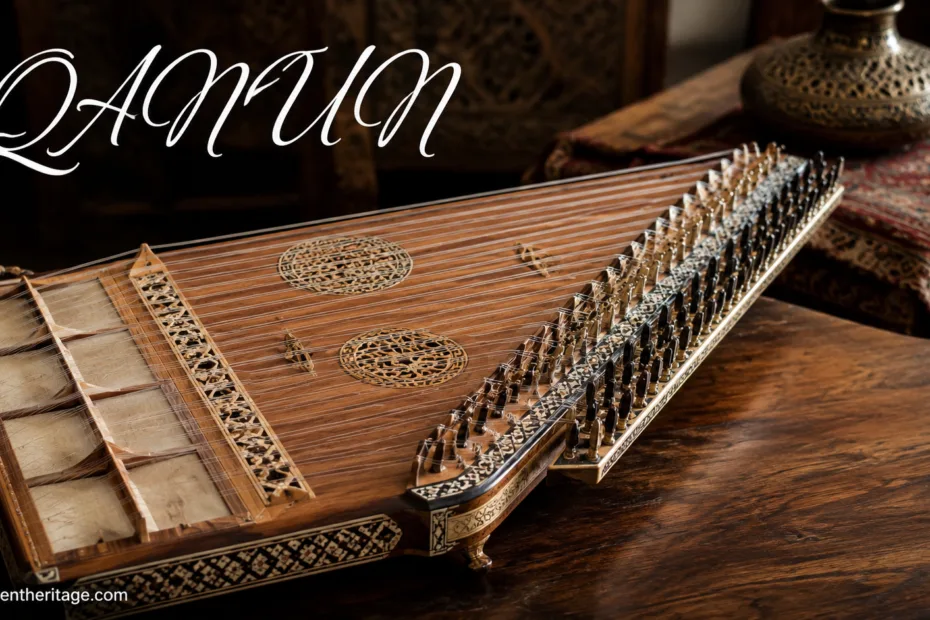
The qanun does not shout for attention. It sits flat on the lap or a small table, shaped like a neat wooden trapezoid, then fills the room with a bright, glassy shimmer. One touch can sound like falling water. A fast run can feel almost impossible to follow. This is the charm of the qanun: a plucked zither with a calm body, a restless voice, and a deep place in Middle Eastern, North African, Turkish, Armenian, Greek, and wider Mediterranean music culture.
| Detail | Qanun Information |
|---|---|
| Instrument Family | Chordophone, more specifically a plucked box zither with strings stretched across a flat soundboard. |
| Common Names | Qanun, kanun, kanoon, qanoun, qānūn. The spelling changes by language and region, but the instrument is closely related in form and playing method. |
| Body Shape | A flat trapezoid-shaped wooden body, wider on one side and narrower on the other, designed to hold many string courses under stable tension. |
| Typical String Layout | Many modern Arabic qanuns use around 81 strings arranged in triple courses, while some historical and regional instruments differ in course count and size.Reference-1✅ |
| Playing Method | Usually plucked with two small plectra attached to the index fingers, often with metal rings. The hands work like two quick birds over the strings. |
| Pitch Control | Small metal levers, often called mandals in Turkish practice, let the player shift pitch while performing. |
| Musical Role | The qanun can carry melody, decorate a vocal line, answer the oud, support an ensemble, or open a piece with a free taqsim. |
| Sound Character | Bright, ringing, precise, and liquid, with a fast attack and a sparkling decay. |
What Is the Qanun? 🎶
The qanun is a plucked zither used across many Middle Eastern and Mediterranean music traditions. It is built as a shallow wooden soundbox with many strings stretched across the top. The player does not press the strings against a fingerboard, because there is no fingerboard. Instead, the strings are tuned in courses, and the hands pluck them directly.
That is why the qanun feels different from the oud, saz, guitar, or violin. On those instruments, one string can create many notes under the fingers. On the qanun, the notes are already laid out across the surface. The musician moves over them like someone reading a map from left to right, only much faster.
In instrument classification, the qanun belongs to the zither family, and Britannica describes it as a plucked trapezoidal zither with three strings to each pitch and levers used for fast retuning in Arab scales.Reference-2✅ That short description is useful, but it does not capture the feel of the instrument. The qanun is exact, yes. It is also warm, decorative, and surprisingly expressive.
Plainly said: the qanun is like a small horizontal harp with a zither body and a clever pitch-changing system. It can sparkle in fast passages, then soften into a singing line without losing clarity.
The Name Qanun
The word qanun is often linked with ideas of rule, measure, or law. That makes sense musically. In an ensemble, the qanun can help define pitch with a clean and steady tone. It does not have the breathy slide of the ney or the rounded woodiness of the oud. Its sound lands clearly.
You may see different spellings: qanun, kanun, kanoon, qanoun, and qānūn. English spelling is not fully fixed because the word travels through several languages and writing systems. The instrument travels too.
Shape, Body, and Materials 🪵
The first thing most people notice is the shape. The qanun is not rectangular. It is a trapezoid, with one long side, one shorter side, and an angled edge where the pitch levers usually sit. This angled side is not decoration. It gives the instrument a practical layout for tuning pegs, levers, and string length.
A qanun body is usually made from carefully chosen wood. Walnut, maple, spruce, plane, and other tonewoods may appear depending on the maker and regional habit. The top must be light enough to respond. The frame must be strong enough to hold tension. If the body is too heavy, the sound can feel stiff. If it is too weak, the instrument may lose tuning stability.
The top board often includes ornamental sound holes, called kafes in some traditions. These are not only visual details. Their placement, size, and carving can affect how air moves inside the body. A good qanun does not just shine from the strings; it breathes through the wood.
The Bridge and Skin Sections
On many qanuns, the bridge rests over small skin-covered windows on the right side of the soundboard. These skin areas may be made from fish skin, goat skin, or other prepared membrane material depending on tradition and maker. The result is a tone that has a little bite at the start, followed by a clean ring.
This is one reason the qanun is not simply a flat harp. The bridge, skin, wood, and string tension all work together. Change one part, and the voice changes. A thicker bridge may add focus but reduce openness. A very thin top may respond quickly but become fragile. Instrument making is a balancing act. Always.
Small Parts That Shape the Voice
- Soundboard: the main vibrating wooden surface.
- Bridge: carries string vibration into the body.
- Skin windows: add a lively attack and special resonance.
- Tuning pegs: hold string tension and fine tuning.
- Mandals or levers: raise or lower pitch by small steps.
- Ornamental rosettes: help airflow and give the instrument its visual identity.
Strings, Courses, and the Mandal System ⚙️
A qanun usually has strings grouped in sets. A set of strings tuned to the same note is called a course. Many instruments use three strings per note, which gives the tone more width. When all three strings speak together, the sound has that familiar shimmer. Not a blur. A shimmer.
Older instruments used gut strings. Many present-day qanuns use nylon, PVF, or related synthetic materials. These strings are more stable under changing weather, though they still react to heat, humidity, and fresh tuning. Anyone who lives with a qanun learns this quickly: the instrument has moods.
What the Levers Do
The small metal levers near the left side are one of the qanun’s most clever features. A player can lift or lower them to change the sounding pitch of a course. In Turkish practice, these levers are often called mandals. In Arabic contexts, other terms may be used. The idea is the same: tiny pitch changes, made quickly.
This matters because Middle Eastern modal music uses pitch colors that do not always fit neatly into the twelve-note equal-tempered system familiar from the piano. The qanun can move through these shades with a mechanical elegance. The left hand may change levers while the right hand keeps playing. Done well, the change feels invisible.
The Metropolitan Museum of Art notes that a 19th-century Turkish qānūn in its collection has 72 strings grouped in 24 courses, and describes its adjustable levers as devices that raise the pitch of each triple course.Reference-3✅ That historical example also shows how the instrument’s build has changed over time. Present-day qanuns may be larger, with different lever counts and regional setups.
The Sound of the Qanun ✨
The qanun has a bright attack. The note appears quickly, almost like a spark. Then it rings. This makes fast ornamentation very clear. A skilled player can run through many notes without turning the melody into mud.
Its voice is often described as harp-like, but that comparison only goes so far. A harp usually has a rounder bloom. The qanun has more edge, more silver in the tone. It can be delicate, but it is not weak. In a small ensemble, it can cut through the sound of oud, ney, violin, riqq, and voice with surprising ease.
Why It Sounds So Clear
Several things create the qanun’s clarity. The plectra give each note a clean start. The grouped strings add shimmer. The flat soundboard spreads the vibration. The bridge and skin areas give a crisp touch to the tone. Put these together and you get a sound that is bright but not thin, decorated but still direct.
Players also use techniques that shape the color. They can play tremolo, broken chords, fast runs, repeated notes, octave passages, and soft answering phrases. Some use the left thumb or fingernail for temporary pitch bends. Some create a flowing harp-like texture under a singer. Some play sharply rhythmic patterns that almost sound percussive.
Listen for this: a qanun often sounds like many small beads of sound rolling across polished wood. The notes are separate, but they still feel connected.
How the Qanun Is Played
The player usually sits with the qanun on the lap, or places it on a small table or stand. The long straight side faces the body. The tuning pegs and lever area sit to the player’s left. The bridge is to the right. Both hands hover over the strings.
Each index finger wears a ring with a plectrum attached. Traditional picks could be made from natural materials, while many players now use synthetic picks. The pick must be firm enough to speak clearly but not so harsh that every note becomes sharp-edged.
The Two Hands Have Different Jobs
- Right hand: often carries melody, fast passages, repeated notes, and rhythmic patterns.
- Left hand: answers the melody, fills harmony, changes levers, and shapes small pitch movements.
- Both hands together: create rippling textures, octaves, tremolo, and call-and-response lines.
A beginner may first feel overwhelmed because the instrument has so many strings. After a while, the layout begins to make sense. The qanun is visual. The player sees the notes. Muscle memory grows from patterns, not from finger positions on frets.
The hardest part is not simply hitting the right string. It is staying musical while managing pitch levers, ornaments, rhythm, and tone. A good qanun player makes the mechanism disappear. You hear music, not machinery.
History and Cultural Life of the Qanun
The qanun has deep roots in the musical cultures of the Middle East and surrounding regions, but its present form is best understood through centuries of craft, court music, urban ensembles, and regional taste. It did not freeze into one shape. It changed as players asked for more range, more pitch control, and more flexibility.
Historical descriptions can be tricky because the word qanun may appear in older texts while the instrument form itself changes over time. The name is old; the familiar trapezoid zither form developed through later craft traditions. That difference matters. It keeps the story honest.
In Arabic Music
In Arabic music, the qanun is strongly connected with maqam, the modal system that shapes melody, ornament, mood, and movement. The qanun can introduce a mode, support a singer, or open space for instrumental improvisation. It is especially loved for taqsim, a free solo exploration where the player moves through related pitch colors with patience and taste.
The instrument’s clear pitch also made it useful in ensembles. When the oud is warm and rounded, the qanun adds shining edges. When the nay breathes, the qanun answers with beads of sound. When a singer stretches a phrase, the qanun can gently mirror the line without crowding it.
In Turkish Music
In Turkish music, the kanun has a close relationship with makam practice. The mandal system is highly developed, allowing fine pitch changes during performance. Turkish kanuns often have many levers, and players use them with great speed. The result can be very elegant: crisp articulation, quick modulation, and clean ornamentation.
The Turkish kanun also appears in classical ensembles, folk-influenced settings, film music, and modern acoustic projects. Its role is flexible. It can sound formal and polished in one setting, then intimate and earthy in another.
In Armenian, Greek, and Wider Regional Traditions
The qanun also appears in Armenian and Greek musical contexts, as well as in many mixed urban traditions around the eastern Mediterranean. Recordings, family ensembles, local teaching lines, and instrument makers all helped the qanun move beyond one single label.
A Library of Congress field recording from Fresno, California, made in 1939, documents Bedros Haroutunian playing open strings on the kanoon/qanun as part of materials connected with Armenian and Armeno-Turkish music.Reference-4✅ A small archive entry like that says a lot. The instrument was not only preserved in museums; it lived with musicians and families far from its older centers.
Arabic Qanun and Turkish Kanun: Main Differences
Arabic and Turkish instruments share the same broad identity, but they are not always built or tuned in the same way. The differences can be subtle to a casual listener and very clear to a player.
| Feature | Arabic Qanun | Turkish Kanun |
|---|---|---|
| General Size | Often slightly larger, with a wide, full tone. | Often a little smaller and lighter, though maker choices vary. |
| Pitch Language | Built for Arabic maqam practice and its familiar pitch shades. | Built for Turkish makam practice with highly detailed mandal use. |
| Lever Setup | May use levers arranged for common Arabic modal needs. | Often uses a dense mandal system for fine pitch movement. |
| Tone | Can sound broad, warm, and ringing. | Can sound focused, agile, and bright. |
| Best Understood As | A qanun shaped by Arabic repertoire and ensemble taste. | A kanun shaped by Turkish makam detail and performance habit. |
These are not strict boxes. Makers experiment. Players adapt. A skilled musician can bring personal color to almost any good instrument. Still, the regional setup matters because the lever system, string response, and tuning habits guide how the hands move.
Craftsmanship: What Makes a Qanun Feel Alive
A qanun can look beautiful and still feel dull under the fingers. The real test is response. When a player touches a string, the note should speak quickly without sounding brittle. The tuning pegs should hold. The levers should move cleanly. The body should ring, but not rattle.
Good makers think about wood thickness, bridge angle, string scale length, peg fit, lever placement, and the tension of each course. None of these details works alone. A small change in string material can affect the balance of the whole instrument. A slightly uneven bridge can make one register feel weak. The qanun is sensitive. That is part of its beauty.
Common Materials in a Well-Made Qanun
- Wood: used for the frame, back, sides, and soundboard.
- Skin or membrane: placed under the bridge area in many designs.
- Metal: used for levers, tuning pins, rings, and sometimes decorative details.
- Nylon or synthetic strings: common on many present-day instruments.
- Mother-of-pearl or wood inlay: used for decoration on some instruments.
Decoration can be lovely, but it should not hide poor construction. A qanun is not a wall ornament. It is a tension machine with a singing top. The best ones feel balanced before a note is even played.
The Qanun in an Ensemble
In a traditional ensemble, the qanun often sits near the center of the sound. It can lead, support, decorate, or answer. It does not need to dominate. Its clarity lets it speak with only a few notes.
With the oud, the qanun creates contrast: wood against shimmer. With the ney, it balances breath with precision. With the riqq or frame drum, it can lock into rhythm. With voice, it can trace the melody like fine thread around cloth.
Melodic Role
The qanun can carry the main tune clearly, especially in instrumental passages. Its fast attack keeps ornamentation clean.
Textural Role
It can fill space with tremolo, arpeggios, repeated notes, and soft answering phrases. A little can go a long way.
Similar Instruments and Close Relatives
The qanun belongs to the wider zither family, so it has cousins in many regions. Some are plucked. Some are struck. Some sit on the lap, some on a stand, and some are much larger. The family resemblance is easy to see: strings stretched across a body, with sound produced by direct vibration rather than a neck and fingerboard.
| Instrument | Main Region or Tradition | How It Relates to the Qanun |
|---|---|---|
| Santur | Persian and wider regional traditions | A trapezoid instrument too, but its strings are usually struck with light hammers rather than plucked with finger plectra. |
| Psaltery | Historical European and Middle Eastern contexts | A plucked zither family member; the qanun is often described as a trapezoidal psaltery in older reference language. |
| Koto | Japanese music | A long zither with movable bridges, plucked by the player, but with a very different body shape and musical language. |
| Guzheng | Chinese music | A large plucked zither with movable bridges and expressive bending techniques, broader and longer than the qanun. |
| Oud | Middle Eastern and Mediterranean traditions | Not a zither; it is a fretless lute. It often plays beside the qanun and offers a warmer, rounder tone. |
| Harp | Many global traditions | Shares plucked strings and ringing tone, but has a different frame, playing posture, and string layout. |
The closest comparison for many listeners is the santur, because both can have a trapezoid outline. The difference is immediate when heard. The santur is struck, giving it a hammered sparkle. The qanun is plucked, so each note has a sharper finger-made edge.
How to Recognize the Qanun by Ear
If you are new to the qanun, listen for a bright string sound that moves faster than a harp but feels lighter than a piano. The notes often come in little waves: runs, turns, tremolos, and glittering fills between vocal phrases.
The instrument can also produce a very touching slow melody. In a slow line, the qanun’s small pitch shifts and delicate repeats become easier to hear. The sound does not swell like a bowed instrument. It glows and fades. Then another note appears.
- Listen for clean plucked notes rather than bowed or blown sound.
- Notice the shimmer of triple strings when a note rings.
- Pay attention to fast ornaments around the melody.
- Hear how the qanun often answers a singer or oud phrase.
- Listen for tiny pitch colors created by lever changes or hand technique.
Why Musicians Love the Qanun
The qanun rewards patience. It asks for careful tuning, clean hands, relaxed wrists, and a good ear for pitch. It is not an instrument that forgives rough movement easily. Yet that same sensitivity gives it a rare range of expression.
A player can make it sound formal, intimate, playful, or meditative. It can decorate a melody like fine embroidery, then suddenly take the lead with a fast passage that wakes up the whole room. The instrument’s beauty is not only in its sparkle. It is in its control.
There is also something satisfying about its design. The qanun is openly mechanical. You can see the strings, pegs, levers, bridge, and soundboard. Nothing is hidden. Yet when a skilled musician plays it, all those visible parts turn into one flowing voice.
FAQ About the Qanun
Common Questions
Is the qanun the same as the kanun?
Yes, in most English usage, qanun and kanun refer to the same general instrument family. The spelling often changes by language, region, and transliteration style. Turkish sources commonly use kanun, while Arabic-related English writing often uses qanun.
Is the qanun hard to learn?
It can be challenging because the player must manage many strings, clean plucking, tuning, rhythm, and pitch levers. The first melodies can be learned step by step, but expressive playing takes a trained ear and calm hand control.
How many strings does a qanun have?
The number varies by maker and regional style. Many Arabic qanuns are often described with around 81 strings in triple courses, while some Turkish and historical examples may have different layouts. It is better to think in courses as well as total strings.
Why does the qanun have levers?
The levers let the player change pitch quickly during performance. This is especially useful in maqam and makam music, where melodies may use pitch shades that do not sit neatly on a piano-style twelve-note layout.
Is the qanun played with fingers or picks?
Most players use small plectra attached to rings on the index fingers. Some techniques may involve fingernails or special hand movements, but the classic sound comes from those bright, direct plucked strokes.
What music uses the qanun?
The qanun appears in Arabic, Turkish, Armenian, Greek, and wider Mediterranean music settings. It is heard in classical ensembles, folk-rooted performances, vocal accompaniment, instrumental solos, and modern acoustic projects.
What makes the qanun sound different from the oud?
The oud is a fretless lute with a rounded wooden tone. The qanun is a flat plucked zither with many open strings and a brighter, more ringing sound. In ensembles, they often balance each other beautifully.
Does the qanun only play melody?
No. It can play melody, ornaments, tremolo, broken chords, rhythmic figures, and soft background textures. Its clear tone makes it useful both as a lead instrument and as a graceful companion to voice or other instruments.
