
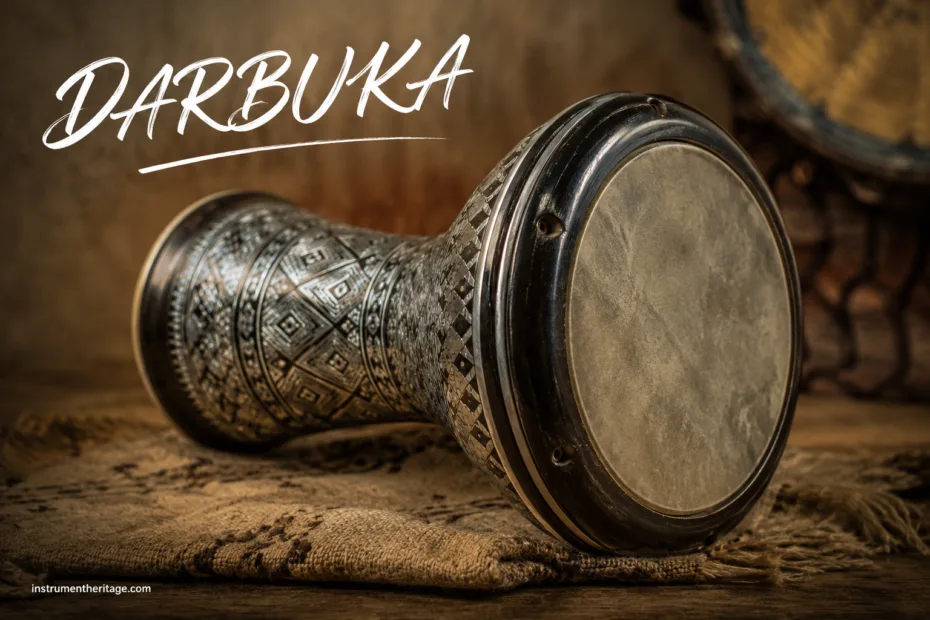
| FeatureInstrument family | Single-headed membranophone with a goblet-shaped, open-ended shell |
|---|---|
| Common English names | Darbuka, darabukka, darbouka, doumbek, dumbek and derbekkeh (usage changes by language and region) |
| Common regional terms | Darbuka in Turkish and wider international use; tabla in much Egyptian and Arabic everyday speech; derbakeh or related spellings in the Levant |
| Traditional body materials | Fired clay, pottery, wood, brass or other metal, often paired with an animal-skin membrane |
| Modern body materials | Cast aluminum is common; some instruments use copper, brass, ceramic, wood or synthetic composites |
| Head materials | Goat, fish or other natural skin on many traditional forms; replaceable plastic film on many modern tunable models |
| Typical modern size | Roughly 30–45 cm tall with a head near 17–23 cm across, though solo, bass and regional models fall outside this range |
| Main stroke syllables | Dum for the low center tone, tek for a bright rim tone, and ka for the supporting hand’s rim articulation |
| Sound character | A rounded bass note, dry edge attacks, finger snaps, muted taps and fast rolls with clear separation |
| Usual playing position | Across one thigh, tucked under an arm, held between the knees, or supported by a strap |
| Musical settings | Solo percussion, dance accompaniment, folk and urban ensembles, popular music, acoustic fusion and studio recording |
Darbuka speaks with two clear voices. A strike near the center gives the familiar dum, a low and rounded note. A touch near the rim produces the brighter tek, followed by a whole family of slaps, clicks, muted taps and rolling fingers. That contrast lets one small drum carry pulse, ornament and conversation at the same time. The instrument belongs to the single-headed goblet-drum family and appears across North Africa, the Middle East, parts of southeastern Europe and neighboring regions under several names. Museum records also document clay, wood and metal bodies, along with playing positions on the thigh, under the arm or from a strap.Reference-1✅
🥁 One Drum, Many Names
Darbuka is the most widely recognized international spelling, but it is not the only correct one. Darabukka, darbouka, darbukka, derbouka, doumbek and dumbek can refer to closely related goblet drums or to the same instrument filtered through different writing systems. The MIMO musical-instrument thesaurus groups several of these spellings under the preferred term darabukka.Reference-2✅
Regional speech adds another layer. In Egypt, a goblet drum is often called tabla, while players in parts of the Levant commonly use forms of derbakeh. Turkish musicians generally say darbuka. The word doumbek is especially familiar in English-speaking teaching and retail settings. None of these labels maps perfectly onto one factory specification, so the shape, head system and playing tradition matter more than the spelling on a box.
A useful distinction: the Persian tombak is also a goblet drum, yet it has its own construction, hand technique, repertoire and musical identity. Calling every goblet-shaped drum a darbuka erases details that players hear immediately.
🏺 What the Historical Record Actually Shows
Goblet-shaped drums have a long visual and material history across a broad stretch of Africa, western Asia and the eastern Mediterranean. Still, a familiar silhouette in an old image does not automatically prove a direct, unchanged line to the modern darbuka. Drum skins decay. Names move between languages. Bodies are repaired, replaced and adapted. A careful history separates related drum forms from a claim that one exact model remained unchanged for thousands of years.
Surviving museum instruments give firmer ground. The Metropolitan Museum of Art holds a late nineteenth-century Middle Eastern darabukka made from clay, skin and wood, as well as a late nineteenth-century Turkish metal example associated with Syria and Turkey. The metal instrument is classified as a single-headed goblet drum and measures about 37.4 cm in length with a head close to 18 cm across.Reference-3✅
Those records show that both ceramic and metal forms were established by the late 1800s. A later British Museum example, dated to the 1970s–1980s, uses a cylindrical ceramic base and a goat-skin head. It is only 20.6 cm high, a reminder that darbukas have never belonged to one fixed size.Reference-4✅
During the twentieth century, metal-shell instruments with mechanical tuning became common in professional and teaching circles. Replaceable synthetic heads made pitch more stable under changing humidity, while rounded rims allowed players to use harder slaps and rapid finger work with less contact against a sharp edge. Traditional clay-and-skin drums did not disappear. They kept their place because their tone, touch and response are different.
🛠️ Anatomy of the Goblet Shape
The darbuka body has four practical zones: the head opening, the rounded bowl, the narrow waist and the flared foot. Each part affects comfort, balance and sound projection. The body is hollow and open at the bottom. When the membrane moves, air is pushed through the shell and out of the base, while the shell itself reflects and colors part of the vibration.
The head and bearing edge
The membrane is the main vibrating surface. Its tension controls pitch and rebound: tighter heads respond quickly and speak with a bright edge; looser heads give a deeper center tone but may feel slower under light fingers. The surface meets the shell at the bearing edge. A smooth, even edge helps the head vibrate cleanly. On modern metal darbukas, the rim may curve over the tuning ring so the hands meet a rounded surface rather than exposed hardware.
Clay and natural skin
A ceramic shell has useful mass and stiffness. Paired with a glued or tied natural skin, it can produce a warm center note and a dry, woody edge. The membrane reacts to moisture and temperature, sometimes changing noticeably between a cool room and a hot stage. Players may gently warm a natural head to raise its pitch, but direct high heat can damage the skin, adhesive or clay. Patience is safer.
Metal and synthetic film
Modern cast-aluminum darbukas usually use a plastic head tightened by several bolts around the rim. They are durable, tuneable and less sensitive to weather. Their attack can be very crisp. Heavier shells often feel planted on the leg and may support a focused bass note, while thin decorative shells can be lively but may add more metallic ring. Construction quality matters more than decoration alone.
Wood, copper and other bodies
Wooden goblet drums tend to soften the sharpest overtones and give the hands a warmer surface. Copper and brass bodies are often chosen for appearance as well as tone, though two metal drums can sound very different because of wall thickness, bowl geometry, rim shape and head tension. Fiberglass and other composites appear in travel or stage-oriented instruments where low weight and stability are useful.
What careful makers pay attention to
- An even bearing edge with no sharp points
- A round head opening that allows balanced tension
- A smooth rim profile for repeated finger contact
- A stable base that does not rock on the floor
- Consistent shell thickness, especially around the waist
- Tuning bolts that turn cleanly and hold their setting
- A head that seats evenly without wrinkles or trapped edges
🔊 Why a Darbuka Sounds So Articulate
A darbuka does not produce one pitch in the way a flute or string does. Its membrane vibrates in several patterns at once. The center stroke excites lower modes and moves more air, creating the rounded dum. Rim strokes involve a smaller area of the head and contain more high-frequency energy, so they arrive as a sharper tek or ka.
The open goblet body helps separate these voices. Its narrow waist and flared foot shape the path of moving air, while the bowl supports the low note. A larger head normally offers more bass potential; a smaller, tighter head favors fast response and a brighter pitch. Yet size never acts alone. Head material, tension, shell mass and technique can overturn simple expectations.
A broad, singing bass
Look for a centered low stroke that blooms without a long metallic after-ring. The note should feel present even at moderate volume.
A clean, dry rim
The edge tone should separate from the bass. Too much uncontrolled ring can blur fast rhythm, though some players enjoy a more open, resonant voice.
✋ The Core Stroke Vocabulary
Darbuka technique is built from efficient motion, not force. Fingers rebound. Wrists stay loose. The drum answers best when the hand leaves the head quickly enough for the membrane to continue vibrating.
Dum: the center voice
The main hand reaches toward the center with relaxed fingers, often led by the ring finger and middle finger area rather than a stiff flat palm. The hand bounces away at once. Leaving it pressed on the surface turns the note into a mute. A good dum is full but not harsh.
Tek and ka: the paired rim voices
Tek is normally played by the main hand near the rim. Ka is the answering articulation from the other hand. Their exact fingerings differ between schools: some lead with one finger, others use two or three, and some rotate the hand slightly for a sharper contact. What matters is contrast. Dum should sound low; tek and ka should sound clear and light.
Slaps, mutes and snaps
A slap uses a loose hand shape and a quick contact that compresses the membrane for a bright accent. Muted strokes keep part of the hand on the head, shortening the note. Finger snaps and nail touches add small sparks between the main beats. These colors are not decoration pasted onto rhythm; they change the grammar of a phrase.
Rolls and split-finger motion
Fast rolls may alternate hands, cycle through individual fingers or combine both methods. Turkish-style playing is often associated with refined finger division and rapid rolls, while Arabic-oriented teaching often gives the large dum–tek contrast a strong role. Real players borrow across these labels. Technique travels easily.
- Set a steady pulse with dum and tek.
- Keep ka lighter so it supports rather than crowds the phrase.
- Add one muted note or snap in a repeated space.
- Use a roll to lead into an accent, then leave a small pocket of silence.
🎶 Rhythm Patterns and Musical Function
The darbuka can act as a timekeeper, a lead drum or both. In an ensemble, one player may state the main cycle while another adds fills around the melody. The best accompaniment leaves breathing room. Constant rolling can flatten the shape of a tune, just as nonstop speech can hide the meaning of a sentence.
Maqsum
Maqsum is a widely taught four-beat rhythm with a balanced low-and-high outline. A basic spoken form is often rendered as dum–tek–tek–dum–tek, with spaces that may be filled or left open. Those spaces matter. They allow the rhythm to fit many tempos and song styles.
Baladi
Baladi carries two opening bass strokes in many common versions, giving it a grounded, forward-moving character. The pattern is often felt as denser than maqsum, though tempo and ornament can transform it. A restrained baladi can be soft; a strongly accented one can fill a room.
Malfuf and ayyub
Malfuf is a compact two-beat cycle often used for entrances, transitions and lively sections. Ayyub is another two-beat pattern with a rolling, circular feel. Neither rhythm is defined by one frozen line of syllables. Local practice, tempo and the needs of a melody shape the final form.
Odd meters and changing accents
Darbuka playing also includes rhythms grouped in five, seven, nine and other uneven counts, especially in Turkish, Balkan and eastern Mediterranean settings. Players rarely experience these as mathematical puzzles. They learn a pattern as a sequence of long and short motions, strong and light steps, or a spoken phrase that settles naturally into the hands.
Rhythm names are maps, not cages. Two musicians may use the same name for slightly different accents, fills or stroke choices. Listening to the local style is more revealing than arguing over one written syllable line.
🎼 Darbuka in an Ensemble
With an oud, qanun, violin, ney or accordion, the darbuka often outlines the rhythmic cycle while following changes in melodic energy. A held note may invite a light roll. A phrase ending may call for a short fill. A singer’s breath may need silence. Skilled accompaniment is alert rather than busy.
In percussion groups, the darbuka may work beside the riq, frame drum, bendir, davul or small hand percussion. The riq can provide jingling subdivision and precise accents; a frame drum can add a broad, soft pulse; the darbuka cuts through with separated bass and rim tones. Their frequency ranges overlap, so players often choose different registers and leave gaps for one another.
Solo playing uses the same vocabulary with more freedom. The player can move from a sparse pulse to split-finger rolls, stop suddenly, then answer with one low note. Good solos are shaped by contrast: dense and open, loud and quiet, ringing and muted.
🔧 Tuning, Head Care and Everyday Maintenance
On a bolt-tuned darbuka, tension should be adjusted gradually in a crossing pattern rather than by tightening neighboring bolts in a circle. Small turns are enough. Tap near each bolt and listen for uneven areas; the pitches do not need laboratory precision, but large differences can cause a papery tone or wrinkles.
- Wipe synthetic heads with a soft, slightly damp cloth, then dry them.
- Keep natural skins away from prolonged moisture and sudden heat.
- Check tuning bolts for looseness, but do not force a resistant thread.
- Transport ceramic shells in a padded case with support around the rim and foot.
- Remove rings, sharp bracelets or rough-edged accessories before long playing sessions.
- Store the drum where the head is not pressed by other objects.
A synthetic head eventually loses clarity, dents or stops holding even tension. Replacement is usually straightforward if the correct diameter and rim style are available. Natural-skin replacement is more specialized because thickness, preparation, wet mounting and drying tension all affect the final sound.
🧭 Choosing Between Common Darbuka Types
| Type | Feel and sound | Practical character |
|---|---|---|
| Rounded-rim cast metal | Strong bass, crisp slaps, smooth contact for fast finger work | Stable tuning, replaceable head and broad use in lessons, ensembles and recording |
| Sharp-edge or exposed-ring metal | Bright attack and direct response | Can suit established technique, though the rim may feel less forgiving during long sessions |
| Clay with natural skin | Warm, dry and earthy, with a lively response to touch | More sensitive to climate and impact; favored for its traditional tactile character |
| Wooden goblet drum | Rounded overtones and a softer shell feel | Varies widely by maker, wood thickness and head system |
| Large bass model | Deeper dum and broad projection | Heavier to carry; useful when a low rhythmic foundation is wanted |
| Small solo or travel model | Higher pitch, fast response and compact voice | Easy to carry, though the bass may be less full |
The most useful test is separation. Play a relaxed dum, then a light tek. If the two notes sound almost identical, the head may be too tight, too loose or poorly seated. Check the rim under the fingers. Listen at low volume. A drum that only sounds convincing when struck hard may be tiring in real music.
🔄 Darbuka and Related Hand Drums
| Instrument | Body and head | Main distinction from darbuka |
|---|---|---|
| Tombak | Usually a one-piece wooden goblet body with natural skin | Persian technique uses detailed finger combinations, rolls and tonal control tied to its own classical repertoire |
| T’arija | Often a slender ceramic goblet with a skin head | Common in Moroccan settings; body proportions and local rhythmic use differ from many Turkish or Egyptian darbukas |
| Djembe | Carved wooden goblet body with rope- or mechanically tuned skin | Larger playing surface, different bass–tone–slap technique and West African ensemble traditions |
| Riq | Small frame drum with a skin or synthetic head and pairs of jingles | Not a goblet drum; combines membrane strokes with controlled jingle sound |
| Bendir | Wide frame drum, sometimes with internal snares | Produces a broad pulse and sustained buzz rather than the darbuka’s sharply divided center and rim voices |
Shape alone can mislead. Darbuka, tombak and djembe all narrow at the waist, but their rims, heads, hand positions and musical languages are not interchangeable. A player moving between them carries useful coordination, yet must relearn touch.
❓ Darbuka FAQ
Common questions about the goblet drum
Is darbuka the same as doumbek?
The words often refer to the same broad instrument family. Doumbek is common in English-language teaching and sales, while darbuka is widely used internationally. Regional makers may attach the labels to different rim shapes or shell styles, so the physical instrument matters more than the spelling.
Why is a darbuka sometimes called tabla?
In Egyptian and some Arabic usage, tabla can mean the local goblet drum. In South Asian music, tabla names a different pair of tuned drums. Context prevents confusion.
What is the difference between dum, tek and ka?
Dum is the open low tone near the center. Tek is a bright rim stroke from the main hand. Ka is a related rim sound from the supporting hand. Schools use slightly different fingerings, but the low-versus-high contrast stays central.
Are clay darbukas better than metal darbukas?
They serve different preferences. Clay with natural skin often feels warm, dry and responsive, while a tunable metal darbuka offers stable pitch, strong projection and easier head replacement. Build quality and the player’s touch matter more than a simple material ranking.
Can a darbuka be tuned to a specific note?
A bolt-tuned synthetic head can be brought near a chosen pitch range, but the drum produces many membrane frequencies rather than one pure note. Players usually tune for response, bass depth, rim clarity and ensemble balance.
Why does a darbuka lose its bass sound?
The head may be too tight, unevenly tensioned or damped by the hand. A dented or badly seated head can also weaken the center tone. Technique matters: the striking hand must rebound so the membrane can move.
Is darbuka difficult to learn?
The first dum and tek can be learned quickly, but clean tone, balanced hands, steady timing and controlled rolls take patient repetition. Progress is easier when sound quality comes before speed.
