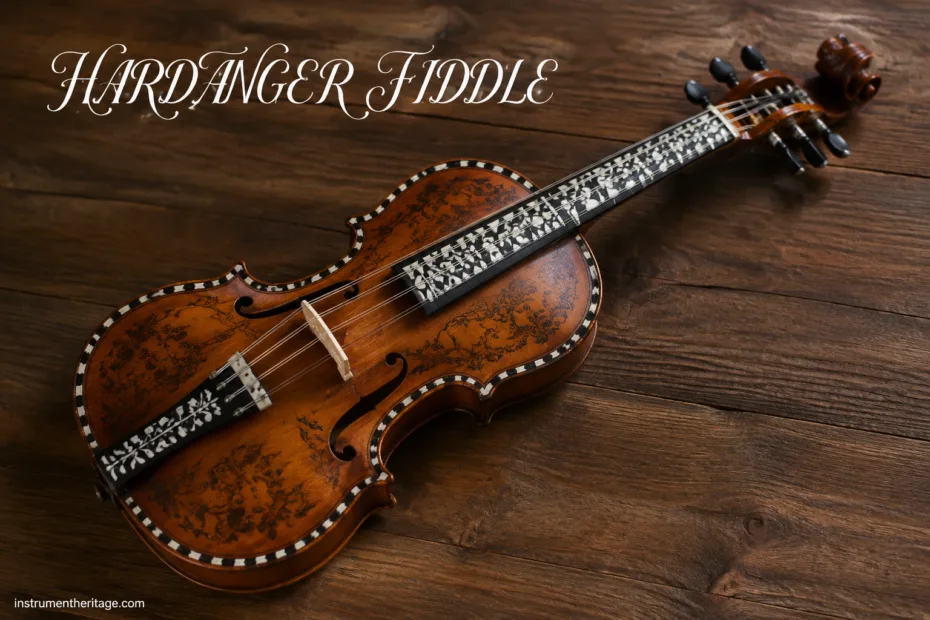
From across a room, a Hardanger fiddle can resemble an unusually ornate violin. Up close, the differences become much clearer. The Norwegian hardingfele normally has four bowed strings plus a second set of sympathetic understrings, a shorter neck, a relatively flat bridge, elaborate surface decoration, and a playing tradition built around tunings that may change from one tune to another.
The understrings are the feature that most strongly separates its sound from an ordinary violin. They are not normally touched by the bow. Instead, they respond acoustically to notes produced on the playing strings, adding sustained resonance around melodies, drones, double stops, and ornaments. Modern instruments commonly have four or five understrings, although historical examples vary. The instrument developed in Hardanger during the seventeenth century rather than appearing in one fixed form all at once. Reference-1✅
| Feature | Hardanger fiddle details |
|---|---|
| Norwegian name | Hardingfele |
| Instrument family | Bowed, unfretted fiddle of the violin family |
| Place of development | Hardanger, western Norway |
| Historical development | Seventeenth century; the modern violin-like form developed later |
| Bowed strings | 4 |
| Sympathetic strings | Usually 4 or 5 on modern instruments |
| Common playing-string tuning | A–D–A–E, with several other traditional tunings used |
| Construction traits | Often somewhat smaller and more arched than a violin, with a shorter neck and flatter bridge |
| Traditional materials | Wooden body; historical makers used materials including spruce, maple or black alder, horn, bone and shell-derived mother-of-pearl |
| Decoration | Rosing, decorative inlay, ornamented fingerboard and tailpiece, and often a carved head |
| Characteristic sound | Resonant, sustained tone shaped by understrings, open strings, double stops and ornamentation |
| Traditional repertoire | Regional dance tunes, wedding music, listening pieces and other Norwegian fiddle repertories |
🎻 The Strings You Play and the Strings You Do Not
A standard violin has four strings, all available directly to the bow. A Hardanger fiddle also has four main playing strings, but another group passes underneath the fingerboard. These lower strings are commonly called understrings, resonance strings, or sympathetic strings.
The distinction matters. Calling the hardingfele simply an “eight-string violin” or “nine-string violin” can suggest that every string is bowed in the same way. It is more accurate to describe the usual arrangement as four bowed strings plus four or five sympathetic strings.
- Bowed strings
- The player produces melody, drones, double stops and ornaments directly on these four strings.
- Understrings
- They run below the fingerboard and respond to compatible frequencies created during playing.
- Bridge
- It carries string vibration into the body and forms part of the mechanical path through which the instrument responds.
How sympathetic resonance works
When a bowed string vibrates, energy moves through the bridge and instrument body. If an understring is tuned to a frequency that matches, or relates closely to, part of the sound being produced, that understring can begin vibrating without being bowed. This is sympathetic resonance.
The response is selective. An understring does not simply copy every note. Its reaction depends on its tuning, the pitch being played, harmonic relationships, the strength of the excitation and the acoustic response of the individual instrument. Some notes therefore activate the lower strings more strongly than others.
Sound path: bow movement → playing-string vibration → bridge and body vibration → compatible understrings respond. The result is extra sustain and resonance around the directly played notes.
The full sound does not come from the understrings alone
Hardanger fiddle playing makes extensive use of double stops, open strings and ornamentation. A player may therefore create several audible pitch layers directly on the four upper strings before sympathetic resonance is added.
This distinction explains why the instrument can sound dense even in solo performance. The bowed strings establish the musical texture; the lower strings extend and reinforce parts of that texture acoustically.
How the Hardanger Fiddle Is Built
The hardingfele belongs close enough to the violin family that a violin maker would recognize much of its basic anatomy: arched plates, ribs, a neck, fingerboard, bridge, tailpiece, soundpost and bowed strings. Yet the proportions and setup are not simply standard violin dimensions with decoration added.
Body, neck and bridge
Traditional Hardanger fiddles show considerable variation from maker to maker and region to region. Many are somewhat smaller than ordinary violins, with pronounced arching and a shorter neck. The bridge is generally flatter, although the exact curvature can vary with regional playing preferences and the needs of a particular player.
A flatter bridge makes moving across adjacent strings different from doing the same thing on a classical violin. That construction suits a style where two-string playing and open-string accompaniment occur frequently.
A fingerboard with another job
The fingerboard has to accommodate the lower string system. The sympathetic strings travel through the space beneath it rather than lying beside the four main strings. Their route continues through the bridge area toward their attachment points, while extra tuning pegs at the head allow the player to adjust them separately.
This explains the unusual pegbox seen on many examples. A Hardanger fiddle needs enough tuning hardware for both sets of strings, so the head and peg arrangement immediately distinguish it from the four-peg layout of an ordinary violin.
Traditional woods and fittings
Older makers often worked with materials available in Norway. Historical construction descriptions include native spruce for the front, while maple or black alder could be used for the back and ribs. Fingerboards and tailpieces on older instruments could be faced with cow horn, while decorative work used bone and mother-of-pearl. Modern makers may instead use ebony and tonewoods familiar from contemporary violin making. Reference-2✅
Material choice is only part of the acoustic result. Plate thickness, arching, bridge geometry, setup, string choice and the response of the finished wooden body also affect how strongly the upper and lower strings interact.
| Construction point | Hardanger fiddle | Classical violin |
|---|---|---|
| Directly bowed strings | 4 | 4 |
| Sympathetic understrings | Usually 4–5 today | None in standard construction |
| Body proportions | Often somewhat smaller, with considerable maker-to-maker variation | More standardized modern violin proportions |
| Neck | Traditionally shorter | Longer standard violin neck |
| Bridge | Generally flatter | More strongly curved |
| Fingerboard area | Designed to accommodate understrings beneath it | No understring channel required |
| Tuning pegs | Extra pegs for resonance strings | Normally 4 |
| Surface decoration | Often extensive | Usually restrained |
| Playing-string tuning | Several traditional tunings | Normally G–D–A–E |
🎨 Rosing, Inlay and the Carved Head
The decoration is visually distinctive, but it should not be treated as the sole definition of a Hardanger fiddle. Even an undecorated hardingfele would retain its specialized string layout, tuning practices, bridge setup and other structural traits.
Rosing on the body
Rosing is the name commonly used for the flowing decorative line work seen across the body of many Hardanger fiddles. Designs can cover areas that would normally remain visually plain on a violin, including portions of the top and back.
The patterns differ. There is no single mandatory rosing design that identifies every authentic instrument, and makers developed recognizable decorative habits of their own.
Fingerboard and tailpiece inlay
The fingerboard and tailpiece can carry dense geometric or floral-style inlay. Bone, mother-of-pearl and dark woods appear in historical examples, producing strong contrast across relatively small surfaces.
A Hardanger fiddle in The Metropolitan Museum of Art dated 1786 offers a useful documented example rather than a template for every instrument. Its record describes a carved fanciful animal head, a gilded crest, bone components, ebony and mother-of-pearl inlay, and elaborate ink decoration on the front and back. The instrument has four playing strings and four sympathetic strings. Reference-3✅
Not every head is the same
Carved heads are common enough to be associated strongly with the instrument, but their subjects vary. Animal forms, human heads and other carved designs occur. Describing every Hardanger fiddle as having a dragon head is therefore too narrow.
Decoration and construction serve different roles. Rosing and inlay establish much of the instrument’s visual identity. The understrings, specialized setup, dimensions and tuning practices explain why it also behaves differently from an ordinary violin.
One Fiddle, Many Traditional Tunings
A violinist normally expects G–D–A–E to remain the basic open-string arrangement. Hardanger fiddle tradition is different. Players use multiple felestiller, or fiddle tunings, selected according to repertoire, region, pitch level and the resonance wanted from the instrument.
Norwegian reference literature documents roughly 25–30 Hardanger fiddle tunings. Only a smaller group is used frequently. A–D–A–E, known as oppstemt bass, is among the central traditional arrangements.
| Traditional name | Playing strings | What changes |
|---|---|---|
| Oppstemt bass | A–D–A–E | The lowest violin-equivalent string is raised, creating useful open-string relationships for a large part of the repertoire |
| Nedstemt / low bass | G–D–A–E | Matches ordinary violin string intervals and pitches |
| Trollstilt | A–E–A–C♯ | Changes both open-string intervals and the resonance available to tunes associated with this tuning |
| Gorrlaus | F–D–A–E | Lowers the bottom string well below the A used in oppstemt bass |
Tuning names can vary between districts, so the pitch sequence is often more informative than the name alone. The understrings must also be adjusted to suit the main-string setup; changing the four bowed strings without considering the resonance strings would alter the acoustic relationships that the tuning is intended to produce.
Why retuning changes more than pitch
Changing an open string affects several things at once. It changes the notes available as drones, the intervals beneath a melody, the position of open-string double stops and the frequencies likely to excite the understrings most strongly.
That is why a traditional tuning is part of the musical design of a slått, not merely a technical adjustment made before playing. Two tunes fingered in similar areas of the fingerboard can feel and sound quite different when their open strings and sympathetic resonance are organized differently.
🎶 How Hardanger Fiddle Playing Builds Its Texture
Hardanger fiddle performance is not simply violin technique transferred onto another instrument. The construction and repertoire encourage their own habits of bowing, fingering and resonance.
Double stops are part of the normal language
Traditional players make frequent use of two sounding main strings at once. One may carry the moving melody while another provides an open or changing accompanying pitch. The relatively flat bridge helps make this kind of playing practical.
The effect should not be confused with the sympathetic understrings. A double stop consists of strings directly engaged by the bow. The understrings add another acoustic layer without being bowed.
Ornamentation is part of the melody
Hardanger fiddle style uses frequent ornamentation. Small finger movements, repeated figures, bow articulations and decorated pitch transitions can shape how a tune is recognized from one tradition or performer to another.
The ornaments also interact with resonance. A short decorative note may activate a different set of overtones or understrings than the sustained note beside it, so details that look small in notation can have a clearly audible effect.
Slått, dance rhythm and regional style
A traditional instrumental tune is commonly called a slått. Hardanger fiddle repertory includes regional dance forms such as halling, gangar, rull and springar, along with wedding marches and pieces intended mainly for listening.
Dance repertory makes rhythm an active part of performance practice. Bow accents, phrase length and repeated motives have to support movement rather than merely produce a sequence of notes. Regional differences matter here: the same broad dance category can carry local rhythmic and stylistic traits.
Three sources of the characteristic texture
- Directly bowed harmony: double stops and adjacent-string playing.
- Open-string support: sustained pitches can accompany fingered melody notes.
- Sympathetic response: understrings reinforce selected frequencies without direct bow contact.
From Seventeenth-Century Hardanger to the Modern Hardingfele
The hardingfele took shape in Hardanger during the 1600s. Its ancestry is better described as a process of development than as the work of one inventor on one date. Older Norwegian bowed instruments and the European violin tradition both formed part of the setting in which the instrument emerged.
The 1651 instrument
The oldest known Hardanger fiddle is generally dated to 1651 and associated with Ole Jonsen Jaastad of Ullensvang in Hardanger. That date provides evidence that the instrument type was developing by the middle of the seventeenth century; it should not be treated as a proven single-year invention date.
Later makers, including Isak Nilsen Botnen and his son Trond Isaksen Flatebø, contributed to the early development and reputation of the instrument. Makers continued changing proportions, decoration, string arrangements and setup rather than following one permanently fixed model.
It did not remain confined to Hardanger
The name points to Hardanger, but the playing tradition spread beyond that district. Hardanger fiddle traditions became established in places including Valdres, Hallingdal, Telemark, Voss, Setesdal and other parts of southern and western Norway.
This geographic spread did not produce one uniform national style. Local musicians maintained different repertories, tunings, bowing habits and preferences in instrument setup. Even bridge curvature can vary according to the amount and type of multi-string playing favored in a regional tradition.
The modern violin-like shape arrived gradually
Early hardingfeler could be noticeably different in outline and arching from a modern violin. During the nineteenth century, makers in Telemark, including members of the Helland maker tradition, developed forms that moved closer to violin proportions while retaining the traits associated with the Hardanger fiddle.
By the later nineteenth century, the instrument could therefore look more violin-like without becoming a standard violin. The understring system, decorative language, tuning practice and performance tradition remained central identifiers.
Related Instruments and Where the Similarity Ends
The Hardanger fiddle is not the only bowed instrument to use sympathetic resonance. Comparing it with a few related instruments helps separate the idea of resonance strings from the specific Norwegian instrument built around them.
| Instrument | Relationship to the Hardanger fiddle | Main difference |
|---|---|---|
| Violin | Closest visual and structural relative; four directly bowed strings | Standard violin lacks sympathetic understrings and normally uses fixed G–D–A–E tuning |
| Viola d’amore | European bowed instrument also known for sympathetic strings | Different body, tuning, repertory and historical performance tradition |
| Nyckelharpa | Swedish bowed instrument that can also use sympathetic strings | Notes are stopped through a key mechanism rather than a violin-style fingerboard |
| Ordinary Norwegian fiddle | Shares Norwegian regional dance and fiddle traditions | Does not use the Hardanger fiddle’s characteristic understring construction |
The comparison also shows why “a violin with extra strings” is incomplete. Sympathetic strings occur elsewhere. A hardingfele is identified by the particular combination of Norwegian construction, tuning, decoration, repertoire and playing practice.
A Folk Instrument That Is Still Played and Taught
The Hardanger fiddle belongs to a continuing performance tradition rather than only to historical collections. Musicians still learn regional repertory, play for dancing, perform on concert stages, teach younger players and use the instrument in newly composed or arranged music.
A clear example is the traditional music and dance practice of Setesdal. UNESCO inscribed the practice on the Representative List of the Intangible Cultural Heritage of Humanity in 2019. Its description identifies the Hardanger fiddle and jaw harp as instruments used for the music and describes transmission through community practice and learning. Reference-4✅
UNESCO also describes the Hardanger fiddle as Norway’s national instrument in that entry. The wording is useful as a description of its cultural status; it should not be read as proof of a separate legal declaration establishing an official national instrument.
That continuing tradition also explains why modern hardingfeler should not be expected to reproduce one museum model exactly. Makers and players work inside a recognizable tradition while still making choices about dimensions, setup, materials, ornament, pitch and regional playing requirements.
Hardanger Fiddle Questions
Is a Hardanger fiddle the same as a violin?
No. It is closely related to the violin and shares four bowed strings and much of the same basic body anatomy, but a Hardanger fiddle normally adds sympathetic understrings, uses different traditional tunings, often has a shorter neck and flatter bridge, and belongs to its own Norwegian performance tradition.
How many strings does a Hardanger fiddle have?
Most modern instruments have four playing strings plus four or five sympathetic understrings, giving a total of eight or nine. Historical instruments have used other numbers of understrings.
Are the sympathetic strings played with the bow?
Normally, no. The bow acts on the four upper playing strings. The understrings vibrate sympathetically when compatible frequencies from the played notes excite them.
What is the normal Hardanger fiddle tuning?
There is no single tuning used for every tune. A–D–A–E, called oppstemt bass, is one of the most common traditional arrangements. G–D–A–E, A–E–A–C♯ and F–D–A–E are among other documented tunings.
Why does a Hardanger fiddle sound more resonant?
The sympathetic strings add resonance when their frequencies respond to notes and harmonics produced on the bowed strings. Double stops, open strings, ornamentation and the instrument’s physical setup also contribute to its sustained texture.
Why are Hardanger fiddles so decorated?
Decoration became a recognizable part of the maker tradition. Rosing, inlaid fingerboards and tailpieces, contrasting materials and carved heads can all appear. Designs vary by maker and period, so no single decorative pattern is required on every instrument.
Where did the Hardanger fiddle originate?
It developed in the Hardanger region of western Norway during the seventeenth century. The oldest known example is generally dated to 1651, while later makers continued changing the instrument’s form.
Can a violinist play a Hardanger fiddle?
A violinist already understands the basic bowed-string layout and left-hand principle, but traditional hardingfele playing requires adjustment. The tuning system, flatter bridge, frequent double stops, resonance, lighter string setup and regional ornamentation make it a distinct playing practice rather than a direct violin substitution.
Is the Hardanger fiddle still used today?
Yes. It remains part of Norwegian folk performance, dance, teaching, competitions and concert music. The living Setesdal music and dance tradition recognized by UNESCO includes Hardanger fiddle performance.
