
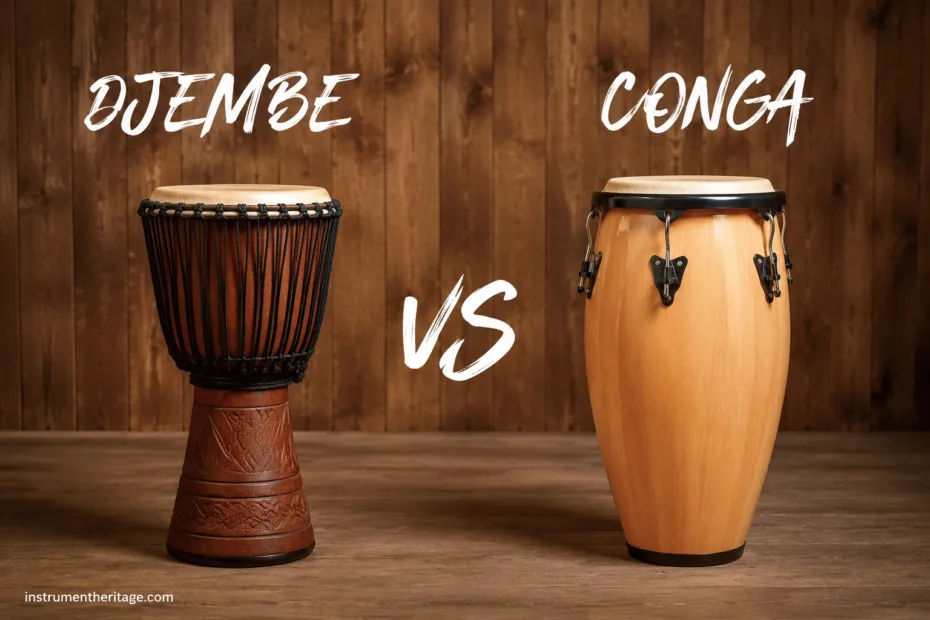
Djembe and conga are both single-headed hand drums, but the similarity fades once their construction, tuning and playing technique are compared. A traditional djembe has a goblet-shaped body associated with the Mandé region of West Africa and commonly produces distinct bass, tone and slap sounds from one drumhead. A conga, also called a tumbadora, has a taller, narrower shell rooted in Afro-Cuban percussion and is commonly played with open, bass, slap and muted strokes. Congas can also be arranged as several differently pitched drums. These differences affect almost everything the player feels and hears.
| Feature | Djembe | Conga |
|---|---|---|
| Instrument family | Single-headed goblet drum | Single-headed tall hand drum, commonly called a tumbadora |
| Cultural setting | Mandé musical traditions of West Africa | Afro-Cuban musical traditions |
| Shell profile | Wide bowl, narrow throat and flared lower foot | Tall shell with a narrower playing head and an open lower end |
| Traditional shell construction | Often carved from a single piece of wood | Modern wooden models are commonly made from joined staves; other shell materials also exist |
| Traditional or common head | Goatskin is strongly associated with traditional djembes | Natural skin or synthetic heads, depending on model and maker |
| Typical tuning | Rope tension on traditional designs | Metal tension lugs pulling a counterhoop |
| Modern exceptions | Key-tuned and synthetic-shell djembes are available | Wood, fiberglass and other modern constructions are available |
| Main hand sounds | Bass, tone, slap, plus additional articulations | Bass, open tone, slap, muted tones and other hand articulations |
| Pitch arrangement | Wide sound contrast can be produced on one drum | Several congas of different sizes can provide separate pitches |
| Common setup | One or several djembes, often within a larger percussion ensemble | One conga or a set of two, three or more drums |
| Playing position | Seated, supported between the legs, on a stand, or suspended by a strap | Usually seated or placed on a stand when played standing |
| Strong musical associations | Mandé djembe repertoire and contemporary hand-percussion settings | Rumba, salsa, Latin jazz and other Afro-Cuban or Latin percussion settings |
Why a Djembe and Conga Have Such Different Shapes
The body profile is the easiest difference to see. It also changes how the drumhead, shell and air inside the instrument interact.
The djembe has a goblet-shaped shell
A traditional djembe starts with a broad upper bowl. The shell narrows into a throat and then opens again toward the bottom. This gives the instrument its familiar goblet shape. The drum is open underneath.
Traditional Mandé examples may be carved from one piece of wood. The skin is secured around the upper bowl with rings, while a rope system runs between upper and lower rings to create tension. The Metropolitan Museum of Art classifies its historical jembe examples as single-headed goblet drums and documents wood, hide, metal rings and rope or cord in their construction. Reference-1✅
- Upper bowl
- The wide section directly below the head.
- Throat
- The narrowest part of the shell.
- Foot
- The lower section that widens toward the open bottom.
- Bearing edge
- The upper rim of the shell where the drumhead changes direction over the body.
The conga uses a tall, narrower shell
A conga does not have the djembe’s narrow waist and flared foot. Its body is much taller in relation to the diameter of its playing surface, with a gentle widening through part of the shell before narrowing toward the open bottom.
Many wooden congas use stave construction: separate shaped pieces of wood are joined together to form the shell. The method is well suited to the tall curved body. Modern instruments can also use fiberglass or other engineered materials.
The upper hardware is equally distinctive. A modern conga typically has a head held beneath a metal counterhoop. Tension hooks or rods connect that hoop to brackets mounted on the shell. Turning the nuts changes head tension and therefore pitch and response.
🥁 Shape matters: calling the conga a “tall djembe” misses several structural differences. The shell profile, head mounting system, playing technique and normal ensemble setup are all different.
Djembe and Conga Hand Technique Is Not Interchangeable
Both instruments are played directly with the hands. That does not make their strokes identical. Hand position, contact area, rebound and the amount of time the hand remains on the membrane all affect the result.
Djembe technique centers on clear bass, tone and slap separation
The three sounds most closely associated with djembe technique are bass, tone and slap. A skilled player makes them clearly different from one another.
- Bass: played toward the center of the membrane, producing the lower part of the drum’s range.
- Tone: played closer to the edge with the fingers contacting the head in a way that allows a clear, open response.
- Slap: also produced toward the outer playing area, but with a different hand action that creates a sharper attack and higher-frequency content.
The difference is not simply how hard the player strikes. A loud tone is still a tone. A correctly formed slap depends on how the hand reaches and leaves the membrane. Percussive Arts Society material on djembe instruction treats the clear separation of bass, tone and slap as a basic part of djembe playing and specifically notes that these sounds should not simply be transferred from conga technique. Reference-2✅
Conga playing uses another set of hand articulations
Conga technique also includes bass and slap sounds, yet the open tone has a particularly strong role. Muted or closed tones add another layer of articulation. Heel-and-finger or heel-tip movements are also used in many conga techniques, especially when continuous patterns require one hand to alternate between different contact points.
| Stroke | Djembe | Conga |
|---|---|---|
| Bass | Central stroke forming the low sound of the drum | Central or near-central stroke used for low resonance |
| Open tone | Usually discussed simply as tone in basic djembe technique | A central part of conga technique, with a clear ringing pitch |
| Slap | Sharp edge-area articulation using djembe-specific hand mechanics | Sharp articulation with conga-specific hand placement and motion |
| Muted tone | Possible, though not one of the basic three sounds normally used to introduce the instrument | Commonly used as part of the conga stroke set |
| Heel-tip motion | Not part of the basic three-note djembe technique | Used in several conga patterns and hand-motion systems |
Technique detail: the word slap appears in both instruments, but the shared name does not mean the hand should move in exactly the same way. Drumhead tension, rim geometry and established playing practice change the stroke.
One Djembe Can Cover a Wide Range; Congas Often Divide Pitch Between Drums
A single djembe can move from a low central bass to a dry, sharp slap without changing instruments. That broad contrast is one reason the location of each strike matters so much.
Congas can certainly be played one at a time. Multi-drum setups are also deeply established in professional playing. Different shell and head sizes give the player several tuned drums within reach, allowing pitch changes to come from both hand technique and movement between drums.
The Metropolitan Museum of Art describes the modern conga as developing from earlier Afro-Cuban instruments and notes that professional players commonly use sets of two or three. Its three-drum Jay Bereck set consists of an 11-inch quinto, a 12-inch tres golpes and a 13-inch tumba. Naming is not perfectly uniform across every tradition, manufacturer or setup, so these labels should not be treated as a fixed size chart for every conga set. Reference-3✅
Djembe sound layout
Center: bass
Outer playing area: tone and slap
One membrane can provide strongly separated sound types.
Conga pitch layout
Each drum: several hand articulations
Across a set: separate drum pitches
Pitch can change through technique and by moving to another drum.
This does not mean djembe music is based on a lone drum. Djembe traditions can involve several djembes and other percussion instruments. The distinction concerns what one individual drum is normally expected to provide and how multiple drums are organized around it.
Rope Tension and Metal Lugs Make Tuning Feel Very Different
Traditional djembe tuning
A traditional rope-tuned djembe uses vertical cords connecting the upper ring system to a lower ring around the body. Greater rope tension pulls the head more tightly over the bearing edge. Players and drum builders can add tension by working the rope through the existing verticals in a patterned series of crossings.
A tighter membrane generally raises pitch and changes rebound. A looser membrane lowers it. Even tension around the head matters because uneven tension can produce inconsistent response around the playing surface.
Conga tuning
Most modern congas use metal hardware. A wrench turns the nuts on the tension rods or hooks, pulling the counterhoop downward and stretching the head. Small changes can be made at several points around the drum until the head responds evenly.
Multi-conga players can then tune neighboring drums to clearly separated pitches. The exact interval is a musical choice; there is no single mandatory tuning relationship that applies to every conga setup.
Not every modern djembe uses rope
The familiar wood-and-rope djembe remains closely tied to the traditional instrument, but modern construction is broader. Key-tuned djembes use tension rods, while some models use synthetic shells and manufactured drumheads. Remo, for example, provides tuning instructions for its key-tuned djembes, where rods are adjusted around the head to balance pitch and response. Reference-4✅
🔧 Construction note: “djembe equals rope” works when describing the traditional form, not every instrument sold today. Shell shape and playing design are more reliable identifiers when modern models are included.
Wood, Skin and Modern Materials Change the Response
Materials do not identify either drum by themselves, though they affect weight, feel, overtone behavior and resistance to changes in humidity.
Traditional djembe materials
Traditional djembes are closely associated with solid carved hardwood shells and goatskin heads. The relatively thin natural skin can respond quickly under high tension, helping skilled players separate the low bass from the much sharper tone and slap articulations.
Natural skins react to their environment. Temperature and humidity can change membrane tension, so the same drum may feel slightly different after moving between conditions.
Conga materials
Wooden congas are often constructed from staves and can use woods such as ash or other suitable hardwoods. Fiberglass shells are also established in modern percussion. Heads vary by maker and instrument: natural skin remains widely used, while synthetic alternatives are available for players who want a more stable response across changing conditions.
A material label alone cannot predict which drum will sound “better.” Head thickness, shell dimensions, bearing edge, tuning and the player’s touch can outweigh a simple wood-versus-synthetic comparison.
Why Their Bass, Open Tones and Slaps Sound Different
The easiest listening test is not “Which one is deeper?” There is no fixed answer that applies to every djembe and every conga.
Head diameter, membrane mass, tension, shell dimensions and playing force all influence pitch. A large, loosely tuned drum can sit lower than a smaller, tightly tuned one regardless of the name printed on it.
Djembe sound contrast
The djembe is especially effective at creating a strong contrast between the central bass stroke and outer-area tone or slap strokes. The player can move between low resonance and a short, bright attack very quickly while staying on one membrane.
Conga pitch definition
A well-produced conga open tone has a clearly perceived pitch and sustained resonance. When several congas are tuned apart, that pitch definition becomes part of the percussion arrangement. A passage can move between a high quinto and lower drums while the hands continue using open, muted, bass and slap articulations.
🎵 Avoid fixed frequency claims: statements such as “a djembe is always higher than a conga” ignore drum size and tuning. Individual instruments must be measured under known conditions before exact frequency values mean anything.
Can the Same Rhythm Be Played on Both?
The timing of a rhythm can be transferred from one drum to another. The result will not automatically reproduce the original instrument’s technique or ensemble role.
A sequence written as bass–tone–slap, for example, can be approximated on either drum because both instruments are capable of low, open and sharp articulations. The physical execution changes. Conga patterns may also depend on muted strokes, heel-tip motion or movement between drums. Djembe repertoire can depend on a particular separation of bass, tone and slap together with parts played by other drums in the ensemble.
- The rhythmic timing may be transferable.
- The hand technique should remain appropriate to the instrument being played.
- The pitch arrangement may change when a multi-conga part is reduced to one drum.
- The ensemble function can change even when the written rhythm looks similar.
This is why an experienced conga player can understand a djembe pattern quickly yet still need time to develop a convincing djembe slap. The reverse can happen to a djembe player learning conga technique.
Playing Position Changes the Physical Experience
A full-size djembe is often played while seated with the drum supported between or near the legs and the bottom opening kept clear. It can also be carried on a strap for standing performance, and stands are available.
A conga is tall enough to stand upright beside a seated player. A standing player commonly uses a conga stand. When two or three drums are used, their arrangement must allow both hands to reach each playing surface without unnecessary movement.
This becomes a practical difference away from the stage. One portable djembe can offer bass, tone and slap without a multi-drum setup. A conga player who wants several pitches may need several shells and stands. A single conga remains fully playable, so a set is an option rather than a requirement.
Their Musical Backgrounds Explain Many of the Design Differences
Djembe and the Mandé region
The djembe, also spelled jembe in museum and scholarly contexts, is associated with Mandé musical traditions across parts of West Africa. Its history is especially connected with areas that include present-day Guinea and Mali, with related traditions extending into neighboring regions.
Djembe performance is therefore more than a generic form of hand drumming. Regional repertoire, ensemble parts, accompaniment patterns and solo practices vary. Even pieces sharing a name can differ according to place and teaching lineage.
Conga and Afro-Cuban percussion
The conga’s traditional Spanish name is tumbadora. The modern instrument developed in Afro-Cuban percussion and became closely associated with rumba before gaining a large role in salsa, Latin jazz and many other styles.
Its multi-drum potential fits music where several tuned percussion parts interact. The higher quinto, for instance, has a different pitch and musical function from lower drums in traditional and modern setups (the exact configuration depends on the music being played).
🌍 Relationship: djembe and conga share broad connections with African hand-drumming practices, but they developed within different musical traditions. A conga is not a type of djembe, and a djembe is not a conga with a different shell.
Where Bongos, Ashiko and Dunun Fit Beside Them
Several other drums appear near djembe and conga in percussion discussions, yet each has its own construction and playing role.
| Instrument | How it differs from djembe and conga |
|---|---|
| Bongos | A connected pair of small Afro-Cuban hand drums. Their size, paired arrangement and finger-oriented technique clearly separate them from both full-size djembes and congas. |
| Ashiko | A single-headed hand drum with a tapered shell. Its profile lacks the djembe’s pronounced goblet waist and foot. |
| Dunun | A cylindrical drum family strongly associated with djembe ensembles in several West African traditions. Dununs commonly provide lower rhythmic and pitched parts and are normally played differently from a hand-struck djembe. |
| Tubano | A modern tall hand drum designed for accessible hand percussion. Its upright form can resemble a conga, but its construction and musical background differ. |
Bongos are therefore closer to congas in cultural setting, while dununs have a much closer ensemble relationship with djembes. Visual similarity alone is a poor way to classify hand drums.
Djembe or Conga for a Beginner?
Neither instrument is automatically easier. A beginner can make a basic sound on either fairly quickly; producing consistently clean tones takes much longer.
| Musical interest or setup | Likely fit | Reason |
|---|---|---|
| Learning Mandé djembe repertoire | Djembe | The instrument and its bass-tone-slap technique belong directly to that repertoire. |
| Learning Afro-Cuban conga technique | Conga | Open tones, muted articulations and established conga patterns require the correct drum. |
| Starting with one portable hand drum | Djembe often suits this setup | One drum can produce a broad bass-to-slap range and can be carried with a strap. |
| Interested in a tuned multi-drum setup | Conga | Different conga sizes can be placed together and tuned to separate pitches. |
| Playing salsa or Latin jazz percussion | Conga | Congas have an established role in these styles. |
| General hand-percussion exploration | Either | Both develop hand control, timing and tone production, though the techniques should be learned separately. |
The musical tradition a player wants to study is usually more useful than trying to declare one drum universally easier. Someone drawn to djembe repertoire gains little by choosing a conga solely because its lug tuning looks convenient. The same applies in reverse.
Common Points of Confusion
“All djembes are rope-tuned.”
Rope tuning defines the familiar traditional construction, but modern key-tuned djembes exist. Synthetic shells and synthetic heads are also available.
“Congas have to be played in pairs.”
A single conga is a complete instrument. Two- and three-drum setups are common because they add separate pitches and expand the available patterns.
“The taller drum must have the lower pitch.”
Pitch depends on several physical variables. Head diameter and tension matter greatly. A drum’s height by itself cannot determine the result.
“A slap is the same stroke on every hand drum.”
The sound name may be shared. The motion is instrument-specific. Djembe and conga players use different contact, rebound and hand-position details to create their characteristic slap sounds.
“Djembe and conga are two names for nearly the same drum.”
Their shell geometry, tuning hardware, traditional repertoire and playing technique separate them clearly. They belong in the same broad category of hand-played membranophones, not in the same instrument type.
Djembe vs Conga FAQ
Are djembe and conga drums the same instrument?
No. Both are single-headed hand drums, but a djembe is a goblet drum associated with Mandé traditions, while the conga or tumbadora developed within Afro-Cuban percussion. Their shells, tuning systems and established techniques differ.
Which has a deeper sound, djembe or conga?
There is no universal winner. Head diameter, membrane thickness, shell dimensions and tuning all affect pitch. A djembe has a particularly noticeable low central bass compared with its own higher tone and slap, while congas can distribute different pitches across several drums.
Can you play conga rhythms on a djembe?
The timing of many patterns can be transferred, but the result is an adaptation. Conga-specific open tones, muted strokes, heel-tip movements and multi-drum pitch changes may not translate directly. The rhythm can move; the original technique does not automatically move with it.
Can a conga be played by itself?
Yes. A conga does not require a second drum to function. Multi-conga setups expand the available pitches and patterns, which is why sets of two or three are common among experienced players.
Do all djembes have goatskin heads?
No. Goatskin is strongly associated with traditional djembe construction, but modern instruments can use manufactured drumheads. Synthetic-shell and key-tuned models are also available.
Is a djembe easier to carry than a conga?
Many full-size djembes are designed to work as a single portable drum and can be played with a strap. Congas are tall instruments, and a player using several drums may also carry stands. Actual weight still varies with shell material and size.
Why do conga players use drums of different sizes?
Different head and shell dimensions allow the drums to be tuned to separate pitches. A player can then change pitch by moving between drums while also changing the sound through open, bass, slap and muted hand strokes.
Which drum should someone learn first?
Choose according to the music being studied. Djembe is the direct choice for Mandé djembe repertoire. Conga is the direct choice for Afro-Cuban conga technique, rumba, salsa and related percussion styles. For general hand percussion, either can be a good first instrument when its own technique is learned properly.
