
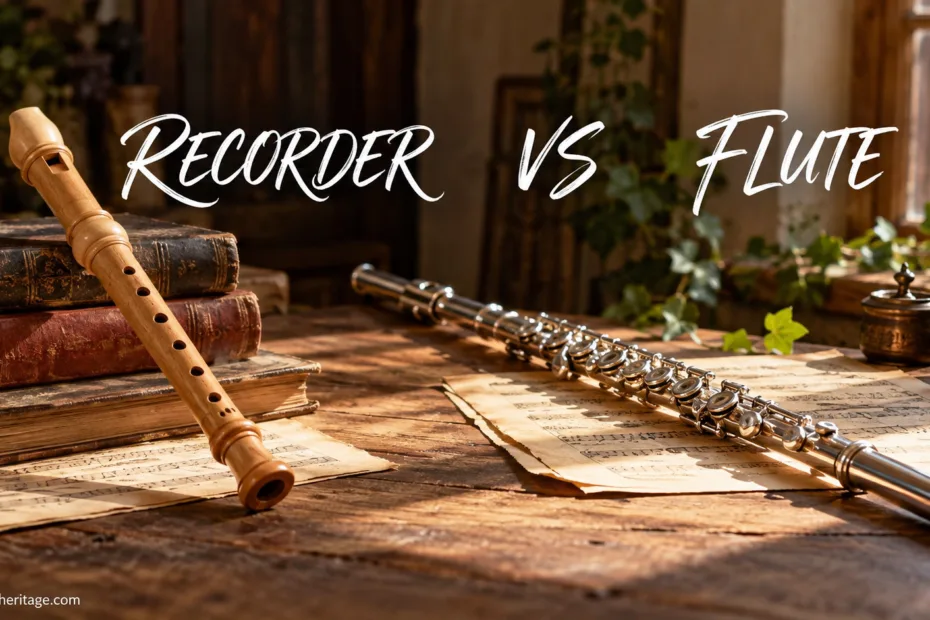
Recorder and concert flute can look like close relatives, yet the way a player creates and controls their sound is quite different. The recorder directs the breath through a built-in windway toward a sharp labium, while the concert flute leaves that air jet to the player’s lips. That one structural difference affects the embouchure, fingering system, dynamic control, playing position, breath use, and even what feels difficult when learning each instrument.
There is also a useful technical detail behind the comparison: a recorder is itself a type of flute. More precisely, it belongs to the duct flute family. The modern concert flute is a transverse, non-duct flute. The Metropolitan Museum of Art classifies the recorder as a duct flute and records soprano, alto, tenor, and bass among its size families. Reference-1✅
| Feature | Recorder | Concert Flute |
|---|---|---|
| Instrument type | Duct flute | Transverse flute |
| Air-jet formation | Windway forms and directs the air jet | Player’s lips form and aim the air jet |
| Blowing edge | Labium beside the recorder window | Far edge of the embouchure hole |
| Playing position | Usually held in front of the body | Held sideways |
| Pitch mechanism | Mostly direct finger holes, with keys on some larger recorders | Mechanical keys, pads, rods, and tone holes |
| Rear thumb hole | Yes on standard recorders | No recorder-style thumb hole |
| First clear note | Usually easier to produce | Requires a working embouchure |
| Tone shaping | Strongly linked to controlled breath pressure and articulation | Strongly affected by lip aperture, air speed, angle, and embouchure shape |
| Dynamic flexibility | More restricted because breath changes also affect pitch | Broader control through embouchure and air management |
| Common materials | Wood and synthetic resin | Silver alloys, silver, gold, other metals, and sometimes wood |
| Family examples | Sopranino, soprano, alto, tenor, bass, larger basses | Piccolo, concert flute, alto flute, bass flute, larger low flutes |
| Typical modern settings | Early music, recorder consorts, chamber music, education, solo repertoire | Orchestra, concert band, chamber music, solo repertoire, many contemporary styles |
The useful comparison is recorder vs modern concert flute. “Flute” is a much broader instrument category, so treating every flute as if it had the construction of a modern silver concert flute creates unnecessary confusion.
The Main Difference Starts with the Air Jet
Both instruments make sound by directing moving air toward an edge and setting an air column into vibration. So their basic acoustic principle is related. What changes is who shapes the air jet.
Recorder: the windway shapes the breath
A recorder has a beak-shaped mouthpiece containing a narrow air channel called the windway. Breath enters this channel and emerges as a thin, organized stream. It then meets the labium, the sharp edge at the recorder’s window.
This means much of the air-jet geometry already exists inside the instrument. The player does not need to create an exposed jet between the lips and aim it across an open embouchure hole. Put the mouthpiece between the lips, use an appropriate breath, and the instrument can respond immediately.
- Block
- The inserted part that helps form the recorder’s internal air channel.
- Windway
- The narrow passage that carries and shapes the player’s breath.
- Window
- The opening where the shaped air stream leaves the windway area.
- Labium
- The edge interacting with the air jet and helping start the oscillation.
The word fipple is also widely used when discussing this kind of mouthpiece, although describing the individual block, windway, window, and labium often makes the mechanism easier to understand.
Concert flute: the player shapes the breath
A concert flute has no recorder-style duct. The player forms a narrow opening between the lips and directs air across the embouchure hole in the headjoint. Small changes in lip opening, air speed, jaw position, flute angle, and the amount of the embouchure hole covered by the lower lip can change the response.
Yamaha describes the sound-producing principle of recorder and flute as the same basic idea, while making one distinction especially clear: the flute player’s lips define the breath outlet, whereas the recorder’s windway defines it. Reference-2✅
🎵 Recorder airflow
Breath → windway → labium → vibrating air column
The instrument fixes much of the air-stream path before the player changes notes or articulation.
🎶 Flute airflow
Lips → free air jet → embouchure edge → vibrating air column
The player continually manages the air jet with the embouchure.
Finger Holes and Keywork Change How the Hands Work
The recorder usually puts the player’s fingertips directly over its tone holes. The concert flute places a mechanical key system between most fingers and the acoustic openings in the tube. That difference changes more than appearance.
Recorder fingers interact directly with the holes
On a standard soprano or alto recorder, the player closes the tone holes with the pads of the fingers and uses a rear thumb hole. Chromatic notes may require forked fingerings, partial opening, or combinations that are less visually obvious than simply lifting one finger at a time.
The thumb hole also helps with register changes. For many upper notes, the player adjusts how much of the rear hole is open rather than simply treating it as an on/off switch.
Not every recorder is completely keyless. Larger tenor, bass, great bass, and contrabass designs may use keys because some holes are too large or too far apart for comfortable direct coverage.
Flute fingers operate a mechanism
On the modern concert flute, pressing one key can move pads over tone holes elsewhere on the instrument. Rods, axles, springs, cups, and linked keys let the maker place acoustic openings where they work well for the bore rather than limiting every hole to a position a fingertip can reach directly.
Recorder: finger → tone hole
Concert flute: finger → key → mechanism → pad → tone hole
Do recorder and flute have the same fingering?
No. Some lower-register finger movements may feel familiar when moving between the instruments, but the systems are not interchangeable. A recorder player works with direct holes, a rear thumb hole, forked patterns, and recorder-specific register techniques. A flutist works with Boehm-style mechanical keywork on the standard modern concert flute.
The recorder family adds another layer. Soprano and tenor recorders are commonly centered on C fingering patterns, while alto and sopranino recorders commonly use F-based patterns. Experienced recorder players therefore learn to associate fingering shapes with different note names when switching sizes.
The Bore Is More Complex Than “One Cylinder and One Cone”
Simple comparisons sometimes reduce the two instruments to a claim such as “the recorder has a cylindrical bore and the flute has a conical bore.” That does not describe modern instruments well enough.
A recorder bore is carefully shaped
The internal passage of a recorder is not merely a straight pipe drilled from one end to the other. Its diameter can change along the instrument, and those changes work together with tone-hole size and tone-hole position to establish pitch, tuning behavior, response, and register relationships.
Yamaha notes that recorder tone holes are neither equally sized nor placed at perfectly regular intervals, and describes the internal bore as following a gradually changing profile rather than a simple straight-sided cone. Reference-3✅
Recorder design also changed across historical periods. Renaissance-style instruments and later Baroque-style recorders do not share exactly the same bore proportions, exterior profile, or tonal priorities. “Recorder bore” therefore describes a family of related solutions rather than one unchanging tube shape.
The modern concert flute mixes cylindrical and tapered geometry
The main body of the modern concert flute is broadly cylindrical, while the headjoint contains a taper. The headjoint is especially sensitive because that is where the embouchure hole, cork assembly, air jet, and first part of the resonating tube interact.
This is one reason bore labels alone cannot explain the recorder–flute difference. Air-jet formation, bore profile, hole geometry, and the way the player controls the resonator all work together.
Why Their Sound and Breath Response Feel Different
The recorder often produces a direct, focused tone because the windway keeps the air jet in a fairly fixed relationship with the labium. A concert flute gives the player more freedom to alter the jet before it reaches the blowing edge. That freedom affects tone color, attack, register response, pitch shading, and dynamics.
Recorder breath control is closely tied to pitch
A recorder responds quickly to changes in breath pressure. More pressure can brighten and strengthen the tone, but it can also move the pitch upward. Too little pressure may flatten the pitch or make the sound unstable. Good recorder playing therefore depends on surprisingly careful breath regulation.
This is why describing the recorder as simply “easy to blow” misses an important distinction. Producing the first note is easy; controlling a refined recorder tone is not automatic.
Flute breath is shaped before much of it enters the instrument
The flute player sends air across an open embouchure hole rather than sealing the mouth around a duct. Part of the air stream passes over the hole instead of entering the tube. The player must manage aperture size, direction, speed, and the relationship between the lips and the blowing edge.
A beginner can therefore use plenty of air yet produce only a weak or unfocused sound. Better flute playing is not simply a matter of blowing harder. It depends on using the air efficiently.
Pressure and airflow are not the same thing
Wind playing becomes easier to understand when air pressure and air quantity are treated as related but different. A recorder can work with a relatively modest flow while remaining sensitive to pressure changes. A concert flute may use a larger quantity of air because the embouchure is open, yet the speed and direction of that air matter just as much as volume.
Articulation also feels different
Both instruments use the tongue to shape attacks, but the tongue acts within different air systems. On a recorder, tonguing controls breath entering a fixed windway. On a flute, the tongue releases an air stream whose final shape is still being controlled by the lips.
That makes flute articulation closely connected with embouchure stability, while recorder articulation interacts strongly with the resistance and response of the windway.
Which instrument has more dynamic range?
The modern concert flute generally offers a broader usable dynamic range. A flutist can alter air speed and embouchure geometry while compensating for pitch changes. A recorder player also changes dynamics, but large changes in breath pressure tend to pull pitch with them, so dynamic control often involves more delicate adjustments in breath, articulation, resonance, and sometimes fingering.
That does not make the recorder less expressive. It means its expressive tools are organized differently.
Range Depends on Which Recorder and Which Flute
A comparison between “the recorder” and “the flute” can become misleading because both names cover instrument families rather than a single size.
| Family position | Recorder family | Modern transverse flute family |
|---|---|---|
| High | Sopranino and smaller recorders | Piccolo and smaller specialty flutes |
| Common upper voice | Soprano recorder | Concert flute |
| Middle voice | Alto recorder | Alto flute |
| Lower voice | Tenor recorder | Bass flute |
| Bass register | Bass, great bass, contrabass and larger recorders | Contrabass and larger low flutes |
A standard concert flute usually gives the player a wider practical span than a single standard recorder, while a recorder commonly covers a little over two octaves in normal use. Yet the question “Which one plays higher?” still needs a size attached to it. A soprano recorder, alto recorder, tenor recorder, concert flute, and piccolo occupy different pitch regions.
Register production is also different. Recorder players use changes in breath and thumb-hole venting for much of the upper register. Flutists rely heavily on faster, differently directed air and changes in embouchure while using the flute’s key system to select the effective tube length.
Wood, Plastic, and Metal Do Not Define the Instruments
The common classroom pairing of a plastic recorder and a silver-colored flute makes material seem like the defining distinction. It is not.
Recorder materials
- Synthetic resin: common for student instruments because it is stable, consistent, washable, and relatively inexpensive.
- Maple: widely used for wooden recorders and available across several instrument sizes.
- Boxwood and related dense woods: common choices for many higher-level recorders.
- Other hardwoods: makers use several species depending on design, availability, working properties, and the intended response.
Concert flute materials
- Silver-plated metal: common in student concert flutes.
- Solid silver: widely used in intermediate and professional instruments.
- Gold and other metals: found in higher-level and specialist instruments.
- Wood: used for some modern flutes and historically common in transverse flute construction.
The important classification point is simple: a wooden transverse flute does not become a recorder, and a plastic recorder does not stop being a recorder. Construction and sound-production mechanism define the instrument more reliably than the surface material.
Why One Is Held Vertically and the Other Sideways
The playing position follows the design of the sound generator.
On a recorder, the mouthpiece, windway, and bore are arranged along the same general axis. The player places the beak in the mouth and holds the instrument forward and downward.
On the concert flute, the embouchure hole is cut into the side of the headjoint. The player places the flute across the body so the lips can direct air across that lateral opening. The familiar horizontal posture is therefore not a decorative tradition. It follows directly from transverse-flute construction.
Which Is Easier to Learn?
For producing a recognizable first note, the recorder is usually easier. Its windway already aims the breath toward the labium, removing the need to discover a flute embouchure before playing a simple melody.
The difficulty changes as the music becomes more demanding.
| Skill | Recorder | Concert Flute |
|---|---|---|
| Producing the first note | Usually straightforward | Embouchure must be learned first |
| Covering notes | Direct holes require accurate fingertip sealing | Keys and pads close most tone holes mechanically |
| Chromatic playing | May involve forked and partial fingerings | Mechanical key system supports chromatic note changes |
| Upper register | Needs refined breath and thumb-hole control | Needs stable embouchure, faster air, and register control |
| Dynamic control | Breath changes must be balanced carefully against pitch | Wider adjustment through air and embouchure |
| Advanced tone | Demands refined breath, articulation, fingering, and voicing | Demands refined embouchure, air direction, articulation, and support |
Easy to start does not mean easy to master. Skilled recorder playing uses delicate intonation control, clean articulation, secure upper-register fingering, flexible phrasing, and finely balanced breath pressure. The concert flute places more difficulty near the beginning because a stable tone must be built with the lips before the rest of the instrument can be used comfortably.
What Transfers from Recorder to Flute?
Recorder experience can make the first stages of flute study feel more familiar, but it does not remove the need to learn a new sound-production technique.
- Music reading transfers well. Rhythm, notation, counting, phrasing marks, and basic musical vocabulary remain useful.
- Breath awareness transfers partly. Both instruments require planned breathing and steady musical phrases, though the physical use of air differs.
- Finger coordination helps. Moving several fingers cleanly and keeping unnecessary tension out of the hands is valuable on either instrument.
- Tonguing concepts transfer. A player already understands that articulation can define the beginning and separation of notes, even though flute embouchure changes how the attack behaves.
- Flute embouchure must be learned separately. Recorder playing does not teach the lips to create and aim the exposed air jet required by a transverse flute.
Recorder experience gives musical preparation more than mechanical equivalence. The player may arrive with useful reading, rhythm, breathing, and coordination skills, while still being a beginner at flute tone production.
The Recorder Is Not Merely a Classroom Version of the Flute
The recorder’s accessibility made it useful in music education, but that educational role is only one part of the instrument’s identity. Recorder repertoire, consort playing, historical performance, contemporary composition, and professional solo playing all require techniques far beyond beginner classroom material.
A high-level recorder player controls articulation, tuning, alternate fingerings, tone color, breath pressure, register response, and ensemble blend. Larger members of the recorder family also bring different hand positions, key mechanisms, breath needs, and tonal behavior.
The concert flute has a different modern center of gravity. It is deeply established in orchestras, wind ensembles, chamber groups, solo literature, and many other musical settings. Its mechanical keywork and flexible embouchure make rapid chromatic writing, wide dynamic shaping, and large-register changes natural parts of modern flute technique.
Why Recorder Tone and Flute Tone Are Not Separated by Material Alone
A metal flute and a wooden recorder obviously differ in material, but the larger tonal difference begins earlier in the acoustic chain. The instruments use different mouthpiece geometry, different bore proportions, different tone-hole systems, and different forms of player control.
The flute player can modify the exposed jet continuously. The recorder player works with a jet already constrained by the windway. That changes how each instrument responds to breath before wood, resin, silver, or another material enters the discussion.
Material still matters to makers. Density, dimensional stability, wall construction, machining, durability, surface treatment, and manufacturing method all influence how an instrument can be built and maintained. Yet material alone does not explain why a recorder sounds or behaves differently from a concert flute.
Historically, the Word “Flute” Can Be Confusing
Modern English usually uses “flute” to mean the transverse concert flute unless another type is specified. Historical terminology was less tidy.
Yamaha’s historical overview notes that the name flute was used for the recorder into the eighteenth century, while sideways-blown instruments were distinguished with terms such as Italian flauto traverso, German Querflöte, and French flûte traversière. Modern names for the recorder include Italian flauto dolce, German Blockflöte, and French flûte à bec. Reference-4✅
📜 Historical score names need context. A reference to “flute” in older material does not always carry exactly the same meaning that the word has in a modern orchestral instrument list.
Recorder Family and Flute Family Are Not One-to-One Matches
Both instrument groups use different sizes to cover different registers, but their naming systems should not be treated as exact equivalents. An alto recorder is not the recorder counterpart of an alto flute in every acoustic or notational sense, and a recorder bass does not simply duplicate the role or construction of a bass flute.
Recorder families often appear as consorts, where related sizes blend as a matched group. Modern transverse flute families also extend well below and above the concert flute, although the standard concert flute and piccolo are far more common in ordinary orchestral scoring than the largest low flutes.
Related Instruments Help Show Where the Boundary Sits
| Instrument | Air system | How it relates |
|---|---|---|
| Tin whistle | Duct directs air to an edge | Shares the recorder’s general fixed-duct principle but has a different fingering layout and musical tradition |
| Traverso | Player blows across an open embouchure hole | Historical transverse flute closely related to the ancestry of the modern concert flute |
| Fife | Side-blown, open embouchure | A transverse flute type with a simpler hole system and a strong projecting sound |
| Piccolo | Side-blown with flute-style embouchure | A high member of the modern transverse flute family |
| Ocarina | Usually duct-blown | Shares a fixed air channel with duct flutes but uses a vessel-shaped resonator rather than a recorder-like open tube |
These relatives show why the simple labels “vertical instrument” and “horizontal instrument” are not enough. The more useful distinction is how the air is directed, what kind of resonator receives it, and how the player changes the effective acoustic length.
Common Recorder vs Flute Misconceptions
“A recorder is not a flute.”
Incorrect A recorder is a duct flute. The modern concert flute belongs to a different branch of the wider flute family.
“The main difference is plastic versus metal.”
Incorrect Recorders can be wooden or synthetic, and transverse flutes can be metallic or wooden. Sound-production design is the stronger dividing line.
“Recorder and flute fingerings are the same.”
Incorrect Some hand movements may feel related, but recorder direct-hole fingering and modern flute keywork use different systems.
“A recorder is only for beginners.”
Incorrect Its simple first sound makes it practical for beginners, but professional recorder technique includes demanding solo, chamber, consort, historical, and contemporary repertoire.
“The two instruments create sound in completely unrelated ways.”
Incorrect Both use an air jet interacting with an edge. The difference is that the recorder builds the jet-forming channel into the instrument, while the flute player creates the exposed jet with the lips.
“The flute is always higher.”
Too broad The answer depends on whether the comparison involves soprano, alto, tenor, or bass recorder and concert flute, piccolo, alto flute, or another member of the transverse flute family.
Recorder or Flute for Different Playing Goals?
The instruments overlap in musicianship skills but lead to different physical playing experiences.
Recorder may fit naturally when…
- direct finger contact with tone holes is appealing;
- early-music repertoire or recorder consorts are the focus;
- a player wants an instrument that speaks easily at the beginning;
- different recorder sizes and historical designs are of interest;
- portable acoustic playing with a simple mechanical layout is useful.
Concert flute may fit naturally when…
- orchestral or concert-band repertoire is the main interest;
- the player enjoys shaping tone directly with the embouchure;
- wide dynamic control is important;
- mechanical keywork feels comfortable;
- a broad modern solo and ensemble repertoire is the goal.
Neither choice is a simplified version of the other. They share an acoustic ancestry but ask the player to control different parts of the sound-making process.
Recorder vs Flute FAQ
Is a recorder actually a flute?
Yes. A recorder is a duct flute. In everyday modern English, however, “flute” often means the transverse concert flute, which is why recorder and flute are commonly treated as separate instrument names.
Why does a recorder make a note more easily than a flute?
The recorder has a built-in windway that shapes and aims the breath toward the labium. A concert flute has an open embouchure hole, so the player must create the correct air stream with the lips before a clear tone develops.
Do recorder and flute use the same fingering?
No. Some lower-note finger movements may feel familiar, but a recorder uses direct tone holes, a thumb hole, and recorder-specific forked or partial fingerings. A modern concert flute uses a linked mechanical key system.
Which is harder, recorder or flute?
The recorder is generally easier for producing a first clear note because its windway fixes the air-jet path. The flute has a steeper tone-production learning stage because the embouchure must be formed by the player. Advanced playing on either instrument demands refined technique.
Can a recorder player learn flute more easily?
Recorder experience can help with notation, rhythm, phrasing, breath awareness, tonguing concepts, and finger coordination. Flute embouchure and flute keywork still have to be learned as new physical skills.
Why is the recorder held vertically but the flute horizontally?
The recorder mouthpiece and windway align with its tube, so it is naturally held in front of the player. The concert flute’s embouchure hole is on the side of the headjoint, requiring a transverse playing position so the lips can blow across the opening.
Is a wooden recorder closer to a wooden flute?
They may share a material, but their sound-producing systems remain different. A wooden recorder still uses a duct and labium, while a wooden transverse flute still requires the player to form an exposed air jet across an embouchure hole.
Can recorder and flute play the same music?
Some melodies can be played on either instrument, especially when the notes fit both instruments’ ranges. More demanding music may need adaptation because their practical ranges, articulations, fingerings, dynamics, and idiomatic techniques are different.
Does a recorder have an embouchure?
Recorder players still use the mouth, breath, tongue, and oral cavity in controlled ways, but they do not form the exposed transverse-flute air jet. The recorder’s windway performs much of the air-jet shaping that the flutist must create with the lips.
Which instrument can play louder, recorder or concert flute?
The modern concert flute generally provides greater dynamic flexibility and stronger projection across much of its practical range. Recorder dynamics are more closely tied to pitch because large changes in breath pressure can alter tuning.
