
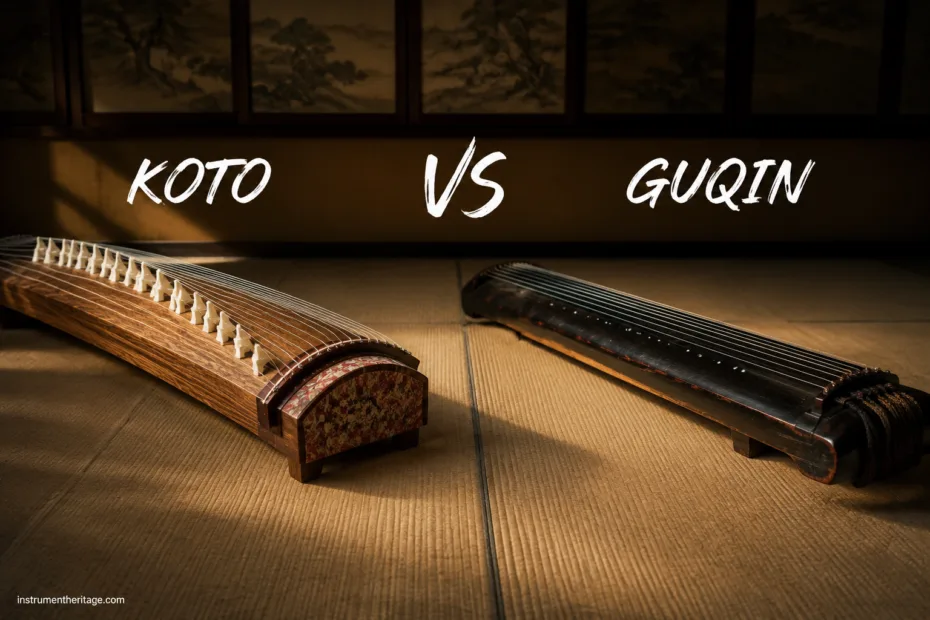
Koto and guqin are long East Asian zithers, yet they organize strings, pitch and hand movement in very different ways. A standard Japanese koto usually has 13 strings set over movable ji bridges, while the Chinese guqin has seven strings and no row of movable bridges. That structural difference changes almost everything that follows: tuning, left-hand technique, harmonics, articulation and the way each instrument responds under the fingers.
| Feature | Koto | Guqin |
|---|---|---|
| Musical tradition | Japanese | Chinese |
| Instrument family | Plucked zither | Plucked zither |
| Standard traditional string count | 13 strings | 7 strings |
| Movable bridges | Yes. A separate ji supports each string. | No row of individual movable bridges |
| Surface markers | No guqin-style position markers | 13 hui markers |
| Typical right-hand approach | Three attached finger picks called tsume | Strings plucked directly with the fingers and nails |
| Left-hand role | Presses and manipulates strings, especially on the opposite side of the bridges | Stops, presses and slides along the strings over the playing surface |
| Pitch organization | Bridge position establishes the basic tuning of each string | Open, stopped and harmonic sounds provide multiple pitches and tone types |
| Traditional string material | Silk; synthetic strings are also widely used | Silk traditionally; modern string types also exist |
| Body material | Commonly associated with kiri (paulownia) construction | Wooden upper and lower boards finished with lacquer in traditional construction |
| Historical setting | Court music, later chamber and broader performance traditions | Closely associated with scholar culture and intimate performance |
| Closest source of common confusion | Guzheng and other movable-bridge zithers | Guzheng because both are Chinese zithers |
🎼 The easiest visual test is the bridge system. If there is a separate movable bridge beneath every string, the instrument may be a koto or another bridge zither. A seven-string instrument with an open playing surface and a line of hui markers points strongly toward a guqin.
The terminology itself can cause confusion. Japan’s National Diet Library distinguishes 箏, the bridge-bearing Japanese instrument usually meant by koto today, from 琴, read kin in this context and associated with the Chinese guqin. It also describes the familiar koto as a 13-string instrument whose movable bridges determine pitch. Reference-1✅
The Physical Difference Starts Under the Strings
A koto and guqin can look related when seen from a distance. Both have an elongated wooden body, strings running parallel to the soundboard and a player seated beside the instrument. Closer inspection reveals two different construction systems.
Koto: 13 strings resting on movable ji bridges
The standard koto has one movable bridge for each string. These bridges, called ji, stand between the string and soundboard. Moving a ji changes the vibrating length of the playable section of the string and therefore changes its pitch.
This is why the bridge arrangement is not simply decorative. Before a piece begins, the performer positions the bridges for the required tuning. The row may form an uneven diagonal pattern because each string needs a different effective length.
Traditional koto bodies are closely associated with paulownia wood, known in Japanese as kiri. Older instruments used silk strings, while modern performers also encounter durable synthetic strings and plastic bridges. Traditional bridge materials included wood and other hard materials; contemporary instruments commonly use modern substitutes suited to regular playing.
Guqin: seven strings over a continuous surface
The guqin does not place a movable bridge beneath every string. Its seven strings pass across a long, smooth playing surface, allowing the left hand to contact a large portion of each string directly. Thirteen small markers called hui appear along the instrument, but these should not be mistaken for frets.
The hui are positional references. The strings remain unfretted, so a player’s left hand can stop a string at many points and slide after a note has been sounded.
Historical guqin construction also has its own material vocabulary. A 19th-century instrument catalogued by The Metropolitan Museum of Art uses wood, horn, silk and mother-of-pearl; the museum describes wutong wood for the upper board, zi wood for the lower board, twisted silk strings and mother-of-pearl hui studs. Reference-2✅
Thirteen hui do not mean thirteen fixed notes. They help a guqin player locate useful string positions, especially harmonic locations. The instrument remains fretless, so stopped notes and slides are not confined to thirteen steps.
Koto and Guqin Organize Pitch in Different Ways
The string count is easy to remember, but the method of controlling pitch tells much more about how these instruments work.
How a koto is tuned
Each koto string has an overall tension, but the working pitch is strongly shaped by where its ji sits. Moving the bridge changes the usable vibrating length. Different pieces and schools can use different tunings, so there is no single tuning that describes all koto music.
- The strings are brought to suitable tension.
- A separate ji is placed beneath each string.
- The bridges are moved until the required pitches are established.
- During performance, the left hand can press a string on the section beyond its bridge, raising tension and bending the sounding pitch.
That last step gives the instrument more flexibility than a simple “13 strings equal 13 notes” description suggests. Pitch bends, vibrato-like movement and portamento effects can all come from left-hand pressure.
How a guqin gets many sounds from seven strings
A guqin uses its seven strings in several ways. UNESCO describes three basic categories: san for open-string sounds, an for stopped sounds and fan for harmonics. This means one string is not tied to one usable pitch. Finger position and type of contact both matter.
- San
- Open strings are plucked without stopping them against the playing surface.
- An
- The left hand stops a string against the surface to create a selected pitch; the hand can also move after the attack.
- Fan
- A light touch at a harmonic position produces a clear overtone rather than an ordinary stopped tone.
UNESCO lists the guqin as a seven-string instrument with thirteen marked positions and describes a range of about four octaves through its traditional stringing and playing methods. Reference-3✅
More strings do not automatically mean more pitch control
The koto begins with more strings, but much of its basic pitch arrangement is prepared through bridge placement. The guqin begins with seven strings yet uses open notes, stopped positions, harmonics and continuous left-hand movement. String count alone therefore gives an incomplete picture of either instrument.
Watch the Hands and the Difference Becomes Clear
The two instruments ask the hands to divide the work differently. This is one of the easiest ways to identify them during a performance.
Koto right hand: tsume finger picks
A koto player normally wears three finger picks called tsume on the right hand: one on the thumb and one on each of the first two fingers. The exact pick shape and manner of attack vary between traditions, but the presence of attached picks is a useful visual clue.
The right hand can pluck individual tones, articulate repeated notes, play chords and sweep across several strings. Because a hard pick contacts the string directly, the beginning of a note can be clean and clearly defined.
Koto left hand: pressure changes the note
The left hand is far from passive. By pressing the section of string on the other side of a ji, the player increases string tension and raises the pitch heard from the plucked section. Controlled pressure can create bends and expressive pitch movement without relocating the bridge in the middle of a phrase.
Guqin: plucking, stopping and sliding
The guqin is played directly with the hands rather than with koto-style attached tsume. The right hand has a large vocabulary of plucking motions. The left hand can press a string onto the smooth board and then move along it.
That movement matters because a guqin phrase can include the audible transition between pitches. A note may be struck and then reshaped by the left hand. Harmonics require another kind of contact: the string is touched lightly at an appropriate point instead of being fully stopped.
Koto hand pattern
- Right: plucks with three tsume
- Left: presses and ornaments strings
- Bridge position: prepares the tuning
Guqin hand pattern
- Right: plucks directly with fingers and nails
- Left: stops and slides along strings
- Hui: provide positional references
Why Koto and Guqin Sound Different
Descriptions such as “bright” or “soft” are useful only up to a point. Tone changes with the instrument, strings, room, player and technique. The more useful question is what physically produces the different sound behavior.
Koto tone begins with the bridge-and-pick system
The tsume gives a koto note a definite attack. The string vibrates through its individual bridge, which transfers energy into the wooden body. A player can then alter a sustained pitch with the left hand.
- Plucked attack: often clearly articulated.
- Bridge transmission: every string contacts its own movable ji.
- Pitch bending: left-hand pressure can raise or shade a note.
- Glissando: several strings can be swept in sequence, making the prepared tuning immediately audible.
Guqin tone changes with the type of contact
A guqin can move between open strings, fully stopped notes and clear harmonics without changing instruments or adding bridges. These techniques do not merely produce different pitches; they also produce different tone qualities.
Sliding is especially characteristic of the playing method. The finger may continue moving along the string after the initial pluck, so the listener can hear both the sustained tone and some of the physical interaction between string and surface. The left hand becomes part of the audible articulation.
Listening clue: a sequence dominated by prepared string pitches, finger-pick attacks and bridge-side bends suggests koto technique. Frequent transitions between open tones, stopped notes, harmonics and long left-hand slides are more characteristic of guqin playing.
The Historical Relationship Is Often Oversimplified
Koto and guqin belong to the broad zither category, but describing the koto as a “Japanese guqin” removes an important distinction. The bridge-bearing Chinese zheng tradition is the closer structural and historical comparison for the koto.
Grinnell College’s Musical Instrument Collection describes a 13-string Chinese zheng of the Tang period as having been introduced to Japan during the early Nara period and developing into the koto. The same collection documents the koto’s movable ji, three tsume and left-hand pressure technique. Reference-4✅
The guqin belongs to another Chinese zither tradition. It is distinguished by seven strings, no per-string movable bridge row and direct use of a smooth playing surface. Its long association with scholars, personal cultivation and small-scale listening also shaped a performance culture different from that of the koto.
Koto’s path in Japan
Koto music became established in Japan after the instrument entered court culture during the Nara period. Its musical life later expanded beyond the court, including accompaniment of vocal music, chamber repertories and instrument-specific solo traditions.
The familiar 13-string koto remains the reference point for comparisons, although the instrument did not stop developing. Twentieth-century makers and performers used larger variants with additional strings, including low-register and extended-range instruments. A photograph of a many-stringed instrument should therefore not be rejected as “not a koto” solely because it has more than 13 strings.
Guqin as a living Chinese music tradition
Written and archaeological evidence places qin-type instruments deep in Chinese history. The modern guqin tradition centers on the seven-string form, detailed hand techniques and a repertory transmitted through specialist teaching and tablature.
Guqin and its music are also listed by UNESCO on the Representative List of the Intangible Cultural Heritage of Humanity. That recognition concerns the musical practice and its transmission, not merely surviving antique instruments.
Their Notation Reflects How the Instruments Are Played
Notation is another place where the mechanical difference between koto and guqin becomes visible. Neither tradition can be reduced neatly to “write a pitch, then play it” because the physical action used to make the sound carries musical information.
Koto notation often relates directly to the strings
Koto traditions use notation systems that can identify the strings to be played and include performance signs for technique. The details vary by school and repertory. Western staff notation is also used for some contemporary compositions and teaching contexts.
This suits an instrument where a prepared tuning gives each string an immediately recognizable role. The performer sees a string indication and already knows where that string sits within the current bridge arrangement.
Guqin jianzipu records playing actions
Traditional guqin repertory is closely associated with jianzipu tablature. Rather than functioning like ordinary staff notation, the system encodes practical information about how a sound is produced: which string is involved, where the left hand acts and what kind of finger movement should be used.
This makes sense for an instrument on which an open note, a stopped note and a harmonic can have very different identities even when pitch alone does not explain the whole musical event. Timing and phrasing still depend heavily on musical transmission and interpretation.
Thirteen Strings vs Seven Strings Is Only the Starting Point
String count is useful for identification, but treating it as the main difference can create several false assumptions.
- A 13-string instrument is not automatically a koto. Other Asian zithers have existed in many string configurations.
- A seven-string guqin does not provide only seven notes. Stopped positions and harmonics greatly expand what each string can produce.
- Not every koto has exactly 13 strings. Extended models were developed for different registers and repertories.
- The guqin’s 13 hui are not frets. They are positional markers on an unfretted playing surface.
A more reliable distinction: koto = individual movable bridges; guqin = seven strings over a continuous, unfretted playing surface with hui markers.
Koto, Guqin and Other East Asian Zithers
The instrument most useful for understanding the koto–guqin comparison is the guzheng. Koto is often visually closer to guzheng than to guqin because both koto and guzheng use a row of movable bridges. That is also why guqin and guzheng should not be treated as interchangeable Chinese names.
| Instrument | Tradition | Bridge arrangement | Useful identification clue |
|---|---|---|---|
| Koto | Japanese | One movable ji per string | Standard form commonly has 13 strings and is played with three tsume |
| Guqin | Chinese | No row of individual movable bridges | Seven strings and 13 hui markers |
| Guzheng | Chinese | Movable bridge beneath each string | Usually has substantially more strings than a standard 13-string koto |
| Gayageum | Korean | Individual bridges | Related East Asian bridge-zither construction with its own playing traditions |
| Wagon | Japanese | Bridge zither | A separate Japanese zither tradition rather than another name for standard koto |
Why guqin and guzheng are easy to confuse
Both names begin with gu in their common Romanized forms and both instruments are Chinese zithers. Their construction is easy to separate visually. A guzheng has individual movable bridges; a guqin does not. A modern guzheng also commonly carries far more strings than the seven-string guqin.
For someone familiar with koto, this means the Chinese instrument that first looks mechanically familiar is often the guzheng rather than the guqin.
How to Identify a Koto or Guqin in Front of You
A few physical details are usually enough. No knowledge of the piece being played is required.
- Look beneath the strings. A row of tall movable bridges strongly favors koto over guqin.
- Count the strings if possible. Thirteen fits the standard koto; seven fits the guqin.
- Look for small dots along the upper surface. Thirteen hui are characteristic of guqin.
- Watch the right hand. Three attached finger picks point toward ordinary koto technique; guqin uses direct finger and nail contact.
- Watch the left hand. Repeated pressing on the string section beyond a bridge is characteristic of koto. Long stopping and sliding movements directly along a bridge-free playing surface fit guqin technique.
The clearest distinction is mechanical. Koto prepares much of its pitch layout with movable bridges before and during performance. Guqin leaves its strings open across a continuous surface so the player’s fingers can create stopped notes, harmonics and slides directly along their length. That difference explains far more than the familiar 13-versus-7 comparison.
Koto vs Guqin FAQ
Are koto and guqin the same type of instrument?
Both are plucked zithers, meaning their strings run across a resonating body without a separate projecting neck. They are not the same instrument. Koto uses individual movable bridges, while guqin uses seven strings over an unfretted playing surface without a row of movable bridges.
Is koto the Japanese version of guqin?
No. That description is too simple. Koto is historically and structurally more closely associated with the Chinese zheng line of movable-bridge zithers. Guqin represents another Chinese zither tradition with a different construction and playing system.
Which has more strings, koto or guqin?
A standard traditional koto normally has 13 strings, while the guqin has seven. Koto variants with additional strings also exist, so 13 should be understood as the standard comparison form rather than the only possible koto design.
Does a guqin have bridges?
It does not have the row of individual movable bridges seen on a koto or guzheng. Its seven strings run over a continuous playing surface, with hui markers helping the player locate useful positions.
What are the dots on a guqin?
They are called hui. A guqin has 13 of these markers. They provide positional references, especially for harmonic relationships, but they are not raised frets and do not divide the string into fixed fretted notes.
What are the bridges on a koto called?
They are called ji. Each string has its own movable ji. Changing a bridge’s position changes the vibrating length of that string and therefore its prepared pitch.
Does a koto player use finger picks?
Yes. Standard koto technique uses three finger picks called tsume, normally worn on the thumb, index finger and middle finger of the right hand. Pick shapes and techniques can vary between schools.
Does a guqin player use koto-style finger picks?
No. Guqin technique relies on direct finger and nail contact rather than attached tsume. The right hand plucks while the left hand can stop, press and slide along the strings.
Which is closer to the koto, guqin or guzheng?
Guzheng is the closer structural comparison. Both koto and guzheng use individual movable bridges beneath their strings. Guqin has a bridge-free string field and a very different left-hand technique.
Is a koto technically a harp?
Koto is sometimes called a Japanese harp in general descriptions, but in musical-instrument classification it is more accurately described as a plucked zither. Its strings run parallel to the resonating body, unlike the string arrangement of a true harp.
