
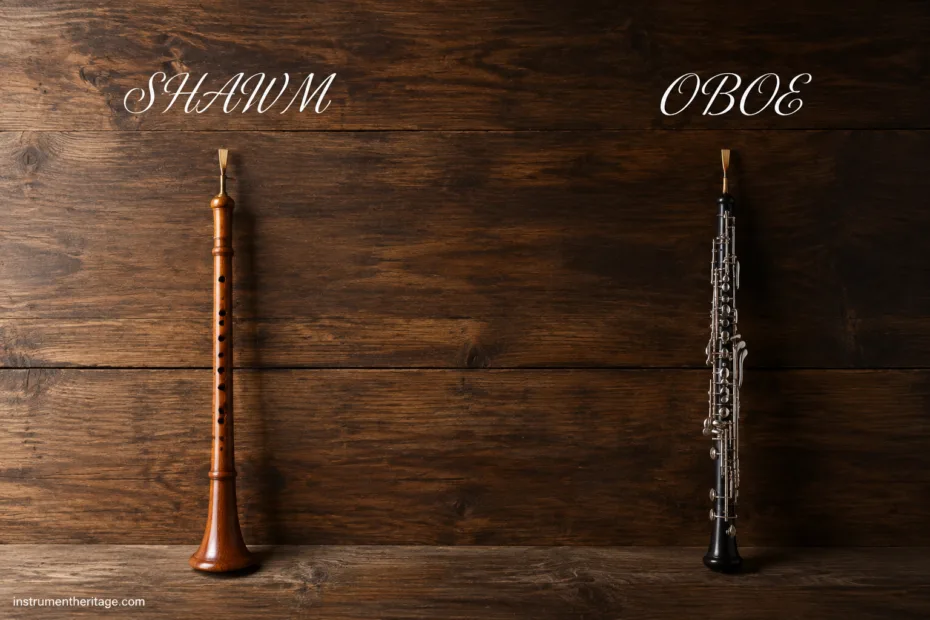
| Feature | Shawm | Oboe | What the Difference Tells Us |
|---|---|---|---|
| Instrument type | Double-reed woodwind with a conical bore | Double-reed woodwind with a narrow conical bore | The two instruments share the same broad sound-producing family. |
| Historical relationship | Major European double-reed instrument of the Medieval and Renaissance periods | Developed in 17th-century France from the treble shawm tradition | The oboe is a descendant, not simply another name for the shawm. |
| Reed control | Many historical shawms used a pirouette that supported the lips and reduced direct reed manipulation | The exposed double reed is held directly between the lips | Direct contact gives an oboist finer control over articulation, pitch, dynamics and tone. |
| Bore and body | Generally broader conical bore with strong flare toward the bell; historical construction varied by size and period | Narrower, carefully shaped conical bore divided among upper joint, lower joint and bell | Bore geometry is one reason the instruments respond and project differently. |
| Keywork | Usually little keywork on surviving historical types; larger shawms could use covered keys | Early oboes had only a few keys; modern oboes use an extensive interconnected mechanism | The oboe’s mechanism developed over generations rather than appearing fully formed. |
| Sound character | Strong, bright and penetrating, especially effective in loud ensembles | Focused, flexible and highly controllable across a wider dynamic range | The tonal change reflects the reed setup, bore, tone holes, bell and playing technique working together. |
| Typical historical setting | Dance music, civic ensembles, ceremonial performance and other situations requiring projection | Court, chamber, orchestral and solo music | The redesign suited musical settings where finer dynamic and expressive control was useful. |
| Materials | Turned wood, with cane reed and metal fittings on some larger forms | Historical examples used woods such as ebony; modern oboes commonly use dense hardwoods such as grenadilla or rosewood | Material changed, but internal dimensions and reed design remain equally important to playing behavior. |
| Modern identity | Historical instrument and living early-music instrument, with related regional shawm traditions still played | Standard orchestral woodwind with several related members in the oboe family | Both remain distinct instruments rather than old and new versions of one standardized design. |
Shawm and oboe are closely related because the oboe grew from the European double-reed shawm tradition, especially the treble shawm that French makers reshaped during the seventeenth century. The connection is physical as well as historical: both use paired reeds and a conical air column. Yet an oboe is not merely a shawm fitted with extra keys. Changes to the reed contact, bore, body construction, tone holes and mechanism created an instrument with a very different playing response.
The clearest lineage is: Renaissance treble shawm → early hautbois → Baroque oboe → later orchestral oboe. That sequence is more accurate than treating every type of shawm as a direct stage in modern oboe development.
The Shawm Is an Ancestor of the Oboe, but They Are Not the Same Instrument
The shawm occupied an established place in European music long before the orchestral oboe appeared. It was a loud double-reed aerophone used during the Medieval and Renaissance periods, and shawms were made in more than one size. Historical records and surviving iconography place them in dance ensembles, court settings and civic music where a strong projecting tone was useful.Reference-1✅
The oboe emerged later. The Metropolitan Museum of Art describes late-seventeenth-century French oboe making as a redesign of the treble shawm. One of the largest changes was how the player interacted with the double reed: on the oboe the reed could be taken directly between the lips, giving the musician much finer control of articulation, volume, pitch and tone quality.Reference-2✅
This makes the relationship close, but not interchangeable. A Renaissance shawm and a modern oboe feel different in the hands, respond differently to air and embouchure, and were designed around different musical demands.
What the Two Instruments Still Share
- A double reed acts as the sound generator.
- The vibrating reed excites an air column inside a conical bore.
- Tone holes change the effective acoustic length of the instrument.
- Both belong to the broader family of double-reed woodwinds rather than the single-reed clarinet family.
- The oboe preserves recognizable ideas from the shawm while changing how those ideas are controlled.
The Missing Step Between Shawm and Modern Oboe: the Hautbois
Jumping straight from a medieval-looking shawm to a silver-keyed modern oboe hides an important stage. During the seventeenth century, French makers developed the hautbois, the early form of the oboe. The name later passed into other European languages and eventually gave English the word oboe.
Yamaha’s historical overview places the oboe’s emergence in seventeenth-century France and identifies the shawm as one of its ancestors. It also notes that early oboes could have only two or three keys, far removed from the dense mechanism seen on a modern instrument.Reference-3✅
- Treble shawm
- A high member of the shawm family whose basic double-reed and conical-bore layout helped feed the later oboe tradition.
- Hautbois
- The early French oboe form in which reed control, body design and limited keywork moved the instrument toward a new playing style.
- Baroque oboe
- A more established form with a jointed wooden body, exposed reed and a small number of keys.
- Modern oboe
- A refined orchestral instrument with extensive keywork, carefully regulated tone holes and a highly developed reed system.
What Changed When the Shawm Design Became an Oboe?
The transformation did not come from one added feature. Several parts changed together. Reed access affected the embouchure, bore refinement altered resistance and resonance, body construction became more controlled, and additional keys expanded what the fingers could manage comfortably.
1. The Player Gained More Direct Control of the Reed
Many Renaissance shawms use a pirouette, a small support around the base of the reed. The player’s lips work at the top of this fitting, but the arrangement gives less freedom to manipulate the vibrating blades than the exposed oboe reed does.
On an oboe, the reed sits directly between the lips. Small changes in lip pressure, reed position and air support can alter the attack of a note, its pitch center and its dynamic shape. Embouchure becomes a much finer control system.
Reed terminology matters: both instruments are double-reed woodwinds, so the difference is not “single reed versus double reed.” The major distinction is how the reed is built into the playing system and how freely the lips can control it.
2. Bore Proportions Became More Refined
Both shawm and oboe use a conical bore, meaning the internal air passage becomes wider toward the lower end. They do not use the same cone, though. Historical shawms generally have a broader, more strongly projecting design, while the oboe has a much narrower internal passage with carefully controlled changes in diameter.
This matters because bore profile affects resistance, resonance and harmonic balance. A change of only one component cannot explain the complete sound. Reed dimensions, bore taper, tone-hole placement, bell form and the player’s embouchure operate as one acoustic system.
3. The Body Became a More Precisely Controlled Multi-Part Instrument
Many smaller historical shawms were turned as largely continuous wooden bodies. The developed oboe uses separate sections: an upper joint, lower joint and bell, with the reed entering the top through its staple and reed well.
Jointed construction also gives makers more control over boring, turning, tone-hole placement and mechanical assembly. On a modern oboe, tiny dimensional changes inside the bore can affect response noticeably.
4. A Few Keys Became a Full Mechanical System
The first oboes were mechanically simple. A surviving early eighteenth-century oboe by Hendrik Richters in The Met has C and E-flat keys, a useful reminder that historical oboes did not begin with modern Conservatoire-style keywork.
Later makers added mechanisms for chromatic notes, register changes, alternate fingerings and easier technical movement. Modern instruments may carry a dense network of keys, rods, springs, pads and linkages over much of the body.
5. Materials Changed Alongside the Design
Shawms were wooden instruments, while surviving early oboes show that makers also used carefully chosen hardwoods and decorative fittings. The Richters oboe in The Met, for example, is recorded as ebony with ivory and silver components.
Modern professional oboes are commonly associated with dense dark hardwoods. Grenadilla is widely used, while rosewood varieties are also found. Material influences weight, stability and aspects of response, although wood species alone does not determine an oboe’s tone.Reference-4✅
Why Do Shawm and Oboe Sound So Different If Both Use Double Reeds?
A double reed explains their family resemblance, but it does not make their sounds identical. The reed begins the vibration. The rest of the instrument determines how that vibration interacts with the air column.
Shawm Sound
- Strong projection
- Bright upper harmonics
- Direct attack
- Historically suited to loud ensembles
- Less delicate reed manipulation on many pirouette-equipped forms
- A broad, flaring acoustic profile
Oboe Sound
- Concentrated, projecting center
- Fine variation in articulation
- Greater dynamic shaping
- Direct embouchure control of the reed
- Narrow, carefully graduated bore
- Mechanical control of many tone holes
The shawm was not simply made “loud” while the oboe was made “soft.” Both can project strongly. The practical difference is that the oboe gives the player more ways to regulate the sound while sustaining that projection.
The Reed Is Only the Beginning of the Acoustic Chain
When air pressure makes the two reed blades open and close rapidly, pressure pulses enter the bore. The vibrating air column then settles into resonances determined by the instrument’s internal dimensions and which tone holes are open or closed.
- The player supplies air to the double reed.
- The reed periodically controls airflow into the instrument.
- The conical bore supports resonant standing-wave patterns.
- Finger holes or keyed tone holes change the effective acoustic length.
- The bell and lower bore influence radiation and resonance behavior.
- The player’s embouchure makes small corrections to response, pitch and tone.
The oboe retained this basic double-reed/conical-bore arrangement while changing almost every detail around it. That is why the family connection remains audible without making the two instruments acoustically identical.
Why the Shawm Projected So Well in Historical Ensembles
The shawm’s reputation for volume makes sense in its historical setting. Medieval and Renaissance musicians used shawms in civic bands, dances and ceremonies, sometimes alongside other strong outdoor instruments. A tone that remained clear across an open space was useful rather than excessive.
A penetrating shawm sound comes from the interaction of its reed setup, bore, flare and playing method. Treating its tone as a flaw misses why the instrument was built that way.
The developing oboe served a different range of musical situations. Direct reed contact made subtle articulation and dynamic changes easier to shape, while refinements to the bore and mechanism supported the more controlled playing required in chamber and orchestral settings.
A useful distinction: the oboe did not become successful merely because it was quieter. It offered greater control over how a note began, changed, blended and ended.
Shawm, Baroque Oboe and Modern Oboe: Three Stages Compared
| Stage | Reed and Embouchure | Body and Mechanism | Playing Character |
|---|---|---|---|
| Renaissance shawm | Double reed, commonly associated with a pirouette on treble forms | Wooden conical body; simple finger holes; limited keywork on larger types | Strong projection with direct, bright response |
| Baroque oboe | Exposed double reed controlled directly by the lips | Jointed body with only a small number of keys | More flexible articulation and dynamic control |
| Modern oboe | Highly refined cane reed and detailed embouchure control | Precisely bored jointed body with extensive metal keywork | Wide technical vocabulary, chromatic facility and fine tonal regulation |
The middle stage matters. Without the Baroque oboe, it is easy to imagine that a shawm simply acquired dozens of keys and became an orchestral instrument. The actual change happened in layers.
Could an Oboist Pick Up a Shawm and Play It?
An oboist would recognize several basic ideas immediately. Breath activates a double reed, finger placement changes the sounding length, and intonation responds to the relationship between air, reed and embouchure.
That familiarity does not make the instruments interchangeable.
Skills That Transfer
- Breath support for a double reed
- Awareness of pitch flexibility
- Finger coordination
- Control of attacks and releases
- Listening for reed response
What Must Be Relearned
- Instrument-specific fingering
- Reed placement
- Embouchure pressure
- Air resistance
- Articulation response
- Historical tuning and temperament expectations
A modern oboist should therefore approach the shawm as a related instrument with its own technique, not as an early oboe that happens to lack modern keywork.
Is a Shawm Basically a Medieval Oboe?
The phrase can be useful as a very loose introduction, but it hides too much detail to work as a technical definition. “Ancestor of the oboe” is more accurate than “medieval oboe.”
The shawm had its own family of sizes, construction traditions and performance roles. The later oboe changed the way the reed was controlled, altered bore proportions, adopted jointed construction and developed its own key system. Calling the shawm an oboe too early erases those differences.
Not Every Shawm Became an Oboe
“Shawm” describes a broad historical type rather than one perfectly standardized model. Renaissance musicians used shawms of different sizes, while related double-reed instruments developed along their own paths. The oboe is best understood as one branch that emerged from the European treble-shawm tradition.
This distinction also prevents a common historical shortcut: visually similar conical double-reed instruments from different regions should not automatically be placed into one straight evolutionary sequence. Similar acoustical ideas can exist in related traditions without every instrument being a direct parent of the next.
Related Double-Reed Instruments Around the Shawm and Oboe
| Instrument | Relationship | Distinctive Feature |
|---|---|---|
| Zurna / sorna traditions | Part of the wider family of strongly projecting conical double-reed instruments associated historically with shawm-like designs | Broad outdoor projection and regional construction traditions |
| Bombarde | Name used for larger shawm forms in historical European contexts and also for later regional double-reed traditions | Lower register and larger body than a treble shawm |
| Rauschpfeife | Shawm-related historical double-reed instrument | The reed is enclosed inside a windcap rather than manipulated directly by the lips |
| Dulcian | A separate Renaissance double-reed woodwind associated more closely with the later bassoon line | Folded internal bore allows a long acoustic tube inside a compact wooden body |
| Oboe d’amore | Member of the later oboe family | Lower pitch than the standard oboe and a distinctive bulb-shaped bell |
| Cor anglais | Lower-pitched relative of the oboe | Longer body, curved bocal and bulb-shaped bell |
These relatives show why double reed alone cannot define the shawm–oboe relationship. Bore shape, reed access, body construction, pitch range and musical tradition all help identify where an instrument belongs.
What the Modern Oboe Still Carries Forward from the Shawm
The visual difference between a plain wooden shawm and a modern silver-keyed oboe can be large, but several older ideas remain easy to recognize.
- The double reed remains the sound source. Two cane blades interact with the player’s air rather than a single reed beating against a mouthpiece.
- The bore remains conical. Its exact profile changed, but the basic expanding air column survived.
- Tone holes still define pitch. Modern keys act as extensions of the fingers, opening and closing holes that would otherwise be difficult to reach or seal.
- A penetrating tonal center remains. The modern oboe has far more dynamic control, yet it still produces a focused sound capable of remaining clear inside a full ensemble.
- Reed making remains central to the instrument. The physical condition and dimensions of the reed strongly influence response, pitch and color.
The modern oboe therefore preserves the double-reed and conical-bore identity of its predecessors while surrounding those ideas with a much more adjustable playing system. The relationship is evolutionary, but the shawm remains a complete instrument in its own right rather than an unfinished oboe.
Shawm and Oboe FAQ
Did the oboe develop directly from the shawm?
The strongest European lineage runs from the treble shawm tradition into the seventeenth-century hautbois and Baroque oboe. It is better to describe the shawm as an ancestor than to suggest that every shawm type directly became an oboe.
Do shawm and oboe use the same kind of reed?
Both use double reeds, meaning two flexible blades interact to regulate airflow. Their reed dimensions, mounting and playing technique differ, and an oboe reed should not be treated as a direct substitute for a shawm reed.
Why is the shawm usually louder than an oboe?
The difference comes from several features working together, including reed setup, bore profile, bell flare and playing technique. Historical shawms were well suited to music that needed strong projection, while the oboe developed finer control over articulation and dynamics.
What is a pirouette on a shawm?
A pirouette is a small fitting around the lower part of the reed on many shawm designs. It supports the player’s lips. Because of that arrangement, the reed is not manipulated in exactly the same way as the fully exposed reed of an oboe.
Did early oboes have modern keywork?
No. Early oboes could have only two or three keys. The extensive mechanism seen on a present-day orchestral oboe developed through later changes in instrument making and fingering design.
Can a modern oboist play a Renaissance shawm?
An oboist already understands double-reed breath control and some related acoustic behavior, so parts of the experience transfer. Shawm fingering, reed response, embouchure and air resistance still require separate practice.
Is the shawm still played today?
Yes. Reconstructed shawms are used in early-music performance, and several living regional double-reed traditions preserve instruments related to the wider shawm family.
Is hautbois another word for oboe?
Hautbois is the French name associated with the early oboe. Forms of that word entered other languages, and the English name “oboe” ultimately comes from the same French term.
