
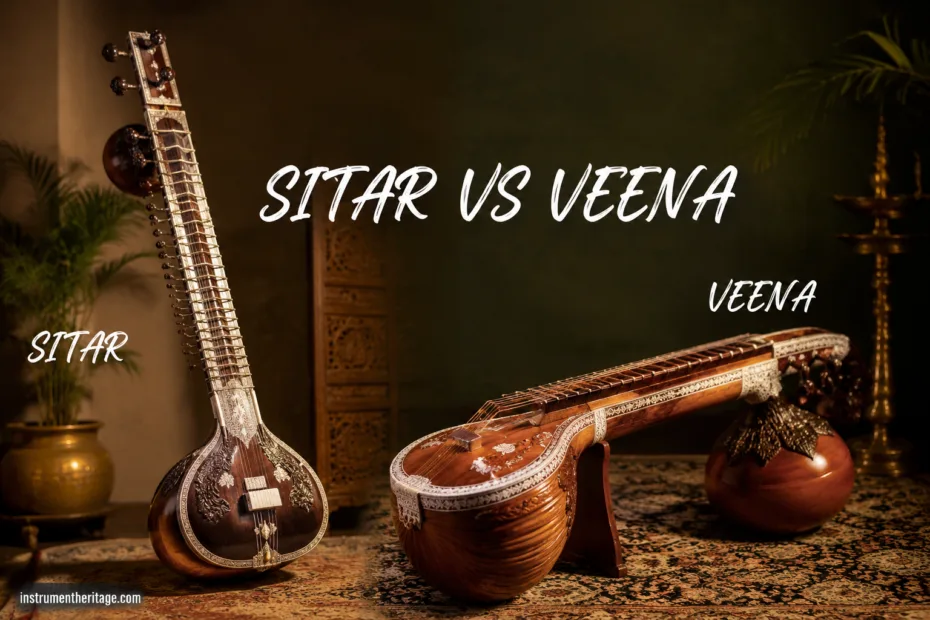
Sitar and veena can look related from across a room: both are long-necked, fretted, plucked string instruments associated with Indian classical music. The sitar is closely associated with Hindustani classical music and normally uses movable frets plus sympathetic strings, while the Saraswati veena belongs mainly to the Carnatic tradition and has 24 fixed frets, four main playing strings and three side strings. Even the way a player bends a note, strikes a string and holds the instrument differs between them.
| Feature | Sitar | Saraswati Veena |
|---|---|---|
| Instrument family | Plucked, fretted long-necked lute | Plucked, fretted long-necked lute |
| Main classical tradition | Hindustani classical music | Carnatic classical music |
| Frets | Curved metal frets that are generally movable | 24 fixed metal frets |
| Playing-string arrangement | Varies by sitar design and playing tradition | Four main melody strings |
| Additional strings | Chikari strings and, on modern forms, numerous sympathetic tarab strings | Three side strings used for tala, drone and rhythmic emphasis |
| Sympathetic strings | Characteristic of the modern sitar, though not universal in historical sitars | Not part of the standard Saraswati veena string arrangement |
| Right-hand attack | Normally plucked with a wire mizrab worn on a finger | Main strings plucked primarily with the fingers or fingernails; side strings are handled separately |
| Characteristic pitch shaping | Strong use of meend, including lateral string pulls | Extensive gamaka produced through controlled string deflection and oscillation |
| Main resonating body | Common modern designs use a gourd resonator with a long hollow neck | Large hollow wooden kudam with a long neck and secondary support resonator |
| Traditional body material | Wood, gourd and metal components; construction varies | Strongly associated with jackwood in the Thanjavur tradition |
| Playing position | Held diagonally, with the neck rising upward | Held more horizontally across the player’s lap |
| Typical tonal impression | Bright, sustained and overtone-rich, with a noticeable sympathetic resonance | Direct, resonant and highly responsive to Carnatic pitch ornamentation |
Which Veena Is Being Compared With the Sitar?
The name veena, also written vina or vīṇā, does not identify one single instrument design. It has been applied to several Indian string instruments whose construction and musical roles can be very different.
For a useful sitar comparison, the instrument normally intended is the Saraswati veena, the fretted South Indian lute strongly associated with Carnatic classical music. The term should not be treated as interchangeable with Rudra veena or fretless instruments such as the Vichitra veena and Chitravina.
A Metropolitan Museum of Art collection record describes the South Indian Saraswati vina with four melody strings, three open tala strings and fixed frets, while also distinguishing its construction from the movable-fret sitar. Reference-1✅
Terminology note: Unless another type is named, veena here means the Saraswati veena. A comparison involving Rudra veena gives a different answer because Rudra veena belongs to another construction and performance tradition.
🎵 The String Systems Work in Different Ways
The most useful physical difference is not simply the outline of the body. Look at the strings. A modern sitar has different groups of strings performing different jobs, including strings that the player does not normally pluck directly. The Saraswati veena organizes its seven strings around another system.
Sitar: playing strings, chikari and tarab
Sitar configurations are not completely uniform. Different instrument makers, historical periods and playing styles have used different numbers and arrangements, which is why a fixed statement such as “every sitar has exactly 18 strings” is too restrictive.
Modern sitars commonly combine directly played strings with chikari strings and a separate bank of sympathetic strings called tarab. The tarab strings run beneath the main strings and frets. They are tuned to pitches relevant to the raga and respond acoustically when matching or closely related frequencies excite them.
The effect is easy to hear. A plucked note does not exist only as the vibration of one string; other tuned strings can begin vibrating without being directly struck. That sympathetic response contributes to the sitar’s lingering, overtone-rich sound.
Saraswati veena: four plus three
The standard Saraswati veena arrangement is much easier to describe numerically: four main playing strings run over the fretted fingerboard, while three additional tala strings run along the side.
Those three side strings should not be described as the equivalent of sitar tarab strings. They are directly used by the performer for rhythmic punctuation, drone reference and tala-related articulation. They serve another musical purpose.
- Tarab
- Sympathetic strings on the sitar that resonate in response to appropriate frequencies.
- Chikari
- High-pitched sitar strings used for rhythmic and drone-like punctuation.
- Tala strings
- The three side strings of the Saraswati veena, directly sounded for rhythmic and tonal functions.
- Mizrab
- A wire plectrum worn on a finger for sitar playing.
The Metropolitan Museum of Art notes that contemporary sitars developed added sympathetic strings and associates the instrument primarily with Hindustani music. The same museum discussion also warns against imagining one unchanged sitar design across its whole history. Reference-2✅
Movable Sitar Frets and Fixed Veena Frets
Both instruments have frets, yet the fret systems are built around different practical ideas.
Why sitar frets can move
A sitar normally has raised, curved metal frets tied around the neck. Their position can be adjusted. This matters because Hindustani ragas do not all use exactly the same pitch material, and instrument setup can be adapted to the requirements of a particular performance practice.
The large clearance created by the raised fret also gives the melody string room to travel sideways. Instead of merely pressing a string vertically against a fret, the left hand can pull it laterally and raise its tension.
Why the Saraswati veena has 24 fixed frets
The modern Thanjavur form of the Saraswati veena has 24 fixed metal frets, covering two chromatic octaves. Traditionally, the frets are seated in a hardened wax mixture on the neck rather than tied around it as on the sitar.
Fixed does not mean melodically rigid. The string can still be pulled sideways across a fret, changing its tension and pitch. That ability is central to the veena’s treatment of gamaka.
India’s Press Information Bureau describes the Thanjavur veena as roughly four feet long, with 24 fixed metal frets embedded in hardened beeswax mixed with charcoal powder. It also records the four playing strings, three drone/tala strings and the traditional use of jackwood. Reference-3✅
Meend and Gamaka Shape Notes Differently
Western fretted instruments can encourage the idea that a fret represents one stable pitch. Sitar and veena playing make that idea much less useful. A fretted note can become the starting point for substantial pitch movement.
Meend on sitar
Meend is a continuous glide between pitches. On sitar, the left hand can pull a melody string sideways across a curved fret after the string has been plucked. As tension rises, the pitch rises smoothly rather than jumping from one fret to another.
A skilled player can shape several notes from one pluck, depending on the string, setup and musical phrase. This is one reason the sitar’s curved, elevated frets are more than simple pitch markers.
Gamaka on veena
Gamaka covers a broader vocabulary of pitch ornamentation in Indian classical music rather than one single bend. In Saraswati veena technique, the left hand can pull or deflect a stopped string to create controlled oscillations, slides and movements around a note.
The distinction should not be reduced to “sitar uses bends, veena uses ornaments.” Both instruments can slide and bend pitches. What changes is the musical grammar, touch and expected contour within Hindustani and Carnatic performance.
Useful distinction: meend describes a particular type of continuous pitch glide, while gamaka refers to a wider set of ornamented pitch movements. Treating them as two names for exactly the same action misses part of the musical difference.
Why Does a Sitar Sound Different From a Veena?
Descriptions such as “bright” and “warm” are useful only up to a point. The more informative question is what physical parts create the difference?
Sympathetic resonance gives the sitar another acoustic layer
When a sitar melody string excites a tarab string tuned to a compatible frequency, the sympathetic string begins vibrating even though the player’s hand has not touched it. Several sympathetic strings can respond during a phrase. The result is an audible layer of resonance beneath and around the directly played note.
That is why the familiar sitar sound cannot be explained only by the number of strings being plucked. Some of the sound comes from strings that are responding rather than being struck.
The veena develops resonance without a tarab bank
The Saraswati veena relies on its directly played metal strings, broad bridge, hollow wooden body and the interaction between string tension and the resonating structure. Its three side strings can reinforce rhythmic and tonal reference, but they do not form a hidden sympathetic-string course beneath the frets.
This gives the veena a more direct relationship between the player’s pluck, the stopped string and the body response. Long bends and oscillations can remain clearly articulated because the string continues to speak through a large wooden resonator.
The bridge matters on both instruments
Sitar and veena bridges are not shaped like a narrow guitar saddle. Their broader contact geometry affects how a vibrating string interacts with the bridge, creating a harmonically active tone. In Indian instrument terminology, this relationship is often discussed through jawari and related bridge behavior.
On a sitar, bridge condition is especially audible. Tiny changes in string-to-bridge contact can alter sustain, clarity and overtone response, which is why maintaining the bridge is part of maintaining the instrument’s voice.
🖐️ The Right Hand Feels Very Different
Sitar
The player normally wears a wire mizrab on the right index finger. Controlled inward and outward strokes drive the melody strings, while chikari strings can add rhythmic punctuation and reinforce the tonal center.
The plectrum is part of the instrument’s technique. Attack, direction, string choice and rhythmic stroke patterns all affect articulation.
Saraswati Veena
The main strings are commonly plucked with the right-hand fingers or fingernails, especially the index and middle fingers. The side tala strings are struck separately to reinforce rhythm and tonal reference.
The result is a different coordination problem: melody-string articulation and side-string punctuation are physically separated across the instrument.
The Instruments Also Sit Differently Against the Body
A sitar is normally held at an angle. Its lower resonator rests against the player’s body while the long neck rises diagonally. The left hand approaches the frets without being asked to carry the full weight of the neck, leaving it free for slides and large lateral string pulls.
The Saraswati veena is positioned more horizontally. Its large kudam rests near the player’s right side, the neck extends toward the left, and a smaller secondary resonator or support sits beneath the far end of the neck.
These positions affect technique. A wide sitar meend and a long veena gamaka may both involve sideways motion of a string, but the player’s wrists, instrument angle and points of physical support are not the same.
Hindustani Sitar and Carnatic Veena
The sitar is one of the best-known melodic instruments of Hindustani classical music. The Saraswati veena is deeply established in Carnatic classical music. Geography is part of that distinction, but the musical difference runs deeper than “north versus south.”
Sitar in Hindustani performance
A sitar performance may develop a raga gradually through unmetered exploration before moving into sections with clearer pulse and tabla accompaniment. Meend, sustained notes, rhythmic mizrab strokes, chikari punctuation and sympathetic resonance become parts of one performance language.
Veena in Carnatic performance
Saraswati veena playing draws from the melodic and rhythmic vocabulary of Carnatic music, including composed repertoire, raga improvisation and detailed gamaka. The instrument is especially suited to reproducing the curved and oscillating pitch movements that give Carnatic melodic lines much of their identity.
Neither tradition should be simplified into “one improvises while the other plays compositions.” Both include composition and improvisation. Their phrase shapes, rhythmic systems, ornament vocabulary and performance conventions differ.
Are the Sitar and Veena Historically Related?
They are related within the wider history of South Asian plucked string instruments, but a straight family-tree statement such as “the sitar is simply a newer Saraswati veena” is misleading.
Veena is the older and broader instrument name. The term has been associated with several types of string instrument rather than one unchanged design. Rudra veena, Saraswati veena and other instruments carrying the name have different structures.
The word sitar is connected with the Persian setar. At the same time, the modern sitar developed within Indian instrument-making and musical practice, and museum scholarship describes its background through both Persian setar and Indian vina traditions. That mixed organological history is more accurate than treating its development as a one-step conversion from one instrument into another.
Modern sitar features were not always present
The sympathetic strings now strongly associated with the sitar are particularly useful here. They can seem so fundamental that it is easy to assume every historical sitar had them.
It did not.
A mid-19th-century sitar preserved by The Metropolitan Museum of Art has a wooden body and no sympathetic strings. Historical examples like this show why sitar specifications should not be projected backward as though the modern layout had always existed. Reference-4✅
How the Saraswati Veena Is Built
Traditional Saraswati veena construction is closely associated with jackwood, especially in the Thanjavur instrument-making tradition. The main parts form a connected acoustic system rather than a neck simply attached to a small resonating box.
- Kudam: the large hollow resonating body.
- Dandi: the long neck carrying the fretboard.
- Metlu: the metal frets.
- Kudurai: the main bridge supporting the strings.
- Yali: the carved decorative terminal at the pegbox end.
- Secondary resonator: a smaller support beneath the far end of the neck.
- Four main strings: used to carry the melodic material.
- Three side strings: used for tala, rhythmic accents and tonal reference.
Traditional makers distinguish between an Ekantha veena, whose main body and neck are carved from a single block of wood, and assembled forms in which major wooden sections are made separately and joined. The construction method changes the woodworking process, but both belong to the recognizable Saraswati/Thanjavur veena tradition.
How Sitar Construction Changes Its Response
A typical modern sitar combines a large lower resonator, a long hollow neck, raised metal frets, several sets of tuning pegs, one or more bridges and multiple categories of metal strings. Many examples use a dried gourd for the main resonator, though wooden-bodied and historically different constructions also exist.
The sympathetic-string pegs along the side of the neck are an immediate visual clue on many modern sitars. Each tarab string passes beneath the main string course, so the instrument effectively contains two visible acoustic layers: strings controlled directly by the player’s hands and strings mainly activated through resonance.
Some sitars also carry a second upper gourd. It can help with balance and add some resonating capacity, but it is not the same structural arrangement as the small support resonator of a Saraswati veena or the two large gourds of a Rudra veena.
What Changes If “Veena” Means Rudra Veena?
This changes the comparison substantially. The Rudra veena belongs to the Hindustani musical tradition rather than serving as the standard South Indian Carnatic veena discussed above. Its long tube is supported by two large resonating gourds, giving it a very different silhouette from a Saraswati veena.
| Feature | Sitar | Saraswati Veena | Rudra Veena |
|---|---|---|---|
| Main tradition | Hindustani | Carnatic | Hindustani, especially associated with dhrupad |
| Main body concept | Long neck with lower resonator | Large wooden kudam with long neck | Long tubular body with two large resonating gourds |
| Sympathetic strings typical? | Yes on modern forms | No | Not the defining feature |
| Frets | Movable | 24 fixed frets | Raised frets, traditionally adjustable depending on construction |
| Characteristic context | Broad Hindustani solo tradition | Carnatic solo and ensemble tradition | Dhrupad-related instrumental practice |
Do not transfer Saraswati veena specifications to every veena. The familiar “seven strings and 24 fixed frets” description belongs to the Saraswati/Thanjavur form and should not be used as a universal definition for the whole veena family.
Is Sitar or Veena Harder to Learn?
Neither instrument has a useful claim to being universally harder. They place difficulty in different parts of the hands, ears and musical training.
A sitar student develops
- Mizrab stroke control
- Accurate meend across curved frets
- Chikari coordination
- Raga-specific fingering and phrasing
- Control of sympathetic resonance
- Awareness of tarab tuning
- Clean articulation around a harmonically active bridge
A veena student develops
- Alternating right-hand plucking
- Coordination with the side tala strings
- Precise gamaka movement
- Controlled lateral string deflection
- Carnatic raga phrasing
- Rhythmic articulation
- Stable playing posture around a large instrument body
The number of strings is therefore a poor measure of difficulty. A sitar may have many more strings to tune, yet the veena demands its own detailed control of gamaka, rhythmic side strings and finger articulation.
Which Instrument Fits Which Musical Direction?
The most practical choice begins with the music rather than the appearance of the instrument.
- Choose the sitar for Hindustani raga practice. Its mizrab technique, meend, chikari strings and sympathetic resonance are closely tied to that musical language.
- Choose the Saraswati veena for Carnatic music. Its fixed fretboard, gamaka technique, four main strings and three tala strings are integrated into Carnatic performance practice.
- Listen to the pitch movement you prefer. Sitar often makes long pulled glides especially conspicuous; veena playing can place dense oscillation and curved pitch movement inside individual phrases.
- Consider the right hand. Wearing and controlling a mizrab feels very different from plucking the veena’s main strings with the fingers.
- Consider access to a teacher. Both instruments make far more sense when technique is learned together with the raga tradition that shaped it.
A musician drawn specifically to the sustained halo of sympathetic strings will find that quality much more directly in a modern sitar. Someone interested in the tactile relationship between fixed frets, strong lateral string movement and Carnatic gamaka will find the Saraswati veena more closely aligned with that sound and technique.
Can a Sitar Play Carnatic Music or a Veena Play Hindustani Music?
An instrument’s traditional association is not an absolute mechanical limit. A sitar can produce pitches used in Carnatic ragas, and a Saraswati veena is physically capable of playing melodic material outside standard Carnatic repertoire.
The harder part is idiom. Carnatic and Hindustani traditions organize ornament, phrasing, rhythm and raga development differently. Moving repertoire from one instrument to another therefore involves more than locating the same nominal notes on a fretboard.
A technically possible phrase may still need to be reshaped so it feels natural under the receiving instrument’s hands. Instrument design and musical language influence each other.
Related Instruments That Are Easy to Confuse
| Instrument | How it relates | Main distinction |
|---|---|---|
| Rudra veena | Another major instrument carrying the veena name | Two large gourds and a strong Hindustani/dhrupad association |
| Vichitra veena | North Indian veena-family instrument | Fretless and played with a slide rather than stopped against frets |
| Chitravina | South Indian Carnatic relative | Fretless slide technique rather than the fixed-fret Saraswati veena system |
| Surbahar | Closely related to the sitar | Larger, lower-pitched instrument suited to an extended low register |
| Tanpura | Shares Indian plucked-string construction features | Primarily sustains a drone rather than playing fretted melodies |
| Sarod | Major Hindustani plucked instrument | Fretless metal fingerboard and a very different left-hand technique |
The closest-looking instrument is not always the closest-playing one. Sitar and Saraswati veena share frets and plucked metal strings, while Surbahar is much closer to sitar construction and Rudra veena shares the veena name without sharing the standard Saraswati veena body.
Sitar and Veena Terms Worth Knowing
- Raga
- A melodic system containing characteristic pitches, movements, phrases and expressive behavior rather than simply a Western-style scale.
- Tala
- A recurring rhythmic organization used in Indian classical music.
- Tarab
- Sympathetic strings that respond to matching frequencies on instruments such as the modern sitar.
- Chikari
- High-pitched strings on a sitar used for drone and rhythmic articulation.
- Mizrab
- The wire finger plectrum normally used to pluck a sitar.
- Meend
- A continuous glide between pitches, often produced on sitar by pulling a string laterally across a raised fret.
- Gamaka
- A family of melodic ornaments and pitch movements central to Indian classical expression and especially prominent in Carnatic technique.
- Kudam
- The large resonating body of a Saraswati veena.
- Metlu
- The frets of the Saraswati veena.
- Jawari
- The acoustically sensitive relationship between a vibrating string and a broad bridge surface on several Indian string instruments.
Frequently Asked Questions
Sitar vs Veena FAQ
Is a veena the same as a sitar?
No. The sitar and Saraswati veena are separate fretted plucked instruments with different string systems, fret construction, playing positions and performance traditions. Sitar is primarily associated with Hindustani music; Saraswati veena is primarily associated with Carnatic music.
Does a Saraswati veena have sympathetic strings?
The standard Saraswati veena does not use a sitar-style bank of sympathetic tarab strings. It has four main playing strings and three side tala strings. Those side strings are directly played and should not be confused with sympathetic strings.
How many strings does a sitar have?
There is no single string count that applies to every sitar. The number and arrangement vary with design, period and playing style. Modern instruments usually combine main playing strings, chikari strings and a group of sympathetic tarab strings.
How many strings does a Saraswati veena have?
A standard Saraswati veena has seven strings: four main melody strings positioned over the fretboard and three side strings used for tala, rhythmic punctuation and tonal reference.
How many frets does a veena have?
A modern Saraswati or Thanjavur veena normally has 24 fixed metal frets. Other instruments carrying the veena name can have different fret arrangements or no frets at all.
Are sitar frets movable?
Yes. A conventional sitar uses raised metal frets tied around the neck, allowing their positions to be adjusted. Saraswati veena frets are fixed rather than tied in this way.
Why does a sitar have so many strings?
Not all sitar strings perform the same task. Some carry the melody, some provide rhythmic or drone articulation, and the tarab strings resonate sympathetically. The large total therefore reflects several acoustic functions rather than a need to finger every string during a melody.
Which sounds deeper, sitar or veena?
Neither has one fixed tonal profile because tuning, instrument size, string gauges and individual construction all matter. A modern sitar is especially recognizable for its overtone-rich sympathetic resonance, while Saraswati veena tone is closely tied to its wooden resonator, broad bridge, direct string attack and gamaka technique.
Which is older, sitar or veena?
The term veena is much older than the sitar, but it historically referred to multiple string-instrument forms. This does not mean that the present Saraswati veena existed in exactly its current construction throughout that entire period.
Did the sitar evolve directly from the veena?
A simple one-instrument-to-one-instrument lineage is too narrow. The sitar developed within South Asian instrument culture while also carrying a name related to the Persian setar. Museum scholarship discusses both Persian setar and Indian vina connections in its development.
Is veena a Carnatic or Hindustani instrument?
It depends on the veena. The Saraswati veena is strongly associated with Carnatic music, while the Rudra veena belongs to the Hindustani tradition and is closely linked with dhrupad. This is why the exact veena type should always be named in a technical comparison.
Which is easier for a beginner, sitar or veena?
Neither is consistently easier. Sitar introduces mizrab control, meend, chikari technique and sympathetic-string tuning. Saraswati veena requires detailed gamaka control, finger plucking, side-string coordination and Carnatic phrasing. Access to suitable teaching and interest in the associated musical tradition usually matter more than the raw number of strings.
