
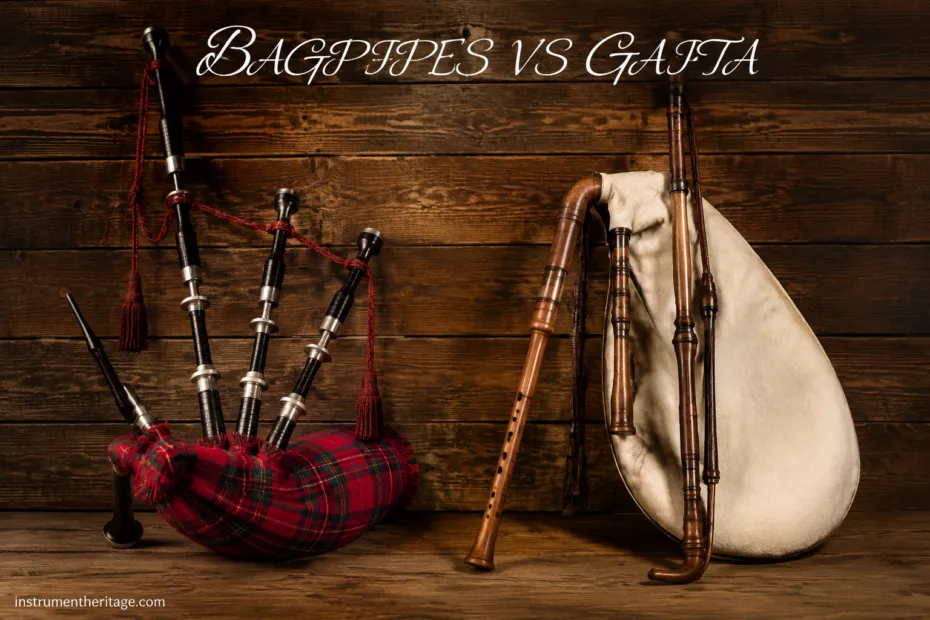
Bagpipes and gaita are not two unrelated kinds of instrument. A Galician gaita de fol is itself a bagpipe. The useful comparison is between the Great Highland Bagpipe associated with Scotland and the Galician gaita de fol of Galicia. Both store air in a bag, feed a reed-driven melody pipe and sustain one or more drones, yet their chanters, drone layouts, tuning habits, fingering systems and musical languages developed along different paths.
Throughout this comparison, bagpipes means the Great Highland Bagpipe, while gaita means the Galician gaita de fol. That distinction matters because the word gaita can refer to other regional pipes and wind instruments in Iberian traditions.
| Feature | Great Highland Bagpipe | Galician Gaita de Fol |
|---|---|---|
| Instrument family | Bagpipe | Bagpipe |
| Primary tradition | Scottish Highland piping | Galician traditional piping |
| Air supply | Mouth-blown bag | Mouth-blown bag in the common gaita de fol form |
| Melody pipe | Chanter | Punteiro |
| Melody reed | Double reed | Double reed called a palleta |
| Main drone layout | One bass drone and two tenor drones | Roncón plus, depending on type and period, possible additional drones |
| Typical melodic compass | Traditional Highland system built around nine conventional chanter notes | Depends on punteiro, fingering and regional or modern setup; overblowing can extend the usable register |
| Fingering | Highly codified Highland fingering and ornamentation | Open, closed and regionally specific approaches are documented |
| Drone character | Three-drone sustained foundation | Historically varied; the roncón is the defining main drone |
| Common materials | Dense hardwood for pipes; hide or synthetic bags are used today | Boxwood has deep traditional roots; olive, ash, ebony and other dense woods have also been used |
| Musical settings | Solo piping, pipe bands, marches, reels, strathspeys and piobaireachd | Solo piping, dance music, alboradas, processional playing and ensembles with percussion |
| Interchangeable? | No. Skills transfer between them, but fingering, tuning, ornaments and repertoire style must be learned separately. | |
🎵 A useful terminology rule: a Galician gaita is a bagpipe, but not every bagpipe is a Galician gaita. Calling the comparison simply “bagpipe versus non-bagpipe” creates the wrong starting point.
A Gaita Is Already Part of the Bagpipe Family
Bagpipe describes a broad family of reed instruments rather than one fixed design. What unites them is a flexible air reservoir feeding a melody pipe and, in many forms, one or more drones.
The Galician instrument is more precisely called the gaita de fol. Its melody pipe, or punteiro, has a conical bore and a double reed known as the palleta. The main drone is the ronco or roncón. Galician documentation also records several traditional types distinguished partly by the number, position and construction of their drones. Reference-1✅
The Great Highland Bagpipe follows the same general acoustic idea, yet it has become a much more narrowly standardized instrument type. Its familiar setup uses a chanter with three shoulder drones: one bass and two tenors.
The family relationship in one line
Great Highland Bagpipe and Galician gaita de fol are two regional bagpipe traditions built around the same air-reservoir principle, not two separate instrument families.
The Same Airflow Idea Produces Two Different Instruments
The basic airflow path is simple:
- The player blows air into the bag.
- The bag stores that air and smooths out the breathing cycle.
- The arm maintains pressure while the player breathes again.
- Air reaches the melody reed and the drone reeds at the same time.
- The melody continues over an uninterrupted drone.
This is why both instruments can sustain sound without the normal breath gaps heard on a directly blown flute, shawm or oboe. The fingers do not stop the airflow. They reshape the sounding air column inside the melody pipe.
Chanter and punteiro
The Highland melody pipe is called the chanter. The Galician equivalent is the punteiro. Both use a conical bore and a double reed, which helps explain why both can produce a direct, reed-rich tone capable of carrying outdoors.
The similarity ends before the fingering system begins. The Highland chanter belongs to a tightly defined piping tradition built around nine conventional notes. The Bagpipe Society describes the Great Highland Bagpipe as having a nine-note scale, its own Highland fingering and three drones worn over the shoulder. Reference-2✅
A Galician punteiro has eight digital holes: seven on the front and one thumb hole at the back. Its playing behaviour can differ considerably according to bore, reed, regional fingering, instrument age and whether the instrument follows an older regional pattern or a more standardized contemporary design.
Three Highland drones versus the Galician roncón
The drone layout is the easiest structural difference to hear and often the easiest to see.
- Great Highland Bagpipe: one bass drone plus two tenor drones, all extending over the player’s shoulder.
- Galician gaita: the roncón forms the principal drone, while additional drones depend on the particular historical or regional type.
Traditional Galician evidence includes a simple form consisting of punteiro + roncón, but Galician gaita design cannot be reduced to “one drone only.” Other documented forms add smaller drones such as the ronquillo, and still more elaborate configurations also existed. Reference-3✅
🪵 Construction detail: historical Galician makers commonly favored boxwood, while olive, ash, ebony and dense imported hardwoods also appear in surviving traditions. Reed design matters just as much as wood. A fine instrument can change noticeably when the palleta, drone reed or bag pressure changes.
Why Their Sound Is Recognizably Different
It is tempting to describe one instrument as simply louder, brighter or warmer than the other. Those labels can be useful when describing a particular recording, but they are unreliable as universal rules.
The sound comes from several interacting parts: reed stiffness, bore shape, hole placement, bag pressure, drone tuning and the player’s technique. Even two gaitas in the same nominal pitch can behave differently if their punteiros and reeds follow different designs.
The drone bed changes what the ear hears
On the Great Highland Bagpipe, three drones create a dense and stable harmonic background. The two tenor drones reinforce the same register while the bass drone adds the lower foundation. The chanter melody is heard continuously against that three-part drone field.
A gaita with one roncón creates a different acoustic balance. Add a ronquillo or another drone and that balance changes again. The number of drones is therefore not just a visual feature. It changes the harmonic weight beneath every melody note.
The reed is a large part of the instrument’s voice
Both melody pipes use double reeds, but they are not interchangeable reeds cut to one shared recipe. Dimensions, cane preparation, opening, stiffness and matching to the bore all affect response.
A reed that demands more pressure can make attacks feel firmer and alter upper-note behaviour. A more responsive setup can feel quicker under the fingers. This is one reason a comparison based only on a phone recording can be misleading: microphone distance and room acoustics may change the apparent balance between chanter and drones.
Loudness does not provide a clean dividing line
Both instruments can project strongly. The Great Highland Bagpipe is built for sustained high-pressure playing, while Galician gaitas also developed for outdoor and communal music-making. Yet a claim such as “one instrument is always a fixed number of decibels louder” would require controlled measurements of specified instruments, reeds, players and distances.
Volume alone cannot identify the instrument.
Their Tuning Systems Need More Than a Key Name
Calling one pipe “in A” and another “in C” looks convenient on paper, but bagpipe tuning contains more detail than a single letter can show.
Highland note names belong to Highland piping practice
The Great Highland chanter uses the conventional note names low G, low A, B, C, D, E, F, high G and high A. Modern instruments are often encountered around a concert B-flat relationship even though pipers continue to use traditional Highland note names.
This means a piper saying “low A” is not automatically describing the same concert pitch implied by an orchestral musician saying “A.” The drone tuning and chanter scale also work as one connected acoustic system rather than as isolated equal-tempered keyboard notes.
There is no single historical Galician gaita pitch
Galician gaitas have existed in several tonalities and regional forms. Older instruments document differences not only in tonic pitch but also in scale shape, drone relationships, bore dimensions and fingering.
That makes statements such as “all Galician gaitas are in C” too narrow. C gaitas are common today, but other pitches belong to both historical and current practice.
Older regional gaitas and modern standardized gaitas may behave differently
One of the most useful distinctions is between an older regional instrument and a contemporary workshop instrument intended to cooperate easily with other modern instruments. Galician research documents changes in punteiro bore, tone-hole dimensions, drone construction and scale design during twentieth-century standardization. Modern punteiros can therefore be much closer to regular tempered ensemble tuning than some surviving older examples. Reference-4✅
Historical instrument ≠ modern standardized instrument. When two sources describe the “Galician gaita” differently, they may be describing different regional types, different periods or instruments built for different musical settings.
Fingering Reveals One of the Largest Practical Differences
A player who can keep a bag inflated has only solved the first part of the problem. The hands speak a different language on each instrument.
Highland piping uses a tightly organized ornament system
The Highland chanter sounds continuously, so pipers cannot normally separate notes by tonguing them as a recorder or clarinet player might. Instead, grace notes and finger movements articulate the melody.
Doublings, strikes, grips, birls and other movements do more than decorate tunes. They help define rhythm, note separation and style. A melody stripped of its Highland ornaments may retain its pitches while losing much of its piping identity.
Galician fingering was not historically one uniform system
Galician piping preserves evidence of both open and closed fingering, along with local articulation methods. Some regional players developed ways of producing short separations between melody notes while the roncón continued sounding. Other areas favored different finger closures, ornaments and ways of reaching upper-register notes.
This matters when learning from a chart. A single modern fingering chart can teach a playable contemporary system, but it does not represent every historical Galician style.
| Playing Detail | Great Highland Bagpipe | Galician Gaita |
|---|---|---|
| Note separation | Mostly finger articulation and codified grace-note movements | Finger articulation varies by style; regional methods include open and closed approaches |
| Tonguing the chanter | Not the normal Highland method | Not the basic mechanism of normal bag-driven playing |
| Upper register | Traditional repertoire stays within the established nine-note chanter compass | Some punteiros and techniques permit overblown notes above the basic octave |
| Ornament vocabulary | Highly codified | Tradition-dependent and historically regional |
| Pressure control | Very steady pressure is needed for stable chanter and three-drone tuning | Steady pressure is equally important, while response varies with reed and gaita type |
Can the Same Tune Be Played on Bagpipes and Gaita?
Often yes, but not unchanged. A simple folk melody may transfer easily if its notes fit both instruments. More style-dependent music needs adaptation.
- Check the range. A melody containing notes outside the Highland chanter compass must be rewritten, displaced or omitted.
- Check the tonal centre. The melody has to sit comfortably against the drones.
- Check accidentals. Notes easily available on one punteiro may not belong naturally to standard Highland fingering.
- Rebuild the ornaments. Copying Galician articulation directly into Highland piping, or the reverse, does not automatically produce an idiomatic performance.
- Listen to the phrasing. Identical written notes can feel very different once regional dance rhythms and ornament patterns are restored.
A tune is therefore more than a row of pitches. The instrument’s fingering and drone system influence how the tune is shaped.
Piobaireachd shows what the Highland system can do with a compact range
Highland piping does not need a wide chromatic compass to create elaborate music. Piobaireachd (also written pìobaireachd) develops a theme through ornamented variations while the drones remain underneath. Its detail comes from timing, embellishment, melodic contour and control rather than a large number of available notes.
Galician repertoire grew around different rhythmic and ensemble habits
The gaita has long been heard in dance music, festive playing, processional settings and morning alboradas. It also works naturally with traditional percussion. Depending on place and period, a gaita might appear with tambor, caixa or bombo, with another gaita, or in a larger traditional ensemble.
The muiñeira is among the best-known Galician dance forms associated with the instrument, but Galician piping is broader than a single dance rhythm.
Neither Instrument Can Be Reduced to One Cultural Setting
The Great Highland Bagpipe is often recognized through pipe bands and formal outdoor performance, yet its repertoire also includes solo competition music, reels, strathspeys, jigs, marches, slow airs and piobaireachd.
The gaita is likewise more than a generic “folk pipe.” It has served solo players, dancers, community ensembles, processional music and staged performance, while regional forms preserved their own tunings, techniques and repertoire.
What the comparison is really measuring
The useful differences are organological and musical: how the pipes are built, how reeds respond, how drones are arranged, how notes are fingered and how each tradition turns those physical features into music.
Is One Harder to Play?
There is no useful universal winner. Both require coordination between breathing, arm pressure, fingers, reeds and tuning, but they place the difficulty in somewhat different places.
| Skill | Great Highland Bagpipe | Galician Gaita |
|---|---|---|
| Bag pressure | Steady high-pressure control is central | Steady control is central; resistance varies with setup |
| Drone management | Three drones must lock together with the chanter | Depends on whether the instrument has one or several drones |
| Basic scale | Compact traditional range | More variation between instrument types and punteiros |
| Ornament learning | Large standardized vocabulary | Style depends more strongly on the Galician tradition being learned |
| Changing traditions | Previous bagpipe experience helps with air control, but fingering and musical grammar must be retrained. | |
Can a Highland piper learn gaita faster?
Usually, some skills transfer immediately. A Highland piper already understands how to inflate a bag, maintain pressure through the breathing cycle, listen to drones and diagnose basic reed problems.
The transferable skills include:
- breath and arm coordination;
- stable bag pressure;
- listening for reed stability;
- tuning sustained drones;
- playing a continuous melody over a drone.
The player still has to relearn fingering, ornamentation, scale behaviour and repertoire phrasing. A Highland piper does not begin from zero on gaita, but Highland technique cannot simply be copied onto the Galician instrument.
The same applies in reverse. A skilled gaiteiro brings highly relevant bag control and reed experience to Highland pipes, yet must still learn Highland gracenotes, chanter conventions and three-drone tuning.
How to Tell Them Apart by Their Construction
The safest visual clue is the overall drone arrangement.
Great Highland Bagpipe
- three long drones over the shoulder;
- one visibly longer bass drone;
- two shorter tenor drones;
- drones commonly joined visually by cords;
- separate chanter extending downward from the bag.
Galician Gaita
- prominent roncón as the main drone;
- punteiro extending downward from the bag;
- additional smaller drones on some types;
- drone placement can vary between historical forms;
- decorative bag coverings and drone ornament vary widely.
Do not turn this into a rigid rule that says three drones equals Scottish and one drone equals Galician. The Great Highland three-drone layout is highly characteristic, but Galician gaita history contains more than one drone configuration.
Why Similar Shapes Do Not Mean One Is a Copy of the Other
Bagpipes appeared in many parts of Europe in different forms. A bag, a reed-driven chanter and a drone are practical solutions to the same musical problem: producing uninterrupted melody with a constant tonal accompaniment.
Galician sources preserve medieval evidence of bagpipes with a punteiro-and-roncón type layout, along with other forms. Highland piping later developed its own highly recognizable three-drone configuration and performance practice.
The resemblance therefore reflects membership in a broad bagpipe family. It does not require treating the Galician instrument as a smaller Scottish pipe or the Scottish instrument as a modified gaita.
Other Bagpipes That Help Place the Gaita in Context
The Galician gaita becomes easier to understand when placed beside nearby and related bagpipe traditions rather than only beside the Great Highland Bagpipe.
| Instrument | How It Relates |
|---|---|
| Asturian gaita | Another northern Iberian bagpipe with a conical double-reed chanter, its own dimensions, reed design and playing practice. |
| Portuguese gaita de fole | Part of the wider Iberian bagpipe landscape, with regional construction and scale traditions distinct from Galician practice. |
| Scottish smallpipes | Scottish bagpipes with a quieter character and different drone arrangement from the Great Highland Bagpipe. |
| Border pipes | Scottish-border tradition commonly using three drones but with construction and repertoire different from Highland pipes. |
| Uilleann pipes | Irish bellows-blown pipes with a very different chanter, drone system and regulators despite belonging to the same broad bagpipe family. |
This wider comparison also explains why the word bagpipes should never be treated as though it describes one universal Scottish design. The family contains mouth-blown and bellows-blown instruments, single- and multi-drone systems, open and stopped chanters, different reeds and very different musical vocabularies.
Common Mix-Ups About Bagpipes and Gaita
- “A gaita is not a bagpipe.”
- Incorrect. The Galician gaita de fol is a bagpipe.
- “All Galician gaitas have one drone.”
- Incorrect. A one-roncón form is historically important, but other Galician drone layouts are documented.
- “All gaitas are in C.”
- Too narrow. C instruments are common, while other pitches and older regional tonal systems also exist.
- “Highland pipes and gaita use the same fingering because both have conical chanters.”
- Incorrect. Their fingering and ornament systems belong to different traditions.
- “A gaita is simply a quieter Highland bagpipe.”
- Incorrect. Drone architecture, reeds, chanter design, scales and playing style differ.
- “A melody that fits both instruments will sound the same.”
- Not necessarily. Drone relationships, articulation and ornaments can change the musical character even when the notes are similar.
Questions About Bagpipes and Gaita
Is a gaita the same thing as a bagpipe?
A Galician gaita de fol is a type of bagpipe. “Bagpipe” names the larger instrument family, while “Galician gaita” identifies one regional tradition within that family.
What is the biggest physical difference between Scottish bagpipes and gaita?
The drone arrangement is usually the clearest difference. The Great Highland Bagpipe has one bass and two tenor drones over the shoulder. A Galician gaita centers on the roncón and may have additional drones depending on the type.
What is the chanter of a gaita called?
It is called the punteiro. In the traditional Galician gaita de fol it has a conical bore and uses a double reed called a palleta.
Does a Galician gaita always have one drone?
No. The simple punteiro-and-roncón form has a long documented history, but Galician traditions also include instruments with additional drones such as a ronquillo and other multi-drone arrangements.
Can a Highland piper play a Galician gaita immediately?
Previous piping experience helps with bag pressure, breathing and drone awareness, but the player still needs to learn Galician fingering, articulation, reed behaviour and repertoire style.
Can a Galician tune be played on Great Highland Bagpipes?
Many melodies can be adapted if their range and pitches fit the Highland chanter. Tunes using notes outside its traditional compass, or details dependent on Galician ornamentation and overblowing, may need alteration.
Are Galician gaitas always tuned to C?
No. C is common among contemporary instruments, but Galician gaitas have been made in several pitches. Older regional instruments may also differ in scale shape from today’s more standardized models.
Which is easier, Great Highland Bagpipe or gaita?
Neither has a universal advantage. Highland piping demands steady pressure, three-drone tuning and a highly codified ornament system. Gaita playing requires equally controlled airflow while adding instrument-specific fingering, reed response and regional or modern stylistic choices.
Do bagpipes and gaita use the same reeds?
No. Both traditions use reed-driven chanters and drone reeds, but their reeds are designed for their own bores, pressure requirements and tuning systems. They should not be treated as interchangeable parts.
Why can two Galician gaitas sound different from each other?
The punteiro bore, palleta, drone arrangement, pitch, wood, bag pressure and regional construction can all change the result. An older regional gaita may also have a different scale and response from a contemporary standardized instrument.
