
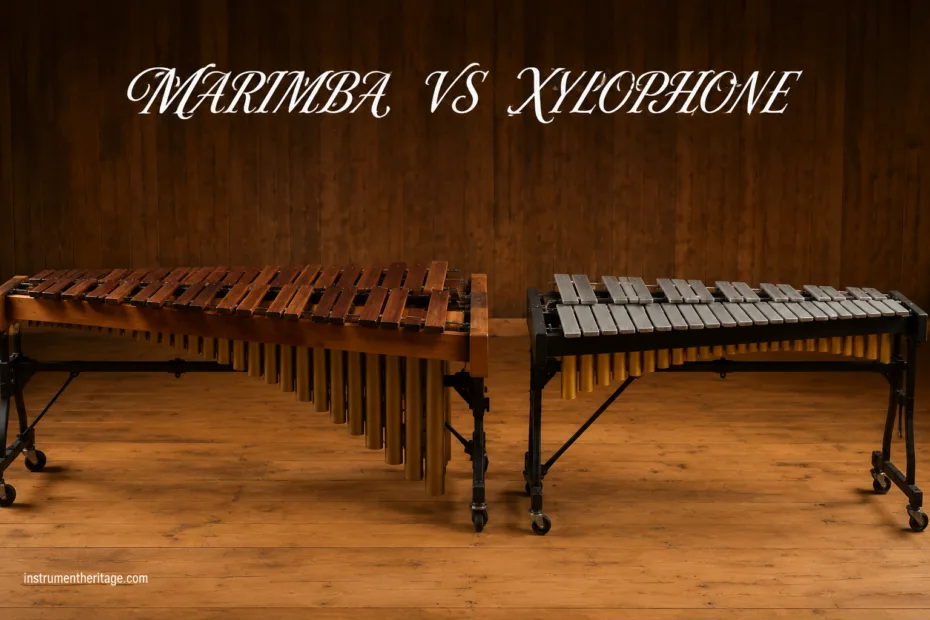
Marimba and xylophone can look remarkably similar: both use two rows of tuned bars arranged like a piano keyboard, both are played with mallets, and concert models often have resonator tubes underneath. The musical result is quite different. A marimba normally reaches much lower, covers a wider range, and produces a rounder tone with more resonance, while a modern orchestral xylophone occupies a higher register and produces a shorter, brighter, more sharply defined sound. Size matters, but the deeper differences come from bar tuning, register, mallet choice, construction, and notation.
| Feature | Marimba | Xylophone |
|---|---|---|
| Instrument type | Tuned percussion; struck idiophone | Tuned percussion; struck idiophone |
| Bar layout | Two chromatic rows arranged like piano keys | Two chromatic rows arranged like piano keys |
| Typical modern range | About 4–5 octaves; common examples extend from C3–C7 down to C2–C7 | About 3–4 octaves; common orchestral examples include C5–C8, F4–C8, and C4–C8 |
| Register | Lower and wider | Higher and narrower |
| Tone | Rounder, fuller, warmer | Brighter, harder, more sharply articulated |
| Note decay | Generally longer, especially in the low register | Generally short and immediate |
| Notation | Normally sounds at the written pitch | Modern orchestral xylophone normally sounds one octave above written pitch |
| Mallets | Yarn-wrapped heads are common; soft, medium, and hard choices are used | Harder rubber, plastic, and wood-type heads are commonly used |
| Bar material | Rosewood, padauk, or synthetic material depending on model | Rosewood and other hardwoods, or synthetic material depending on model |
| Resonators | Common on concert instruments | Also common on modern concert and orchestral instruments |
| Physical size | Usually larger, with broad bass bars and longer low resonators | Usually more compact |
| Typical musical strengths | Wide melodic range, rolls, chords, multiple-mallet writing, low-register lines | Fast figures, short articulation, repeated notes, clearly defined upper-register lines |
🎵 Two visual shortcuts often cause confusion. Resonator tubes do not identify a marimba by themselves, and wooden bars do not separate the two instruments either. Modern examples of both instruments can use resonators, natural wood, or synthetic bar materials. Reference-1✅
Why a Marimba and Xylophone Sound Different
The contrast is easy to hear even when both instruments play the same written melody. A marimba tends to produce a fuller fundamental pitch with a softer attack. A xylophone produces a more pronounced initial attack and a greater amount of upper-frequency energy, giving notes a harder edge.
Mallet hardness contributes to this difference, but it does not create the entire difference. The bars themselves are designed and tuned differently. Register also changes what the listener hears: a low marimba bar moves differently from the much smaller bars found in the upper register of a xylophone.
Their bars emphasize different partials
Every struck bar produces more than its named note. Along with the fundamental pitch, additional partials contribute to timbre. Instrument makers control those partials by shaping and tuning the bar, particularly its underside.
Yamaha describes its marimba bars as being tuned around even-numbered harmonics, including the fundamental, fourth harmonic, and—in its more detailed example—the tenth harmonic. Its xylophone design emphasizes the fundamental and the third harmonic. That difference helps explain why the marimba blends more smoothly while the xylophone produces a more sharply defined tone. Other manufacturers may voice their instruments differently, so this is a design principle rather than a universal formula for every xylophone ever made. Reference-4✅
Attack and decay are different too
A xylophone note normally has a shorter natural decay. This makes repeated notes, accented figures, and rapid passages especially clear. Rolls can extend the apparent duration because the performer repeatedly strikes the bar before the previous vibration has fully disappeared.
Marimba notes, particularly low ones, remain audible for longer. That extra resonance supports slow melodic lines, sustained rolls, overlapping tones, and chordal writing. The exact decay changes with register, bar material, mallet hardness, room acoustics, and the instrument itself.
Range and Size Explain Much of the Visual Difference
The easiest dependable distinction is usually the register. Modern marimbas extend farther downward, so their bass bars must be much larger than the bars at the treble end. This creates the wide, asymmetric shape associated with full-size concert marimbas.
Marimba range
Common modern instruments run from about four to five octaves. Vienna Symphonic Library lists examples including C3–C7, A2–C7, F2–C7, and C2–C7. Marimba notation normally sounds as written. Reference-2✅
Xylophone range
Modern orchestral xylophones commonly cover about three to four octaves, with examples including C5–C8, F4–C8, and C4–C8. The orchestral instrument normally sounds one octave above its written notes. Reference-3✅
These ranges describe common concert instruments, not a rule that every maker must follow. Student instruments, older models, extended-range instruments, and culturally distinct forms of xylophone can have other layouts.
- Five-octave marimba
- C2–C7 is a familiar modern concert range, giving the instrument a substantial bass register.
- Four-octave marimba
- C3–C7 removes much of the deep bass end but retains a broad melodic register.
- Four-octave orchestral xylophone
- C4–C8 extends downward farther than smaller orchestral xylophones while remaining centered much higher than a five-octave marimba.
- Three-octave orchestral xylophone
- C5–C8 occupies a distinctly high register.
Lower notes need larger vibrating parts
Lower pitches require longer and differently shaped bars. The resonating system below them also grows. This is why the bass end of a five-octave marimba can look much larger than its treble end, while a xylophone stays comparatively compact because its normal range does not extend nearly as low.
Bars, Undercuts, and Materials
On both instruments, the bar is the primary vibrating body. Striking it causes the material to flex, and the bar’s length, thickness, density, shape, and tuning determine its pitch and tonal behavior.
The underside matters as much as the polished surface visible to an audience. Material can be removed from selected areas to adjust the fundamental and selected partials. Lower marimba bars often have a deep arch carved into the underside. Xylophone bars are also shaped underneath, but their profile and tuning target differ.
🪵 Wood is not a reliable identification test. Rosewood has long been associated with professional marimbas and xylophones, while padauk and other woods appear on various models. Modern makers also produce synthetic tone bars designed to offer stable tuning and durability.
Material changes response and tonal color, yet it does not turn one instrument into the other. A synthetic-bar marimba remains a marimba, and a synthetic-bar xylophone remains a xylophone. Register, bar voicing, construction, and intended musical function provide much better clues.
Mallet Choice Changes the Character of Each Instrument
Mallets are part of the sound-producing system. A hard head excites more upper partials and gives the beginning of each note greater definition. A softer head suppresses some of that upper-frequency activity, creating a rounder result.
Marimba mallets
Marimba players commonly use yarn-wrapped mallets available in soft, medium, hard, and intermediate grades. Softer heads suit the lower register because the large bass bars respond well to a broad, less concentrated contact. Firmer mallets can bring more definition to the upper register.
Four-mallet playing is especially associated with modern marimba technique. Using two mallets in each hand lets a player perform chords, independent lines, rolled harmonies, and wide intervals that would be impossible with a single pair.
Xylophone mallets
Xylophone playing commonly favors smaller, harder mallet heads made from materials such as rubber, plastic, or wood. The harder contact helps produce the bright attack associated with orchestral xylophone writing.
That does not mean every xylophone passage uses the hardest available mallet. Players change hardness to control articulation and tone. A softer mallet rounds the sound; a harder one brings more upper partials forward.
Resonators Are Not a Marimba-Only Feature
The vertical tubes hanging below the bars are resonators. Each is acoustically matched to a bar or group of pitches so that the vibrating air reinforces the sound produced above it.
Marimbas make these tubes particularly noticeable because the low register requires much longer resonators. The bass end may therefore have large tubes that extend far below the keyboard. Some designs use curved or stopped resonators so that extremely long acoustic lengths can fit within a practical frame.
🔎 Identification mistake: “It has resonator tubes, so it must be a marimba” does not work. Modern orchestral xylophones can have resonators beneath every bar as well. Their resonators are simply associated with a much higher register and are usually less visually dominant.
Older xylophones and simpler educational instruments may be built differently, which is one reason photographs from different periods can be confusing. The comparison here concerns the modern concert marimba and modern orchestral xylophone unless another type is specified.
The Notation Difference Is Easy to Miss
The two keyboards look similar, but performers do not always interpret written pitch in the same way.
Marimba
Sounds as written. A written C4 normally produces C4. Because of its wide range, marimba music can use both treble and bass clefs in a piano-like two-staff layout.
Orchestral xylophone
Normally sounds one octave higher than written. A written C5 is heard as C6 under standard orchestral notation. The instrument is therefore treated as a transposing instrument and is usually written in treble clef.
This octave convention keeps xylophone notation from sitting unnecessarily high above the treble staff. There are score-specific exceptions, so performers still follow the notation instructions provided by the composer or edition.
Can the Same Music Be Played on Marimba and Xylophone?
Some melodies transfer easily because both instruments use the familiar chromatic two-row keyboard. The physical note pattern is closely related. The musical result, however, is not automatically equivalent.
- Range can stop the transfer. A passage that enters the marimba’s bass register may contain pitches a normal xylophone simply does not have.
- Notation can change the sounding octave. An orchestral xylophone part normally sounds an octave above its notation, while marimba does not use that standard octave displacement.
- Decay changes phrasing. A sustained marimba roll or resonant chord becomes more sharply articulated on xylophone.
- Mallet response changes articulation. The same rhythm can feel much more defined on xylophone because its bars and typical mallets emphasize the beginning of each note.
- Four-mallet textures may fit marimba better. Xylophone chords are possible, but the marimba’s bar layout, range, tonal decay, and modern repertoire make multi-mallet harmonic writing especially natural to the instrument.
A simple tune within the shared range can therefore be performed on both. A composition written around the acoustic behavior of the instrument may need rearrangement rather than a direct instrument swap.
Why Composers Use Them for Different Musical Jobs
The difference in tone is functional. A composer choosing between marimba and xylophone is choosing a different register, duration, articulation, and relationship with the rest of an ensemble.
Marimba is often used for
- Low and middle-register melodic writing
- Long rolls and connected phrases
- Four-mallet chords and harmonic textures
- Solo repertoire requiring a wide pitch range
- Passages where a softer attack is wanted
Xylophone is often used for
- Fast upper-register figures
- Short, clearly separated notes
- Repeated-note patterns
- Melodic doubling that needs strong articulation
- Passages where the initial attack needs to remain clearly audible
Neither list is a restriction. Skilled players can create many articulations on both instruments, and composers regularly use them outside their most familiar roles.
How to Tell a Marimba From a Xylophone by Sight
There is no single visual test that works for every model, but several clues together make identification much easier.
- Look at the bass end first. Very broad low bars and a large gap in size between the lowest and highest bars strongly suggest a marimba.
- Consider the overall footprint. A full concert marimba is normally much larger than a standard orchestral xylophone.
- Look at the mallets. Large yarn-wrapped heads strongly suggest marimba playing, while small hard heads are more typical of xylophone.
- Inspect the underside of the bars if visible. Low marimba bars commonly have a deep arched undercut. Xylophone bars are shaped differently because their tuning targets and register differ.
- Do not decide from the resonators alone. Both instruments can have them.
🎼 The strongest combination of clues is register + bar size + mallet type. A large instrument with very wide bass bars and yarn mallets is almost certainly a marimba. A compact instrument concentrated in the high register and played with small hard mallets is much more likely to be a xylophone.
How Closely Related Are Marimba and Xylophone?
Both belong to the family of pitched mallet percussion instruments and, acoustically, both are struck idiophones: the bar itself vibrates to create the note. Their keyboard-like arrangement makes them look related to a piano, but no strings or keyboard mechanism produce the sound.
The word xylophone can also be used more broadly for tuned wooden-bar instruments found in many musical cultures. In modern orchestral language, however, “xylophone” normally refers to the specific high-register chromatic instrument compared with the concert marimba here.
Their histories should not be reduced to a single straight line of development. Tuned wooden-bar instruments have existed in different forms and musical traditions, while the modern concert marimba and orchestral xylophone acquired the standardized chromatic keyboard, frame, tuning, and resonator systems familiar to players today.
Marimba, Xylophone, Vibraphone, and Glockenspiel
Confusion often extends beyond marimba and xylophone because several mallet instruments use the same two-row chromatic layout. The bar material and sound behavior help separate them.
| Instrument | Typical bar material | General register and tone | Note behavior | Easy identifying feature |
|---|---|---|---|---|
| Marimba | Wood or synthetic material | Low to high; full and rounded | More resonance, especially in lower notes | Large bass bars and wide overall range |
| Xylophone | Wood or synthetic material | Higher; bright and sharply articulated | Short natural decay | Compact high-register wooden-bar keyboard |
| Vibraphone | Metal | Middle register; smooth metallic tone | Long sustain controlled by a damper pedal | Metal bars, pedal, and resonator mechanism |
| Glockenspiel | Metal | Very high; bell-like | Clear ringing decay | Small, narrow metal bars in a very high register |
A useful distinction is therefore wooden or wood-like bars versus metal bars. Marimba and xylophone belong together acoustically more closely than either does with vibraphone or glockenspiel, even though all four use mallets and chromatically arranged bars.
Common Marimba and Xylophone Mix-Ups
“A marimba is just a large xylophone.”
The larger size is only one visible difference. Range, bar voicing, notation, mallet practice, decay, and repertoire separate the modern instruments.
“Only marimbas have resonators.”
Modern orchestral xylophones can also have individual resonator tubes beneath their bars. Resonator presence alone does not identify the instrument.
“Marimba is wood and xylophone is synthetic.”
Both instruments can use natural wood or synthetic bar materials. Material choice is model-dependent, not the defining difference.
“They read exactly the same music.”
The keyboard geometry is related, but standard orchestral notation differs: marimba normally sounds as written, while xylophone normally sounds one octave higher than written.
Frequently Asked Questions
Is a marimba just a bigger xylophone?
No. A marimba is usually larger because it extends much farther into the low register, but size is only part of the distinction. Its bars are voiced differently, its tone is rounder, its natural decay is generally longer, and its standard notation differs from orchestral xylophone notation.
Which is lower pitched, marimba or xylophone?
The marimba. Modern concert marimbas commonly cover four to five octaves and can extend to C2, while modern orchestral xylophones normally occupy a considerably higher range.
Which instrument has the brighter sound?
The xylophone generally sounds brighter and more sharply articulated. Its higher register, bar voicing, and frequent use of harder mallets place more emphasis on upper partials and the beginning of each note.
Does a xylophone sound an octave higher than written?
A modern orchestral xylophone normally does. Its standard part is written one octave below the pitch heard by the listener. Marimba normally sounds at written pitch.
Do xylophones have resonator tubes?
Yes. Modern concert and orchestral xylophones can have resonators beneath the bars. Resonators are therefore not exclusive to marimbas.
Are marimba and xylophone bars always made of wood?
No. Natural woods such as rosewood and padauk are used, but synthetic bar materials are also found on modern instruments. The choice depends on the maker, model, intended use, tonal design, and durability requirements.
Can you use marimba mallets on a xylophone?
Some softer effects are possible, but the result changes substantially. Marimba mallets are commonly yarn-wrapped and may produce a less defined attack on xylophone. Xylophone players normally choose smaller and harder heads when they want the instrument’s familiar bright articulation.
Can a xylophone play marimba music?
It can play melodies that fit within its range, but much marimba repertoire depends on low notes, longer resonance, wide intervals, four-mallet chords, or other features that do not transfer directly. An arrangement may therefore be needed.
Which instrument is usually larger?
The marimba. Its lower register requires much larger bass bars and a larger resonating system, making a full-size concert marimba noticeably wider and deeper than a standard orchestral xylophone.
