
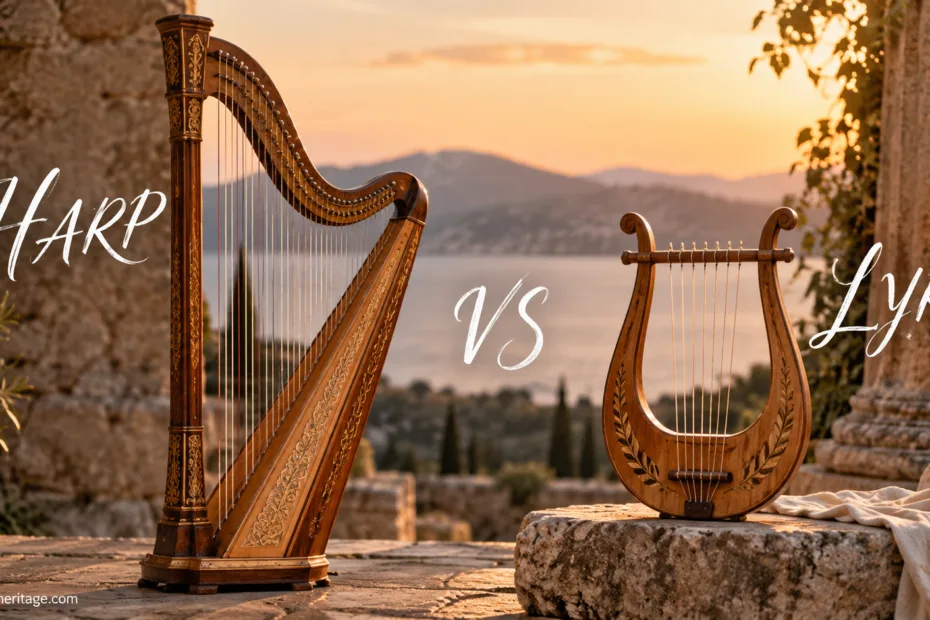
Harp and lyre are both plucked chordophones, and both can place a row of open strings in front of the player. The reliable difference is not size, age, or string count. It is how the strings are arranged in relation to the soundboard. A lyre carries its strings to a yoke formed by two arms and a crossbar, with the string plane running broadly parallel to the soundboard. A harp stretches its strings between the soundboard and a neck, with the string plane set at a right angle to the soundboard.
| Feature | Harp | Lyre |
|---|---|---|
| Instrument family | Composite chordophone; harp group | Composite chordophone; yoke lute or lyre group |
| Hornbostel–Sachs group | 322 Harps | 321.2 Yoke lutes or lyres |
| String plane | At a right angle to the soundboard | Parallel with the soundboard |
| Upper string support | Neck | Crossbar or yoke |
| Two arms joined by a crossbar | Not the defining structure | Defining lyre structure |
| Pillar | Present on frame harps; absent on open harps | No harp-style pillar |
| Bridge | Not a family-defining feature | Common on many lyres, but the yoke and string plane are more reliable identifiers |
| Typical playing method | Strings plucked individually with the fingers; technique varies by harp type | Plucking, strumming, plectrum use, and damping all occur in different lyre traditions |
| Pitch control | Tuning pins; some modern harps add levers or pedals | String tension and tuning hardware; systems vary widely by tradition |
| String length | Often graduated from long bass to short treble strings | May be equal or graduated depending on the instrument |
| Usual outline | Arched, angular, or triangular depending on type | Yoke-shaped frame with two arms and a crossbar |
| Best identification clue | Follow the strings from soundboard to neck | Find the yoke and check that the strings lie in the soundboard plane |
The difference starts with string geometry
If you can see the instrument clearly, follow one string from its lower end to its upper support. That usually tells you more than counting strings or judging the outline.
Lyre: strings run toward a yoke
In the Hornbostel–Sachs system used by MIMO, the lyre sits in group 321.2, “Yoke lutes or lyres.” The defining arrangement is precise: the string plane runs parallel with the sound-table, and the strings attach to a yoke formed by two arms and a crossbar. Reference-1✅
That yoke is not decorative trim. It is the upper string-bearing structure. On many lyres, the strings also pass across a bridge before reaching the lower attachment area on or near the resonator. The bridge helps transfer vibration into the body, but the yoke and string-plane relationship are safer identification tests than the bridge alone.
Harp: strings run between soundboard and neck
A harp uses another geometry. Hornbostel–Sachs group 322 Harps places the string plane at a right angle to the sound-table, with the lower string ends oriented toward the neck. This separates harps from lyres even when two instruments happen to be similar in height, age, decoration, or number of strings. Reference-2✅
🎼 A useful visual rule: on a lyre, look for a crossbar joining two arms above the resonator. On a harp, look for strings spanning the space between a soundboard and a neck. Size is secondary.
Harp and lyre anatomy use different load paths
Harp parts
- Soundbox: the resonating body.
- Soundboard: the vibrating face where the strings are anchored or coupled.
- Neck: the upper string-bearing member.
- Tuning pins: used to set string tension and pitch.
- Pillar: closes the frame on frame harps, but is absent on open harps.
- Levers or pedals: found on some modern harp families for pitch alteration.
Lyre parts
- Resonator or soundbox: supports and amplifies string vibration.
- Soundboard: the vibrating surface on the front of many lyres.
- Two arms: rise from or beside the body.
- Crossbar or yoke: joins the arms and supports the strings above.
- Bridge: common on many lyres and used to transfer vibration to the resonator.
- Tuning system: may use pegs, rings, windings, or other tradition-specific arrangements.
A harp does not always have a pillar
The familiar concert harp has a closed triangular frame, so it is easy to assume that every harp must have three sides. That is not the case. Organologists distinguish open harps from frame harps. In the MIMO classification, open harps are specifically defined as harps without a pillar. Reference-3✅
This matters when looking at historical instruments. An arched harp can be unmistakably a harp even though it does not form the modern triangular outline. The defining clue remains the relationship between strings, soundboard, and neck.
Why the bridge is useful, but not absolute
Many lyres route their strings over a bridge that presses vibration into the soundboard. This is an excellent secondary clue. Still, a definition based only on “bridge present” versus “bridge absent” is too narrow because instrument construction varies between periods and traditions. The parallel string plane plus yoke remains the cleaner lyre test.
String count, size, and shape can mislead you
Modern retail instruments make the distinction look simpler than it is. Small lyres often have relatively few strings, while orchestral harps can be very large and heavily strung. Those tendencies are real in particular modern contexts, but they are not definitions.
| Claim | Reliable? | Why |
|---|---|---|
| A lyre has a yoke supported by two arms | Yes | This is part of the defining lyre structure. |
| Harp strings are arranged at a right angle to the soundboard | Yes | This is a primary organological distinction. |
| Every harp is triangular | No | Open harps can lack a pillar and do not make a closed triangle. |
| Every lyre is small | No | Lyres occur in different sizes and regional forms. |
| Harps always have more strings | No | String count changes with instrument type and period. |
| All lyre strings are equal in length | No | Some historical lyres used equal-length strings, but the family is broader than one design. |
| A bridge automatically makes an instrument a lyre | No | Bridge design alone does not establish the whole classification. |
Materials change, but the structural distinction stays
Both families have been built in many places and over long periods, so there is no single “harp wood” or “lyre string material.” Traditional construction may combine hardwood or softwood components, skins or membranes on some resonators, gut or sinew strings, plant fibers, metal fittings, and decorative materials. Modern makers also use nylon, fluorocarbon, metal strings, engineered components, and modern adhesives.
Material choice changes tension, mass, attack, sustain, stability, and how strongly the soundboard is driven. Yet a steel-strung lyre does not become a harp, and a gut-strung harp does not become a lyre. Construction geometry carries more classificatory weight than material.
They can both be plucked, but the hands meet the strings differently
Plucking is a shared feature, not a sign that the instruments are interchangeable. Harp technique normally treats the strings as a vertical or angled plane that can be approached from either side with the fingers. Lyre traditions may use individual plucking, strumming, a plectrum, damping from behind the strings, or combinations of these actions.
Harp technique
- Fingers pluck individual strings to form melody, bass lines, chords, and arpeggios.
- Different harp schools use different hand positions and articulation habits.
- Lever harps can alter selected strings by semitone with hand-operated levers.
- Pedal harps use foot pedals linked to mechanisms in the neck, allowing pitch classes to be changed while both hands continue playing.
- Glissandi are possible because many adjacent strings can be swept in a single gesture.
Lyre technique
Lyre technique is especially diverse because “lyre” names a family rather than one standardized modern instrument. One player may pluck selected strings with both hands. Another tradition may strum with a plectrum and mute unwanted strings with the opposite hand. Some modern lyres are approached more like compact melody instruments, while historical reconstructions may follow evidence from art, surviving instruments, written descriptions, and comparative practice.
The ancient Greek kithara shows why a single “lyre technique” should not be assumed. The Metropolitan Museum of Art describes the kithara as a member of the lyre family with seven equal-length strings running over a bridge to a crossbar; it also records plectrum playing with the right hand while the left hand damped strings. Reference-4✅
Tuning works differently because the structures are different
On both instruments, pitch begins with familiar string physics: length, tension, and mass per unit length all matter. The hardware used to control those variables differs.
- Harp tuning
- Strings are tuned to individual pitches with tuning pins. Lever and pedal systems can temporarily shorten selected strings or string classes on instruments designed for chromatic alteration.
- What changes most visibly
- String lengths often become progressively shorter toward the treble, creating the familiar fan-like string field.
- Lyre tuning
- Pitch is commonly set by changing string tension at the yoke or tuning hardware. Pegs, rings, windings, and modern machine-style fittings can all appear.
- What changes most visibly
- String lengths may be equal or unequal. Tension and string thickness can do more of the pitch work in designs where the vibrating lengths are similar.
Harp vs lyre sound: construction matters more than labels
It is tempting to describe every harp as warm and resonant and every lyre as bright and short-lived. Real instruments are less tidy. Size, string material, tension, soundboard thickness, resonator volume, bridge design, plucking position, and room acoustics can all change what reaches the ear.
There are still useful tendencies. A large harp with long bass strings can sustain low notes for a long time and support a wide register. A compact lyre with lighter construction may speak quickly and decay sooner. Another lyre with a large resonator, different strings, or a membrane soundboard can behave very differently. Sound is helpful for recognition, but structure is more dependable.
🎵 Listening alone can mislead. If an unfamiliar recording sounds “harp-like,” that describes the impression of the tone, not necessarily the instrument family.
Harp and lyre developed as separate chordophone traditions
Both instrument families have very old histories, and both appear in several cultural regions. They should not be arranged into a simple sequence where the lyre is an early harp or the harp is a later lyre. Their string-bearing systems are different enough that instrument historians treat them as separate structural lineages.
Lyre is broader than the Greek lyra
The word lyre is often associated with ancient Greek art, but the organological family is wider. Hornbostel–Sachs divides yoke lutes into bowl lyres and box lyres, and living or historically documented lyre traditions occur beyond the Mediterranean. The Greek lyra is therefore one form within a broader family, not a synonym for every lyre.
Kithara and lyra are related, not identical
The Greek kithara belongs to the lyre family, yet it was not simply another name for the lyra. Historical descriptions and surviving imagery point to differences in body construction, performance setting, and playing practice. This is a useful reminder that family names and individual instrument names operate at different levels.
Harp means more than the concert pedal harp
The orchestral pedal harp is only one branch. Harp history also includes arched harps, angular harps, open harps, frame harps, lever harps, and pedal harps. Some historical harps have no forepillar at all. Others use a rigid pillar to close the frame and manage higher structural loads.
Why “lyre harp” is a confusing label
The phrase lyre harp appears often in modern product names and casual descriptions. It does not automatically identify a separate organological family. Many instruments sold under that phrase use a lyre-like yoke, two arms, and strings running across the soundboard plane, so structurally they are better understood as lyres.
A name on a listing can describe appearance, audience familiarity, or a seller’s vocabulary. The physical instrument is more informative. Check the string plane, the yoke, the neck, and the way the strings meet the resonating body.
Similar instruments that clarify the boundary
| Instrument | Relationship | What to notice |
|---|---|---|
| Kithara | Member of the lyre family | Two sidepieces and a crossbar support strings running over the body. |
| Greek lyra | Member of the lyre family | Yoke construction; historically distinct from the larger, more solidly built kithara. |
| Bowl lyre | Lyre subgroup | A bowl-shaped resonator sits beneath the familiar arms-and-yoke arrangement. |
| Box lyre | Lyre subgroup | The resonator is box-like rather than bowl-like. |
| Arched harp | Open harp | A curved neck extends from the resonator; a pillar is not required. |
| Frame harp | Harp subgroup | A pillar closes the structure between neck and body. |
| Lever harp | Frame harp with manual pitch-altering hardware | Levers near the neck shorten individual strings when engaged. |
| Pedal harp | Frame harp with pedal-operated pitch alteration | Pedals control mechanical action for groups of similarly named strings. |
How to identify a harp or lyre from the instrument itself
🧭 Museum labels, product names, and older translations can use broad terminology. The instrument’s construction gives you a stronger starting point.
- Find the upper string support. A crossbar joining two arms points toward a lyre. A neck running from the resonator toward the top of the string field points toward a harp.
- Check the string plane. Strings broadly parallel to the soundboard fit lyre construction. Strings standing at a right angle to the soundboard fit harp construction.
- Look for a yoke before counting strings. Seven, ten, sixteen, or many more strings do not establish the family by themselves.
- Do not require a pillar for a harp. Open harps lack one.
- Treat the bridge as supporting evidence. It is common and informative on many lyres, but it should not replace the yoke-and-plane test.
- Use sound and playing posture last. Both vary strongly with regional type, scale, materials, and performance practice.
The shortest dependable distinction: a lyre organizes its strings around a two-arm yoke in the soundboard plane; a harp organizes its strings between soundboard and neck on a different plane.
The difference matters when reading instrument history
Correct identification affects more than terminology. It helps explain how tension is carried through the body, where vibration enters the resonator, what kinds of tuning systems are practical, and which playing motions make sense. It also keeps historical comparisons clear: two instruments can share a plucked-string sound and still use very different construction logic.
For a museum object, archaeological reconstruction, replica, or modern handmade instrument, architecture should come before appearance. Decoration can change. Materials can change. String counts can change. The relationship between the yoke, neck, soundboard, and string plane is far harder to mistake once you know what to look for.
Harp vs Lyre FAQ
Common questions about harp and lyre
Is a lyre a type of harp?
No. Modern organological classification treats lyres and harps as different chordophone groups. A lyre uses a yoke made from two arms and a crossbar, while a harp places its string plane at a right angle to the soundboard between the soundboard and neck.
Is a harp a type of lyre?
No. Harps belong to Hornbostel–Sachs group 322, while yoke lutes or lyres belong to 321.2. They are related broadly as chordophones, not as the same instrument family.
What is the easiest way to tell a lyre from a harp?
Follow the strings. If they run across the soundboard plane toward a crossbar supported by two arms, the instrument fits lyre construction. If they span between a soundboard and neck on a plane set at a right angle to the soundboard, it fits harp construction.
Does every harp have a triangular frame?
No. Frame harps have a pillar that helps form a closed frame, but open harps do not. Arched and angular harps can therefore look very different from a modern concert harp.
Does every lyre have the same number of strings?
No. String count varies between historical, regional, reconstructed, and modern lyres. The arms, crossbar, and string-plane arrangement are more useful for identification than a fixed number.
Is a kithara a harp or a lyre?
A kithara belongs to the lyre family. Its strings run from the body, over a bridge, to a crossbar joining the two sidepieces.
What does “lyre harp” mean?
It is a common modern label, especially in retail use, rather than a precise family name. Many instruments sold as “lyre harps” have the two-arm yoke and parallel string arrangement of a lyre.
Which has more strings, a harp or a lyre?
There is no family-wide rule. Large modern harps often carry more strings than small modern lyres, but both families include instruments with different string counts. String number is a secondary clue, not a definition.
Do harp and lyre sound the same?
No single tone describes either family. Their construction differs, and sound also changes with size, string material, tension, resonator design, bridge arrangement, plucking position, and technique. A large harp and a small metal-strung lyre may sound very different, but other examples can overlap in character.
