
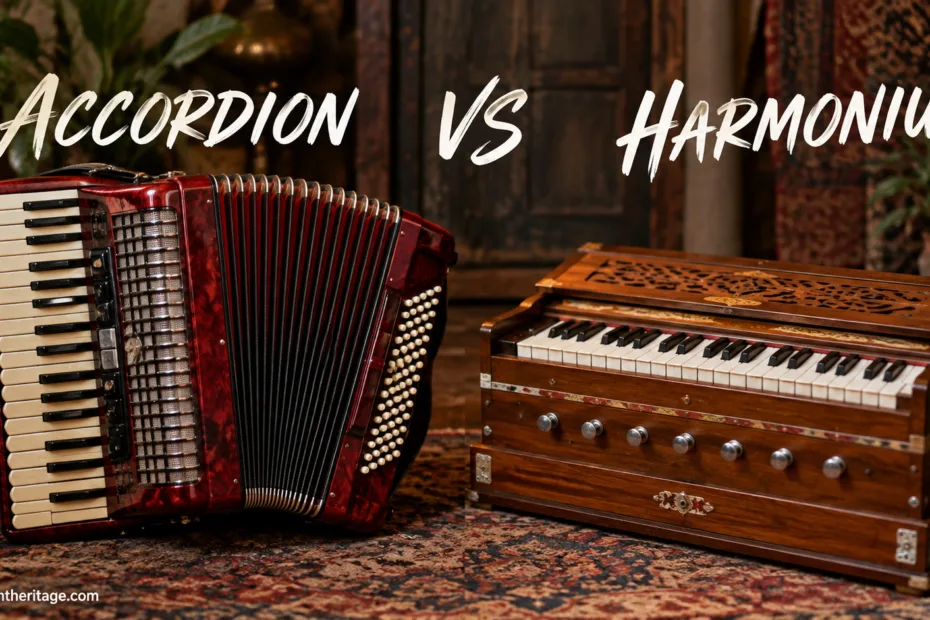
Accordion and harmonium both make sound with free reeds moved by air, yet their playing systems are quite different. An accordion places its bellows between two hand-operated ends, so the player controls air, melody and usually bass or chords while holding the instrument. A harmonium is a reed keyboard organ: its keys sit over a wind chest, while air is supplied by a separate pumping system. In many South Asian harmoniums that pumping is done with one hand; in many historical European harmoniums it is done with the feet. That difference in air supply changes the posture, hand roles, phrasing and accompaniment style of each instrument.
| Feature | Accordion | Harmonium |
|---|---|---|
| Instrument family | Free-reed aerophone | Free-reed keyboard aerophone |
| Air source | Expandable bellows moved by the player’s arms | Feeder bellows supplying a wind chest or reservoir |
| Typical playing position | Held against the body, on the lap, or supported by straps | Placed on the floor, table, stand or furniture-style base |
| Melody control | Piano keys or buttons | Usually piano-style keys |
| Other hand | Commonly controls bass/chord buttons while also moving the bellows | Often pumps the bellows on a South Asian harmonium; both hands may use the keyboard on a pedal harmonium |
| Bass system | Many models have a dedicated bass and chord system | No accordion-style bass-button board; harmony is normally produced on the keyboard |
| Push/pull pitch behavior | Depends on type: piano and chromatic accordions are generally unisonoric; many diatonic accordions are bisonoric | Keyboard pitch does not normally change according to the pumping stroke |
| Sustained sound | Continues while a key/button is held and bellows air is maintained | Continues while a key is held and sufficient air remains in the wind system |
| Tone shaping | Bellows pressure, reed sets, registers and tuning | Air pressure, reed banks, stops, couplers, drones and instrument design |
| Portability | Designed to be played while supported by the player | Ranges from compact portable boxes to large historical furniture-style instruments |
The bellows reveal the main mechanical difference
A bellows is not merely a container full of air. It is the part that creates the pressure difference needed to make a free reed vibrate. Accordion and harmonium makers solve that job in different ways.
Accordion: the bellows sits between two playable ends
On an accordion, the flexible bellows occupies the center of the instrument. One end carries the treble keyboard or button board; the other normally carries the bass mechanism. The player’s arms open and close the bellows, drawing or pushing air across whichever reeds have been selected by the keys or buttons.
This makes bellows movement part of normal musical technique. Pressure can affect attack, volume, articulation and phrase shape. A player may begin a note gently, increase pressure during the sustain, or make a short accent without changing the fingered pitch.
🪗 Accordion airflow
Treble side → bellows movement → airflow through selected reeds ← bass side
The player’s arms provide the air while the fingers decide which valves open.
Harmonium: pumping and keyboard control are separate tasks
A harmonium places its reeds in or around a wind chest connected to bellows and, in many designs, an air reservoir. Pressing a key opens a valve associated with a reed or reed set. The instrument still needs air, but the movement that supplies it is physically separate from the keyboard action.
That distinction matters. A harmonium player is not pulling two sounding halves of the instrument apart. The keyboard stays in place while a feeder bellows replenishes the air supply.
Airflow path: feeder bellows → reservoir or wind chest → opened key valve → free reed → sound.
“Harmonium” can describe two quite different playing arrangements
One source of confusion is the word harmonium itself. A nineteenth-century European harmonium and a modern South Asian hand-pumped harmonium use the same broad free-reed keyboard principle, but their physical layouts and playing techniques are not identical.
European pedal harmonium
Historical European harmoniums were often built as substantial keyboard instruments with a cabinet, wind chest, stops and foot-operated feeder bellows. A mid-nineteenth-century German harmonium in The Metropolitan Museum of Art, for example, has two wooden pedals that pump two bellows beneath the wind chest. Its keyboard controls brass free reeds, while separate stops affect the instrument’s response. Reference-1✅
Because the feet can provide the air, both hands remain available for the keyboard. This produces a playing relationship closer to other keyboard organs than to a handheld accordion.
South Asian hand-pumped harmonium
The compact harmonium widely encountered in South Asian music is normally placed on the floor or another stable surface. One hand plays the keys while the other operates a rear or side bellows. A documented Horniman Museum instrument is played seated on the ground with the left hand operating the bellows; it also has two reed sets, nine stops and a coupler. Reference-2✅
Many instruments in this tradition may include drone stops, reed-selection stops, couplers or tremulant mechanisms, though the exact arrangement varies by maker and model. The keyboard remains the main pitch-control surface.
Useful distinction: saying that “a harmonium is pumped with the left hand” describes a common South Asian playing arrangement, not every harmonium ever made. Historical pedal harmoniums place the pumping job at the feet.
What actually vibrates inside each instrument?
Both instruments belong to the free-reed family. A free reed is a thin metal tongue fixed at one end and positioned over or within a closely fitted opening. When air pressure reaches the reed, the tongue oscillates through that opening and produces a pitched tone.
The pitch depends on the reed’s physical properties, including its length, thickness, mass distribution and stiffness. The enclosure, reed chamber and nearby air volume then affect how that vibration reaches the listener.
Accordion reed construction
Modern accordions commonly use steel reed tongues attached to metal reed plates. Those plates are arranged on reed blocks inside the instrument. Depending on the accordion, one note may have several reed ranks at different octave positions or slightly different tunings. Register switches can select combinations of those reed sets.
The surrounding construction can include wooden reed blocks, metal plates, leather or synthetic valves, and a bellows built from folded board, fabric and reinforced corners. Materials vary across period, region and price level, so there is no single material recipe for every accordion.
Harmonium reed construction
Harmoniums also use metal free reeds, often arranged in banks beneath or within the wind chest. Historical European examples frequently use brass reeds. South Asian instruments may contain one or more reed banks selected by stops, with designs varying widely between workshops.
The wooden case does more than hold the parts together. It supports the keyboard, channels, valves, reservoir and reed chambers, so accurate joints and reliable air seals matter. A leaking bellows or poorly sealing pallet reduces pressure before the air even reaches the reed.
They use the same acoustic principle, not necessarily the same reed assembly
It is accurate to say that accordion and harmonium use the same type of sound-producing principle. It is less accurate to say that they simply use identical internal reeds. Reed dimensions, mounting methods, wind pressure, chambers and voicing are designed around the needs of each instrument.
Does pushing and pulling change the note?
This question needs a distinction between accordion families.
| Instrument type | Bellows direction and pitch |
|---|---|
| Piano accordion | A key is normally unisonoric: it produces the same pitch on opening and closing bellows. |
| Chromatic button accordion | Treble buttons are normally unisonoric as well. |
| Many diatonic button accordions | A button may be bisonoric, producing one note on push and another on pull. |
| Harmonium | The keyboard note normally remains the same regardless of the feeder-bellows pumping stroke. |
This is why the statement “accordion notes change when you reverse the bellows” is too broad. It fits many diatonic accordions, but it does not describe the standard behavior of piano accordions or chromatic button accordions.
On a harmonium, pumping replenishes the air supply. It does not serve as a second fingering system in the way bellows direction can on a bisonoric accordion.
Why the accordion has a separate bass side
The keyboard visible on a piano accordion is only half of its control system. On the opposite side, the left hand normally reaches a field of bass buttons while the same arm manages bellows movement.
A common Stradella-style bass system organizes buttons into rows for functions such as counter bass, fundamental bass, major chords, minor chords, dominant-seventh chords and diminished chords. Smaller accordions may omit some rows or use fewer bass buttons, while free-bass and diatonic systems follow different layouts.
- Right hand
- Melody, intervals and chords on piano keys or treble buttons.
- Left fingers
- Bass notes and chord buttons on many accordion types.
- Left arm
- Bellows direction and pressure.
This lets many accordionists combine melody, bass, harmony and rhythmic articulation within one self-contained instrument.
Why the harmonium does not need accordion-style bass buttons
A harmonium places harmony on the same keyboard used for melody. The player can sound single notes, intervals, chords or drones through the keyboard and available stops. There is no need for a separate accordion-style bass board because the instrument was built around a different division of physical tasks.
On a South Asian hand-pumped harmonium, one hand is commonly occupied with air supply, so keyboard writing often reflects that practical arrangement. On a European pedal harmonium, the feet operate the bellows and both hands can remain on the keyboard, allowing fuller two-handed textures.
How the player’s hands and feet divide the work
🪗 Accordion
- Right hand: treble notes and chords
- Left fingers: bass and chord controls on many models
- Left arm: opens and closes the bellows
🎹 South Asian harmonium
- One hand: keyboard
- Other hand: feeder bellows
- Instrument: rests on a stable surface
🎼 European pedal harmonium
- Both hands: keyboard
- Feet: bellows pedals
- Stops: select or modify tonal resources
What changes musically?
The accordion makes bellows motion part of arm technique. The harmonium separates pitch selection from the mechanism that replenishes air.
The piano-style keys can make them look more alike than they are
A piano accordion and a harmonium may both show a familiar row of white and black keys. That resemblance is visual rather than structural.
- On a piano accordion, the keyboard forms one end of a portable bellows instrument.
- On a harmonium, the keyboard sits over or beside the wind system in a box or cabinet.
- An accordion usually has a second playable control area for the opposite hand.
- A harmonium normally concentrates pitched keyboard control in one keyboard.
- Not every accordion has piano keys; chromatic and diatonic button accordions use buttons instead.
So the presence of piano-style keys does not place the harmonium and piano accordion in the same mechanical subtype.
Why accordion and harmonium can sound related
The shared free-reed principle gives both instruments a sustained tone with audible upper harmonics. A listener may hear a similar reed-based edge in both, especially when comparing simple registrations.
The resemblance stops short of making their tone interchangeable. Air pressure, reed scale, chamber design, tuning and the number of active reed ranks all change the final sound.
Accordion tone
An accordion can respond immediately to changes in bellows pressure because the player is directly moving the main bellows. Multiple reed ranks may be combined through registers. Some accordions also use reeds tuned slightly apart from one another, creating the beating effect associated with certain musette-style sounds.
Harmonium tone
A harmonium’s reservoir and wind chest can smooth the air delivered from individual pumping strokes. Stops may bring additional reed banks into use, while drones and couplers on some South Asian instruments expand the sustained accompaniment texture.
The result is often a steadier airflow relationship than on an accordion. That does not mean a harmonium lacks expression. Pumping rate, pressure, registration, fingering and the design of the wind system still influence attack and tonal response.
Can either instrument sustain a note without interruption?
A free reed does not sustain because it keeps vibrating after the air stops. It sustains because airflow keeps driving it.
On an accordion, a held note can continue while the bellows travels, but eventually the player has to change direction. Skilled bellows control can make that reversal musically smooth.
A harmonium uses its feeder and reservoir arrangement to replenish the air supply while keys remain depressed. In practical playing, the goal is often to keep enough stable pressure available that the listener does not hear each pumping motion as a separate interruption.
Portability means something different for each instrument
An accordion is designed around body-supported performance. Straps or the player’s seated posture support the instrument while both ends move relative to each other.
Many South Asian harmoniums are also portable in the everyday sense: they can be carried from one place to another, and some cases fold or close for transport. Yet they are normally placed on a surface before being played.
Historical European harmoniums can be much larger, with cabinet bodies, pedals and furniture-like construction. Size alone therefore cannot define a harmonium. Playing architecture is the better clue.
Their histories overlap in the early free-reed era
Accordion and harmonium did not develop in isolation. During the early nineteenth century, instrument makers were experimenting with several ways of combining metal free reeds, valves, keyboards and bellows.
Anton Haeckel’s Physharmonika, designed in Vienna in 1821, is one documented example of an early keyboard free-reed instrument. A surviving museum example uses pedals to operate a bellows and represents part of the same period of experimentation that preceded later harmonium forms. Reference-3✅
The name Accordion entered documented instrument history soon afterward. Viennese organ and piano maker Cyrill Demian received a patent in May 1829 for an instrument called the Accordion. The patent described a compact box containing metal reeds and a bellows, with the early design producing different chordal results according to bellows direction. Goethe University’s historical collection preserves an 1833 accordion tutor and records Demian’s 1829 patent. Reference-4✅
From there, free-reed instruments diversified rapidly. Accordions developed new treble keyboards, bass systems and reed arrangements. Reed keyboard instruments developed their own stops, reservoirs, pedal systems and cabinet forms. The South Asian harmonium later established a distinctive hand-pumped performance practice suited to its musical settings.
- Early 1800s
- Several makers experiment with free reeds, keyboards and mechanically supplied air.
- 1821
- The Physharmonika is documented in Vienna.
- 1829
- Cyrill Demian receives the Vienna patent associated with the early accordion.
- Mid-nineteenth century onward
- Accordion and harmonium designs develop into increasingly distinct performance systems.
Are accordion and harmonium members of the same family?
Yes, at a broad acoustic level. Both belong among free-reed aerophones. The relationship becomes less direct when the instruments are classified by playing method and construction.
| Shared feature | How the implementation differs |
|---|---|
| Free reeds | Both use metal tongues activated by moving air, but reed dimensions and mounting systems differ. |
| Bellows | The accordion’s main bellows moves between its two ends; the harmonium uses a feeder system connected to a wind chest. |
| Valves | Keys or buttons open air paths in both, but the mechanism is arranged differently. |
| Sustained tone | Both require continued airflow rather than relying on a struck or plucked element ringing on its own. |
| Registers or reed combinations | Both may offer more than one reed set, but the control systems and tonal traditions differ. |
A useful functional distinction is portable bellows instrument versus reed keyboard organ. It explains more than the superficial fact that both contain reeds.
How to identify an accordion or harmonium by its construction
- Look at the center. Large expandable bellows between two playable ends strongly suggests an accordion.
- Look for shoulder straps or hand straps. These are normal parts of accordion support systems.
- Check the opposite side of the melody controls. Rows of bass or chord buttons point toward an accordion.
- Look at how the keyboard is mounted. A horizontal keyboard built into a rectangular wind chest or cabinet points toward a harmonium.
- Watch the air supply. Repeated pumping of a rear or side feeder with one hand is typical of many South Asian harmoniums.
- Check beneath the keyboard. Foot pedals that pump bellows can indicate a historical European harmonium or another form of reed organ.
This method works better than judging by keyboard appearance alone. A piano accordion may look familiar from the treble side, while a button accordion may have no piano-style keys at all.
Accordion and harmonium for vocal accompaniment
Both instruments can accompany a singer, but they encourage different accompaniment habits.
Harmonium accompaniment
A harmonium is well suited to sustained pitch support, chords, drones and melodic doubling. Its keyboard layout makes chord voicings easy to understand for players familiar with keyboard instruments. Hand-pumped South Asian harmoniums are closely associated with several vocal traditions and teaching settings.
Accordion accompaniment
An accordion can place melody, bass and chord rhythm under the control of one player. Its left-hand bass system allows alternating bass patterns and chordal accompaniment, while the bellows can supply rhythmic accents. That makes bass movement and articulated rhythm especially accessible on many accordion designs.
Which feels more familiar to a pianist?
A pianist may recognize the keyboard immediately on both a piano accordion and a harmonium, but familiarity ends fairly quickly.
On a piano accordion, the right-hand fingering resembles a small piano keyboard, yet the player must also learn bellows control and a left-hand bass system. The instrument moves while it is played.
A harmonium keeps its keyboard stationary. On a hand-pumped model, however, one hand must repeatedly manage the bellows, changing the way a pianist would normally divide notes between two hands. A pedal harmonium permits two-handed keyboard playing, making the physical division of labor closer to other organ-type instruments.
Harmonium, reed organ and pump organ are related terms, but not perfect synonyms
Reed organ is a broad term for keyboard instruments whose tones come from free reeds rather than organ pipes. Harmonium became an important European name for a particular branch of pressure-wind reed organs and is also the established name of the South Asian hand-pumped keyboard instrument.
Pump organ is another common term, especially for reed organs whose bellows are worked with pedals. Historical naming is not perfectly uniform, so construction details are often more informative than the label on an old catalog or instrument case.
Terminology note: an Indian harmonium is not simply a miniature accordion, and an accordion is not a portable harmonium. Their common free-reed principle sits inside different mechanical systems.
Related free-reed instruments
| Instrument | How it relates | Main distinction |
|---|---|---|
| Concertina | Portable bellows-driven free-reed instrument | Compact polygonal or rectangular ends with its own button systems |
| Diatonic button accordion | Part of the accordion family | Many models use bisonoric buttons whose pitches change with bellows direction |
| Chromatic button accordion | Accordion with chromatically arranged treble buttons | Normally unisonoric rather than push/pull pitch-changing |
| Harmonica | Uses free metal reeds | Air comes directly from the player’s breath instead of a mechanical bellows |
| Physharmonika | Early keyboard free-reed instrument related to later reed-organ development | Belongs to the historical keyboard branch rather than the modern accordion layout |
| Reed organ | Broad keyboard free-reed category | Includes multiple historical constructions and pumping arrangements |
These instruments show why free reeds are better understood as a sound-producing technology shared by several instrument forms, rather than as proof that every bellows-driven reed instrument is mechanically the same.
Questions about accordion and harmonium
Is a harmonium a type of accordion?
No. Both are free-reed aerophones that use bellows-driven air, but a harmonium is a reed keyboard organ with a separate feeder system, while an accordion places its main bellows between two playable ends.
Do accordion and harmonium use the same reeds?
They use the same broad free-reed principle, but their reed assemblies are not necessarily identical. Reed materials, sizes, plates, chambers, mounting systems and operating pressures can differ.
Does an accordion play different notes when the bellows changes direction?
It depends on the accordion. Piano accordions and chromatic button accordions are normally unisonoric, so a key or treble button keeps the same pitch on push and pull. Many diatonic button accordions are bisonoric, meaning one button can produce different pitches according to bellows direction.
Does a harmonium need constant pumping?
It needs a continuing supply of air while sound is being produced. A feeder bellows replenishes the wind system, while a reservoir in many designs helps smooth the pressure between pumping strokes.
Why does an accordion have bass buttons but a harmonium does not?
Many accordions are designed so the left hand supplies bass notes and preset chord functions while the right hand plays the treble side. Harmoniums place melodic and harmonic note selection on their keyboard instead of adding a separate accordion-style bass board.
Can a harmonium be played with both hands?
Yes, depending on the design. Historical pedal harmoniums let the feet operate the bellows so both hands can remain on the keyboard. On many South Asian hand-pumped harmoniums, one hand normally supplies air while the other plays the keys.
Which instrument came first, accordion or harmonium?
The history is not a simple two-instrument sequence. Keyboard free-reed experiments such as the Physharmonika were documented by 1821, before Cyrill Demian’s 1829 accordion patent. Harmonium designs then developed as part of the wider nineteenth-century reed-organ tradition.
Why can accordion and harmonium sound similar?
Both use metal free reeds activated by airflow, so they can share a sustained, harmonically active reed tone. Their final sound differs because bellows behavior, wind pressure, reed scaling, tuning, reed combinations and internal chambers are different.
