
| Aspect | What matters | Why it matters in real playing |
|---|---|---|
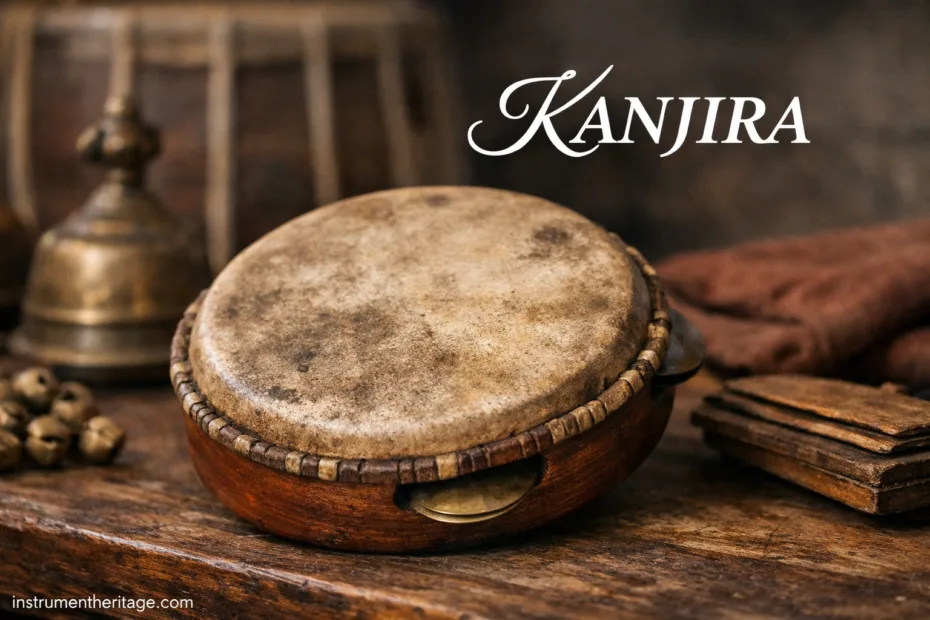
| Instrument family | A small frame drum with a shallow body, single head, and a restrained jingle element rather than a bright tambourine wash.Reference-1✅ | The membrane stays in the spotlight, so the kanjira can sound dry, punchy, and surprisingly deep for its size. |
| Historic path | Its older relatives belong to a wider khanjari lineage, while the concert kanjira took shape as the instrument moved into South Indian classical performance.Reference-2✅ | This helps explain why it still feels part folk drum, part concert percussion voice. |
| Traditional materials | The frame is commonly made from hard resonant wood, often jackwood, while older instruments were known for monitor-lizard skin heads. | Wood choice affects weight and response; membrane choice changes feel, bass drop, and how far the pitch can bend. |
| Present-day material reality | The historic Bengal monitor source is legally protected in India, which changed how makers and players approach the drum today.Reference-3✅ | That shift is not just ethical or legal. It also changes tone, upkeep, and what players expect under the fingers. |
| Sound behavior | A tight head speaks high. A slightly moistened head drops into a bass-heavy growl. Hand pressure can pull the note lower still. | This is the secret behind the kanjira’s “small drum, big voice” reputation. |
| Concert role | In Carnatic music it often works beside the mridangam, not as filler, but as a second rhythmic mind that trims, answers, and lifts the groove. | The best playing feels like conversation, not duplication. |
| Playing feel | Fast finger attack, short decay, sudden bass drops, dry slaps, and quick pitch bends. | The instrument rewards touch more than force. Tiny changes in hand angle matter. |
| Closest comparisons | It shares family ties with the tambourine, khanjari, and other frame drums, yet behaves more like a pitch-flexible hand drum than a jingle instrument. | That is why a kanjira player listens for membrane speech first and metal shimmer second. |
- South Indian frame drum
- Carnatic percussion
- Single-headed membrane
- Pitch-bending hand drum
- Compact but bass-capable
The kanjira is one of those instruments that can fool you in a second. You see a small round drum in one hand and expect something light, maybe even decorative. Then it speaks. A dry crack. A soft thud. A low bend that seems too large for the frame that produced it. That contrast is the whole charm of the instrument. It is compact, but never small in character. In a Carnatic concert, the kanjira does not sit on the edge of the music like a polite accessory. It nudges, shadows, snaps back, and sometimes steals the ear with a single phrase. In folk and devotional settings, it carries an older, earthier pulse. Both sides matter. The kanjira is really a study in control: control of tension, moisture, pressure, timing, and silence.
🥁 Shape and sound: why the kanjira feels bigger than it looks
At first glance, the kanjira looks like a close cousin of the tambourine. That comparison helps a beginner for about ten seconds, then it starts to fail. A tambourine often throws its metal shimmer forward. A kanjira does the opposite. The jingles are there, yes, but the membrane voice is the real story.
A good kanjira stroke can land in a few different ways. It can crack sharply, almost like a rim-accent without a rimshot. It can pop with a dry, papery bite. It can also bloom downward into a rounded bass sound that feels oddly elastic, as if the note is folding under your hand while it speaks. That last part is what grabs people. The drum does not merely ring. It changes shape sonically while you play it.
What makes that low tone possible? A taut head always wants to speak high. The kanjira player works against that by using a slightly relaxed, often moistened membrane and by squeezing or shifting pressure with the supporting hand. The result is not ordinary retuning. It is live, moment-to-moment tension sculpting.
The drum’s shallow frame helps too. There is not much shell for the sound to wander around in, so the attack arrives fast and the decay stays short. That gives the kanjira its clean edges. Notes do not hang in the air for too long. They land, speak, and get out of the way. In dense rhythmic music, that is gold.
This is one of the big things many articles skip. They say the kanjira is “small but powerful,” which is true, but thin. The more useful point is how it creates that power: not through sheer volume, but through contrast. Bright attack against dark bass. Dry surface against flexible pitch. A hint of jingle against a speaking skin. That mix lets one hand drum cover a lot of ground without sounding crowded.
🪵 Materials and build: wood, skin, metal, and touch
The kanjira is simple in structure. That simplicity is deceptive. There is nowhere to hide in a drum like this. Every material choice shows up in the sound, and it shows up fast.
The frame is usually made from a dense but workable wood, very often jackwood in South Indian instrument making. Makers like it for good reason. It keeps the frame light enough for quick hand control, yet stable enough to hold shape and survive constant pressure changes. With a tiny instrument, balance matters. Too heavy, and the hand tires. Too dead, and the strokes lose spring. Too flimsy, and the drum feels nervous rather than alive.
Then comes the head. Historically, older concert instruments were known for monitor-lizard skin, prized for its responsive bend and the way it could drop into a dark bass after wetting. That older material story now sits under a different light. The Bengal monitor is listed in India’s wildlife protection law, and that legal reality changed the instrument’s material culture as much as its supply chain.Reference-3✅
That change matters musically. A kanjira is not just a frame with skin on top. It is a pressure-sensitive surface. Different skins react differently to water, dryness, hand oil, room temperature, and repeated pitch bends. Goat skin versions can feel a little rougher, sometimes warmer, sometimes less spring-loaded. Synthetic heads bring their own advantages, especially steadiness, but some players still miss the hand-feel and pliancy of natural skin. This is not nostalgia for its own sake. It is about what the fingers can persuade the surface to do.
What each part contributes
- Wood frame: weight, comfort, rebound, and the basic dryness of the drum.
- Membrane: pitch range, bass drop, slap clarity, and sensitivity to moisture.
- Jingle set: edge, sparkle, and a quick metallic accent rather than a constant shimmer.
- Open back: hand pressure access, easier control of tension, and a more immediate feel.
That last point is easy to underrate. The open back is not just a structural fact. It is a playing system. The supporting hand does not merely hold the drum. It keeps negotiating with the head. A kanjira player is always half percussionist, half mechanic.
🎶 How it reached the Carnatic stage
The concert kanjira did not appear out of nowhere. It grew from an older family of small frame drums used in folk, devotional, and regional performance traditions. That older family is important because it explains two things at once: why the instrument feels rooted in everyday musical life, and why its eventual concert form is so focused.
Research on the instrument’s development describes a path from North Indian folk and court circles into South Indian usage, where the kanjira was later renewed inside the Carnatic concert tradition.Reference-2✅ That one line clears away a lot of confusion. The instrument is old in lineage, but its modern concert identity is comparatively focused and shaped by a particular musical setting.
Once it entered that setting, the drum had to become more disciplined. In a classical concert, a percussion instrument cannot rely on broad texture alone. It must sit inside tala, answer phrasing with precision, and support melodic music without turning everything into noise. So the kanjira that rose in concert life became less about obvious jingle display and more about membrane intelligence: controlled accents, phrase endings, split-second bends, and perfectly judged silence.
This is another place where many summaries feel too flat. They say the kanjira “accompanies the mridangam,” which is true, but incomplete. The better way to hear it is this: the mridangam lays down the main rhythmic body, while the kanjira can trim its contours, push inner movement forward, and make the groove feel tighter, sharper, and more alive. It is a supporting instrument, yes. It is also a reactive instrument.
One quiet but important part of the kanjira story: it carries older village and devotional memory into a highly refined concert space. That tension gives the instrument much of its personality. It can sound polished without losing its earthy edge.
🔔 In performance: not just support, but rhythmic dialogue
When the kanjira works well in concert, it does not feel pasted onto the ensemble. It breathes with the lead line, shadows the mridangam when needed, and then cuts across it with a different texture at exactly the right moment. Good kanjira playing is full of judgment. Too much weight, and the line gets muddy. Too much metal, and the tone turns cheap. Too little presence, and the music loses an entire layer of motion.
A university listening guide to a Carnatic kriti offers a lovely little reminder of the instrument’s real agency: at one point in the piece, the mridangam drops out and the kanjira becomes the only percussion before the full texture returns.Reference-4✅ That is worth sitting with. The kanjira is not merely there to decorate somebody else’s beat. It can hold rhythmic space on its own.
In the percussion solo section of a Carnatic concert, the instrument becomes even more revealing. It can answer longer mridangam phrases with compressed replies, almost like a sharp-witted speaker who says less but lands harder. It can also create contrast by moving from a low, moist, rounded tone to a bright slap in the space of a breath. That speed of transformation is one of its most addictive qualities.
Players and listeners with experience often listen for a few things at once. Is the bass drop full without going woolly? Are the slaps clean instead of choked? Does the jingle arrive as spice rather than clutter? Can the player bend pitch without making the phrase sag? Those questions are more useful than asking whether the drum sounds “nice.” The kanjira is not here to be nice. It is here to be exact.
What a strong kanjira player controls
- Membrane moisture
- Grip pressure
- Attack angle
- Jingle restraint
- Phrase timing
- Recovery as the head dries out
What the ear usually notices first
- Dry slap
- Short bass bloom
- Fast rebound
- Sudden pitch dip
- Clean phrase endings
- Conversation with mridangam
🧭 Similar instruments, and where the kanjira stands apart
Comparisons help, as long as they stay honest. The kanjira does resemble a tambourine in outline. It does belong to the larger frame-drum family. It does share ancestry with instruments often called khanjari or khanjari-type drums in other parts of the subcontinent. Still, once you hear it closely, the instrument starts refusing easy labels.
| Instrument | Main sound focus | Typical feel in performance | How it differs from the kanjira |
|---|---|---|---|
| Kanjira | Membrane speech with a touch of jingle | Dry attack, bass dip, fast pitch modulation | Built around hand pressure and tonal bending more than bright metal wash |
| Tambourine | Jingle shimmer plus head attack | Brighter, more public, often more overtly rhythmic | The tambourine usually announces its metal; the kanjira usually hides it behind the skin voice |
| Riq | Highly articulate jingles with refined finger work | Crisp, dancing, metallic detail | The riq treats jingles as a lead color; the kanjira keeps them secondary |
| Khanjari / related folk frame drums | Rhythmic pulse, song support, local playing styles | Often more direct and less pitch-flexible in concert terms | The concert kanjira is a more tightened, more tactically responsive branch of that broader family |
| Mridangam | Primary Carnatic percussion body | Longer phrase architecture, tonic-aware support, broader stroke vocabulary | The mridangam anchors; the kanjira sharpens, answers, and compresses |
If you want one plain sentence, here it is: the kanjira is the frame drum that behaves least like a toy and most like a living membrane. That is why skilled players speak about touch so much. The drum changes under the hand in real time.
What makes a good kanjira worth keeping
Not every kanjira feels good, even if it looks neat. A useful instrument has a frame that sits naturally in the hand, a head that responds without feeling stiff, and a jingle that adds edge without spitting random chatter. The bass should arrive when invited, not by accident. The slap should cut without sounding brittle. And the drum should still feel musical when played softly. That last point matters a lot.
Experienced players often test a kanjira in small ways rather than flashy ones. They listen to how quickly the head answers a light finger touch. They check whether pitch can be bent smoothly or only in a clumsy jump. They notice whether the jingle wakes up too easily. They also pay attention to recovery. A fine kanjira does not merely sound good at one moisture level. It stays readable as the surface shifts.
That is the hand-crafted soul of the instrument. No giant body. No heavy hardware. Just wood, skin, metal, and skill. Very little material. A lot of result.
FAQ
What kind of instrument is the kanjira?
The kanjira is a South Indian frame drum. It has a single playing head, a shallow circular frame, and a small jingle element. In practice, it behaves less like a bright tambourine and more like a highly responsive hand drum with pitch-bending ability.
Why does the kanjira sound so deep for such a small drum?
The depth comes from the membrane, not from a large shell. Players lower the speaking pitch by managing moisture and by pressing the frame and head with the supporting hand. That drops the tone and gives the drum its dark, elastic bass effect.
Is the kanjira the same as a tambourine?
No. They are related as frame drums, but they do not behave the same way. A tambourine usually pushes its jingles forward. A kanjira keeps the metal color restrained and depends much more on membrane attack, bass drops, and hand pressure.
What is the kanjira made from?
The frame is commonly made from hardwood, often jackwood in South Indian instrument making. Older instruments were known for monitor-lizard skin heads, while present-day instruments are more often encountered with other natural skins or modern alternatives, depending on maker and player preference.
How is the kanjira used in Carnatic music?
It usually works alongside the mridangam. Its role is not merely to copy the beat. It adds tension, reply phrases, accent shape, and tonal contrast. In the right hands, it becomes a second rhythmic voice inside the ensemble.
Is the jingle sound the main feature of the kanjira?
Not really. The jingle is part of the sound, but the heart of the instrument is the speaking membrane. Most serious listeners pay attention first to slap clarity, bass depth, and pitch movement.
What should a listener notice in a strong kanjira performance?
Listen for quick response, clean slaps, controlled bass drops, tasteful jingle use, and close dialogue with the mridangam or main rhythmic line. The best playing feels exact, relaxed, and alive at the same time.
