
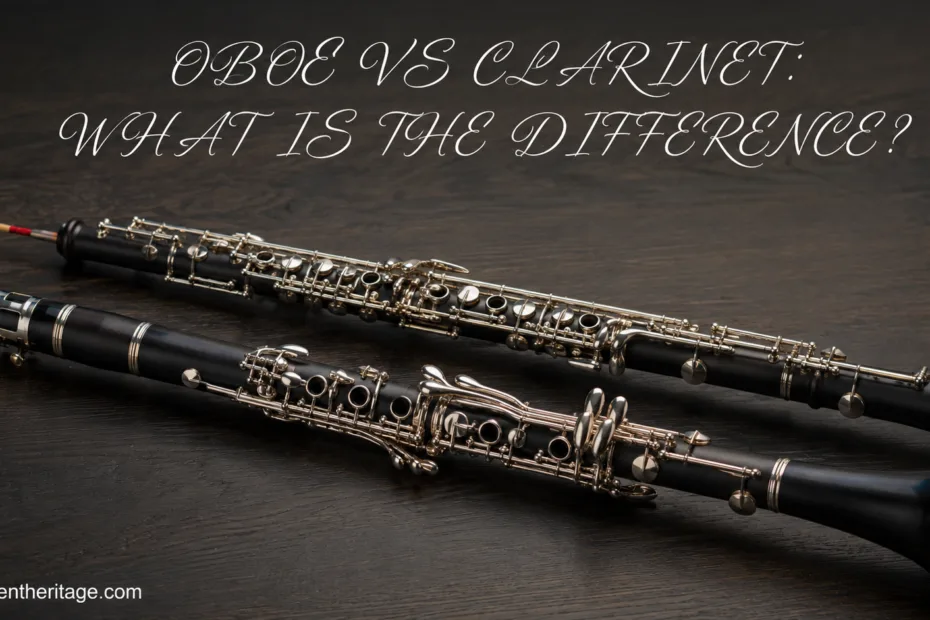
| Feature | Oboe | Clarinet |
|---|---|---|
| Reed | Double reed: two thin cane blades vibrate against each other. | Single reed: one cane or synthetic reed vibrates against a mouthpiece. |
| Bore Shape | Conical bore, gently widening toward the bell. | Cylindrical bore, mostly even through the main tube. |
| Sound Character | Focused, nasal-sweet, bright, and easy to hear in an ensemble. | Warm, rounded, flexible, with a wide color range from dark to brilliant. |
| Pitch Behavior | Usually a non-transposing instrument in C. | Most often a transposing instrument, especially B♭ and A clarinets. |
| Common Range | Roughly B♭3 to A6, with the middle register used most often. | Often written from E3 upward into a very high altissimo register. |
| Main Materials | Grenadilla, other dense hardwoods, resin for student models, metal keywork, cane reed. | Grenadilla, boxwood in older instruments, resin for student models, nickel-silver or silver-plated keywork, cane or synthetic reed. |
| Orchestral Personality | Often carries expressive solos, tuning A, lyrical lines, pastoral color, and piercing melodic detail. | Moves easily between melody, harmony, runs, soft blends, folk-like color, and jazz-influenced writing. |
Oboe vs clarinet is one of those comparisons that looks simple until you hear both instruments in the same room. They are both woodwind instruments. They both use reeds. They both sit near the center of the orchestra and can sing beautifully. Yet the way they make sound is completely different. The oboe feels like a narrow beam of light; the clarinet feels more like a ribbon of warm air that can darken, brighten, bend, and float.
The short answer is this: the oboe uses a double reed and a conical bore, while the clarinet uses a single reed and a mostly cylindrical bore. That small-looking difference changes nearly everything: tone, tuning, breath pressure, fingering feel, range, maintenance, and the kind of musical lines each instrument naturally loves.
🎼 The Main Difference Between Oboe and Clarinet
The oboe and clarinet differ most in the part you put in your mouth. An oboe has no mouthpiece in the clarinet sense. The player blows directly into a double reed, made from two shaped pieces of cane tied together on a small metal tube called a staple. A clarinet has a mouthpiece, a ligature, and a single reed fastened against the mouthpiece table.
That is the root of the whole family tree. The oboe reed is tiny, resistant, and very sensitive. The clarinet reed is larger, flatter, and more forgiving to start with. The oboe’s sound begins inside two pieces of cane squeezing air into a narrow opening. The clarinet’s sound begins when one reed beats against a mouthpiece. Different engine, different voice.
Plain Difference
Choose “oboe” in your mind if you hear a clear, slightly reedy, singing sound that can cut through an orchestra without shouting.
Choose “clarinet” in your mind if you hear a rounder, smoother woodwind sound that can move from velvet-soft low notes to bright high notes with a wide emotional range.
There is another big structural difference: the oboe’s tube is conical, while the clarinet’s tube is mostly cylindrical. A cone and a cylinder do not vibrate the same way. This is why an oboe and clarinet do not simply sound like “two reed instruments.” They are built on different acoustic ideas.
🌬️ Reed, Bore, and Sound: Why They Do Not Speak the Same Language
The Oboe’s Double Reed
The oboe reed is small, handmade, and personal. Many players adjust their own reeds by scraping, clipping, soaking, and testing them. A tiny change can alter response, pitch, color, and comfort. This is why oboists often talk about reeds as if they have moods. Some mornings they behave. Some mornings they do not.
A double reed creates a tone with a concentrated edge. The air opening is narrow, so the instrument gives back a lot of resistance. The player does not pour air into the oboe in the same way a flutist fills a flute. Instead, the air is shaped through a small gate. The result is a focused and carrying tone, often described as clear, bright, plaintive, or voice-like.
The Clarinet’s Single Reed
The clarinet reed is wider and sits against a mouthpiece. A ligature holds it in place. When the player blows, the reed vibrates against the mouthpiece and starts the sound. Reed strength, mouthpiece facing, ligature fit, and embouchure all matter, but the setup is usually easier for a beginner to understand at first glance.
The clarinet’s single reed gives it a smooth, flexible tone. It can sound woody and dark in the low chalumeau register, clear and speech-like in the middle, and brilliant in the high register. Few woodwinds change character so much from bottom to top. The clarinet is almost like three related instruments sharing one body.
Conical Bore vs Cylindrical Bore
The oboe’s conical bore helps produce its direct, singing sound. The tube gradually widens, which gives the instrument a strong upper-partial profile and a compact tone. Yamaha’s instrument guide notes the oboe’s French origin around the mid-17th century and connects the name hautbois with a high or loud wood sound.Reference-1✅
The clarinet’s cylindrical bore is one reason it overblows at the twelfth rather than the octave. That is a fancy way of saying its second register does not behave like the oboe’s. The clarinet’s register key opens a leap that gives the instrument its wide range and its very different fingering logic. It is not just a tube with holes. It is a clever acoustic puzzle.
🎧 Tone Color: Bright Line vs Velvet Curve
The oboe is often heard as bright, compact, and expressive. It can sound tender without becoming blurry. It can also sound alert and almost vocal, especially in slow orchestral solos. In a large ensemble, an oboe line tends to stand out because its tone has a pointed center. It does not need much volume to be noticed.
The clarinet has a wider emotional wardrobe. Its low notes can be round and shadowy. Its middle notes can blend with strings, horns, and other woodwinds. Its high notes can sparkle. A good clarinetist can make one phrase sound like warm speech and the next like liquid silver. That flexibility is one of the clarinet’s great charms.
| Musical Situation | Oboe Sound | Clarinet Sound |
|---|---|---|
| Solo melody | Clear, singing, slightly plaintive, easy to locate. | Warm, flexible, lyrical, able to shift mood quickly. |
| Soft passage | Delicate but still focused. | Very smooth, often dark or velvety. |
| Fast runs | Articulate and bright, with a reed-colored edge. | Fluid, agile, and clean across a large range. |
| Orchestral blend | Blends best when used as a clear color inside the woodwind section. | Blends easily with strings, woodwinds, and brass-like colors. |
Neither sound is “better.” They do different jobs. The oboe is a fine brush with a sharp tip. The clarinet is a brush that can paint a thin line, a broad wash, and a soft shadow.
📜 History: From Hautbois and Chalumeau to the Modern Orchestra
Where the Oboe Came From
The oboe belongs to a long line of double-reed instruments. Earlier reed instruments were often louder and more outdoor-friendly. The modern oboe developed into something more refined: still clear, still bright, but suited to chamber music, orchestral music, and close listening.
Historical oboes were far simpler than today’s instruments. Early models had fewer keys, fewer mechanical helpers, and a more direct relationship between the player’s fingers and the tube. The Metropolitan Museum of Art describes a grand oboe from around 1650 as a rare transitional example in the development of the instrument, made from boxwood and brass.Reference-2✅
Over time, makers added more keys and refined the bore. The French conservatoire style became widely used, while the Viennese oboe preserved a different sound and build tradition. That is a lovely detail: even within “the oboe,” there are regional voices.
Where the Clarinet Came From
The clarinet is younger than the oboe. It grew from the chalumeau, a single-reed instrument with a limited range. The clarinet’s early development is usually linked with Johann Christoph Denner of Nuremberg around the start of the eighteenth century. Yamaha’s clarinet guide also notes that B♭ and A soprano clarinets are among the most common forms today, and describes the clarinet’s single reed, cylindrical bore, and expanding keywork history.Reference-3✅
The clarinet became loved because it solved several musical problems at once. It could sing in the low register, speak clearly in the middle, and climb high with confidence. It also came in many sizes: E♭ clarinet, B♭ clarinet, A clarinet, alto clarinet, bass clarinet, contrabass clarinet, and more. A whole family grew around one reed idea.
By the nineteenth century, clarinet key systems were changing fast. The Met’s record for an 1830 B♭ clarinet by Charles Joseph Sax identifies it as a single-reed cylindrical aerophone and notes its early use of Ivan Müller’s improved thirteen-key system.Reference-4✅
🪵 Materials and Construction
Both instruments are often made from grenadilla, also called African blackwood. This dense wood helps support a stable, refined tone. Student models may use resin or composite materials, which can handle temperature changes and daily school use better. Professional instruments usually feel more responsive, but they also ask for more care.
The oboe body is usually built in three main sections: upper joint, lower joint, and bell. It has delicate keywork, small tone holes, and a narrow bore. The reed goes into the top of the instrument without a separate mouthpiece. The key system can look crowded because the instrument needs many small mechanical routes for chromatic notes, trills, and alternate fingerings.
The clarinet is usually built from mouthpiece, barrel, upper joint, lower joint, and bell. The barrel helps with tuning and response. The mouthpiece and reed setup gives players many possible combinations, which is why clarinetists often compare reed strengths, mouthpiece openings, and ligature designs. A tiny change can make the instrument feel more open, more resistant, brighter, or darker.
Small Parts That Change a Lot
Oboe: reed scrape, cane density, staple length, opening size, and thread binding can all change pitch and response.
Clarinet: reed strength, mouthpiece facing, barrel length, pad sealing, and ligature fit can all change tone and comfort.
🎵 Playing Feel: Breath, Embouchure, and Technique
Breath Pressure
The oboe uses a small amount of air under high pressure. Beginners are often surprised because they do not run out of air in the usual way. They may feel like they have too much used air trapped inside. The player must learn to release air and breathe in a controlled cycle. It is a strange feeling at first. Very strange.
The clarinet uses a more open air stream. It still needs support, but the resistance feels different. A clarinetist sends air through a mouthpiece and reed setup that can be adjusted with reed strength and mouthpiece choice. This gives the clarinet a more flexible first step for many beginners, though fine playing is still a lifelong craft.
Embouchure
Oboe embouchure is built around the lips cushioning the double reed. The reed is tiny, so the lips must be firm but not biting. Too much pressure can choke the sound. Too little support can make pitch and tone unstable. The oboe rewards small adjustments. It also exposes them.
Clarinet embouchure usually involves the top teeth resting on the mouthpiece, the lower lip cushioning the reed, and the corners supporting the air column. Good clarinet tone needs steady air, a stable jaw, and a relaxed but formed mouth. The clarinet forgives some things early, then demands polish later.
Fingering and Registers
Oboe fingerings can feel detailed and compact. Alternate fingerings matter, especially for tuning, color, and smooth movement between notes. The instrument has a smaller common range than the clarinet, but each note often has a strong personality. Some notes want help. Some notes shine on their own.
Clarinet fingerings are built around its register break. Moving from the lower register into the upper clarion register can feel like crossing a bridge. Once that bridge becomes comfortable, the clarinet opens up a large range. The low register, clarion register, and altissimo register each need a different kind of control.
🎹 Range and Transposition
The oboe is normally written in concert pitch. If an oboist reads a C, the audience hears a C. That makes it simpler on paper, especially for readers comparing scores. The instrument’s practical range is smaller than the clarinet’s, but it sits in a useful melodic area where the human ear notices detail.
The B♭ clarinet is a transposing instrument. If a clarinetist reads a written C on a B♭ clarinet, the sounding pitch is B♭. The A clarinet sounds a minor third lower than written. This can seem odd at first, but it helps clarinetists move between instruments in the clarinet family while keeping familiar finger patterns.
| Instrument | Written Pitch | Sounding Pitch | What It Means |
|---|---|---|---|
| Oboe | C | C | The oboe usually reads and sounds at concert pitch. |
| B♭ Clarinet | C | B♭ | The sound is a whole step lower than the written note. |
| A Clarinet | C | A | The sound is a minor third lower than the written note. |
This is one reason clarinet parts can look different from oboe parts in a score. The composer or arranger has already handled the transposition. The player reads the part as written and the instrument produces the expected sounding pitch.
🏛️ Role in Orchestra, Band, Chamber Music, and Jazz
Oboe in Ensembles
The oboe often carries exposed melodies. It is trusted with lines that need tenderness, clarity, and a slightly human ache. In orchestras, it is also famous for giving the tuning note before the group plays. The reason is practical: its sound is easy to hear, centered, and clear enough for other players to match.
In chamber music, the oboe brings color quickly. Put it beside strings and it can sound like a voice entering a conversation. Put it with flute, bassoon, and horn, and it becomes part of the classic wind quintet blend. It is not a background instrument by nature, though it can blend when played with care.
Clarinet in Ensembles
The clarinet is a shape-shifter. In orchestra it can blend, sing, chatter, or leap. In wind band it is central, almost like the violin section of the group. In chamber music, it sits beautifully with piano, strings, and other winds. In jazz, klezmer, and many folk traditions, it has a strong life outside the classical hall.
The clarinet’s wide dynamic range is part of its identity. It can play very softly without losing tone, then rise into a bright, ringing sound. That makes it useful for long crescendos, expressive solos, and fast passagework. It can whisper, then grin.
🎒 Which One Is Easier to Learn?
For most beginners, the clarinet is easier to start. The reed setup is more straightforward, beginner instruments are widely available, and early tone production usually comes faster. A new clarinet player can often make a playable sound quite soon, though making a beautiful sound takes time.
The oboe can be more demanding at the beginning because of the double reed, breath pressure, and tuning sensitivity. The reed is the heart of the instrument, and that heart can be fussy. A good teacher helps a lot. So does a reliable reed source. Without those, the oboe can feel harder than it really is.
Oboe May Suit You If
- You love clear, expressive solo lines.
- You enjoy detail and careful sound shaping.
- You like the idea of a rare and distinctive voice.
- You are patient with reeds and small adjustments.
Clarinet May Suit You If
- You want a wider range of styles.
- You enjoy warm tone and flexible expression.
- You like orchestral, band, chamber, jazz, or folk music.
- You want a more accessible first reed instrument.
This does not mean one is easy and the other is hard. Better wording: the clarinet often gives beginners an easier doorway, while the oboe asks for careful reed and breath control earlier. Both become deep instruments once you stay with them.
💰 Cost, Maintenance, and Everyday Care
Oboes are often more expensive than clarinets at similar student or professional levels. The mechanism is intricate, the bore is delicate, and good reeds are an ongoing cost. Professional oboists may spend a lot of time making or adjusting reeds. That is part of the craft, not a side chore.
Clarinets can be more budget-friendly, especially for beginners. Reeds still cost money, pads still need care, and wooden instruments still react to temperature and humidity. Yet the overall maintenance path is usually simpler. A student clarinet can serve well for years with regular swabbing, careful assembly, and occasional adjustment by a repair technician.
| Care Area | Oboe | Clarinet |
|---|---|---|
| Reeds | Highly personal; often handmade or adjusted by the player. | Available in many strengths; easier to replace and test. |
| Swabbing | Important because moisture can affect pads and the narrow bore. | Important after playing, especially for wooden clarinets. |
| Assembly | Needs gentle handling because of delicate keywork. | Also needs care, especially around bridge keys and corks. |
| Weather Sensitivity | Reeds and wooden body can react strongly. | Wooden clarinets can react; resin models are steadier for school use. |
One practical difference is emotional: oboe players often think about reeds before they think about music. Clarinet players think about reeds too, but the reed world is usually less intense. The oboe reed is almost a second instrument.
🧭 Similar Instruments Worth Knowing
The oboe and clarinet sit inside larger families. Knowing their relatives makes the comparison clearer.
| Instrument | Related To | What Makes It Different |
|---|---|---|
| English Horn | Oboe family | Lower, warmer, and more mellow than the oboe; often used for lyrical solos. |
| Oboe d’amore | Oboe family | Sits between oboe and English horn, with a softer, sweet tone. |
| Bassoon | Double-reed family | Uses a double reed but has a much lower range and a folded bore. |
| E♭ Clarinet | Clarinet family | Smaller and brighter than the B♭ clarinet. |
| Bass Clarinet | Clarinet family | Lower, darker, and more resonant; often has a curved neck and upturned bell. |
| Saxophone | Single-reed cousin | Uses a single reed like a clarinet, but has a conical metal body and a different tone world. |
A simple way to remember it: oboe and bassoon are double-reed relatives; clarinet and saxophone are single-reed relatives. The saxophone is not a clarinet, of course, but its reed setup feels more familiar to clarinet players than to oboists.
🎯 Oboe or Clarinet: Which Sound Belongs to You?
If you are choosing between oboe and clarinet, start with sound. Not price. Not reputation. Not what looks easier. Listen to slow orchestral solos, wind quintets, concertos, and beginner demonstrations. The instrument you keep wanting to hear again is usually telling you something.
Choose the oboe if you are drawn to a clear, reed-rich, expressive voice that stands out in a beautiful way. The oboe can feel intimate even in a large hall. It has a directness that suits players who like detail, color, and careful control.
Choose the clarinet if you want range, warmth, and stylistic freedom. It is at home in orchestra, concert band, chamber music, jazz, and many traditional styles. It can blend like cream or leap out like a spark. That range of character is hard to beat.
Musician’s note: If possible, try both instruments with a teacher or experienced player nearby. A good reed and a properly adjusted instrument can completely change your first impression.
Questions About Oboe vs Clarinet
Common Questions
Is oboe harder than clarinet?
For many beginners, oboe feels harder at first because the double reed is sensitive and the breath pressure is unusual. Clarinet usually gives a faster first sound, but advanced clarinet playing is still highly skilled. Both instruments become demanding in different ways.
Do oboe and clarinet use the same reed?
No. The oboe uses a double reed made from two cane blades tied together. The clarinet uses a single reed attached to a mouthpiece with a ligature. This reed difference is the biggest reason the two instruments sound and feel different.
Which instrument has a wider range, oboe or clarinet?
The clarinet usually has the wider practical range. Its low chalumeau register, middle clarion register, and high altissimo register give it a large span. The oboe has a smaller range, but its middle and upper registers carry very clearly.
Why does the oboe tune the orchestra?
The oboe’s tone is focused and easy for other players to hear. Its sound cuts through the ensemble clearly, so orchestras often tune to the oboe’s A before playing.
Is the clarinet louder than the oboe?
Not exactly. The clarinet can play a very wide dynamic range, from extremely soft to bright and strong. The oboe may not always be louder, but its focused tone can be easier to hear through an ensemble.
Can a clarinet player learn oboe?
Yes, but the player must adjust to the double reed, smaller air opening, different embouchure, and oboe fingerings. Clarinet experience helps with reading music and general woodwind awareness, but the oboe has its own feel.
Can an oboe player learn clarinet?
Yes. An oboe player may already have strong breath control and pitch awareness. The main changes are the single-reed mouthpiece, the clarinet’s register break, transposition, and the larger range.
Which instrument is better for jazz?
The clarinet is far more common in jazz, especially in early jazz, swing, and several folk-influenced styles. The oboe can appear in jazz or crossover music, but it is much more closely linked with orchestral and chamber music.
