
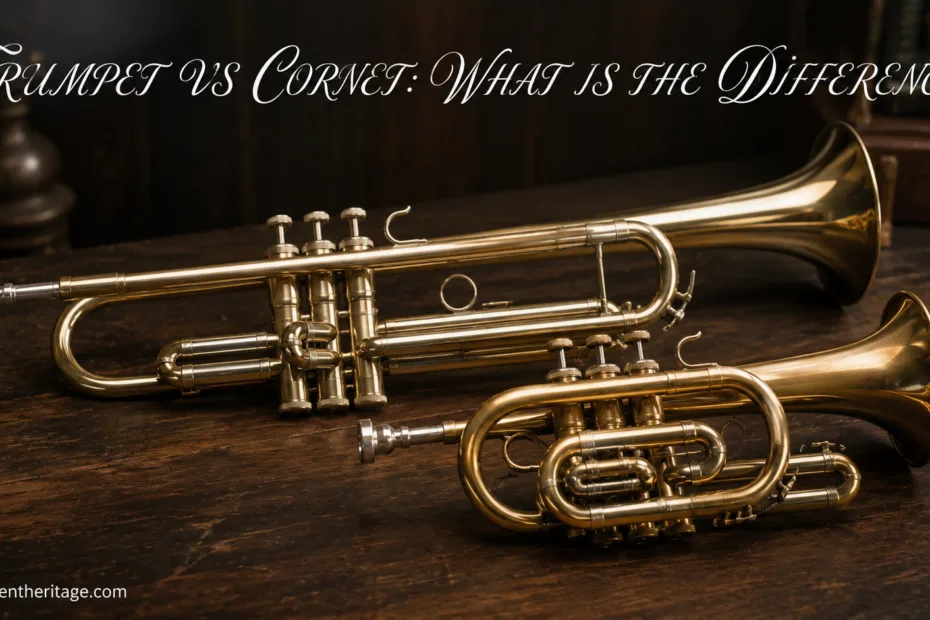
Trumpet and cornet look like close cousins because they are. Both are valved brass instruments, both are usually pitched in B-flat, and both speak when the player buzzes the lips into a cup-shaped mouthpiece. Yet they do not feel or sound the same in the hands. The trumpet is straighter, brighter, and more direct. The cornet is more compact, rounder in shape, and usually warmer in tone. Small design choices make a big musical difference.
| Feature | Trumpet | Cornet | Why It Matters |
|---|---|---|---|
| Main bore shape | Mostly cylindrical tubing, with a bell flare near the end | More conical tubing, widening more gradually through the instrument | The trumpet tends to sound brighter; the cornet tends to sound rounder. |
| Tone character | Clear, focused, brilliant, projecting | Warm, mellow, blended, singing | The trumpet cuts through an ensemble; the cornet melts into brass band and lyrical textures. |
| Shape in the hand | Longer and straighter | Shorter and more compact | The cornet can feel snug and balanced for smaller hands, though model design matters. |
| Mouthpiece tendency | Often shallower or more bowl-shaped, depending on style | Often deeper and more funnel-like | Mouthpiece shape helps explain why the cornet speaks with a softer edge. |
| Common pitch | B-flat is most common; C, E-flat, D, piccolo, and other trumpets also exist | B-flat is most common; E-flat soprano cornet appears in brass bands | Both are transposing instruments in many settings, so written pitch and sounding pitch may differ. |
| Typical musical home | Orchestra, jazz, wind band, pop, studio work, marching settings | Brass band, concert band, beginner brass programs, lyrical solos | They overlap, but each has a natural voice in certain ensembles. |
| First impression | Shiny line of sound | Velvet-edged brass voice | A good player can blur the line, but the native character is still there. |
The Main Difference Between Trumpet and Cornet
🎺 The plain answer
The trumpet has a more cylindrical tube and a brighter, sharper sound. The cornet has a more conical tube and a warmer, smoother sound. That is the heart of the difference.
Think of the trumpet as a clean beam of light. Think of the cornet as the same light passing through warm glass. Same family. Different color.
Both instruments use valves to change the length of tubing, and both can play fast, high, lyrical, bold, and delicate music. A skilled player can make a trumpet sound gentle and a cornet sound bright. Still, the natural design of each instrument nudges the sound in a certain direction.
The trumpet’s long shape and mostly cylindrical bore help create a tone with edge, sparkle, and projection. The cornet’s tighter wrap and more conical bore soften the front of the note. It speaks a little more like a singer. Not weak. Just rounder.
Shape, Bore, and Build
The easiest visible difference is shape. A trumpet looks stretched out. A cornet looks tucked in. That compact shape is not only cosmetic; it reflects how the tubing is wrapped around the instrument body.
The deeper difference is inside the tube. In brass instrument language, the word bore means the inner width and shape of the tubing. Trumpets are usually described as having a more cylindrical bore. Cornets are known for a more conical bore. Yamaha’s brass explanation also points to the same practical result: trumpet tone tends to be brighter, while cornet tone tends to be warmer.Reference-1✅
What Cylindrical Bore Means
A cylindrical bore keeps a more even inner diameter through much of the tube. On the trumpet, that gives the air column a firm, focused path. The tone can feel clean and pointed, especially in the middle and upper register.
This is why trumpets often sit so well in jazz lead lines, orchestral fanfare-style writing, studio brass sections, and places where the sound needs to travel clearly over other instruments.
What Conical Bore Means
A conical bore widens more gradually. The cornet’s tube feels less like a straight pipe and more like a gentle funnel. That shape helps create a tone with softer corners. The attack can feel less sharp. The center of the note often sounds thicker.
This is one reason the cornet has such a strong place in brass bands. It blends beautifully. It can lead without sounding harsh, especially when the music asks for a lyrical line rather than a glittering edge.
Small detail, big result: the trumpet and cornet may share the same basic pitch, but the inner shape of the tubing changes how the player feels resistance, how the note starts, and how the sound spreads in a room.
How They Sound Side by Side
The trumpet is often described as brilliant. The cornet is often described as mellow. Those words are useful, but they can be too neat. Real instruments vary. A dark trumpet with a deep mouthpiece can sound broad. A bright cornet with a shallow mouthpiece can sound surprisingly lively.
Still, when both are played in their usual setup, the difference is easy to hear.
| Sound Area | Trumpet | Cornet |
|---|---|---|
| Attack | More immediate; the note can start with a clean edge | Softer front to the note; often feels rounder |
| Projection | Strong forward carry, especially in bright registers | More blended spread, especially in ensemble playing |
| Low register | Can sound firm and centered | Often sounds warm and cushioned |
| High register | Clear, ringing, and brilliant | Sweet, singing, but usually less piercing |
| Lyrical playing | Expressive with a clear line | Very natural for song-like phrasing |
The trumpet sound can feel like polished metal catching sunlight. The cornet feels closer to a warm lamp in a wooden room. That image is not technical, but many players recognize it right away.
Playing Feel, Air, and Response
Players often notice the difference before listeners do. The cornet can feel more compact against the body. The trumpet can feel more open and directional. But feel depends on more than shape: bore size, leadpipe design, valve alignment, mouthpiece, bell thickness, and even how clean the instrument is all matter.
Air Resistance
Some cornets feel slightly more resistant in a comfortable way, as if the instrument gives the air something soft to lean against. Some trumpets feel freer and more direct. Neither is better. They simply ask for a slightly different kind of breath support.
A beginner may find the cornet friendly because it is compact and the tone is forgiving. A trumpet may feel more exposed because the brighter sound reveals rough attacks quickly. That can be useful too. It teaches clean playing.
Embouchure and Articulation
The embouchure is the way the lips, facial muscles, jaw, and air stream work together. Trumpet and cornet use the same basic brass technique, so a player can move between them more easily than, say, trumpet and clarinet.
The articulation may feel different. On trumpet, tongued notes often pop with a crisp front. On cornet, the same tongue stroke may sound gentler. For lyrical lines, that can be lovely. For sharp rhythmic figures, the player may need to shape the attack more carefully.
🎼 Player’s Note
A trumpet player switching to cornet should not only change instruments. Try a true cornet mouthpiece as well. A trumpet mouthpiece in a cornet-style instrument can make the tone brighter and reduce the very quality many players want from a cornet.
A Short History of Trumpet and Cornet
The trumpet is the older idea: a lip-vibrated tube used for ceremony, signals, and later art music. The modern valve trumpet grew from older natural trumpets after valve technology changed brass playing in the 19th century. Britannica describes the modern valve trumpet as ordinarily built in B-flat while keeping the trumpet’s traditional cylindrical character with a terminal bell flare.Reference-2✅
The cornet arrived later. It developed in the early 19th century from the post horn, a small coiled horn associated with travel and public signaling. Once valves were added, the instrument gained full chromatic ability. It could play melodies with ease, not just simple calls.
Britannica places the cornet’s development in the 1820s and notes Jean Asté, known as Halary, among its early makers in Paris in 1828.Reference-3✅ That date matters because the cornet quickly became a favorite in bands and solo playing. It was agile, lyrical, and easier to use melodically than many older brass designs.
The Metropolitan Museum of Art holds an 1833 Courtois frères cornet in B-flat, one of the early surviving examples of a valved cornet. The museum notes that early brass instruments with valves before 1840 are rare.Reference-4✅
Why the Cornet Became So Popular
The cornet was practical. It was smaller than many older brass instruments, had a flexible sound, and worked well in bands. It could play fast passages, sing a melody, and blend with other brass voices. In the 19th and early 20th centuries, cornet soloists were admired for their smooth tone and clean technique.
Later, the trumpet became more dominant in many orchestral, jazz, and commercial settings. Its brighter sound suited changing ensemble tastes. The cornet never disappeared, though. It simply kept its own seat at the table, especially in brass band culture.
Where Each Instrument Feels at Home
Trumpet and cornet can cross into each other’s territory. A cornet can play a trumpet-like part. A trumpet can play lyrical music beautifully. But tradition, tone, and ensemble balance still shape where each instrument feels most natural.
Trumpet in Ensembles
The trumpet is common in orchestras, jazz bands, wind ensembles, brass sections, studio recordings, pop arrangements, salsa, funk, and many school bands. Its sound can sit above a large group without losing clarity.
In jazz, the trumpet’s bite and flexibility are part of its charm. It can whisper, growl, shout, or float. Add a mute, and the color changes again. Straight mute, cup mute, harmon-style mute, plunger effects — the trumpet loves color.
Cornet in Ensembles
The cornet is strongly linked with brass bands. In that setting, it often carries melody, harmony, and inner texture. The principal cornet can lead with a singing sound, while other cornets build the group’s warm upper-brass layer.
In many beginner programs, the cornet also appears because of its compact size. Younger players may find it easier to hold. The sound is kind to early notes. A beginner still has to work, of course. Brass never plays itself.
Mouthpiece, Bell, Valves, and Materials
Most trumpets and cornets are made mainly from brass, often finished with clear lacquer, silver plating, or sometimes gold plating on higher-end or custom instruments. The finish can affect feel and maintenance, though the player, bore, bell design, and mouthpiece shape usually matter far more to the sound.
Mouthpiece Shape
A trumpet mouthpiece often has a cup that helps focus the tone. A cornet mouthpiece is often deeper and more funnel-like. That extra depth supports a rounder tone center.
This is why mouthpiece swapping can confuse the issue. Put a shallow, bright mouthpiece on a cornet and it may lose some of its warm identity. Put a very deep mouthpiece on a trumpet and it may darken, but it will not fully become a cornet because the instrument body is still different.
Bell and Metal Thickness
The bell is the flared end where sound leaves the instrument. Bell shape, diameter, metal thickness, and hammering can all influence response. A lighter bell may feel more lively. A heavier bell may feel steadier. Some players like a free-ringing instrument; others want more resistance and control.
Valves and Slides
Modern trumpets and cornets usually have three piston valves. Pressing a valve redirects air through extra tubing, lowering the pitch. The first valve lowers by a whole step, the second by a half step, and the third by one and a half steps. Used together, they let the player reach the chromatic notes between open harmonics.
Good valve action should feel smooth, fast, and even. Sticky valves are usually a maintenance issue, not a personality trait of the instrument. Clean oil, clean hands, and regular care help a lot.
Pitch, Transposition, and Written Music
Most student trumpets and cornets are in B-flat. That means when the player reads a written C, the sounding pitch is B-flat. This is normal for both instruments. It can feel strange at first, but brass players learn it early.
In orchestral playing, trumpet players may use C trumpet, E-flat trumpet, piccolo trumpet, and other specialist instruments. Cornet players in brass bands may meet the E-flat soprano cornet, a small, bright, demanding instrument that sits above the B-flat cornet section.
For most beginners, the practical answer is simple: start with the instrument your teacher or ensemble expects. If the band program uses B-flat cornet, use cornet. If it uses B-flat trumpet, use trumpet. The skills transfer well later.
Similar Instruments Often Confused with Trumpet and Cornet
The brass family has several close relatives. Some look alike from a distance, but each has its own voice. The cornet sits between trumpet and flugelhorn in many players’ minds: brighter than a flugelhorn, softer than a trumpet.
| Instrument | How It Relates | Typical Sound |
|---|---|---|
| Flugelhorn | More conical and wider-feeling than a cornet | Darker, softer, very mellow |
| Pocket trumpet | Trumpet tubing wrapped into a compact body | Trumpet-like, though response varies by model |
| Bugle | Usually valveless; plays notes from the harmonic series | Simple, open, call-like |
| Natural trumpet | Historical trumpet without modern valves | Clear and noble, but limited to harmonic-series notes unless using hand or venting techniques on modern replicas |
| Soprano cornet | Small E-flat cornet used in brass bands | Bright, high, focused, and exposed |
Which One Should You Choose?
Choose the instrument that fits your musical setting first. Sound preference comes next. Comfort matters too.
- Choose trumpet if you want a bright, flexible brass voice used widely in jazz, orchestra, studio music, wind band, and modern brass sections.
- Choose cornet if you love a warmer tone, play in a brass band, or want a compact brass instrument with a lyrical character.
- Choose based on your ensemble if you are joining a school band, brass band, or community group with set parts.
- Choose based on feel if you can try both. Five minutes in the hand can answer what a whole page cannot.
Trumpet May Suit You If
- You like a clear, bright lead sound.
- You want wide use across many styles.
- You enjoy crisp articulation.
- You plan to play jazz or orchestral trumpet parts.
Cornet May Suit You If
- You like a warm, rounded tone.
- You play or plan to play in a brass band.
- You prefer a compact instrument shape.
- You enjoy lyrical melody playing.
Is Trumpet or Cornet Easier for Beginners?
Neither is automatically easy. Brass playing asks for breath control, lip coordination, steady practice, and patience. The first notes can sound rough on both. That is normal. Every brass player has been there.
Some teachers like cornet for younger beginners because the body is shorter and easier to hold. The warmer tone can also make early playing sound less sharp. Other teachers prefer trumpet because it is common, widely available, and used in many ensembles.
The better beginner instrument is usually the one that is well-made, well-maintained, comfortable to hold, and supported by a good teacher. A leaky, poorly aligned instrument will make either path harder.
Care, Tuning, and Everyday Ownership
Trumpets and cornets need similar care. Both have valves, slides, water keys, mouthpieces, and inner tubing that collect moisture and residue. A clean instrument feels better. It also responds better.
- Oil the valves with proper valve oil when they begin to feel dry or slow.
- Grease tuning slides lightly so they move without sticking.
- Empty water keys during practice, especially in longer sessions.
- Wash the mouthpiece often. It is the part touching your face every day.
- Use a case that holds the instrument firmly, not loosely.
- Have a repair technician check dents, valve problems, and stuck slides.
Tuning works in the same broad way. The main tuning slide adjusts overall pitch. Valve slides help certain notes sit better. Brass tuning is partly mechanical and partly human: air speed, embouchure, temperature, and listening all play a role.
Buying Notes: Student, Intermediate, and Professional Models
A good student trumpet or cornet should be easy to play, sturdy, and repairable. Fancy engraving is nice, but smooth valves and solid intonation matter more. For a beginner, the best instrument is one that does not fight back.
Intermediate models may offer better valves, more refined bell design, and a more responsive feel. Professional models often give the player more color and control, but they can also be less forgiving. A serious player should test instruments with the mouthpiece they actually use.
Practical buying thought: do not buy only by shine. A clean used instrument from a trusted maker can be better than a new instrument with weak valves, poor slide fit, or unreliable tuning.
Trumpet vs Cornet FAQ
Questions Players Often Ask
Is a cornet the same as a trumpet?
No. They are closely related brass instruments, but the trumpet usually has a more cylindrical bore and a brighter sound, while the cornet has a more conical bore and a warmer tone.
Can a trumpet player play cornet?
Yes. The valve fingerings and basic brass technique are very similar. The player may need time to adjust to the cornet’s mouthpiece, response, and softer tone shape.
Which sounds brighter, trumpet or cornet?
The trumpet usually sounds brighter and more projecting. The cornet usually sounds warmer and more rounded, especially with a traditional cornet mouthpiece.
Is cornet easier than trumpet?
Not always. Some beginners find the cornet easier to hold and more forgiving in tone, but both instruments require breath control, lip strength, listening, and steady practice.
Do trumpet and cornet use the same mouthpiece?
They do not always use the same mouthpiece. Cornet mouthpieces are often deeper and shaped differently from trumpet mouthpieces. Some instruments and adapters blur the line, but a true cornet mouthpiece helps produce the classic cornet tone.
Why do brass bands use cornets instead of trumpets?
Cornets blend smoothly with other brass band instruments. Their warmer sound helps create the rounded upper-brass texture that many brass bands are built around.
Can cornet music be played on trumpet?
Often, yes, especially when both parts are written for B-flat instruments. The notes may work, but the sound color may change. A lyrical cornet solo can feel sharper on trumpet unless the player shapes the tone carefully.
Is a pocket trumpet a cornet?
No. A pocket trumpet is usually trumpet tubing wrapped into a smaller shape. It may look compact like a cornet, but its design and tone are still closer to trumpet.
