
| Feature | Banjo | Mandolin |
|---|---|---|
| Instrument family | Plucked string instrument with a membrane head stretched over a rim. | Plucked lute-family instrument with a wooden soundboard. |
| Most common form | Five-string banjo, often with a short drone string. | Eight-string mandolin, arranged as four paired courses. |
| Usual tuning | Five-string banjo: commonly gDGBD in open G tuning. | Standard mandolin: commonly GDAE, in fifths like the violin. |
| Sound engine | The bridge drives a tight head, giving a bright, percussive snap. | The bridge drives a wooden top, giving a clear, singing shimmer. |
| Playing attack | Often played with fingers, fingerpicks, or clawhammer-style downstrokes. | Usually played with a flat pick, with tremolo and fast alternate picking. |
| Musical personality | Rhythmic, ringing, punchy, and very good at making a groove feel alive. | Melodic, compact, bright, and very good at cutting cleanly through a group. |
| Common settings | Old-time music, bluegrass, folk, classic banjo, Irish tenor banjo, jazz banjo. | Bluegrass, folk, classical mandolin, Italian traditions, Irish tunes, choro, acoustic ensembles. |
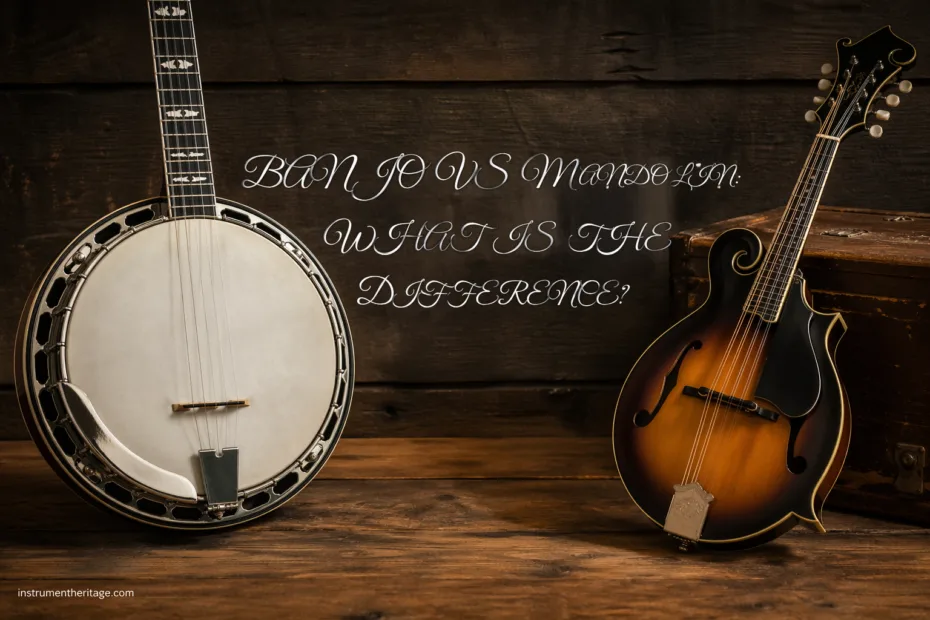
A banjo and a mandolin can sit in the same acoustic band and still feel like they were built from two different ideas of sound. The banjo is a string instrument with a drum-like head; the mandolin is a small wooden-bodied instrument with doubled strings. One speaks with a crisp pop. The other shines with a tight, ringing tremble. Same neighborhood, different houses.
The short answer is simple: a banjo gets its voice from a stretched membrane, while a mandolin gets its voice from a vibrating wooden top. That one build difference changes nearly everything: volume, sustain, picking feel, tuning logic, maintenance, and the way each instrument sits inside a tune.
The Main Difference: Head, Body, and Voice 🪕
A banjo is often described as a string instrument, and that is true. But the part that makes it sound like a banjo is closer to a small drum. Its bridge sits on a stretched head, traditionally skin and now often synthetic film. When the strings vibrate, the bridge shakes that head. The result is quick, bright, and direct. The note jumps out.
A mandolin works in a different way. It has a wooden resonating body, usually with a spruce top and maple back or sides on many familiar models. Its bridge sends vibration into the top, not into a membrane. That wooden top gives the mandolin its clear, bell-like ring. The note is small but pointed, like light catching the edge of a knife.
The banjo often feels more rhythmic. The mandolin often feels more melodic. That is not a rule carved into stone. Skilled players can make either instrument do surprising things. Still, the design pushes them in different directions.
Plain answer: choose the banjo if you want snap, drone, rolling rhythm, and a drum-like attack. Choose the mandolin if you want paired-string shimmer, compact melodies, tremolo, and a violin-like tuning layout.
Where the Banjo and Mandolin Come From
Banjo roots: a membrane instrument shaped across cultures
The banjo’s early story is tied to African and African-descended makers in the Caribbean and North America. Smithsonian material notes that the banjo was created by Africans and their descendants in those settings, with early forms using a gourd or calabash-like body, a skin head, long strings, and a shorter thumb string.Reference-1✅
That short thumb string matters. It is not just an extra string. It changes the whole feel of the instrument. On a five-string banjo, the short fifth string can act like a ringing drone, dropping little sparks between melody notes. That is why many banjo patterns feel circular and rolling rather than straight and ladder-like.
Over time, the banjo took many forms: fretless gourd banjos, open-back banjos, resonator banjos, tenor banjos, plectrum banjos, and long-neck banjos. Some are warm and dry. Some are loud and metallic. Some are built for porch-like old-time playing; others are made to throw sound across a lively acoustic group.
Mandolin roots: a small lute-family instrument with a bright top
The mandolin belongs to the lute family. Britannica traces the mandolin to 18th-century Italy and Germany, developing from the 16th-century mandora, and describes its familiar form as having four pairs of steel strings tuned to violin pitch.Reference-2✅
That violin-pitch tuning is a big part of the mandolin’s identity. GDAE gives the player a neat, symmetrical fingerboard. If you move a scale pattern across strings, the layout stays friendly. For fiddle players, the tuning feels like home. For guitarists, it can feel upside down for a little while.
The mandolin also has several body traditions. The Neapolitan bowlback has a rounded, ribbed back and an old European look. The flatback is easier to hold for many players. The American archtop mandolin, often with carved top and back, became a major voice in bluegrass and other acoustic styles. Small body. Big vocabulary.
Construction: What Your Hands and Ears Notice First 🛠️
The difference between banjo and mandolin becomes obvious when you look at the body. A banjo is built around a rim, head, bridge, and often a tone ring. A mandolin is built around a carved or bent wooden body, a soundboard, a bridge, a tailpiece, and paired strings. One is tension and snap. The other is wood and shimmer.
Banjo body parts
- Head: the vibrating membrane; skin on older and some traditional instruments, synthetic on many current banjos.
- Rim: the circular wooden or metal shell holding the head.
- Tone ring: a metal ring on many resonator banjos, adding brightness, weight, and projection.
- Bridge: a movable wooden bridge that sits directly on the head.
- Tailpiece: anchors the strings and affects down-pressure.
- Resonator: a back plate on many bluegrass banjos, helping project sound forward.
Mandolin body parts
- Soundboard: often spruce; the vibrating wooden top.
- Back and sides: often maple on many archtop and flatback mandolins.
- Bridge: a floating bridge, held in place by string pressure.
- Tailpiece: anchors eight strings in four paired courses.
- Soundholes: oval hole or f-holes, depending on model.
- Fingerboard: fretted, compact, and usually shorter than a guitar’s.
Because the banjo bridge sits on a membrane, small setup changes can be easy to hear. Head tension, bridge weight, tailpiece angle, string gauge, and even the tightness of hardware can change the bite of the note. A banjo can feel like a little machine. It rewards careful setup.
The mandolin is fussy in a different way. The paired strings must match cleanly, the bridge needs correct placement for intonation, and the top must be allowed to vibrate. On archtop mandolins, carved wood, bracing, bridge fit, and tailpiece pressure all shape the voice. The Met describes a 1916 Gibson F-2 mandolin with a carved arched top and back, ebony fingerboard, nickel-silver frets, and eight steel strings in four unison courses.Reference-3✅
Sound Character: Snap vs Shimmer 🎶
The banjo has a fast attack. You hit a note and it appears almost instantly, with a clear edge. The sound can be dry and woody on an open-back banjo, or bright and forceful on a resonator banjo with a metal tone ring. That is why a banjo can be heard clearly even when other acoustic instruments are moving around it.
The mandolin has a shorter natural sustain than a guitar, but its doubled strings create a lively sparkle. Players often use tremolo, a rapid back-and-forth pick motion, to make a note feel longer. Instead of holding sound like an organ, the mandolin keeps refreshing it. Tiny strokes. Continuous glow.
| Listening cue | Banjo | Mandolin |
|---|---|---|
| Attack | Immediate, crisp, drum-like. | Clear and pointed, but less drum-like. |
| Sustain | Usually short to medium, with a ringing decay. | Short natural decay, often extended by tremolo. |
| Texture | Open, percussive, sometimes metallic depending on setup. | Chiming, compact, bright, and paired-string rich. |
| Low-end feel | Light in bass; strongest in rhythmic sparkle and midrange cut. | Small body means modest bass, but the low G course can sound woody and firm. |
| Group role | Can drive rhythm with rolls, drones, and syncopated patterns. | Can play melody, tremolo, double stops, and sharp offbeat chops. |
If you listen with your eyes closed, the banjo often feels like beads dropping onto a wooden table. The mandolin feels more like two thin wires vibrating together in the same beam of light. Both can be bright. The brightness comes from different places.
Tuning and String Layout: Two Different Maps 🎼
The standard five-string banjo is commonly tuned gDGBD. The lowercase g is the short fifth string, set higher than you might expect. That high drone string is one reason the banjo does not feel like a small guitar. It interrupts the straight line of the fretboard in a good way, giving the right hand a bright point to bounce off.
The mandolin is usually tuned GDAE, low to high, in fifths. Each note is doubled in a pair, so you are really managing four courses rather than eight separate melodic strings. The paired courses give the mandolin its silver edge, but they also demand clean tuning. When one string in a pair is slightly off, the ear notices.
For guitar players: banjo chord shapes may feel closer at first, especially in open G tuning, but the fifth string changes the right-hand logic. Mandolin tuning is less guitar-like, yet its pattern in fifths is neat once the hand learns the spacing.
Tenor banjo adds another twist. A tenor banjo has four strings, not five, and is used in jazz, Irish music, and other traditions. Some tenor banjos are tuned in fifths, which brings them closer to mandolin logic. That is one reason beginners sometimes confuse “banjo vs mandolin” with “tenor banjo vs mandolin.” They are related in playing circles, but the bodies still speak differently.
| Fretboard feel | Banjo | Mandolin |
|---|---|---|
| Left-hand spacing | Often roomier than mandolin, depending on scale length and model. | Compact; fingers sit close together, especially high up the neck. |
| String pressure | Often lighter under the fingers, especially on many five-string banjos. | Often firmer because paired steel strings must be pressed cleanly. |
| Pattern logic | Open tunings make some chords easy and resonant. | Fifths tuning makes scales and transposition tidy. |
| Tuning patience | Head tension, bridge position, and hardware can affect stability. | Eight strings mean more tuning points, especially before playing. |
Playing Technique: Rolls, Drones, Tremolo, and Chop
The banjo’s right hand often builds patterns that roll forward, backward, or around a melody. In three-finger bluegrass style, thumb, index, and middle fingers can create a stream of notes that feels almost woven. In clawhammer playing, the hand moves more like a pendulum: a downstroke with the finger, then the thumb catching the drone. It has body movement in it.
Mandolin technique usually centers on the pick. Alternate picking, tremolo, crosspicking, double stops, and chop chords are part of the instrument’s daily language. A strong mandolin player can make a tiny instrument behave like a snare drum, a fiddle, and a bright rhythm guitar in the same tune. Not all at once. But close.
Banjo techniques
- Clawhammer: downstroke playing with a rhythmic thumb.
- Three-finger rolls: flowing fingerpicked patterns.
- Drone use: the fifth string adds sparkle and pulse.
- Melodic banjo: scale-like passages across open and fretted notes.
- Single-string style: picked lines that can feel closer to flatpicked instruments.
Mandolin techniques
- Tremolo: fast pick motion that sustains a note.
- Chop chords: short, percussive offbeat rhythm.
- Double stops: two-note shapes borrowed from fiddle language.
- Crosspicking: broken chord patterns across courses.
- Fast melody picking: clean single-note lines with a flat pick.
The most useful comparison is this: the banjo often makes rhythm out of ringing patterns, while the mandolin often makes melody out of tight pick control. The banjo rolls. The mandolin flickers.
Where Each Instrument Fits in Music
Both instruments are strongly linked with acoustic music, yet they do not play the same job. In a bluegrass band, the banjo may supply rolling drive, while the mandolin often chops on the offbeats and takes high, fast breaks. The Met notes that bluegrass musicians such as Bill Monroe used the Gibson F-5 archtop mandolin in the 1930s and 1940s, helping lift the archtop mandolin’s place in American roots music.Reference-4✅
In old-time music, an open-back banjo can sit with fiddle in a loose, earthy groove. It does not need to be loud. It needs to lock with the bow. In Irish sessions, tenor banjo and mandolin may share melodic territory, especially when both are tuned in fifths, but the tenor banjo will usually speak with more edge and volume.
In classical and chamber settings, the mandolin has a long written tradition. Its tremolo can carry lyrical lines, and its small body can blend gently with guitar, strings, or voice. The banjo also has concert and classic traditions, but many listeners first recognize it through folk, bluegrass, and old-time sounds.
- Banjo in a group
- Often adds pulse, syncopation, drone color, and bright rhythmic motion.
- Mandolin in a group
- Often adds high melody, tremolo sustain, tight harmony, and offbeat chop.
- When they play together
- The banjo can fill the rhythmic air while the mandolin cuts short, clean shapes through it. When balanced well, the two do not crowd each other.
Similar Instruments and Easy Mix-Ups
The confusion around banjo vs mandolin grows because there are hybrid and neighboring instruments. Some look like banjos but tune like mandolins. Some belong to the mandolin family but sit lower in pitch. Names can be slippery, especially in older catalogs and regional music scenes.
| Instrument | What it is | Why people mix it up |
|---|---|---|
| Five-string banjo | A banjo with four long strings and one short drone string. | It is the banjo most people picture, especially in bluegrass and old-time music. |
| Tenor banjo | A four-string banjo, often used for melody or chord rhythm. | Some tunings overlap with fifths-based mandolin thinking. |
| Mandolin | A small lute-family instrument with four paired courses. | Its bright tone can cut like a banjo, but its body and string layout differ. |
| Mandola | A larger, lower member of the mandolin family. | Looks mandolin-like but has a deeper range. |
| Octave mandolin | A larger mandolin-family instrument tuned an octave below mandolin. | Shares GDAE logic but sounds fuller and lower. |
| Mandolin-banjo | A hybrid with a banjo-style body and mandolin-like string courses. | It has the naming problem built in: part banjo body, part mandolin layout. |
| Banjolele | A ukulele neck and tuning paired with a banjo-like body. | Looks like a small banjo but plays more like a ukulele. |
The mandolin-banjo is the one to watch. It can have mandolin tuning and paired strings, but the sound is driven by a banjo-style head. So it may feel like a mandolin in the left hand and a banjo in the ear. That is not a contradiction. It is a hybrid doing exactly what hybrids do.
Which One Suits Your Ear and Hands?
The better instrument is the one whose sound makes you want to pick it up again. That sounds almost too simple, but with banjo and mandolin it matters. Their physical feel is different enough that love for the sound can carry you through the awkward first weeks.
A banjo may suit you if…
- You like rhythmic motion more than long sustained notes.
- You enjoy drones, open strings, and patterns that loop around the beat.
- You want a voice that can sound dry and woody or bright and projecting.
- You are drawn to clawhammer, three-finger rolls, old-time grooves, or bluegrass drive.
- You do not mind setup details like head tension and bridge position.
A mandolin may suit you if…
- You like melody playing, compact chords, and fast picked lines.
- You enjoy the clean logic of fifths tuning.
- You want a small instrument that can be bright without being large.
- You are drawn to tremolo, fiddle tunes, chop rhythm, or archtop acoustic tone.
- You are patient with paired-string tuning and firmer left-hand pressure.
For a complete beginner, the banjo may feel easier on the fingertips at first because many setups use lighter string tension. The mandolin may feel tougher under the left hand because every course has two strings. Yet the mandolin’s tuning layout is orderly. Once you learn a scale shape, it moves neatly.
For a guitarist, the banjo can feel familiar and strange at the same time. Some chord shapes are friendly, especially in open G, but the fifth string changes the map. For a violin or fiddle player, the mandolin’s GDAE tuning is familiar right away, and the frets remove the fear of exact finger placement. The pick still needs work. It always does.
Setup, Materials, and Long-Term Care 🌿
A banjo is adjustable in more visible ways than a mandolin. The head can be tightened or loosened. The bridge can be swapped. The tailpiece can be changed. The resonator can be removed on some models. This makes the banjo fun for players who like to shape tone by hand. It can also confuse new players, because one small change may alter the whole response.
A mandolin asks for a more luthier-minded kind of care. The bridge must sit in the correct place, the top should not be dried out, and the paired strings should be changed carefully so the bridge does not slide. A carved-top mandolin is a small wooden voice box. Treat it like wood, not furniture.
Material note: banjos often combine wood, metal, and membrane tension. Mandolins rely heavily on spruce, maple, ebony or similar fingerboard woods, metal strings, and the carved or bent shape of the body. That is why a banjo setup often feels mechanical, while mandolin setup often feels woodworking-sensitive.
Humidity matters for both, especially if the instrument has solid wood parts. Extreme dryness can shrink wood, lower action in odd ways, or cause fret ends to feel sharp. Too much moisture can make response dull. A simple case humidifier in dry seasons is not glamorous. It works.
Banjo vs Mandolin FAQ
Common questions about the two instruments
Is a banjo harder to play than a mandolin?
Not always. Banjo can feel easier on the fretting hand because many setups use lighter tension, but the right-hand patterns can take time. Mandolin has a logical tuning layout, yet the paired strings can feel firm under the fingers.
Do banjo and mandolin use the same tuning?
Standard five-string banjo and standard mandolin do not use the same tuning. A common five-string banjo tuning is gDGBD, while mandolin is usually tuned GDAE in fifths. Some tenor banjos can be tuned in fifths, which is why the comparison can get confusing.
Why does a banjo sound louder than a mandolin?
The banjo’s bridge sits on a stretched head, so the instrument reacts with a fast, percussive attack. Resonator banjos can project strongly. Mandolins can also cut through a mix, but their sound comes from a wooden top and paired strings rather than a membrane.
Can a mandolin play bluegrass like a banjo?
A mandolin can play bluegrass, but it usually plays a different role. Banjo often supplies rolling rhythmic drive. Mandolin often plays chop chords, fast melody breaks, tremolo, and high harmony lines.
What is a mandolin-banjo?
A mandolin-banjo is a hybrid instrument. It usually combines a banjo-style body with mandolin-like tuning and string courses. The result has some mandolin fingerboard logic but a sharper banjo-like sound engine.
Which is better for a guitarist: banjo or mandolin?
A guitarist may find some banjo chord shapes more familiar, especially in open G tuning. Mandolin feels less like guitar because it is tuned in fifths, but that tuning becomes very tidy for scales and melody once the hand adjusts.
