
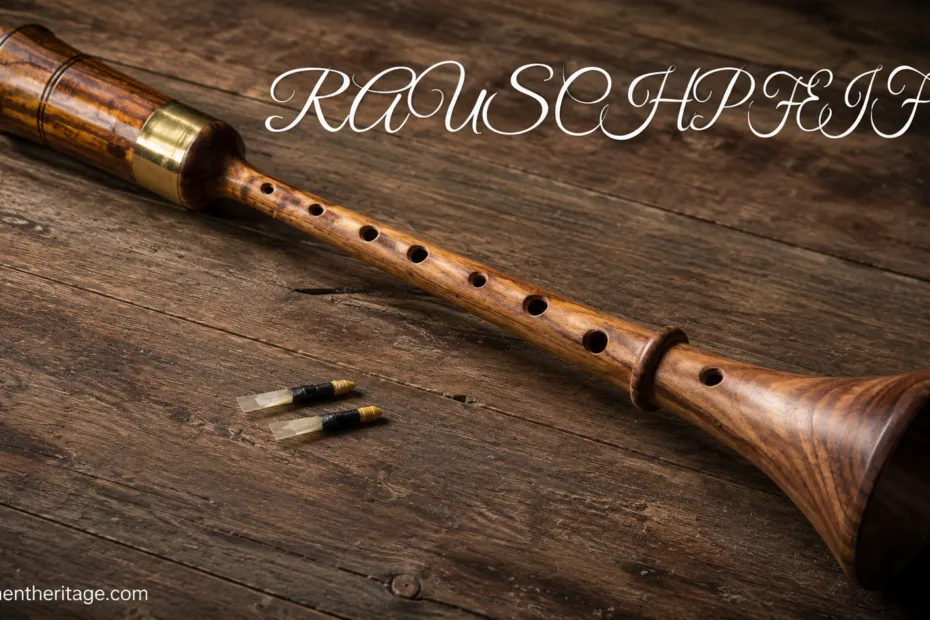
| Feature | Rauschpfeife detail |
|---|---|
| Instrument family | Woodwind aerophone, usually grouped with Renaissance double-reed instruments. |
| Reed system | A double reed sits inside a protective windcap, so the player blows into the cap rather than holding the reed directly between the lips. |
| Bore shape | Conical bore, closer in spirit to a shawm than to the softer cylindrical crumhorn. |
| Typical body | Turned wooden body, often in two sections, with finger holes, thumb hole, reed chamber, windcap, and flared bell. |
| Sound | Bright, loud, reedy, outdoor-friendly; a small instrument can sound far larger than it looks. |
| Historical setting | Used in Renaissance-style loud wind bands, festive processions, dance music, and open-air performance settings. |
| Related instruments | Shawm, cornamuse, crumhorn, dulcian, rackett, curtal, and later oboe-family instruments. |
| Museum record note | A public collection record describes a rauschpfeife as a wooden instrument with the reed inside the head, seven finger holes, thumb hole, and a flared bell Reference-1✅. |
The rauschpfeife is the sort of Renaissance wind instrument that does not politely ask for space in the room. It takes it. One breath, one firm stream of air, and that capped double reed wakes up with a clear, nasal, carrying tone that feels built for courtyards, town squares, dance floors, and busy halls. It is not a soft parlor voice. It is closer to a wooden lantern with sound pouring out of it.
Its name is often linked with German words around reed, rush, and noisy piping. That fits the instrument well. A rauschpfeife is not just a loud pipe, though. It is a clever little piece of woodwind design: the bite and projection of a shawm, but with the reed hidden under a windcap. That cap changes everything for the player.
Why the Rauschpfeife Sounds So Bold
The loudness comes from a simple pairing: a double reed and a conical bore. A double reed is made from two thin blades of cane that vibrate against each other. In the rauschpfeife, the reed is not softened by the player’s lips. It sits inside the windcap, free to buzz with a strong, open tone.
That makes the sound direct. There is very little whisper in it. The tone can feel bright, grainy, and energetic, with a reedy edge that cuts through other instruments. A recorder blends like warm breath. A rauschpfeife announces itself like a street crier with excellent lungs.
The conical bore helps the sound expand as it travels down the body. Think of the bore as a narrow hallway opening into a wider room. The air pressure and reed vibration move through that widening space, and the bell lets the tone bloom outward. This is why the instrument can feel related to the shawm, even though the playing method is not the same.
Sound character: a rauschpfeife usually has a piercing but rounded reed voice. It is louder than many capped reed instruments because its conical bore gives the tone more thrust.
The windcap makes it easier to start, but harder to shape
On a shawm, the player controls the reed with the lips. On a rauschpfeife, the reed is covered. The player blows into a slot or opening in the windcap, and the reed vibrates inside. This means the player does not need the same delicate embouchure used for oboe-like instruments.
That sounds easy. In one way, it is. But there is a trade-off: less direct reed control. Since the lips do not touch the reed, the player has fewer ways to shade pitch, color, and attack. The instrument rewards steady air, clean fingering, and good ensemble awareness.
Body, Reed, Windcap, and Bell
A rauschpfeife is usually made from turned wood. Modern makers may use maple, boxwood, plum, sycamore, pearwood, or other stable hardwoods, depending on the desired tone and durability. The body is shaped by boring, turning, reaming, and careful finishing. Small changes matter. A tiny adjustment in the bore or reed seat can change the way the whole instrument speaks.
The body often has seven front finger holes and a thumb hole, though exact layouts vary by maker, pitch, and model. Larger instruments may include keys to reach lower notes comfortably. The bell is usually flared, not only for appearance but also for projection and tuning behavior.
| Part | What it does | Why it matters |
|---|---|---|
| Windcap | Covers the reed and gives the player a blow-in chamber. | Creates the capped-reed feel and keeps the reed away from the lips. |
| Double reed | Produces vibration when air pressure passes through it. | Gives the instrument its strong reedy bite. |
| Conical bore | Widens from the reed area toward the bell. | Adds volume, brightness, and shawm-like projection. |
| Finger holes | Change the sounding length of the air column. | Control melody, tuning, and scale patterns. |
| Thumb hole | Helps with upper notes and fingering balance. | Gives the player more range and control. |
| Flared bell | Opens the final part of the bore. | Helps the sound carry and affects low-note response. |
Materials and the feel of the instrument
Wood choice is not magic, but it is not meaningless either. Dense woods can give a crisp response and a focused feel. Slightly lighter woods may feel warmer under the fingers and quicker to speak. The reed, bore, and maker’s voicing still do most of the heavy lifting. A fine body with a poor reed will not sing well.
The reed is the living part of the instrument. It swells, dries, softens, stiffens, and changes mood with humidity. Any player who works with double reeds knows this little drama. One day the reed behaves like a loyal friend. The next day it acts like it has never met you before.
🎵 The small design choice that changes the whole personality
The windcap is the rauschpfeife’s quiet trick. It hides the reed, protects it, and makes the instrument easier for non-oboe players to approach. Yet it also locks the sound into a more fixed, open, buzzing character. That is why the instrument feels bold rather than flexible.
Renaissance Setting and Musical Role
The rauschpfeife belongs to the noisy end of Renaissance wind culture. This was a time when wind instruments served dance, ceremony, outdoor music, civic display, and lively ensemble playing. Soft indoor instruments had their place. So did loud reeds. The rauschpfeife sat happily in that louder family.
Its closest cousin is the shawm, a direct double-reed instrument with a conical bore. Case Western Reserve University’s Early Music Instrument Database notes that shawms were often heard with sackbuts in Renaissance wind bands, and that larger shawms could be used in powerful indoor and outdoor settings Reference-2✅. The rauschpfeife shares that public, carrying spirit, but it wraps the reed inside a cap.
That one difference matters. A shawm asks the player to manage the reed with lip pressure. A rauschpfeife asks for strong, steady air through a cap. In a mixed wind band, this means the instrument can deliver clear melody lines without needing the same mouth technique as a shawm.
Where it would have made sense
Rauschpfeifen fit naturally into open, social, and rhythmic music. Dance tunes need a firm melodic line. Outdoor music needs carrying power. Ceremonial entrances need an instrument that does not disappear under drums, bells, voices, or other winds. The rauschpfeife handled those jobs well.
- Dance music: bright tone, clear pulse, and easy melodic projection.
- Outdoor performance: enough volume to travel through open space.
- Renaissance wind bands: a good match for shawms, sackbuts, and other loud instruments.
- Processional music: strong attacks and a tone that keeps moving forward.
- Educational early-music groups: useful for showing how capped reeds differ from direct reeds.
Surviving original examples are not as common as recorders, viols, or later orchestral winds. Much of today’s playing comes through careful reconstruction, museum study, iconography, instrument treatises, and the work of modern makers. The result is not guesswork thrown at a lathe. It is a practical craft conversation between old evidence and modern hands.
How the Rauschpfeife Is Played
Playing begins with air. Not a timid puff. A rauschpfeife wants a steady stream, with enough pressure to set the reed moving inside the windcap. The player seals the lips around the cap opening or blow-in slot, covers the holes, and lets the reed speak through the bore.
The first surprise for many players is that the instrument can feel physically easy at the mouth but demanding in breath support. Because the reed is capped, the lips do not tire in the same way they might on a shawm or oboe. Yet the air column needs confidence. Weak air can make the tone unstable, thin, or reluctant.
Fingerings and tuning
Fingerings vary. Modern makers often provide charts for their own instruments, and those charts matter more than generic advice. Historical pitch standards also varied, and modern early-music groups may choose instruments at A=440, A=415, or other pitch levels depending on the ensemble. A rauschpfeife is not a plug-and-play modern flute. It likes context.
Because the player cannot shape the reed directly, tuning is managed through air steadiness, finger hole coverage, reed condition, and sometimes alternate fingerings. Half-holing may appear in some ranges, but it depends on the instrument. The player learns the instrument’s habits the way a sailor learns a small boat.
Practical note: a rauschpfeife often feels more forgiving than a shawm at the mouth, but less forgiving in tone color. The reed speaks with its own bright personality, so the player’s job is to guide it rather than tame it.
Range and sizes
Modern rauschpfeifen are commonly made in several sizes, such as sopranino, soprano, alto, and tenor. Larger sizes need more air and may have keys. Smaller ones can be sharp, bright, and agile; lower ones bring a thicker reed voice, like a wooden horn speaking through a reed.
| Size | General sound feel | Typical musical use |
|---|---|---|
| Sopranino | Very bright, sharp-edged, and nimble. | High melody lines and color effects. |
| Soprano | Clear, lively, and direct. | Main melody in small loud-wind settings. |
| Alto | Fuller, rounder, and less piercing. | Middle lines, dance tunes, and mixed consorts. |
| Tenor | Broad, reedy, and grounded. | Lower melody, inner parts, and ensemble body. |
How It Fits with Other Renaissance Instruments
The rauschpfeife works best when paired with instruments that can meet its volume. A lute will not enjoy being placed too close to it. A recorder consort may politely step aside. But shawms, sackbuts, drums, and other loud reeds can stand beside it with confidence.
In a loud Renaissance-style group, the rauschpfeife can take a melody, double a line, or add a bright upper color. It is not usually the soft shading instrument of the group. It is the clear edge, the line that helps the music travel.
- With sackbut: good contrast between reed brightness and brass smoothness.
- With shawm: strong blend, though the rauschpfeife feels more capped and fixed in tone.
- With drum: useful for dance pulse and outdoor rhythm.
- With crumhorn: possible, but the rauschpfeife will usually dominate.
- With cornett: bright wind colors can sit well together when balanced carefully.
- With dulcian: a lower reed foundation can support the upper rauschpfeife line.
Rauschpfeife and Similar Instruments
The rauschpfeife is easiest to understand by placing it between the shawm and other capped reeds. It has the reed-under-a-cap idea of the crumhorn and cornamuse, but the conical bore points toward the shawm family. That is why it sounds stronger and more open than many capped reed cousins.
| Instrument | Reed access | Bore shape | Sound character | Main difference from rauschpfeife |
|---|---|---|---|---|
| Shawm | Direct reed at the lips | Conical | Loud, bright, flexible, outdoor-ready | The player controls the reed directly; The Met classifies a related shawm as a double-reed aerophone Reference-3✅. |
| Cornamuse | Capped reed | Often more closed or less shawm-like | Softer, smoother, more contained | Usually less piercing and less outdoor-focused. |
| Crumhorn | Capped reed | Cylindrical | Buzzing, nasal, curved-horn tone | Curved body and softer, more enclosed sound. |
| Dulcian | Direct double reed | Folded bore | Warm, reedy, bass-rich | Lower range and direct reed control. |
| Rackett | Double reed, compact body | Folded internal channels | Low, compact, unusual reed tone | Very different construction and lower sound role. |
| Oboe | Direct reed at the lips | Conical | Focused, expressive, orchestral | Later design, finer control, different musical setting. |
Rauschpfeife vs shawm
The shawm is more flexible because the lips touch the reed. The player can shape attacks, pitch, and color with the mouth. The rauschpfeife is more direct: blow into the cap, keep the air alive, and the instrument gives back a strong, ringing reed tone. Both are loud. They simply ask for different skills.
Rauschpfeife vs crumhorn
The crumhorn is also capped, but its cylindrical bore and curved body create a more compact buzzing voice. It can sound charming, even a little comic in the best way. The rauschpfeife is straighter, brighter, and more forceful. If the crumhorn is a friendly duck, the rauschpfeife is a reed trumpet with muddy boots.
Instrument Making and Modern Reconstructions
Many rauschpfeifen played today are modern reconstructions rather than untouched Renaissance originals. Makers study museum records, surviving related instruments, historical drawings, treatises, and playing practice. The aim is not to freeze the instrument in a glass case. It is to make a playable object that respects what the old evidence suggests.
Museum collections are useful here because they preserve shapes, measurements, labels, and material evidence. KHM’s Collection of Historic Musical Instruments describes its holdings as including Renaissance woodwind instruments and older European instruments from major historical inventories Reference-4✅. For makers, that kind of collection work is not decorative. It gives the craft something firm to stand on.
A maker must balance several things at once: pitch, response, bore angle, reed seat, wall thickness, bell shape, and finger placement. The result should not merely look old. It should play. A beautiful rauschpfeife that refuses to speak is just a carved tube with good manners.
🪵 Woodwork
The body needs clean boring, stable wood, accurate hole placement, and a bell that supports the intended pitch. Small errors can show up as stubborn notes.
🎶 Reed work
The reed must match the bore and windcap. Too stiff, and the instrument resists. Too soft, and the tone can sag or rattle.
Care, Handling, and Reed Habits
A rauschpfeife is sturdy in sound, but not careless in body. Wood moves with humidity. Reeds change with weather. Caps and joints can loosen or tighten. Good care keeps the instrument playable and stable.
- Warm the instrument gently before hard playing, especially in cold rooms.
- Let moisture escape after use; do not trap dampness inside the cap.
- Store reeds safely so the blades are not crushed or twisted.
- Avoid sudden humidity changes, since wood can swell or shrink.
- Use maker-approved fingering and reed advice, because each instrument has its own setup.
The reed is the part players talk about most. It may need soaking, adjusting, resting, or replacing. A stable reed makes the instrument feel alive in the hands. A poor reed makes everything harder than it needs to be.
Why the Rauschpfeife Still Catches Attention
The rauschpfeife has a voice people remember. It is not background color. It is a strong line, a bright reed flame, a reminder that Renaissance music was not always soft, polite, or museum-quiet. Some of it moved through open air. Some of it had dust on its shoes.
For players, the instrument offers a rare mix: historical flavor, bold projection, and a playing style that does not require direct reed embouchure. For listeners, it gives early music a fresh edge. One well-played rauschpfeife can make a dance tune feel as if it has just stepped out into daylight.
It also teaches a useful lesson about instrument design. Cover the reed, and the player’s relationship with the sound changes. Shape the bore as a cone, and the voice grows louder and brighter. Add a bell, and the tone travels. Nothing here is random. The rauschpfeife is simple to describe, but full of small craft decisions.
Rauschpfeife FAQ
Is the rauschpfeife the same as a shawm?
No. They are related, and both use a double reed with a conical bore, but the shawm has a reed played directly by the lips. The rauschpfeife has its reed enclosed inside a windcap.
Why is the rauschpfeife so loud?
Its loudness comes from the double reed, the capped reed chamber, and the conical bore. The reed vibrates freely inside the cap, while the widening bore helps the sound project outward.
Is it hard to play?
It is easier at the mouth than a shawm because the lips do not touch the reed. Still, it needs steady breath, clean finger coverage, and a good reed. The sound is bold, so mistakes are easy to hear.
What music is the rauschpfeife used for?
It suits Renaissance dance music, loud wind bands, outdoor-style performance, and early-music ensembles that want a strong reed color. It works best with instruments that can match its volume.
What is the difference between a rauschpfeife and a crumhorn?
Both are capped reed instruments, but the crumhorn usually has a cylindrical bore and a curved body, giving it a softer buzzing sound. The rauschpfeife has a conical bore and a stronger, more shawm-like voice.
Are modern rauschpfeifen historical originals?
Most instruments played today are modern reconstructions or modern interpretations based on historical evidence, museum records, related instruments, and early-music craft practice.
Does the player need to make reeds?
Not always, but reed knowledge helps a lot. Many players buy reeds from makers, then learn basic care and adjustment. A well-matched reed can make the instrument feel much easier and more stable.
