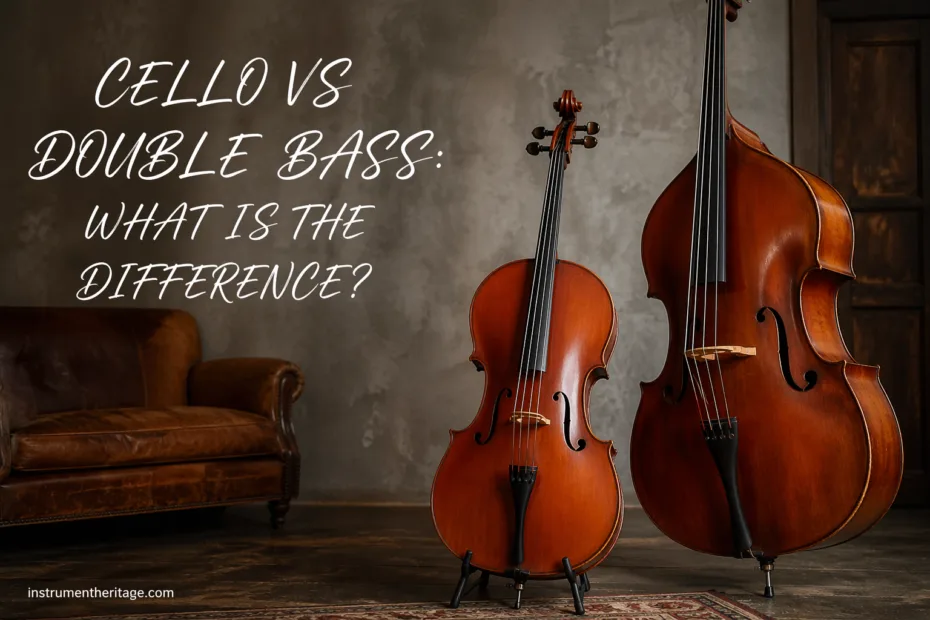
Cello and double bass look like close relatives because they are both large bowed string instruments with curved wooden bodies, long strings, bridges, fingerboards, soundholes, and endpins. Yet under the player’s hands they feel almost like two different animals. The cello speaks with a warm tenor-bass voice that can sing melodies like a human baritone. The double bass sits lower, wider, and deeper; it gives music its floor, pulse, and weight. Same family gathering. Different jobs.
| Feature | Cello | Double Bass |
|---|---|---|
| Full name | Violoncello, usually shortened to cello | Double bass, also called contrabass, string bass, or upright bass |
| Instrument family | Bowed, unfretted string instrument; part of the violin family tradition | Bowed, unfretted string instrument with mixed violin-family and viol-family traits |
| Standard tuning | C–G–D–A, tuned in fifths from low to high Reference-1✅ | E–A–D–G, tuned in fourths from low to high Reference-2✅ |
| Lowest open string | C2, a deep note but still inside the cello’s singing range | E1 on a standard four-string bass; many orchestral basses use a low C extension or a fifth string |
| How the part sounds | Sounds as written | Usually sounds one octave lower than written notation |
| Typical role | Melody, bass line, inner harmony, solo writing, chamber music lines | Lowest foundation, harmonic support, rhythmic drive, pizzicato bass lines, orchestral depth |
| Playing position | Played seated, held between the knees, supported by an endpin | Played standing or on a tall stool, supported by an endpin |
| General sound | Warm, vocal, rounded, clear | Deep, woody, broad, grounded |
| Common materials | Spruce top, maple back and ribs, ebony or similar dense wood for the fingerboard; carbon-fiber models also exist Reference-3✅ | Spruce top, maple back and ribs in many instruments; laminated woods are common in student and touring basses |
🎻 The Main Difference Between Cello and Double Bass
The simplest answer is this: the cello is the smaller and higher-voiced instrument, while the double bass is the larger and lower-voiced instrument. The cello often carries melodies, countermelodies, expressive bass lines, and lyrical solo passages. The double bass usually works underneath the texture, giving the music shape from below.
Think of the cello as a singer who can step forward. It can support the harmony, then suddenly take a melody and make the room lean in. The double bass is more like the wooden floor under the singer’s feet. You may not always notice every note, but when it disappears, the whole sound feels lighter and less anchored.
Plain difference: a cello is tuned in fifths and sounds in the tenor-bass range. A double bass is tuned in fourths, sounds lower than written, and gives ensembles their deepest bowed-string voice.
Both instruments are used in orchestras, chamber music, film scores, experimental music, folk traditions, and teaching studios. The double bass also has a strong life in jazz, bluegrass, tango, rockabilly, and acoustic popular music, where plucked bass lines can carry the whole groove with only a few notes.
🎼 Tuning: Fifths on Cello, Fourths on Double Bass
Tuning is where the difference becomes clear. The cello is tuned like a large member of the violin family: C–G–D–A, each string a fifth apart. That spacing gives cellists wide intervals under the hand and a very logical relationship with violin and viola technique.
The double bass uses E–A–D–G, usually in fourths. This is closer to the tuning pattern of the electric bass guitar, which is one reason many bassists can move between upright bass and bass guitar more easily than a cellist can. The hand shapes feel different. The musical thinking feels different too.
- Cello tuning: C2, G2, D3, A3
- Double bass tuning: E1, A1, D2, G2
- Cello interval pattern: fifths
- Double bass interval pattern: fourths
- Bass notation habit: written one octave higher than it sounds
That last point matters. If a double bass part were written exactly where it sounds, many notes would sit far below the staff. Reading would become messy. So composers usually write bass notes an octave higher, and the instrument speaks lower in performance. Clean page. Huge sound.
Why the Tuning Changes the Hand
On cello, fifths make the instrument feel broad. One left-hand position covers fewer stepwise notes, so shifting is part of normal playing from the beginning. Cellists learn to move across the fingerboard like someone climbing smooth stones across a stream: reach, land, listen, adjust.
On double bass, fourths make close bass patterns easier to manage on a very long string length. A full-size bass has a much larger scale than a cello, and the physical distance between notes is wider. The fourths tuning keeps many common bass lines under the hand without forcing the player into constant jumps.
Small detail, big effect
Cello tuning favors wide melodic reach. Double bass tuning favors practical low-register movement. This is one reason a cello line often feels vocal, while a bass line often feels architectural.
🔊 Sound Character: Singing Wood vs Grounded Wood
A cello can sound dark, tender, bright, nasal, smoky, sweet, or almost speech-like, depending on bow speed, contact point, string choice, and the player’s left-hand vibrato. Its middle register is famous for feeling close to the human voice. Not identical, of course. But close enough that many listeners feel the cello is “speaking” rather than simply producing pitch.
The double bass has a different kind of beauty. Its sound is slower to bloom, broader in the body, and less eager to cut through a texture. A bass note can feel like a large door opening. It does not need to shout. The wood, air, and string length do the work.
Philharmonia lists the cello’s frequency range as about 65 Hz to 1.0 kHz, while the double bass page gives 41–392 Hz for the bass and notes that a low C extension can take the instrument down to C1. Reference-4✅
Cello Tone
The cello’s low C string has a dark, grainy pull. Its G string is warm and centered. The D string can be lyrical without becoming too bright, and the A string carries melodies with a clean, forward edge. Good cello writing often knows which string to use for color, not just pitch.
When a cellist plays a phrase sul C or sul G, the line stays on a lower string even when another fingering might seem easier. Why? Color. The same note can feel more covered, more intense, or more vocal depending on the string. On cello, string choice is part of the language.
Double Bass Tone
The double bass has more air inside the body and longer, heavier strings. This gives it a slow, large response, especially in the lowest register. Under the bow, it can sound broad and velvet-like. Plucked with the fingers, it becomes round, percussive, and rhythm-friendly.
In jazz, the walking bass line is one of the instrument’s natural homes. In an orchestra, basses often double cellos at the octave, deepen harmonic roots, or add weight to rhythmic figures. In small acoustic groups, one good bassist can make the whole ensemble feel settled.
Cello sound
Closer, clearer, more vocal. The cello can carry melody without losing warmth.
Double bass sound
Lower, wider, more grounded. The bass shapes the room before it asks for attention.
🪵 Construction and Materials
Both cello and double bass are wooden resonating bodies built around tension. A stretched string vibrates. The bridge transfers that vibration into the top plate. The soundpost and bass bar help the body move in a controlled way. The hollow body pushes air. That is the simple version.
The real craft is less simple. A luthier chooses spruce for the top because it can be light, stiff, and responsive. Maple is often used for the back, ribs, and neck because it gives strength and a clear reflective surface for vibration. Ebony or another dense hardwood is used for the fingerboard because the player’s fingers and strings would chew through softer wood too quickly.
Body Size and Air Volume
The cello is large enough to make a warm low C, yet still small enough for fast passagework, thumb position, lyrical bow control, and seated balance. Its shoulders, waist, arching, rib depth, and bridge height all help shape the response.
The double bass is much larger, but it is not simply a “big cello.” Many basses have sloped shoulders, flat backs, broad ribs, and outline features closer to the viol family. Others look more violin-like. This mixed ancestry explains why one bass can look rounded and another can look almost gamba-like, with shoulders that slope gently away from the neck.
Bridge, Soundpost, and Bass Bar
The bridge is not just a string holder. It is a carved wooden filter. It decides how energy moves from string to body. A cello bridge is smaller, lighter, and more responsive to delicate bow changes. A bass bridge is taller and wider, and it must handle heavier strings with much greater tension and motion.
Inside the instrument, the soundpost sits between the top and back near the treble foot of the bridge. It is sometimes called the soul of the instrument, which sounds romantic but is also practical: a tiny adjustment can change response, brightness, focus, and balance. The bass bar, glued under the top on the bass side, helps support the plate and guide low-frequency vibration.
Strings and Feel Under the Fingers
Cello strings feel firm, but the left hand can still shape notes with vibrato, shifts, extensions, and thumb position in a very singing way. Double bass strings are thicker and longer. The player uses more arm weight, more finger strength, and more careful body balance.
On cello, vibrato can be narrow and vocal or wide and warm. On bass, vibrato often needs more physical space to be heard clearly, especially in the lower register. The player may use the whole hand and arm in a slower motion. Small movement can vanish down there. The string is huge.
| Part | Cello Effect | Double Bass Effect |
|---|---|---|
| String length | Allows lyric playing, wide shifts, and strong melodic control | Creates deep pitch and strong low-frequency energy |
| Body cavity | Large enough for warmth, still quick enough for clear articulation | Much larger air space gives the bass its broad, low resonance |
| Bridge curve | Supports clean bowing across four strings and fast string changes | Usually broader; demands larger bow motion and careful angle control |
| Fingerboard | Supports thumb position and high lyrical work | Longer and wider; high playing needs strong technique and exact shifting |
| Bows | Usually one main bow style, held overhand | French bow and German bow traditions both remain active |
🧍 Playing Position and Technique
The cello is played sitting down. The instrument rests on its endpin and leans gently against the player’s chest and knees. This posture gives the cellist close contact with the body of the instrument. You feel the sound through your ribs, hands, and legs.
The double bass is taller. Many bassists stand, while others sit on a high stool. The player’s body works around the instrument rather than enclosing it. The left arm reaches higher. The right arm draws a shorter, heavier bow across thicker strings. Even pizzicato needs a different kind of pull; it is not a guitar-like pluck but a full-bodied release of the string.
Bowing Differences
A cello bow can produce long lyrical lines, quick off-string strokes, soft attacks, sharp accents, and dense chords. Because the cello speaks fairly quickly, bow changes can be subtle and still audible.
Double bass bowing has more mass to manage. The string may need a fraction more time to start. This gives the bass its earthy character, but it also asks for patience. Too much pressure chokes the sound. Too little contact leaves the note pale. The sweet spot can feel narrow until the player learns it.
- Cello bowing often rewards speed, flexibility, and fine color changes.
- Double bass bowing rewards weight, timing, clean contact, and relaxed strength.
- Pizzicato cello is clear and rounded, often used as color.
- Pizzicato bass can become the rhythmic spine of an ensemble.
Left-Hand Work
Cellists learn extensions early. The hand opens to cover whole steps and half steps across a fairly broad fingerboard. Later, thumb position opens the upper register and lets the cello sing high without losing control.
Double bassists often use a different fingering logic in lower positions because the distances are larger. Instead of using one finger for each semitone in the same way a violinist might, bass technique often groups fingers for strength and accuracy. It looks simple from the audience. It is not simple under the hand.
Player feel: cello technique feels close, curved, and vocal. Double bass technique feels larger, slower, and more physical, especially in the low register.
📖 Notation, Clefs, and Musical Range
Cello music is usually written in bass clef, but tenor clef and treble clef appear when the line climbs. A trained cellist moves among these clefs as part of normal reading. The cello has a broad written range, and composers use that range freely.
Double bass music is usually written in bass clef too, but the instrument sounds one octave below the written note. This keeps the notation readable. Solo bass music may use tenor or treble clef, especially when the line climbs into thumb position or uses a solo tuning setup.
Range in Real Musical Use
The cello’s low end begins at C2, but its upper range can sing far above the staff in skilled hands. This gives it a rare balance: it can act as a bass instrument, an inner voice, or a solo melody instrument. In a string quartet, the cello may support harmony one moment and carry the emotional center the next.
The double bass begins lower, and its natural strength is the area where harmony becomes physical. Low E, low D, and low C do not just “sound”; they change the pressure in the room. In orchestral writing, those notes can make a chord feel rooted. In jazz, they can make time feel alive.
🏛️ Historical Development Without the Museum Dust
The cello developed in the violin-family tradition of northern Italy, where makers refined bowed instruments with arched plates, f-holes, four strings, and clear family relationships between sizes. Early cellos were not always standardized. Some had different sizes, tunings, or string counts before the instrument settled into the form players know now.
The name violoncello points to its older relationship with the violone, a large bass instrument. Over time, the cello became more than a bass-line helper. It became a solo voice. Composers learned that its range could hold both gravity and lyricism, which is why the cello later became central in sonatas, concertos, suites, quartets, and orchestral writing.
The double bass has a more mixed family story. It carries traits from the violin family and the viol family. Some basses have violin-like corners and arched backs. Others have sloping shoulders, flat backs, and a more gamba-like outline. This is not a flaw. It is part of the bass’s identity.
Why the Double Bass Did Not Become Just a Bigger Cello
A giant cello shape would be difficult to manage, transport, and tune at very low pitch. Luthiers had to solve practical problems: body size, string length, tension, neck angle, shoulder shape, and player reach. That is why bass design has always allowed more variation than violin or cello design.
This variety also explains why bass sizes can be confusing. A so-called 3/4 double bass is not tiny. It is the normal working size for many players. Full-size basses exist, but they are less common because the scale length and body size can become hard to handle.
🎶 Musical Roles: Melody, Foundation, and Texture
The cello and double bass often play together, yet they do not do the same job. In an orchestra, cellos may carry melody, harmony, counterpoint, fast passagework, lyrical solos, and bass support. Double basses often reinforce the lowest line, add mass, shape rhythm, and deepen the harmonic roots.
When cellos and basses play the same line an octave apart, the result can feel like a single large instrument with two layers: cello gives definition, bass gives depth. The cello draws the line. The bass shades the paper under it.
Cello in Ensembles
- String quartet: usually the lowest voice, but often melodic and conversational.
- Piano trio: shares melodic duties with violin while supporting harmony.
- Orchestra: moves between bass lines, inner motion, lyrical themes, and dramatic textures.
- Solo music: capable of melody, harmony, chords, and implied counterpoint.
Double Bass in Ensembles
- Orchestra: supports the lowest register and gives the string section depth.
- Jazz group: shapes harmony and time through walking lines and pizzicato feel.
- Bluegrass and folk settings: gives acoustic rhythm and low-end body.
- Chamber music: adds depth, color, and unusual balance when used thoughtfully.
One useful listening trick
Listen to the start of a phrase and ask: who is shaping the melody, and who is shaping the ground? If the line feels vocal and forward, it may be cello. If it feels like the room’s low pulse, it is probably double bass.
🌿 Solo Writing and Repertoire
The cello has one of the broadest solo repertoires among bowed string instruments. Its range, clarity, and vocal quality make it natural for unaccompanied music, sonatas, concertos, and chamber works. A single cello can suggest harmony through broken chords, double stops, register changes, and rhythmic motion.
The double bass also has a solo tradition, though it asks different things from the listener and player. Bass solo music often uses higher positions, harmonics, lyrical upper-register writing, and sometimes solo tuning. The instrument can be surprisingly agile, but its beauty is never exactly cello-like. It has its own center of gravity.
Some listeners expect the double bass to stay low all the time. That misses half the fun. In the upper register, a bass can sound pale, intimate, and almost flute-like in a woody way. The notes still carry the memory of a large body underneath them.
🛠️ Craft Details That Shape the Difference
Material choice matters, but it does not work like a simple recipe. Spruce, maple, ebony, varnish, glue, arching, thickness, bridge cut, soundpost placement, strings, and setup all interact. Two cellos made from similar woods can feel completely different. Two basses from the same workshop can have different personalities.
Solid Wood vs Laminated Wood
Many higher-level cellos and basses use carved solid wood plates. Solid wood can respond with greater nuance when the instrument is well made and well set up. Laminated instruments, made with layered wood, are common for student basses because they can be durable and more stable in changing climates.
This is especially useful for double bass players who travel, play outdoors, or move through busy gig settings. A carved bass may have a lovely voice, but a laminated bass can survive a hard-working life with fewer worries. Practicality has a sound too.
Setups Are Not Interchangeable
A cello setup aims for response, evenness, comfortable string height, and clean tone across a wide expressive range. A double bass setup has to balance bowing, pizzicato, string height, fingerboard scoop, bridge height, and the player’s genre. A jazz bassist may want a different feel from an orchestral bassist.
That is one reason “which is better?” is not a useful question. Better for what? A cello is better for cello writing. A double bass is better for true low-register foundation. Each instrument solves a different musical problem with wood, string, and air.
🪕 Similar Instruments Often Confused with Them
Cello and double bass sit near several related instruments. Some are family members. Some are cousins. Some only look similar from a distance.
| Instrument | How It Relates | Main Difference |
|---|---|---|
| Viola | One step above cello in the string-family range | Held under the chin; tuned C–G–D–A like cello but one octave higher |
| Viola da gamba | Historical bowed viol with frets and a vertical playing position | Usually fretted, often six or seven strings, and built with a different family design |
| Violone | Large historical bass viol related to older low-string traditions | Name and tuning varied by place and period; not the same as the modern cello |
| Electric bass guitar | Shares E–A–D–G tuning pattern with standard double bass | Fretted or fretless guitar-like body; amplified by pickups rather than a large acoustic body |
| Octobass | Very rare giant bowed bass instrument | Much larger and lower than normal orchestral bass; not a standard ensemble instrument |
Cello vs Viola da Gamba
The cello has no frets, four strings, violin-family construction, and a strong solo tradition in later classical music. The viola da gamba usually has frets, more strings, and a softer, more transparent voice. They can both sound beautiful in old music, but their feel under the hand is not the same.
Double Bass vs Bass Guitar
The double bass and electric bass often share the same tuning pattern, but they produce sound in very different ways. A double bass is an acoustic body first. The player’s fingers, string height, body resonance, and room all become part of the note. A bass guitar is pickup-based; its tone depends heavily on strings, electronics, amplification, and playing touch.
🎯 Which One Is Easier to Learn?
Neither is easy in a casual sense. The cello asks for accurate intonation, bow control, shifting, clef reading, and relaxed seated posture. The double bass asks for body balance, large left-hand spacing, strong timing, and comfort with a very large instrument.
For many beginners, cello feels more approachable because instruments, teachers, cases, and learning materials are easier to find in many places. It fits into a car more easily. It can live in a small room without taking over the furniture. These things matter.
The double bass has its own practical demands. Transport is harder. Good setup is vital. The instrument’s size can be tiring until posture becomes natural. Yet bass players are often welcome in many kinds of ensembles because low-end players are always needed.
Cello may suit you if…
- You love lyrical melodies.
- You want a large solo and chamber repertoire.
- You like the sound of a warm tenor-bass voice.
- You prefer seated playing.
Double bass may suit you if…
- You enjoy rhythm and low-end support.
- You like jazz, orchestral bass lines, or acoustic groove.
- You want the deepest regular string voice.
- You do not mind a large instrument.
👂 How to Hear the Difference by Ear
When listening, focus less on size and more on function. The cello usually has more edge in the middle register, especially when playing melody. The double bass sits lower and can be harder to isolate on small speakers. On headphones or good speakers, its low notes feel rounder and wider.
A bowed cello line often has a clear start to each note and a vocal curve through the phrase. A bowed bass line may sound darker, slower, and more blended. A plucked cello sounds like a large string instrument making a color effect. A plucked double bass sounds like a bass line with body and time.
- Hear a warm melody in the low-middle range? Likely cello.
- Hear the lowest pulse under the harmony? Likely double bass.
- Hear fast singing lines above the bass floor? Often cello.
- Hear round plucked notes carrying the groove? Often double bass.
One more clue: if the line feels low but still clearly melodic and speech-like, it may be cello. If the line feels like it is holding the whole ensemble from below, it is probably double bass. The difference is not only pitch. It is behavior.
FAQ
Cello vs Double Bass Questions
Is a double bass just a bigger cello?
No. A double bass is larger and lower, but it is not simply an enlarged cello. The cello is tuned in fifths, while the double bass is usually tuned in fourths. Many double basses also show design traits linked with the viol family, such as sloped shoulders or flat backs.
Which is lower, cello or double bass?
The double bass is lower. A standard cello’s lowest open string is C2. A standard four-string double bass usually goes down to E1, and orchestral basses may reach low C with an extension or a fifth string.
Why is the double bass written an octave higher than it sounds?
Double bass parts are usually written an octave higher to keep the notes readable on the staff. If the music were written exactly where it sounds, many notes would sit far below the bass clef staff and become harder to read quickly.
Can a cello play double bass music?
A cello can play some bass lines, but it cannot produce the same low register as a double bass. The tuning, string length, sound, and physical role are different. A cello can imitate the shape of a bass line, but not the full depth of a bass section.
Is cello or double bass better for beginners?
Cello is often easier to manage at home because it is smaller and easier to transport. Double bass can be physically demanding because of its size, but it is very rewarding for players who love rhythm, low sound, and ensemble support.
Do cello and double bass use the same bow?
No. A cello bow and double bass bow are different in size, weight, and handling. Double bass players may use either a French-style bow held overhand or a German-style bow held underhand.
Why does the cello sound more like a human voice?
The cello’s range sits close to many human singing registers, especially in its middle strings. Its bow response, vibrato, and phrasing style also help it shape notes in a speech-like way.
