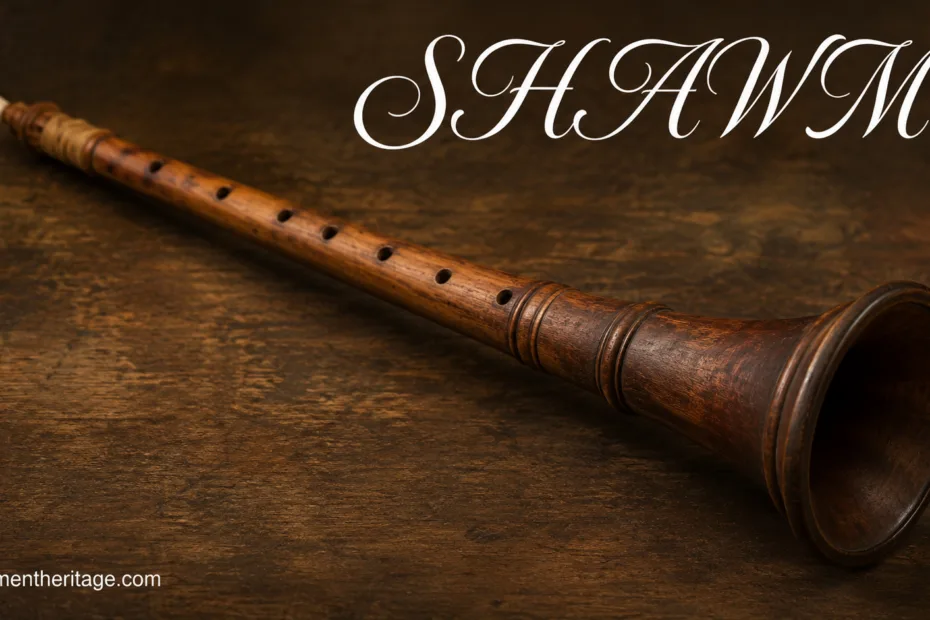
| Feature | Shawm Details |
|---|---|
| Instrument family | Double-reed woodwind, classed as an aerophone; the vibrating cane reed starts the sound. |
| Main period of use in Europe | Medieval and Renaissance performance, with strong use in civic bands, dance music, courtly ceremony, and outdoor gatherings. |
| Sound character | Bright, loud, reedy, and carrying; it can cut through outdoor noise like a clear beam of sound. |
| Body shape | Conical bore with a flared bell, usually turned from hardwood. |
| Reed setup | Two cane blades tied to a staple; many European shawms use a wooden lip-support called a pirouette. |
| Typical materials | Hardwood body, cane reed, brass or metal staple, sometimes wax for tuning vent holes. |
| Musical relatives | Zurna, suona, shehnai, ciaramella, piffaro, dulzaina, bombard, and early oboe-family instruments. |
| Later descendant | The Baroque oboe softened and refined parts of the shawm idea for indoor art music. |
The shawm is the kind of instrument that does not ask politely to be heard. It arrives. A medieval shawm has a sharp double-reed voice, a flared wooden body, and a tone made for streets, courtyards, dances, towers, and open air. Before the oboe became the elegant reed voice of the orchestra, the shawm carried melodies with a rougher edge and a wider grin.
Think of it as the oboe’s older, louder cousin: less polished silverware, more carved oak table. It belongs to the long family of conical-bore double-reed instruments, where air, cane, wood, and pressure work together in a very direct way. The player blows into two thin blades of cane. Those blades beat against each other. The wooden tube then shapes that buzz into a focused musical tone.
The shawm was not built for whispering. Its voice has edge, strength, and outdoor reach. That is exactly why it mattered.
🎵 What Is a Shawm?
A shawm is a loud double-reed woodwind with a flared bell and a conical bore. In plain words: it is a wooden pipe that widens as it goes down, powered by a cane reed that buzzes at the top. The result is a strong, nasal, brilliant tone that can travel across open space.
The instrument appears in many medieval and Renaissance contexts under related names such as chalemie, shalm, schalmei, ciaramella, and piffaro. The exact name depends on place, language, and period. The basic idea stays familiar: a reed-driven wooden wind instrument with a bold public voice.
Case Western Reserve University’s Early Music Instrument Database describes the shawm as a loud double-reed instrument and an ancestor of the oboe, noting its role in dance bands, municipal ceremony, and court settings by the late Middle Ages.Reference-1✅
The simple picture: the recorder sings with a clean whistle-like stream, the bagpipe chanter speaks under bag pressure, and the shawm barks through a reed held close to the mouth. Not ugly. Not crude. Just direct.
Why the shawm sounds so strong
The shawm’s strength comes from three things working together: the double reed, the wide conical bore, and the flared bell. The reed makes a bright buzz. The bore amplifies and shapes it. The bell helps the sound open out. You can feel the design with your ears; it does not hide the reed.
- Double reed: two cane blades vibrate against each other.
- Conical bore: the inner tube widens toward the bell, helping the instrument speak with bite.
- Pirouette: a small wooden disk on many European shawms, supporting the lips near the reed.
- Finger holes: used to change pitch, often with limited chromatic flexibility compared with later oboes.
- Open-air tone: clear, bright, and hard to miss.
🪵 Anatomy of the Shawm
A shawm looks simple from a distance, but close up it is a clever piece of craft. The body is usually turned from hardwood. The bore is not a straight tunnel; it is carefully tapered. Small changes inside the bore can change the pitch, response, and color of the instrument. This is where woodworking meets acoustics.
The body and bell
The body of a historical shawm is often made from one piece of wood, shaped on a lathe. The bell flares at the end, giving the instrument its familiar horn-like outline. A larger bell usually means a broader sound and stronger projection. It also gives the shawm that unmistakable silhouette seen in manuscript art and museum collections.
Hardwoods are favored because they can be turned cleanly, hold detail, and resist the pressure of playing. Boxwood, maple, plum, pear, and similar dense woods are often seen in historical woodwinds and modern reconstructions. The wood matters, but not in a magical way. Bore shape, reed setup, and maker skill matter just as much.
The reed, staple, and pirouette
The reed is the shawm’s spark plug. It is made from cane, scraped and shaped so the two blades vibrate when air passes through them. The reed usually sits on a small metal tube called a staple. On many European shawms, the staple passes through or near a wooden disk called the pirouette.
The pirouette is easy to misunderstand. It does not make the sound by itself. It gives the player’s lips a place to brace. This helps with the heavy air pressure needed to make the reed speak. A player can lean into the instrument more firmly, almost like setting a bow on a string before drawing the note out.
Britannica describes the shawm as a double-reed wind instrument of Middle Eastern origin and a precursor of the oboe, with a conical bore, wide bell, wide finger holes, and a wooden disk called a pirouette on European shawms.Reference-2✅
Finger holes and vent holes
Many shawms use front finger holes rather than the complex key systems found on later oboes. A few larger Renaissance shawms added keys for notes the fingers could not reach. These keys were often covered by a decorative and protective wooden guard called a fontanelle. It looks a bit like a small pepper shaker wrapped around the lower body.
Some instruments also have vent holes near the lower end. These can adjust the sounding length of the bore. On reconstructions, wax may be used to close or shape such holes. That sounds humble, but it is very practical. Medieval and Renaissance instruments were living objects, tuned by hands, ears, breath, and small material choices.
| Part | What It Does | Why It Matters |
|---|---|---|
| Double reed | Creates the vibration that starts the note. | Gives the shawm its reedy bite and fast attack. |
| Staple | Holds the reed and connects it to the body. | Affects response, tuning, and reed stability. |
| Pirouette | Supports the lips near the reed. | Helps the player manage strong breath pressure. |
| Conical bore | Shapes the air column inside the instrument. | Helps create the loud, bright, open tone. |
| Flaring bell | Projects the sound outward. | Adds reach and presence in outdoor performance. |
| Finger holes | Change pitch by shortening or lengthening the air column. | Keep the instrument direct, tactile, and melodic. |
🔊 The Sound: Bright, Reedy, and Built for Distance
The shawm does not melt into the background. Its sound is bright and penetrating, with a grainy reed edge that can feel almost vocal. Not smooth like a modern oboe. Not airy like a flute. More like a wooden trumpet with a reed at its heart.
This is why the shawm worked so well outdoors. In a town square, a procession, a dance, or a large hall, soft instruments can disappear. The shawm stays present. It rides above drums, bells, feet, chatter, and other wind instruments. It is not loud for the sake of being loud; it is loud because its job demanded it.
A sound made from pressure
Playing a shawm takes a firm air stream. The reed needs pressure before it opens into sound. Once it speaks, the tone has a high-energy center. A gentle beginner may expect it to behave like a recorder and get a surprise. The shawm asks for commitment.
Grinnell College’s Musical Instrument Collection describes a reconstructed medieval-style shawm with a hardwood body, flared bell, brass staple, pirouette, seven finger holes, five vent holes, and a range listed around C4 to A5 for that specific instrument.Reference-3✅
What a listener may notice first
- A clear reed buzz, especially at the start of notes.
- A forward tone that seems to point outward.
- A strong middle register, often more useful than extreme high notes.
- A festive color that suits dance rhythms and ceremonial lines.
- Less soft shading than a modern oboe, but more raw sparkle.
📜 The Shawm in Medieval and Renaissance Music
The shawm’s European story sits inside a wider reed-instrument family that stretches across many regions. Similar double-reed pipes appear in different forms around the Mediterranean, West Asia, South Asia, East Asia, and Europe. Names change. Body shapes change. The musical idea keeps traveling: a loud reed pipe for public sound.
In medieval Europe, shawms became strongly linked with professional players. These were not quiet parlor instruments. They belonged with dances, civic events, outdoor ceremonies, and ensembles that needed volume. A shawm player was closer to a public musician than a private hobbyist sitting by the fire.
Town bands and loud ensembles
Late medieval towns often paid musicians for public functions. Shawms worked well in that setting because they could carry melody in open spaces. They also paired well with slide trumpets, sackbuts, drums, and larger reed instruments such as the bombard. In this setting, the shawm was not a solo show-off. It was part of a bright, practical band sound.
The phrase alta capella is often used for loud wind ensembles of the period. “Alta” points toward high or loud music rather than a modern pitch label. A shawm in this group could handle the main tune while lower instruments gave weight below it. Simple idea. Strong result.
Renaissance families of shawms
By the Renaissance, shawms were made in different sizes. Small shawms played higher melodies. Larger types, such as bombardes, added lower lines. This family approach mattered because Renaissance musicians loved balanced consort sound: instruments of related design covering different ranges, like voices in a choir.
Lower shawms often needed keys because human fingers could not stretch far enough across large bodies. Those keys were protected by wooden covers. The look is wonderfully practical: a musician’s tool, made sturdy for use, not just display.
🎼 Why the Shawm Came Before the Oboe
The shawm is often called the oboe’s ancestor, and that is a fair shortcut as long as we do not flatten the story. The modern oboe did not simply appear by shrinking a shawm and polishing it. Makers changed the bore, reed style, finger-hole layout, keywork, and playing expectations. The goal shifted too.
The shawm was a strong public instrument. The Baroque oboe became better suited to indoor ensemble blend, courtly chamber music, and later orchestral writing. The oboe kept the double reed and conical bore idea, but it softened the edges. It learned to speak with more shade.
Good way to hear the difference: a shawm sounds like a reed instrument made to cross a courtyard. An oboe sounds like a reed instrument trained to sit inside a string section and still keep its own color.
Shawm vs oboe
| Feature | Shawm | Oboe |
|---|---|---|
| General tone | Loud, bright, nasal, outdoor-ready | Focused, expressive, more controlled in softer dynamics |
| Reed contact | Often supported by a pirouette, with strong pressure | Reed held directly between the lips with fine embouchure control |
| Bore and holes | Wider bore, wider finger holes | Narrower, more refined bore and later complex keywork |
| Best-known setting | Outdoor dance, civic bands, Renaissance wind groups | Orchestra, chamber music, solo repertoire |
| Musical feel | Direct, earthy, festive | Flexible, lyrical, polished |
🛠️ Making a Shawm: Wood, Reed, Bore, and Hands
A good shawm begins before any note is played. The maker needs suitable wood, a stable bore design, careful turning, clean finger-hole placement, and a reed that matches the instrument. One weak choice can make the whole instrument stubborn. This is why historical woodwind making feels part carpentry, part mathematics, part ear training.
Wood selection
Dense fruitwoods and fine-grained hardwoods are common choices for historical-style reed instruments. The wood must survive turning and drilling. It must also handle moisture from breath. A shawm is not a museum sketch; it is a wet, vibrating, pressure-filled object when played.
Wood grain can affect stability. A maker wants clean, even material without cracks or wild movement. The finished bore must stay smooth. A rough or warped bore can make notes unstable, especially on an instrument where small acoustic details have large effects.
Reed making
The reed may be small, but it has a big temper. Cane thickness, scrape, opening, binding, and staple size all matter. A reed that is too closed may choke. Too open, and the instrument may feel like blowing into a stubborn door. When the reed matches the shawm, the instrument wakes up.
Players often adjust reeds by tiny amounts. A little scrape here. A slight change there. It is not random fiddling. It is listening with a knife and fingertips.
Museum objects and surviving traditions
Museums help show how shawm-related instruments remained part of living craft beyond the medieval period. The Metropolitan Museum of Art lists an Italian Shawm (Ciaramella or Piffaro) from the late 19th century, made of wood and classified as a double-reed aerophone.Reference-4✅
That matters because the shawm is not only a “past instrument.” In several local traditions, shawm-like pipes kept playing for dance, ritual, and community music. Some changed names. Some gained keys. Some kept a rustic reed bite. The family did not vanish.
🌍 Similar Instruments in the Shawm Family
The shawm has cousins all over the map. These instruments should not be treated as copies of one another. Each belongs to its own musical culture, tuning habits, repertory, and craft tradition. Still, the shared idea is easy to hear: a loud double reed, usually with a flared bell, made to carry melody in a public space.
| Instrument | Common Region or Tradition | Relationship to the Shawm | Typical Character |
|---|---|---|---|
| Zurna | West Asian, Balkan, and nearby folk traditions | Close loud double-reed relative | Piercing, festive, outdoor sound |
| Suona | Chinese musical traditions | Related conical double-reed pipe | Brilliant, flexible, ceremonial and theatrical color |
| Shehnai | South Asian classical and ceremonial settings | Double-reed cousin with its own refined tradition | Warm, singing, ornamented tone |
| Ciaramella | Italian folk traditions | Often used as an Italian shawm-type name | Reedy, pastoral, dance-friendly voice |
| Dulzaina | Iberian folk traditions | Shawm-like double reed | Clear, lively, suited to outdoor dance |
| Bombard | Breton and other European traditions | Lower or regional shawm-like instrument | Strong, nasal, often paired with bagpipes |
Why the family resemblance is easy to hear
Most of these instruments share the same acoustic engine: a double reed feeding a widening tube. That gives them a high-energy tone and a strong attack. The differences come from bore size, reed shape, local tuning, playing style, ornament, ensemble setting, and the ears of the makers who shaped them.
A zurna line may feel raw and blazing. A shehnai phrase may curl and sing. A suona can leap through bright ornaments. A Renaissance shawm can drive a dance tune with square-shouldered force. Same reed family. Different dialects.
🎶 How the Shawm Was Used in Music
The shawm’s musical life was tied to movement. Dances, processions, outdoor ceremony, public signals, and ensemble playing all suited its voice. It could play melodies that needed to be clear and rhythmic. Long, soft, private lines were less natural for it.
In a loud band, the shawm often carried the tune. Lower reed instruments or brass could support it. Percussion could lock in the pulse. The result was practical music: not background decoration, but music that organized space and bodies. People could hear where the beat was. They could follow.
Dance music
A shawm is well suited to dance because its attack is crisp. Each note begins clearly. That helps dancers feel the rhythm. The sound has a little bite at the front, like a heel striking a wooden floor.
Ceremonial music
For public events, the shawm’s volume made sense. A soft lute would vanish outdoors. A shawm could carry a melody across a courtyard, along a street, or from a raised platform. Its tone said, “Listen here,” without needing words.
Early music revival
Today, the shawm is played by early music specialists, historical wind players, instrument makers, and curious reed musicians who like a challenge. Modern replicas are often based on museum instruments, iconography, written descriptions, and surviving folk relatives. No single reconstruction tells the whole story, but each one gives the old reed voice a new breath.
👂 What to Listen for in a Shawm Performance
Listening to shawm music becomes easier when you stop expecting an oboe. The shawm is not trying to be silky. Its beauty sits in clarity, pressure, color, and motion. It likes lines that move. It likes rhythm. It likes open space.
- Notice the attack. Notes often begin with a firm reed edge.
- Listen to the carrying tone. The sound seems to travel forward rather than float.
- Hear the bore color. The flared body gives the tone a wide, open ring.
- Follow the melody. Shawms often lead rather than blend quietly.
- Compare sizes. Larger shawms and bombardes add weight, while smaller shawms cut more sharply.
A shawm may feel familiar if you like…
- Early music wind bands
- Outdoor folk double reeds
- Bagpipe and bombard pairings
- Dance tunes with a firm pulse
- Bright reed colors in traditional music
It may surprise oboe players because…
- The air pressure feels heavier.
- The tone is less soft-edged.
- The pirouette changes lip contact.
- The pitch system can feel less chromatic.
- The instrument rewards bold playing.
🧰 Care, Handling, and Playing Reality
A shawm is a hands-on instrument. Reeds need care. Wood reacts to moisture. Tuning can shift with temperature. The player must learn the instrument’s pressure, not fight it. There is nothing delicate about the sound, yet the setup itself can be fussy.
For a modern player, the reed is often the first real hurdle. A reed that works for one shawm may not suit another. Historical pitch standards also vary, so players in early music groups must match instruments carefully. That is part of the charm. A shawm is not a plug-and-play keyboard. It has moods.
- Keep reeds protected so the cane does not split or warp.
- Warm the instrument gently before long playing sessions.
- Dry the bore after use with care, especially on wooden instruments.
- Check joints and reed fit before performance.
- Use steady breath rather than forcing every note harder.
📚 Useful Shawm Terms
- Double reed
- Two pieces of cane that vibrate together to produce the sound.
- Conical bore
- An inner tube that widens along its length, helping produce a bright and projecting tone.
- Pirouette
- A small wooden disk near the reed that supports the player’s lips on many European shawms.
- Staple
- A small tube that holds the reed and connects it to the instrument body.
- Bombard
- A larger or regional shawm-like double-reed instrument, often with a strong lower voice.
- Fontanelle
- A perforated wooden cover protecting keywork on some larger Renaissance shawms.
- Alta capella
- A loud wind ensemble tradition often linked with shawms, brass, and public performance.
Shawm FAQ
Common questions about the shawm
Is the shawm the same as an oboe?
No. The shawm is an earlier double-reed woodwind with a louder, brighter, more outdoor-focused sound. The oboe developed later with a more refined bore, reed setup, and key system suited to chamber and orchestral music.
Why is the shawm so loud?
The shawm uses a double reed, a conical bore, wide finger holes, and a flared bell. That design creates a strong, focused tone. It was made for spaces where a soft instrument would be lost.
What is a pirouette on a shawm?
A pirouette is a small wooden disk near the reed. It supports the lips and helps the player manage the firm pressure needed to play. It does not replace the reed; it helps the player control contact with it.
What was the shawm used for?
It was used for dance music, civic bands, outdoor ceremonies, courtly events, and loud wind ensembles. Its tone made it useful wherever melody needed to carry across open space.
Is the shawm hard to play?
Yes, especially for players used to softer woodwinds. It needs strong breath support, reed control, and comfort with a bright, high-pressure sound. The reed setup can also be sensitive.
What instruments are related to the shawm?
Related instruments include the zurna, suona, shehnai, ciaramella, piffaro, dulzaina, and bombard. They are not all the same instrument, but they share the loud double-reed idea in different musical traditions.
Can you still hear shawms today?
Yes. Early music ensembles, historical performance groups, and some folk traditions still use shawm-like instruments. Modern makers also build replicas for musicians who perform medieval and Renaissance music.
