
| Feature | Details |
|---|---|
| Instrument family | Free-reed aerophone, often described in simple terms as a Chinese mouth organ. |
| Chinese name | Sheng / 笙, usually written in pinyin as shēng. |
| Typical pipe layout | Traditional examples often have 17 bamboo pipes, though 13, 14, 21, 24, 36, and larger modern forms also exist.Reference-1✅ |
| Sound character | Bright, reedy, clear, and lightly nasal, with the rare ability among traditional Chinese wind instruments to play melody and harmony. |
| Main materials | Bamboo pipes, metal reeds, a wind chamber made from gourd, wood, or metal, plus fittings that may include lacquer, wax, resin, or thread. |
| Playing method | The player blows and draws air through a mouthpiece while covering selected finger holes. The reed sounds when the pipe’s hole is closed. |
| Musical settings | Used in Chinese ensemble music, opera accompaniment, folk traditions, contemporary composition, and solo performance. |
| Related instruments | Japanese shō, Korean saenghwang, Lao and Thai khaen, and later Western free-reed instruments such as harmonica, accordion, and harmonium. |
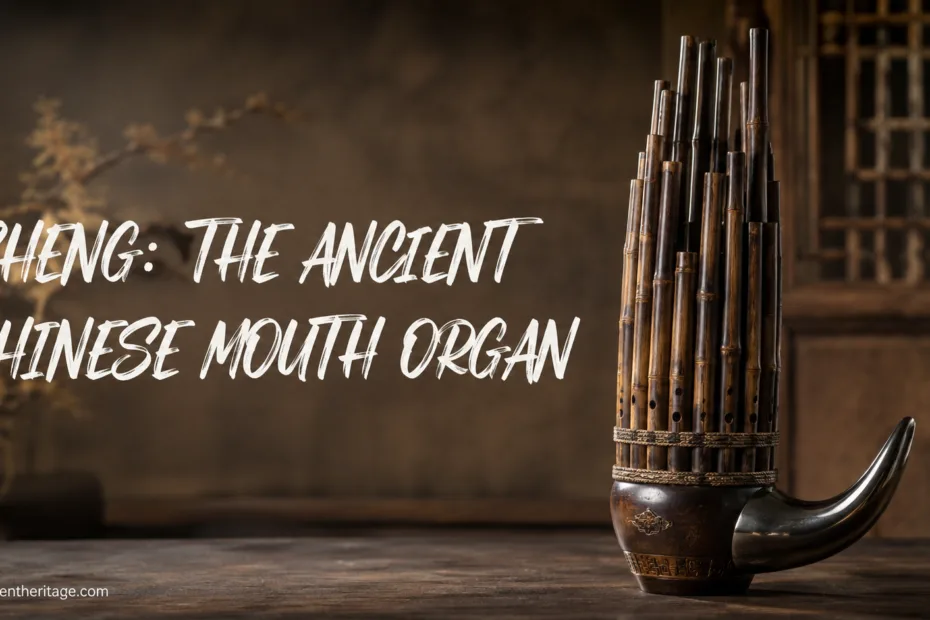
The sheng looks like a small forest of bamboo pipes rising from a bowl-shaped chamber. Pick it up, and it feels part flute, part organ, part handmade puzzle. Its sound is just as unusual: a glowing reed tone that can move in a single line or open into gentle harmony. That is why the sheng has such a special place in Chinese music. It does not only sing. It can breathe in chords.
Many wind instruments can shape a melody beautifully, but the sheng does something different. Because each pipe has its own free reed, the player can sound more than one note at the same time. A small hand movement changes the color. A breath changes the pressure. One instrument can feel like a tiny reed choir tucked inside a musician’s hands.
🎵 What Makes the Sheng Different?
The sheng is a mouth-blown free-reed instrument. That phrase can sound a little technical, but the idea is simple. A thin reed vibrates as air passes over it. The reed is not beaten like a drum or bowed like a string. It flutters inside the pipe, almost like a tiny metal tongue.
Each pipe has a finger hole. When the player covers that hole, the air pressure activates the reed and the pipe speaks. Leave the hole open, and that pipe stays quiet. This is the opposite of what many beginners expect, and it gives the sheng its own physical logic.
Small detail, big effect: the sheng can sound on both exhaled and inhaled breath. That means a skilled player can create long, smooth phrases without the obvious breathing breaks heard on many wind instruments.
The pipe cluster
The most recognizable part of the sheng is its pipe cluster. Traditional pipes are usually made from bamboo, set upright into a wind chamber. Older forms often used a gourd chamber; later instruments may use wood or metal. The pipes are not just decoration. Each one carries its own pitch, reed, tuning slot, and finger hole.
The layout is often linked with the shape of folded phoenix wings. That image appears in museum descriptions and instrument writing because the pipes spread upward in a graceful, wing-like curve. It is not a loud visual trick. It is quiet and elegant.
The wind chamber
The chamber is the sheng’s air hub. Blow into the mouthpiece, and the chamber distributes air to the pipes. Draw air back in, and the same reed system can still respond. On older instruments, the chamber may be rounded and organic, especially when made from gourd. On newer concert shengs, it may look cleaner, stronger, and more engineered.
Think of the chamber as a small harbor. The air arrives there first. Then it travels into whichever pipes the player opens through fingering. The whole system depends on balance: airtight joints, responsive reeds, and a chamber that does not leak away the breath.
🔊 The Sound: A Reed Choir in One Pair of Hands
The sheng has a clear, reedy voice. It can be soft and glowing in slow music, but it can also cut through an ensemble with a bright edge. The tone has a slightly nasal color, though not in an unpleasant way. More like a fine reed pen making a clean line on paper.
What makes the instrument feel almost magical is its ability to play several notes together. In older ensemble settings, the sheng often supports melody with simple harmonic tones, commonly fourths or fifths. In modern versions, especially larger chromatic shengs, the harmony can be much wider and more flexible.
Melodic voice
The sheng can play quick ornaments, smooth lines, and song-like phrases. Its tone stays focused even when the music moves fast.
Harmonic voice
Several pipes can sound together, giving the instrument a small-organ effect. This is one reason it feels so different from flutes, shawms, or single-reed pipes.
Why free reeds matter
A free reed vibrates through its own frame. It is not pressed against a mouthpiece like a clarinet reed, and it does not need a vibrating lip like a brass instrument. Because of this, the reed can respond to air moving in either direction. That is one reason the sheng can feel so smooth in the hands of a good player.
This free-reed idea later became central to instruments far beyond the sheng’s home tradition. The harmonica, accordion, concertina, harmonium, and reed-organ family all use related principles. The sheng did not simply stay in one corner of music history. Its reed idea traveled.
🎼 A Long History Without Dusty Museum Distance
The sheng is among the oldest known Chinese instruments still recognized by living players. Early sheng-like instruments appear in very old visual records, and surviving archaeological pieces show that the mouth-organ idea had deep roots. The Smithsonian’s National Museum of Asian Art records pieces of a mouth organ from the Warring States period, dated 475–221 BCE, made of wood and gourd.Reference-2✅
That age matters, but not because old automatically means better. It matters because the sheng’s basic idea stayed useful. A breath chamber. Pipes. Reeds. Fingers choosing notes. This design kept working across court settings, ritual music, regional music, opera accompaniment, and modern concert stages.
The sheng in the bayin system
Chinese instrument classification traditionally used the bayin, or “eight sounds,” grouping instruments by material. The sheng belonged to the gourd category because early wind chambers were made from gourd. Later materials changed, but the old classification kept a memory of the instrument’s older body.
This is one of those small historical details that makes the sheng feel alive. A modern player may hold a metal-chambered instrument, yet the older material story still sits behind the name and shape.
From courtly sound to modern ensemble
The sheng has been used in formal music, folk music, Chinese opera, and newer concert writing. In older settings, it often filled space between melodic instruments. It could thicken a line, soften an entrance, or add a gentle harmonic cushion. In modern Chinese orchestras, larger shengs can handle fuller chords and more chromatic writing.
So the instrument is not frozen in one period. A small traditional sheng and a large keyed chromatic sheng may share the same family name, yet they live in different musical rooms. One is intimate and hand-shaped. The other can stand inside a concert hall texture.
🛠️ Materials and Craft: Bamboo, Reeds, Wax, Breath
A sheng is not just assembled. It is balanced. The maker has to think about air, pitch, reed response, pipe length, sealing, and hand comfort. A tiny leak can weaken the tone. A reed set too stiff may speak slowly. A reed set too loose may sound unstable. The best instruments feel awake under the fingers.
| Part | Common material | Role in the instrument |
|---|---|---|
| Pipes | Bamboo, sometimes metal on modern types | Carry pitch, hold reeds, and shape the visual identity of the instrument. |
| Reeds | Metal, formerly also organic reed materials in older traditions | Vibrate to create the sound. Their response affects attack, tuning, and tone color. |
| Wind chamber | Gourd, wood, or metal | Collects and distributes air from the mouthpiece to the pipes. |
| Sealing materials | Wax, resin, lacquer, thread, or fitted joints | Help prevent air leaks and stabilize the pipes. |
| Mouthpiece | Wood, metal, or fitted chamber extension | Directs breath into the chamber and affects comfort during long playing. |
Bamboo pipes
Bamboo suits the sheng beautifully. It is light, strong, and naturally tubular. The pipe is not a passive tube, though. Its length, inner diameter, tuning slot, reed placement, and finger hole all matter. The player sees bamboo; the maker sees a series of tiny acoustic decisions.
Metal reeds
The reed is the small part that does the hard work. It must vibrate cleanly inside its frame. A well-set reed speaks without fuss. It starts quickly, keeps pitch, and lets the player move from single notes into chords without a heavy push of air.
On many shengs, reeds are protected inside the wind chamber area, which makes the instrument look simpler than it really is. The quiet machinery is hidden. That is part of its charm.
🪶 How the Sheng Is Played
The player holds the sheng close to the body, with the pipe cluster rising upward. The mouthpiece sits at the lips, and the fingers cover holes on selected pipes. The hands do not simply press keys; they shape breathing, fingering, and harmony at the same time.
Beginners often notice one surprise right away: covering a hole makes the note sound. That feels backward if you come from recorder or flute. After a while, it makes sense. The covered hole allows the reed-and-pipe system to respond to chamber pressure.
Basic playing actions
- Breathing: air may be blown out or drawn in, giving the sheng a smooth, almost circular feel.
- Fingering: the player covers pipe holes to activate selected reeds.
- Chords: several holes can be covered together, producing harmony.
- Ornaments: fast finger changes create turns, grace notes, and bright melodic movement.
- Balance: breath pressure must stay steady so reeds speak evenly.
Player’s feel: the sheng rewards relaxed breath. Push too hard and the tone can stiffen. Breathe with control, and the instrument opens like a lantern.
Traditional and modern technique
Traditional sheng playing often uses melody with small harmonic support. The instrument blends with bowed strings, plucked strings, flutes, and percussion. It can be modest, almost conversational.
Modern concert sheng technique can be much more demanding. Larger instruments may use keys, extended range, chromatic layouts, thicker chords, fast arpeggios, and contemporary effects. The sound is still sheng-like, but the musical grammar expands.
Where the Sheng Fits in Music
The sheng often works as a bridge instrument. It can sit between melody and harmony, between wind color and organ-like texture. In ensemble music, it may support a tune without taking attention away from it. In solo music, it can show off quick fingerwork, flexible breathing, and bright chordal flashes.
In Chinese opera and folk music
In opera accompaniment and folk settings, the sheng can add warmth and lift. It is not always the loudest voice, but it changes the room. A melody can feel thinner without it. Add the sheng, and the musical line gains a soft glow around the edges.
In the modern Chinese orchestra
Modern Chinese orchestras use several sheng types, including soprano, alto, tenor, and bass-range instruments in some settings. These larger versions help composers write fuller harmony. The instrument family can cover more range than a small hand sheng, and it can blend with bowed strings, plucked strings, winds, and percussion.
This newer role does not erase the older one. It adds another layer. A small traditional sheng feels close and personal; a modern concert sheng can feel architectural.
Types and Variants of Sheng
Not every sheng is built for the same music. Some are compact and mostly diatonic. Others are chromatic, keyed, and made for concert stages. The family is wider than many first-time listeners expect.
| Type | General build | Common use |
|---|---|---|
| Traditional sheng | Often 17 pipes, hand-covered holes, compact chamber | Folk music, opera accompaniment, traditional ensemble music |
| 21- or 24-pipe sheng | Expanded pipe count, wider pitch options | Ensemble and solo pieces needing more notes |
| Chromatic sheng | Built to include all semitones across a range | Modern repertoire, orchestra, arranged music |
| Keyed concert sheng | Uses key mechanisms and larger body designs | Concert stage, extended technique, large ensemble writing |
| Bass sheng | Larger pipes and lower range | Orchestral harmony and lower reed color |
Why pipe count changes the instrument
Pipe count affects range and harmony. A small sheng may be wonderfully direct, but it has fewer pitch choices. A larger chromatic sheng gives more notes and chord options, though it may feel less intimate in the hands. Neither version is “better” in a simple sense. They serve different musical jobs.
A folk player may prefer the response and touch of a smaller instrument. A contemporary soloist may need a wider range and chromatic notes. Instrument design follows musical need.
Similar Instruments and Close Relatives
The sheng sits inside a larger family of Asian mouth organs and free-reed instruments. Some relatives share the same basic breath-and-reed idea but use a different layout, tuning, or musical role. The relationship is easiest to hear when you listen for the reed tone: bright, steady, and alive under changing air pressure.
| Instrument | Region or tradition | How it relates to the sheng |
|---|---|---|
| Shō | Japan | Descended from the Chinese sheng and used in gagaku court music; its pipes are also linked with folded phoenix-wing symbolism.Reference-3✅ |
| Saenghwang | Korea | A Korean mouth organ related to the sheng family, known for a refined reed tone and courtly associations. |
| Khaen | Laos and nearby regional traditions | A bamboo mouth organ with free reeds, often arranged in long parallel pipes rather than the sheng’s compact cluster. |
| Harmonica | Western free-reed family | Uses free reeds and breath direction, though its body and playing layout are very different. |
| Accordion | Western free-reed family | Uses free reeds activated by bellows rather than the player’s mouth. |
Sheng and shō: close, but not the same
The Japanese shō is often compared with the sheng, and the connection is real. Yet their musical habits differ. The shō is strongly associated with sustained chord clusters in gagaku, while the Chinese sheng more often moves between melody and harmony. Same family. Different accent.
Sheng and khaen: two mouth-organ paths
The khaen has long bamboo pipes that pass through a wind chamber, creating a different shape and playing feel. The sheng’s pipes usually rise from the chamber in a compact group. Both use free reeds, but they look and behave differently in the player’s hands.
The Sheng as an Object of Craft
Museum examples show how much can be learned from the sheng as a physical object. A Qing dynasty sheng in The Metropolitan Museum of Art collection is listed with wood, metal, and ivory, and described as a free-reed mouth organ with bamboo pipes fitted into a bowl-shaped wind chamber.Reference-4✅
Look closely at such instruments and you notice that craft is not only about beauty. It is practical. The pipes must sit firmly. The chamber must hold air. The reeds must be protected but reachable for tuning and repair. The instrument has to survive breath moisture, handling, travel, and time.
Tuning and reed response
Free reeds are sensitive. A maker or repairer may adjust a reed’s shape, weight, or clearance to change response. The pipe itself also matters, especially its tuning slot and acoustic length. A sheng can look simple from the outside, but inside it is a careful conversation between metal and bamboo.
Good tuning does not only mean correct pitch. It also means that notes speak at similar breath pressure. If one reed needs much more air than the rest, chords become uneven. A well-made sheng lets the player think about music instead of fighting the instrument.
How to Listen to a Sheng
When hearing the sheng for the first time, listen for three layers: the reed tone, the chord color, and the breath flow. The reed tone is the bright line. The chord color is the soft shimmer around it. The breath flow is the reason phrases can feel so connected.
- Single-note passages show the instrument’s clean, singing side.
- Chords reveal its organ-like nature.
- Fast ornaments bring out the finger agility of the player.
- Long sustained tones make the breath technique easier to notice.
- Ensemble passages show how well the sheng can blend without disappearing.
It helps to compare the sheng with a harmonica for a moment, then forget the comparison. Yes, both use free reeds and breath. But the sheng’s vertical pipe body, chord logic, and long cultural use give it a very different personality.
Care, Handling, and Long Life
A sheng needs gentle handling. Bamboo can react to dryness and moisture. Reeds can shift. Seals can age. The chamber can suffer if it is knocked or left in harsh conditions. This is not a fragile museum-only object, but it is not a toy either.
Basic care habits
- Keep the instrument away from extreme heat, direct sun, and very dry storage.
- Let moisture clear after playing rather than sealing the instrument away immediately.
- Avoid forcing reeds or poking inside pipes without proper knowledge.
- Use a protective case, especially for travel.
- Have reed or tuning issues checked by someone familiar with free-reed instruments.
The sheng rewards patience. Its design is old, but the care is very practical: protect the reeds, respect the bamboo, and keep the air path clean.
Why the Sheng Still Feels Fresh
The sheng still catches modern ears because it solves a musical problem in a beautiful way. It lets a wind player create harmony without using bellows, keyboards, or multiple performers. That is a neat trick. More than that, it gives the music a tone color that feels both earthy and bright.
It also connects craft with breath. Bamboo, reed, chamber, lips, fingers. Nothing feels separate. The instrument only wakes when all of those parts agree.
For instrument lovers, the sheng is worth knowing because it changes how we think about wind instruments. A wind instrument does not have to be only a melody pipe. It can be a handheld organ. It can be a chord-maker. It can be a soft lantern of reeds.
Sheng FAQ
Is the sheng the same as a harmonica?
No. Both use free reeds and breath, but the sheng has upright pipes set into a wind chamber, while the harmonica places reeds inside a small rectangular body. The sheng can also play chordal textures in a very different way.
Can the sheng play more than one note at a time?
Yes. That is one of its best-known features. A player can cover several finger holes and sound several reeds together, creating harmony as well as melody.
What is a traditional sheng made from?
Traditional shengs commonly use bamboo pipes, metal reeds, and a wind chamber made from gourd, wood, or metal. Sealing materials such as wax, resin, or lacquer may also be used around joints.
Why does the sheng have so many pipes?
Each pipe is connected with a pitch and reed. More pipes give the player more note choices, wider range, and more harmonic options. Smaller shengs feel compact and direct; larger modern ones offer broader musical reach.
Is the sheng hard to learn?
The first challenge is getting used to its fingering logic and breath control. Covering a hole makes a note sound, which may feel unusual at first. Chord playing adds another layer, but the basic sound can be understood with patient practice.
What does the sheng sound like?
It has a bright, reedy, slightly nasal tone. Single notes can sound clear and singing, while chords create a small organ-like shimmer.
What instruments are related to the sheng?
Close relatives include the Japanese shō, Korean saenghwang, and Southeast Asian khaen. Western free-reed instruments such as the harmonica, accordion, concertina, and harmonium share a related reed principle, though their shapes and musical roles differ.
