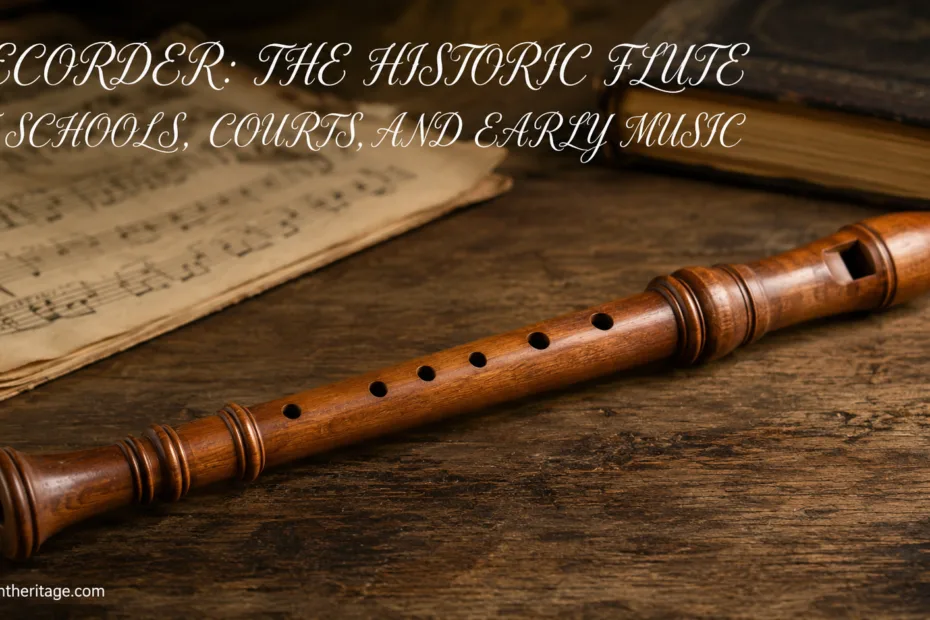
The recorder is one of those instruments people think they already know. A small plastic flute from school. A bright classroom sound. A tune learned before guitar chords or piano scales. Yet behind that familiar beak-shaped mouthpiece sits a much older story: a courtly woodwind, a consort instrument, a Baroque solo voice, and a living tool for early music players who care about breath, wood, tuning, and the small drama of a cleanly shaped note.
| Feature | Recorder Details |
|---|---|
| Instrument family | Woodwind aerophone, more precisely a duct flute or fipple flute |
| Playing position | Held vertically in front of the player, with the breath directed into a beak-shaped mouthpiece |
| Core structure | Whistle mouthpiece, windway, block, labium, seven front finger holes, and one rear thumb hole |
| Historic materials | Maple, boxwood, pearwood, plumwood, ebony, and other hardwoods; ivory appears in some historic luxury examples |
| Modern materials | Wood for serious playing; plastic resin for schools, beginners, and durable practice instruments |
| Main sizes | Sopranino, soprano, alto, tenor, bass, great bass, and contrabass |
| Peak historic use | Western European Renaissance consorts and Baroque solo/chamber music |
| Sound character | Clear, direct, reedy-sweet, with less volume than the modern concert flute but a very intimate tone |
| Best-known settings | Schools, early music ensembles, chamber music, folk-inspired projects, and historical performance |
🪈 What Makes a Recorder a Recorder?
A recorder is not just “a simple flute.” Its identity comes from a very specific sound-making system. The player blows into a narrow windway, where the air is shaped into a thin stream and sent against a sharp edge called the labium. That edge splits the air. The tube vibrates. A note appears.
That built-in air channel is why the recorder belongs to the duct flute family. Unlike the modern transverse flute, the player does not have to form a delicate sideways embouchure with the lips. The instrument does part of that work for you. Easy to start, yes. Easy to master? Not even close.
The classic recorder layout is easy to spot:
- Seven finger holes on the front
- One thumb hole on the back
- A beak-shaped mouthpiece
- A block, often made of cedar or another stable wood in handmade instruments
- A bore that may be cylindrical, conical, or historically somewhere between the two
That thumb hole matters. It helps the recorder jump into its upper register when the player “pinches” or half-opens it. This gives the recorder a range and agility that many simple whistles do not have. A good player can make it chatter, sing, sigh, or sparkle. The instrument is small, but it is not shallow.
The Name: “Recorder” Before Recording Machines
The word recorder can be confusing today because it sounds like a device that captures sound. The instrument is older than that meaning. Early English use is tied to the verb “record,” meaning to remember, repeat, or learn by heart. The Library of Congress notes that recorders were associated with soft indoor sound and the Italian name flauto dolce, meaning “sweet flute.” Reference-1✅
That older meaning feels right. The recorder has always had a close link with memory: songs learned by ear, dance tunes kept in the fingers, court music copied into partbooks, school melodies passed from one child to another. It remembers through breath.
From Medieval Pipes to Courtly Consorts
The recorder’s family tree grows out of older end-blown flutes and whistle flutes. By the late medieval period, the instrument had taken a recognizable European form. The Metropolitan Museum of Art describes the earliest surviving recorders as small wooden instruments from the fourteenth century, with written and visual evidence from the same period. Reference-2✅
In the Renaissance, the recorder found a natural home in consort playing. A consort is a matched family of instruments: small, middle, and low voices built to blend like a choir. Think of it as a wooden vocal group. One recorder carries the upper line, another supports the middle, a larger one gives warmth below. No single voice tries to dominate.
Renaissance recorders were often made from one piece of wood. Their bores were usually more cylindrical than later Baroque models, and their tone was broad, soft-edged, and blended. This was music for rooms, chambers, chapels, dances, and cultivated households. Not loud spaces. Not giant halls. The recorder liked walls close enough to return the sound gently.
Music theorists and writers such as Sebastian Virdung, Martin Agricola, Michael Praetorius, and Marin Mersenne gave us valuable descriptions of recorder families and their use. Their writings show an instrument with a serious place in musical life, not a toy waiting for a classroom.
The Renaissance Recorder: Blend Over Brilliance
A Renaissance recorder does not behave like the bright school soprano many people remember. Its sound is more like polished wood than glass. Warm, even, and rounded. It sits beautifully with viols, lutes, voices, and other soft instruments.
The range was smaller than the later Baroque recorder, but that was not a flaw. The instrument was built for balanced polyphony, where each line matters and no part shouts. The music often moved in woven strands: a phrase enters in one part, then another answers it, then the lower voice leans in. A recorder consort can make that texture feel almost physical, like threads crossing under the fingers.
Renaissance makers also cared about matching. A set of recorders from one maker could share a tone color and tuning logic. This mattered because ensemble playing depends on trust. If the tenor sags sharp or the alto speaks late, the whole texture feels crooked. Matched consorts were practical, not just pretty.
The Baroque Recorder: Three Joints, More Fire
During the later seventeenth century, the recorder changed shape. The familiar three-part body — head joint, middle joint, foot joint — became common. The bore became more tapered. Decorative turnings appeared around the joints. The sound gained focus in the upper register.
This is the Baroque recorder many early music players love today: agile, clear, and capable of quick ornaments. It can dance through a Telemann fantasia, speak tenderly in a slow Handel movement, or cut through a small chamber group with a bright upper note. The alto recorder in F became the main solo recorder of the Baroque period, especially in sonatas, concertos, trio sonatas, cantatas, and chamber works.
Britannica notes early instruction books by Sebastian Virdung in 1511 and Silvestro Ganassi in 1535, and describes the Baroque repertory as centered largely on the treble recorder, then often called flute or common flute. Reference-3✅
That older naming can trip people up. In many Baroque scores, “flute” may mean recorder, not the modern metal flute. Context matters. So does pitch. So does the composer. Early music is full of these little traps, and they are part of the fun.
Materials, Bore, and Craft
A recorder looks plain until you understand how unforgiving it is to make. The outside shape can be elegant, but the real story is inside: the windway, block, bore, and tone-hole undercutting. Tiny changes alter the response. A breath channel that is slightly too open can make the tone airy. A labium cut too bluntly may slow the attack. A bore that narrows in the wrong place can make certain notes stubborn.
Traditional wooden recorders use woods chosen for stability, density, and tone. Common choices include boxwood, maple, pearwood, plumwood, olivewood, rosewood, and grenadilla. Softer fruitwoods can give a mellow response. Dense tropical hardwoods often add edge and carrying power. Boxwood has long been admired for its balance: firm, fine-grained, and friendly to detailed turning.
Modern school recorders are usually plastic resin. That sounds less romantic, but it has real value. Plastic recorders are stable, washable, affordable, and less likely to crack. They also helped put the instrument into millions of hands. Access matters.
Old material note: Some historic luxury recorders used ivory or ivory decoration. Modern players and makers generally use legal, sustainable alternatives and historic-style substitutes when a pale decorative look is desired.
How the Recorder Produces Its Voice
The recorder’s sound begins with a simple idea: air meets an edge. Yet the result is surprisingly sensitive. Blow too hard and the note can sharpen or squeak. Blow too softly and it may sag or fail to speak. A recorder rewards calm breath. Not weak breath. Steady breath.
The labium acts a bit like the lip plate of a flute, except the recorder fixes the air stream for you. The player shapes tone mostly through breath speed, finger coverage, articulation, and subtle changes in the mouth. The tongue starts notes with syllables such as tu, du, ru, or double-tongued patterns for fast passages.
Good recorder tone has a living center. It is not meant to be pushed like a trumpet. It should feel more like a clear line drawn with ink: direct, flexible, and easy to bend if the hand is skilled. The best players make the instrument breathe like a singer.
Why Recorders Squeak
The famous recorder squeak is usually not a curse. It comes from ordinary causes:
- A finger hole is not fully covered.
- The thumb hole is opened too much in the upper register.
- The player blows harder than the note needs.
- Condensation collects in the windway.
- The instrument is poorly voiced or damaged.
Once those problems are handled, the recorder becomes far less unruly. The instrument is honest. Sometimes brutally honest.
The Recorder Family: Small Voices, Deep Voices
The recorder is not one instrument but a family. The small ones speak like birds. The larger ones hum with a wooden chest voice. A full recorder ensemble can cover a wide pitch range, with each size bringing its own color.
| Recorder Size | Usual Pitch | Sound Character | Common Use |
|---|---|---|---|
| Sopranino | F | Bright and high | Color lines, bird-like effects, upper consort parts |
| Soprano / Descant | C | Clear, light, direct | Schools, beginners, simple melodies, consort top lines |
| Alto / Treble | F | Balanced and expressive | Main Baroque solo recorder; chamber music |
| Tenor | C | Warm and vocal | Consort middle lines, lyrical melodies |
| Bass | F | Round, mellow, grounded | Lower consort parts and ensemble foundation |
| Great Bass / Contrabass | C or F, depending on type | Soft, deep, breathy-wooden | Large recorder orchestras and low ensemble support |
The soprano is famous because of school music. The alto is famous among Baroque players. The tenor often wins hearts quietly because it feels close to the human voice. The bass recorders are special beasts: slower to speak, more expensive, and deeply satisfying when they lock into an ensemble.
Why the Recorder Became a School Instrument
The recorder entered schools for practical reasons. It is small. It is affordable. It teaches breath, rhythm, pitch, fingering, and ensemble listening without needing reeds, strings, tuning pegs, or large storage space. A class set fits in a box. That matters in real classrooms.
The recorder also gives children a quick first taste of melody. A student can play a recognizable tune with only a few notes. That early success is powerful. Music becomes something the hand can do, not just something heard from a speaker.
Still, the school recorder has a reputation problem. Many people remember shrill notes and uneven classroom sound. That says more about beginner breath and group noise than about the instrument itself. A well-made soprano recorder, played softly with covered holes, can sound clean and charming. A fine wooden alto can sound graceful enough for Bach. Same family. Very different manners.
The school recorder’s real gift
It turns music into something physical and shared. Finger holes, breath, listening, waiting for a cue, matching a line with others — these are not small lessons. They are the roots of ensemble playing.
The Recorder in Early Music Today
For early music players, the recorder is not a nostalgic classroom object. It is a serious historical voice. Modern performers use copies of Renaissance and Baroque instruments, often tuned for older pitch standards such as A=415 for Baroque music or other pitches for Renaissance consorts. The goal is not costume drama. It is sound logic.
A Baroque alto recorder speaks differently from a modern concert flute. It has a smaller dynamic range, but its articulation can be astonishingly alive. Fast notes flicker. Ornamented lines bloom. In a small room, with harpsichord or theorbo underneath, the recorder can feel close enough to touch.
Yamaha’s instrument guide places the recorder’s European birth in the Middle Ages, notes its strong activity from the fifteenth to seventeenth centuries, and describes its later pressure from the transverse flute before the twentieth-century revival. Reference-4✅
Names tied to the recorder revival include Arnold Dolmetsch and, later, Frans Brüggen. Their work helped move the recorder away from novelty status and back into serious performance. Today, recorder players explore medieval music, Renaissance consorts, Baroque sonatas, contemporary pieces, improvisation, folk traditions, and new chamber music. The instrument keeps changing without losing its old bones.
Music Written for the Recorder
The recorder’s repertory is wider than many expect. It includes dance tunes, consort music, divisions, sonatas, concertos, cantata parts, theatre music, and modern works. Some pieces are modest and charming. Others are technically fierce.
Important names often connected with recorder music include Jacob van Eyck, Georg Philipp Telemann, Antonio Vivaldi, George Frideric Handel, Johann Sebastian Bach, Henry Purcell, and Benedetto Marcello. Van Eyck’s music for solo soprano recorder is especially loved because it turns familiar tunes into spinning variations. It feels almost improvised, like someone walking through a melody and finding new doors in it.
Baroque recorder music often uses basso continuo, where a bass line and chordal instrument support the soloist. Harpsichord, organ, lute, theorbo, cello, or viol may take part. The recorder floats above, but it does not float alone. It talks with the bass.
Similar Instruments and Easy Mix-Ups
The recorder belongs to a large family of end-blown and duct flutes. Some relatives look close. Others only share the same basic air principle. Knowing the difference helps, especially when reading old scores, museum labels, or instrument listings.
| Instrument | Shared Trait | Main Difference | Typical Sound Feel |
|---|---|---|---|
| Tin whistle | Duct flute with a fixed windway | Usually six finger holes and no rear thumb hole | Bright, direct, folk-centered |
| Flageolet | Historic duct flute relation | Different hole systems and playing traditions | Light, agile, often delicate |
| Traverso | Historic flute used in Baroque music | Side-blown, no fipple mouthpiece | Breathy, shaded, flexible |
| Modern concert flute | Member of the flute family | Metal, side-blown, keyed, much greater projection | Brilliant, wide-ranging, orchestral |
| Ocarina | Breath-based vessel flute | Enclosed chamber instead of a long tube | Soft, rounded, compact |
| Pipe and tabor pipe | End-blown flute tradition | Often played one-handed with drum accompaniment | Sharp, rhythmic, dance-friendly |
The thumb hole is one of the recorder’s clearest markers. So is its historical role in consorts and Baroque chamber music. A whistle can be lovely. A recorder can whistle. But they are not the same creature.
Care, Tuning, and the Feel of a Good Instrument
A recorder is sensitive because it lives where breath meets material. Moisture collects in the windway. Wooden bodies react to humidity. Joints need gentle handling. Even plastic instruments benefit from being kept clean and dry.
Wooden recorders need a slower start. New instruments are often played in gradually so the wood can adjust to moisture and vibration. Many players oil certain wooden recorders according to the maker’s instructions. Not all woods need the same care, and not every instrument should be treated the same way. The maker’s guidance matters.
Tuning on a recorder is a living negotiation. The player can adjust slightly by moving the head joint, changing breath pressure, shading holes, and listening closely. But the recorder is not a machine that fixes everything for you. It asks for attention. A good one feels responsive under the fingers and honest under the ear. The note should speak without a fight.
Why the Recorder Still Matters
The recorder survives because it sits in rare territory. It is simple enough for a child’s first tune and deep enough for a lifetime of study. It can cost very little, yet handmade examples are objects of refined craft. It belongs in schools, but also in museums, chapel music, Baroque ensembles, contemporary concerts, and quiet rooms where someone wants to hear a melody without electricity.
Its voice is not huge. That is part of its charm. The recorder does not flatten a room with sound; it invites the room to come closer. Small sound can still carry weight.
Perhaps that is why the recorder keeps returning. It teaches breath without drama. It turns wood and air into line. It reminds players that music does not always need force to feel alive.
Recorder FAQ
Is the recorder the same as a flute?
The recorder is part of the flute family, but it is not the same as the modern concert flute. A recorder is a duct flute with a fixed windway and a beak-shaped mouthpiece. A modern concert flute is side-blown and uses keys.
Why is it called a recorder?
The name is linked to older meanings of “record,” connected with remembering, repeating, or learning by heart. The name came long before sound-recording machines.
Which recorder is best known in schools?
The soprano recorder, also called the descant recorder in some places, is the common school instrument. It is small, affordable, and easy for beginners to hold.
Which recorder is most used in Baroque music?
The alto recorder in F is the main recorder for much Baroque solo and chamber music. It has a warmer, more flexible voice than the small soprano recorder.
Are wooden recorders better than plastic recorders?
Wooden recorders often offer richer color and finer response, especially in handmade instruments. Plastic recorders are durable, stable, and useful for schools or travel. A well-designed plastic recorder can be much better than a poorly made wooden one.
Why does a recorder squeak?
Squeaks usually come from uncovered holes, too much breath pressure, an unstable thumb opening, or moisture in the windway. Careful fingering and gentler breath solve many problems.
Can the recorder play serious music?
Yes. The recorder has music by major Baroque composers, a large Renaissance consort tradition, and a growing modern repertory. It is a beginner-friendly instrument, but it is not only a beginner instrument.
What is the difference between a recorder and a tin whistle?
Both are duct flutes, but the recorder usually has seven front holes and a rear thumb hole. The tin whistle usually has six holes and no thumb hole. Their traditions, fingering systems, and tone colors are also different.
