
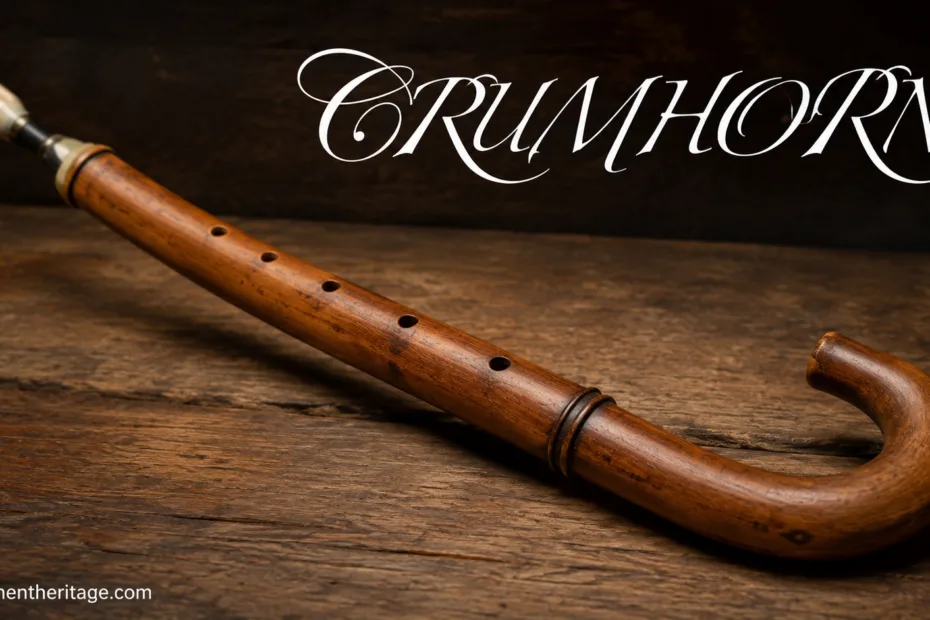
| Instrument detail | Crumhorn information |
|---|---|
| Instrument family | Woodwind; a capped double-reed instrument used mainly in Renaissance music. |
| Name origin | Linked to German Krummhorn, meaning “bent horn,” a plain nod to its curved lower body. |
| Main period of use | Most closely tied to the 15th to mid-17th century, with a later revival among early music players.Reference-1✅ |
| Typical material | Wooden body, often associated with boxwood in historical descriptions; cane double reed, wooden windcap, and sometimes brass keywork. |
| Shape | A straight fingered pipe ending in a curved, upward turn; the curve looks dramatic but does not work like a horn bell. |
| Sound | Buzzing, reedy, nasal, warm-edged; softer than a shawm, firmer than a recorder. |
| Range | Usually around a ninth, so crumhorns were often played in families rather than as lone melody instruments. |
| Playing method | The player blows into a windcap; the lips do not touch the reed, so tone control comes mostly from breath, fingering, and reed setup. |
| Common sizes | Soprano, alto, tenor, bass, and great bass; some modern makers add extra keys for comfort and range. |
| Closest relatives | Cornamuse, kortholt, rauschpfeife, shawm, recorder, bagpipe chanter, and capped reed organ stops. |
The crumhorn is one of those Renaissance instruments that seems to have wandered out of a woodcarver’s dream: a slim wooden pipe, a little cap at the top, and a curved foot that turns upward like the end of a walking stick. Then it speaks. Not with the smooth silver line of a flute, and not with the bright bite of a modern oboe. A crumhorn has a softly buzzing reed voice, earthy and compact, almost like a tiny bagpipe chanter tucked inside a polished wooden shell.
It is a simple-looking instrument, but not a plain one. The crumhorn sits at a lovely meeting point: woodcraft, reed-making, Renaissance dance music, consort playing, and the patient hands of instrument makers who understood that a small bore and a tiny reed could still fill a room with character.
What a Crumhorn Really Is
A crumhorn is a double-reed woodwind, but the reed is hidden inside a small chamber called a windcap. That one detail changes almost everything about the way the instrument feels. On an oboe, shawm, or bassoon, the player’s lips touch the reed and shape the tone directly. On a crumhorn, the player blows into the cap and lets the reed vibrate inside.
That makes the crumhorn friendlier in one sense. You do not need the embouchure of an oboist to get a sound. Blow, and the reed answers. Yet it also means the player has less fine control over color and volume. The sound is honest. It does not bend itself into many masks.
The body is usually a cylindrical bore pipe with finger holes, much like a recorder in hand position. The lower end bends upward, giving the instrument its name and its instantly recognizable silhouette. The curve is visually charming, but the main voice comes from the bore, reed, windcap, and finger holes.
- Double reed: two thin blades of cane vibrate against each other.
- Windcap: a protective cap surrounds the reed and receives the player’s breath.
- Cylindrical bore: the inside tube stays fairly even in width, helping create the crumhorn’s compact tone.
- Finger holes: the player changes pitch by opening and closing holes.
- Curved foot: the visual feature that gives the instrument its “bent horn” identity.
🎶 A crumhorn is often easy to start but not always easy to play beautifully. Clean tuning, smooth finger changes, and a steady breath matter more than force.
The Crumhorn Sound: Buzz, Reed, and Warm Nasal Color
The first thing people notice is the buzz. A crumhorn has a reedy edge that can feel playful, rustic, or courtly depending on the music around it. It is not a huge outdoor instrument like a shawm. It does not roar. Its tone sits closer to a chamber sound: firm, nasal, and rounded at the edges.
Think of a recorder that swallowed a small reed engine. That is not a perfect comparison, but it gets near the feeling. The fingers may remind you of old duct flutes, while the tone reminds you that this is still a reed instrument with a small, lively heart beating under the cap.
Why the tone sounds so contained
The reed sits inside a cap, so the player cannot shape it with the lips. This gives the crumhorn a stable and slightly boxed-in sound. Boxed-in is not a weakness here. It is part of the charm. The voice has edges, but they are held in place, like candlelight behind horn windows.
Because the bore is cylindrical, the instrument does not behave like a loud conical shawm. The sound stays compact. In a consort, several crumhorns can stack into a warm, buzzing chord that feels less like a choir of modern woodwinds and more like carved wood humming together.
Range and musical limits
Most crumhorns have a limited compass, often around a ninth. That is just a little more than an octave. This is why Renaissance players used several sizes together. A soprano alone can be charming, but a full consort gives the music its body: treble line, inner parts, bass floor.
Some larger instruments include a key for the lowest hole. Museum descriptions of historical sets note seven finger holes, a thumb hole, and bass keys used for low notes.Reference-2✅ The small range may sound restrictive to a modern player, yet it suits much Renaissance music, where lines often move in clear steps, neat turns, and dance-like phrases.
| Instrument | Reed or mouthpiece | Sound character | Best-known role |
|---|---|---|---|
| Crumhorn | Capped double reed | Buzzing, nasal, compact, steady | Indoor consorts, dances, early music ensembles |
| Shawm | Exposed double reed | Bright, projecting, open-throated | Outdoor bands and strong ceremonial sound |
| Cornamuse | Capped reed | Gentler and more covered than many reed pipes | Soft Renaissance reed color |
| Kortholt | Capped reed | Lower-sounding than its small body suggests | Consort texture with compact bass color |
| Recorder | Duct flute | Clear, breathy, flute-like | Melody, consort, teaching, chamber music |
A Short History Without the Dust
The crumhorn belongs to the late medieval and Renaissance soundscape of Europe. It was especially at home in the 16th century, when instrument families were often built like vocal choirs: soprano, alto, tenor, bass, sometimes great bass. Instead of one instrument trying to do everything, a family of related instruments shared the work.
That family idea matters. Renaissance music loved blended lines. A group of crumhorns could play dance tunes, secular songs, part-music, and arrangements that also worked for recorders, viols, shawms, or voices. The crumhorn’s capped reed gave it a special seat in that mix: reed color without the full bite of an open reed.
Praetorius and the written memory of the instrument
One of the names that keeps returning in crumhorn history is Michael Praetorius, the German composer and music theorist whose Syntagma musicum preserved a huge amount of early 17th-century instrument knowledge. The second volume, De Organographia, was printed in Wolfenbüttel in 1619, with the related instrument plates published in 1620.Reference-3✅
Praetorius is not useful because he makes the crumhorn feel remote. He does the opposite. He helps us see that instruments were practical things: grouped by size, tuned for use, chosen for color, and understood by working musicians. The crumhorn was not a museum oddity then. It was part of a living toolkit.
Survival, copies, and the early music revival
Original crumhorns are rare. Many instruments played today are modern copies, shaped by surviving examples, old descriptions, and the hands-on work of makers. The Bate Collection in Oxford notes a crumhorn often regarded as the oldest in Britain, thought to date from about 1600, made in two lengthwise halves and covered in leather.Reference-4✅
The 20th-century early music revival brought the crumhorn back onto stages, recordings, workshops, and university collections. It found new friends among recorder players, historical wind players, folk musicians, and listeners who enjoy instruments with personality. A crumhorn does not pretend to be sleek. It has elbows.
🎵 Why the crumhorn fits Renaissance music so well
Renaissance part music often favors clear melodic lines, balanced ranges, and blended families of sound. The crumhorn’s limited range, steady tone, and consort-friendly tuning make sense in that setting. It is not trying to be a solo acrobat. It likes company.
How a Crumhorn Is Made
A crumhorn may look like a bent stick with holes, but its making is fussy work. The bore must be clean. The finger holes must sit in the right places. The windcap must hold the reed safely without choking it. And the reed itself? That tiny piece of cane can decide whether the instrument sings, grumbles, or refuses to behave.
The wooden body
Historical descriptions often connect crumhorns with boxwood, a dense, fine-grained wood long loved by woodwind makers. Boxwood turns well on a lathe, holds detail, and gives a smooth surface for precise finger holes. Modern makers may use other suitable hardwoods, depending on stability, availability, and tonal preference.
The body is usually drilled as a cylindrical tube. In some construction methods, the instrument may be made from two halves and joined, especially when the curved lower section makes drilling harder. Leather covering, decorative rings, brass keys, and protective fittings may appear depending on size and model.
The windcap
The windcap is the crumhorn’s little roof. It covers the double reed and includes a blowing slot or hole. The player blows into this cap, not directly onto the reed. That is why the crumhorn is called a capped reed instrument.
A well-made windcap must do several jobs at once:
- Protect the reed from lips, teeth, and handling.
- Allow air to reach the reed evenly.
- Leave enough room for the reed blades to vibrate.
- Fit securely without leaks.
- Keep the playing feel stable across repeated use.
The reed: the small part with the loud opinion
The reed is usually made from cane, shaped into two blades tied onto a small staple or tube. Because the player cannot adjust it with the lips while playing, the reed must be set carefully before performance. Too open, and the instrument can feel heavy. Too closed, and the tone may thin out or stall.
Reed work is one reason crumhorn playing still feels like craft, not just technique. A player may check the reed opening, scrape lightly, adjust moisture, or swap reeds for tuning. The reed is small, but it has a stubborn little personality.
Finger holes and keys
Most crumhorns use front finger holes and a thumb hole. Larger crumhorns may need a key for the lowest tone, because the player’s finger cannot comfortably reach the final hole. This is common in Renaissance wind families: once the instrument grows, human hands ask for help.
Modern crumhorns sometimes add extra keys to improve chromatic notes or extend the range. Purists may prefer simpler historical layouts, while practical players may enjoy a little help. Both approaches can serve the music when the instrument is made with care.
| Part | Material or form | What it does | What the player notices |
|---|---|---|---|
| Windcap | Wooden cap with blowing opening | Encloses and protects the reed | Easy sound start, less lip control |
| Double reed | Cane blades tied together | Creates vibration and tone | Breath response, tuning, tone color |
| Body | Usually hardwood with cylindrical bore | Shapes pitch and resonance | Stable, compact reed tone |
| Finger holes | Drilled into the pipe | Control scale notes | Recorder-like hand feel |
| Lower curve | Curved wooden foot | Gives the instrument its shape | Visual identity more than tonal force |
| Bass key | Metal key on larger sizes | Closes hard-to-reach low hole | Better access to low notes |
What It Feels Like to Play
For a recorder player, the crumhorn may feel familiar in the fingers but strange in the breath. For an oboist, it may feel familiar in reed energy but strange because the mouth cannot touch the reed. The crumhorn sits between worlds.
The breath must be steady. Not huge. Just steady. A shaky air stream can make the reed wobble or speak unevenly, while too much pressure can push tuning sharp or make the sound coarse. The instrument rewards a calm body and clear finger work.
Articulation
Since the reed is hidden in the cap, articulation happens mostly through the tongue and air stream. Short dance notes can sound lively. Longer notes need support so they do not sag. The best crumhorn playing often has a gentle bounce, like footsteps on a wooden floor.
Fingering and tuning
Basic fingerings can feel straightforward, but chromatic notes often use cross-fingerings. These are finger patterns that partly cover the bore in less direct ways. They work, but each instrument has its own habits. One alto may prefer a slightly different touch than another.
That is part of the pleasure. Historical-style instruments rarely behave like factory-perfect plastic tools. They have grain, breath, tiny unevenness, and a voice that asks the player to listen back.
🪵 The crumhorn is not a loudness contest. Its best color appears when the reed, bore, fingers, and breath settle into the same small pocket of sound.
Crumhorn Sizes and the Consort Sound
Crumhorns were built in families, just like recorders and viols. This matters because the instrument’s range is modest. A full consort lets the music breathe across registers: soprano carries bright lines, alto fills the middle, tenor gives warmth, bass adds weight, and great bass brings that low wooden buzz that makes listeners smile before they know why.
| Crumhorn size | Typical register | Musical role | Player experience |
|---|---|---|---|
| Soprano | High | Melody lines, dance tunes, upper consort part | Bright response, nimble fingers |
| Alto | Upper-middle | Inner part or tune carrier | Balanced feel and useful range |
| Tenor | Middle-low | Warm inner line, harmonic support | Comfortable but needs steady air |
| Bass | Low | Foundation part | May use keys; slower, weightier response |
| Great bass | Very low | Deep consort floor | Physical, breath-led, wonderfully woody |
The consort sound is where the crumhorn becomes more than a curiosity. One crumhorn can be amusing. Four or five can be beautifully strange. Their tones lock together like pieces in a small carved box, each one buzzing with its own line but blending into a shared reed color.
Music, Repertoire, and Where the Crumhorn Fits
The crumhorn fits naturally into Renaissance dances, part songs, consort pieces, and arrangements of vocal music. It can play cheerful branles, pavans, galliards, hymn-like settings, and simple contrapuntal lines. Because of its range, the music often needs to be chosen or arranged with care.
It is not the instrument for long chromatic fireworks. It prefers clear shapes. A good crumhorn line sits under the fingers with a satisfying plainness: step, turn, small leap, held note, answer. When the rhythm has lift, the crumhorn comes alive.
Indoor color, outdoor cousins
Compared with the shawm, the crumhorn is more contained. Compared with the recorder, it has more reed grain. Compared with the cornamuse, it can feel a little firmer and more nasal. These differences helped Renaissance musicians choose color the way painters choose pigments.
A crumhorn consort can support singers, join recorders, or stand on its own. In modern early music groups, it often appears when the program wants a Renaissance reed color that is vivid but not overpowering.
Similar Instruments and Common Name Confusions
The crumhorn is easy to confuse with other old reed instruments, especially because historical names drift between languages. Spelling also varies: crumhorn, krummhorn, krumhorn, and related forms all appear. The basic idea stays the same: a bent, capped, double-reed woodwind.
Crumhorn and cromorne
The word cromorne can be tricky. In some contexts it points to a French reed stop or a different historical woodwind identity, not simply the same instrument under a French hat. For readers and players, the safest path is to look at the construction: capped reed, cylindrical pipe, curved lower end. If those are present, you are likely dealing with the crumhorn family.
Crumhorn and bagpipe chanter
The crumhorn’s capped reed setup has a family resemblance to the reed chamber of a bagpipe chanter. In both cases, air drives a reed that the lips do not touch. The difference is that a bagpipe uses a bag as an air reservoir, while the crumhorn depends directly on the player’s breath through the windcap.
Crumhorn and rauschpfeife
The rauschpfeife is another capped reed instrument, but it has a stronger outdoor personality because of its conical bore and louder projection. The crumhorn is more compact and chamber-friendly. One is a lantern. The other is a torch.
🎼 Instruments close to the crumhorn
- Cornamuse
- Kortholt
- Rauschpfeife
- Shawm
- Recorder
- Bagpipe chanter
🧰 Words often linked with it
- Capped reed
- Double reed
- Windcap
- Consort
- Cylindrical bore
- Renaissance woodwind
Why Makers Still Build Crumhorns
Modern crumhorn making is part research, part woodworking, part reed craft, and part musical stubbornness. The maker must respect old evidence while also building an instrument that modern players can tune, maintain, and perform. That balance is delicate.
A maker may ask: should the bore follow a surviving model closely? Should the reed be easy for beginners? Should extra keys be added? Should the instrument be tuned to modern pitch, historical pitch, or a flexible compromise? None of these questions has one tidy answer.
The best modern crumhorns keep the reed-capped character intact while making the instrument playable enough for real music. A crumhorn that only looks old is not enough. It must breathe.
Materials in modern instruments
Modern makers may use boxwood, maple, pearwood, plum, or other stable hardwoods. The choice affects weight, feel, durability, and sometimes tone. The reed remains the most sensitive part, while the windcap and bore geometry shape how that reed energy turns into pitch.
Some instruments are built for historical pitch standards used by early music ensembles. Others are made for modern pitch so they can play more easily with recorders, viols, keyboards, and singers. Small choices matter. A millimeter can be a mood.
Care, Reed Behavior, and Tuning Habits
A crumhorn needs gentle care. It is wood, reed, and air. That means moisture, temperature, and handling all matter. The instrument should be warmed gradually, dried after use, and stored where the wood will not swing wildly between dry and damp.
- Reeds need moisture, but soaking too much can make them unstable.
- Wood needs rest after playing, especially in long sessions.
- Keys need light movement, not force.
- Windcaps should fit cleanly so air does not leak around the reed chamber.
- Finger holes should stay clean, since small changes can affect response.
Tuning usually depends on reed setup, breath pressure, and instrument temperature. The crumhorn does not invite constant pitch bending in the way some modern winds do. A player learns where the instrument wants to sit and works with it. That is a different kind of musicianship: less pushing, more listening.
- Best storage habit
- Keep the instrument dry, supported, and away from sudden heat or cold.
- Most sensitive part
- The cane reed, especially its opening, scrape, and moisture level.
- Most common playing challenge
- Keeping a steady tone and tuning without direct lip contact on the reed.
- Most satisfying musical setting
- A small consort where the crumhorn’s woody reed color can blend with related parts.
How to Listen to a Crumhorn
When listening to a crumhorn, do not wait for modern polish. Listen for grain. Listen for the way the note begins with a tiny reed bite, then settles into a warm buzz. Listen to the inner parts of a consort, where the alto and tenor crumhorns often do the quiet glue work.
The bass crumhorn is worth special attention. Its low notes can sound like a friendly wooden animal clearing its throat. Not elegant in the modern orchestral sense. Better than that: alive, textured, and unmistakably handmade.
In mixed ensembles, the crumhorn pairs well with recorders, viols, frame drums, small percussion, voices, and other early winds. It adds reed color without covering everything around it. That is one reason it still appears in Renaissance fairs, early music festivals, workshops, and historical recordings.
Why This Bent Reed Pipe Still Holds Attention
The crumhorn reminds us that musical beauty is not only smoothness. Some instruments charm us because they keep a little rough edge. The crumhorn buzzes, bends upward at the foot, and speaks through a hidden reed. It is practical, odd, and wonderfully direct.
It also shows how Renaissance makers thought in families of sound. They did not only build solo instruments; they built musical communities out of wood, cane, brass, leather, and breath. The crumhorn consort is a small wooden choir with a reed in every throat.
For modern listeners, the crumhorn offers a clean path into early music culture. You can hear material. You can hear craft. You can hear an older idea of ensemble playing, where the pleasure comes from shared color rather than spotlight display.
Crumhorn FAQ
Is the crumhorn a reed instrument?
Yes. The crumhorn is a double-reed instrument, but the reed is enclosed inside a windcap. The player blows into the cap rather than placing the reed between the lips.
Why is the crumhorn curved?
The curved lower end gives the instrument its name and visual identity. The name is linked to words meaning bent or crooked horn. The curve is not what creates the reed tone; the bore, reed, and windcap do that work.
Is a crumhorn hard to play?
It is often easy to make a first sound, because the reed is capped. Playing it well takes care. The player must manage breath pressure, tuning, cross-fingerings, and reed behavior without touching the reed directly.
What does a crumhorn sound like?
A crumhorn sounds buzzy, nasal, reedy, and compact. It is softer than many outdoor Renaissance reeds, yet it has more grain than a recorder. In a group, several crumhorns create a warm wooden buzz.
What music is played on crumhorns?
Crumhorns are often used for Renaissance dances, consort music, part songs, and arrangements of vocal pieces. Their range is limited, so music is usually chosen or arranged for a family of sizes.
What is a crumhorn consort?
A crumhorn consort is a group of crumhorns in different sizes, such as soprano, alto, tenor, bass, and great bass. Together they cover more range than one crumhorn can manage alone.
Is the crumhorn the same as a shawm?
No. Both are reed instruments, but the shawm usually has an exposed reed and a louder, more projecting tone. The crumhorn has a capped reed and a more contained chamber sound.
Are crumhorns still made today?
Yes. Modern makers build crumhorns for early music ensembles, workshops, collectors, and players who enjoy historical woodwinds. Some models follow older designs closely, while others add small practical changes such as extra keys.
