
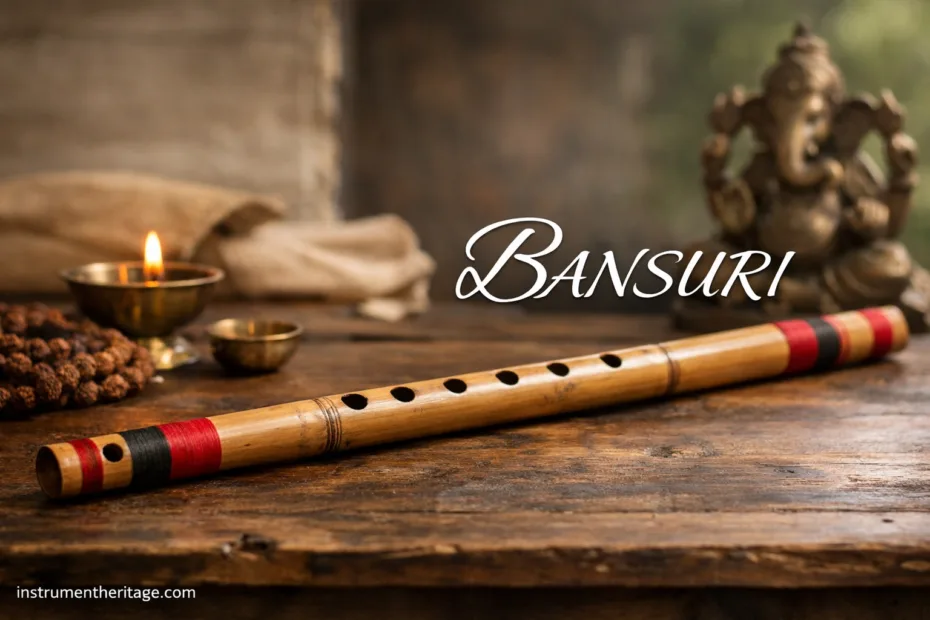
| Aspect | Details |
|---|---|
| Instrument family | An edge-blown, side-played bamboo flute used most closely with Hindustani classical music, while still living comfortably in folk, devotional, studio, and crossover settings. |
| Core material | Usually a single length of seasoned bamboo, chosen for a clean bore, stable walls, and a node pattern that does not fight the tuning. |
| Hole layout | Most instruments use six finger holes; many concert flutes use seven. A blowhole sits near the top, and makers often add thread wrappings to reduce splitting. |
| Pitch logic | Players often treat one bansuri as one home pitch, then switch to a longer or shorter flute when the tonic changes. That is why serious players usually own a set, not just one. |
| Tone | Low notes feel woody and rounded, the middle register sings, and the upper register can turn bright and piercing without losing that soft bamboo grain. |
| Playing language | The bansuri shines in meend (glides), murki (quick turns), delicate pitch shading, and a very voice-like line that sits beautifully inside a raga. |
| Historical arc | For a long time it was heard mainly as a pastoral and folk flute. In the 20th century, artists such as Pannalal Ghosh pushed it onto the concert stage in a new way. |
| Closest relatives | The south Indian venu, the Chinese dizi, and the Japanese shakuhachi all sit nearby in the flute family, but they do not speak with the same attack, tuning habits, or ornament style. |
The bansuri looks disarmingly simple. A piece of bamboo. A few holes. Breath. That is the whole picture from far away. Up close, it is a much more exact instrument. The inner bore, the spacing of the holes, the thickness of the bamboo wall, the warmth of the player’s air, even the way a finger rolls off a hole by a hair instead of fully lifting it — all of that changes the result. A good bansuri can sound open, tender, conversational, almost like a singer leaning into a phrase. A rough one can feel stubborn and flat. That gap matters. So does the hand behind it.
- Transverse bamboo flute
- North Indian concert tradition
- Six or seven holes
- Breath-shaped intonation
- Built for ornament
🎋 How the bansuri is built
The first thing worth clearing up is this: a bansuri is not “just a bamboo flute.” It is a carefully proportioned air column made visible. The bamboo gives it life, yes, but the real instrument is the column of air inside. Makers work with the natural tube, then decide how that tube will behave once the blowhole and finger holes begin interrupting it. The best instruments feel balanced in the hands and balanced in the lungs. They do not ask for a fight on every note.
Most bansuris are made from one piece of bamboo with a cylindrical bore, a blowhole, and six finger holes, with many concert models adding a seventh finger hole slightly out of line for reach. Some also use a stopper near the blowing end and a vent near the foot so the acoustical length is not simply the full physical length of the tube. That detail often gets skipped in surface-level writeups, even though it is one of the reasons two flutes of similar outer size may behave very differently.Reference-1✅
Then there is the bamboo itself. One tube may have slightly thicker walls. Another may have a node in a friendlier place. Another may be lighter and quicker in response but a little less grounded in the low register. This is where the bansuri feels beautifully handmade. A metal concert flute aims for repeatability. The bansuri still carries the fingerprint of the plant. That is not a flaw. It is part of the voice.
Three build details that shape the voice
- Bore width: a wider feel inside the tube usually supports a fuller low register, but it can demand steadier breath.
- Wall thickness: thicker bamboo can give a denser, more settled tone; thinner walls may feel quicker and lighter.
- Hole size and spacing: this affects tuning, comfort, speed, and the ease of meend when the fingers partly uncover holes.
A bansuri also belongs to a family of lengths. Longer flutes speak lower and often feel slower, deeper, and more meditative. Shorter flutes answer faster and brighten sooner. Serious players move between instruments as singers move between songs. One bansuri for one tonic, another for the next. That habit is not a side detail. It sits right at the center of how the instrument is actually used in performance.
The physical logic is simple enough to picture. Open a hole and the speaking length of the air column changes. Move the first open hole higher up and the pitch rises. Keep more tube in play and the pitch falls. On paper, this sounds dry. Under the fingers, it becomes lyrical because the bansuri lets the player live in the space between fully closed and fully open. That is where much of its personality sits.
General flute acoustics explain why this happens: an open tone hole acts like a new acoustic end point and shortens the effective length of the vibrating air column. On the bansuri, that basic rule is heard with unusual clarity because there are no keys between the player and the tube — just fingers, skin, breath, and bamboo.Reference-2✅
🕰️ How a pastoral flute became a concert voice
The bansuri carries an old cultural memory. It is tied to pastoral life, to devotional imagery, and to a long Indian flute tradition that appears in texts and visual art well before the modern concert era. That older memory matters because it explains the instrument’s emotional pull. The bansuri does not arrive in music history as a machine-built orchestral tool. It arrives as something intimate, portable, and close to the body — a flute you can imagine in open air, not only under stage lights.
Older references to side-blown flutes on the Indian subcontinent go back at least two millennia, and the instrument’s link with Krishna became one of the most durable images in South Asian music culture. That pairing left a mark on how listeners hear the bansuri even now: not just as a wind instrument, but as a carrier of melody, affection, stillness, and call-and-response with the human voice.Reference-3✅
For much of its life, though, the bansuri was not treated as a heavyweight solo instrument in elite classical settings. It had charm. It had beauty. It did not yet have the same concert status as instruments that already carried an established grammar of raga development and virtuoso presentation. That changed in the 20th century, and the name most often standing in the middle of that change is Pannalal Ghosh.
What made that shift so important was not fame alone. It was design. Ghosh is remembered not simply as a great player but as a builder-thinker who helped turn the bansuri into a stronger classical vehicle. Archive and research records describe him creating a much longer bansuri — about 32 inches in one documented case — and promoting deeper-pitched models, including bass bansuri, at a time when woodwinds had little place in Hindustani recital culture. That move changed the instrument’s range, weight, and seriousness on stage.Reference-4✅
The longer concert bansuri gave players more room for alap, more authority in the low register, and a tone that could hold a hall without losing softness. It also nudged the instrument away from being treated as only light or decorative. You can hear the effect even in later generations. The modern concert bansuri still carries that broadened profile: lower, fuller, more patient, more able to sit inside a long raga arc without sounding slight.
That history is easy to flatten into a neat before-and-after story. Real life is messier. Folk practice did not vanish. Devotional use did not vanish. Lighter and smaller bansuris did not vanish either. The better way to see it is this: the instrument kept its old roots while gaining a new concert body. It learned how to stand in more than one room.
🎶 Why the bansuri sounds the way it does
A bansuri note rarely feels hard-edged. Even when it is bright, there is usually a soft grain around the center of the pitch. That comes from bamboo, from the open-hole system, and from the way the player shapes the airstream directly at the embouchure. You do not just “blow into” a bansuri. You place the air. A tiny shift of angle can make a note bloom, thin out, sharpen, or sink into a warmer center.
- Low register
- Round, woody, inward. This is where a long bansuri can feel almost vocal in its patience.
- Middle register
- The most speech-like part of the instrument. Melodic lines often feel easiest to shape here.
- Upper register
- Brighter, leaner, more penetrating — but still softer in edge than a silver concert flute.
- Ornament zone
- Meend, grace notes, and breath-colored attacks turn a plain scale into actual musical language.
The bansuri’s reputation for singing lines comes from its willingness to bend. Notes do not sit as fixed pegs. They can be approached from below, leaned into, shaded, or brushed past. A player might half-cover a hole, roll a finger, or use a breath swell so a note arrives as a curve rather than a point. That is why the instrument feels so at home in raga music. It likes continuity. It likes the route more than the stop.
This is also where many short articles miss the real story. They say the bansuri is “melodious,” which is true but thin. The fuller truth is that its beauty comes from the meeting of pitch flexibility and breath texture. A technically correct pitch on bansuri is not always the most alive pitch. Sometimes the note has to move a little, settle a little late, or carry a whisper of air to sound right in context. A raga phrase often asks for that kind of living intonation.
What listeners often hear without naming it: the bansuri can make a phrase feel as though it is being spoken rather than mechanically played. That comes from finger slides, breath pulses, and the softness of bamboo response, not from volume alone.
Another quiet truth: the bansuri loves space. It does not always need thick accompaniment. In sparse settings, the tiny details come forward — the breath before a note, the feather-light attack, the way one pitch melts into the next. In fuller ensemble settings, the same flute can still cut through, but it does so with color rather than metallic edge. That difference is part of why the bansuri remains so attractive to both traditional players and contemporary composers.
🫁 What the player is really doing
Watching a good bansuri player can fool the eye. The hands seem calm. The face seems calm. The sound feels effortless. Underneath, dozens of adjustments are happening at once. The lips are aiming the air with precision. The fingers are sealing holes fully or imperfectly on purpose. The breath is not merely strong or weak; it is shaped, timed, and textured.
On many Hindustani bansuris, the tonic called sa is commonly taken from the fingering with the upper three holes closed and the lower three open, and performers simply switch to a differently sized bansuri when they need another tonic rather than rethinking the whole instrument from scratch. That habit says a lot about the instrument’s design philosophy: consistency in fingering, variety in flute length.Reference-5✅
How expression gets built on the bansuri
- Embouchure angle decides whether the note lands warm, bright, airy, or clean.
- Finger pressure changes more than sealing; it affects speed, grace notes, and pitch shading.
- Breath speed helps with octave shifts and color, not just loudness.
- Partial uncovering makes slides and micro-adjustments possible.
- Timing turns ornament into grammar. The same pitch, placed a breath later, can mean something else.
Because the bansuri has no key mechanism, it gives and it demands. The reward is intimacy. The demand is discipline. Intonation is never fully outsourced to the instrument. It lives in the body. That is why experienced players often speak about a flute being “cooperative” or “stubborn.” They are not being poetic. They are describing how easily the instrument meets the breath halfway.
Material behavior matters here too. Bamboo is organic. It reacts to temperature and moisture. A bansuri that feels a little resistant when first picked up may relax after a few minutes once the tube warms from breath and the player settles into it. Makers know this. Serious players know it too. It is one reason the instrument feels less like a factory object and more like a partner that wakes up gradually.
The shape of the finger holes matters for comfort, but also for style. Wider holes can give a more open, resonant response, yet they ask more from finger reach and control. Smaller holes may feel easier at first, though they can limit the width of slides and the openness of the sound. That tradeoff is one of the least discussed parts of bansuri design, and one of the most important. A flute can be beautifully tuned on a chart and still feel wrong in the hand.
So when someone asks whether bansuri playing is hard, the honest answer is simple: the basics are friendly, the depth is endless. You can make a note soon enough. Making that note carry the right weight inside a phrase — that takes time, listening, and a lot of very patient repetition.
🌿 Bansuri and similar flutes
The bansuri sits in a broad family of flutes, but its closest cousins do not sound or behave exactly like it. Some use membranes. Some are end-blown rather than side-blown. Some follow other tuning ideas. Putting them side by side helps sharpen what the bansuri actually is.
| Instrument | How it is played | Build and sound | What feels different from bansuri |
|---|---|---|---|
| Bansuri | Side-blown | Bamboo, open holes, soft-grained tone, wide room for slides and breath-led phrasing. | The reference point here: deeply tied to raga ornament and fixed fingering across multiple flute sizes. |
| Venu | Side-blown | Also bamboo and also Indian, but linked more strongly with Carnatic practice. | The family resemblance is close, yet the musical language, phrasing habits, and concert context differ. A Met collection record for a mid-20th-century veenu from Madras confirms the same side-blown bamboo foundation.Reference-6✅ |
| Dizi | Side-blown | Bamboo flute with a membrane that adds a bright, buzzy shimmer. | The bansuri has no membrane, so its attack is usually softer and less glittering. |
| Shakuhachi | End-blown | More breath-forward, often more solitary in feeling, with a very different embouchure approach. | The bansuri’s sideways blowing position and finger-led glide language produce another kind of melodic motion. |
If you come from the Western concert flute, the bansuri can feel both familiar and startling. Familiar because it is still a flute, still an air column, still a dance between lips and pitch. Startling because the bansuri gives up the metal body, the keywork, and the equal-tempered certainty. In return it offers a more direct bond between skin and sound. Less machinery. More touch.
If you come from other bamboo flutes, the surprise may be different. The bansuri’s strength lies in how naturally it handles continuity. It wants one note to bleed into the next. It wants the phrase to curve. Even when it moves fast, it rarely stops feeling vocal. That is the line running through its history, its design, and the way musicians still approach it now.
❓ Common questions about the bansuri
Questions people usually ask once they spend a little time with the instrument
Is a bansuri the same thing as a flute?
It is a flute, but not just “the flute” in a generic sense. The bansuri is a side-blown bamboo flute with its own tuning habits, ornament language, and performance history. It sits much closer to voice-led phrasing than to a standard keyed concert flute.
Why do some bansuris have six holes and others seven?
Six-hole bansuris are very common. Seven-hole versions give players an extra fingering option and can make some phrases or pitch relationships more practical, especially in concert use. The extra hole does not change the soul of the instrument; it expands the working vocabulary.
Why do advanced players own several bansuris?
Because one bansuri usually serves one main tonic area best. When the musical center changes, players often pick up a different length of flute rather than force a single instrument to cover every situation. Think of it as one musical language spoken through a whole shelf of closely related voices.
What gives the bansuri its soft, human feel?
Bamboo, open holes, and direct breath control all matter. The player shapes the airstream with very fine control, and the fingers can shade pitches instead of only opening and closing them like switches. That is why the bansuri often sounds as though it is singing a line instead of merely stating notes.
Does bamboo quality really make a difference?
Very much. Wall thickness, inner smoothness, density, and the placement of natural nodes can change tuning stability, response, and tone color. Two flutes that look almost identical may feel completely different once they are played for a few minutes.
Is the bansuri mainly a folk instrument or a classical instrument?
Both, depending on context. Its older identity is strongly pastoral and folk-facing, but 20th-century performers brought it into the center of classical recital life in a powerful way. That double identity is one reason the instrument still feels so alive.
