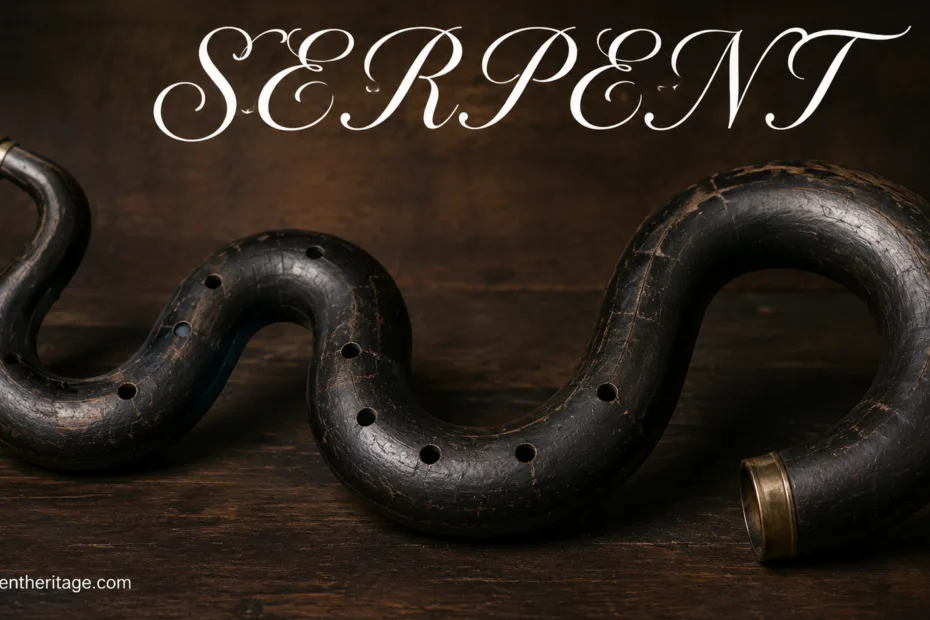
| Instrument point | Serpent details | Why it matters to listeners and players |
|---|---|---|
| Instrument family | Brasswind aerophone, even though many historical examples have a wooden body. | The sound starts with lip vibration in a cup mouthpiece, closer to trombone and tuba than to flute or oboe. |
| Basic shape | A long conical tube folded into an S-shaped body. | The curve brings the finger holes close enough for the hands while keeping a long bass tube. |
| Common materials | Wood, leather covering, brass bocal, horn or ivory mouthpiece on older examples, later brass keys. | Its mix of woodworking and brass playing gives the instrument its unusual identity. |
| Finger system | Usually six finger holes; some later serpents gained keys. | The open holes help shape its vocal quality, while keys improve reach and tuning in later models. |
| Main historical use | Church bass support for chant and lower voices, later military bands and some orchestral writing. | The serpent was built to support human voices, not to dominate them. |
| Sound character | Warm, reedy, rounded, and slightly grainy; often compared with bassoon, euphonium, and early tuba colors. | It can feel like a wooden shadow under a choir: soft, dark, and alive. |
| Related instruments | Cornetto, bass horn, ophicleide, early tuba, euphonium, bassoon. | These comparisons show where the serpent sits between Renaissance wind craft and later brass design. |
The serpent looks like a musical instrument that refused to be ordinary. It bends like a river on a map, speaks with a dark bass voice, and sits in that curious borderland between wooden craft and brasswind sound. The body is often wood. The playing method is brass. The tone? Something earthy, vocal, and a little mysterious. Not polished like a modern tuba. Not nasal like a bassoon. More like an old church floorboard humming under a choir.
For centuries, the serpent served a practical musical job: it helped lower voices stay steady in church music, especially in places where an organ was too expensive, too small, or simply not available. It did not need to be glamorous. It needed to blend, breathe, and hold the bass line.
What Is a Serpent? 🐍
The serpent is a bass wind instrument with a cup-shaped mouthpiece, finger holes, and a long conical bore folded into a snake-like curve. It is usually described as a bass brasswind instrument, because the player makes sound by buzzing the lips into the mouthpiece. That part matters. It explains why a wooden serpent belongs closer to the brass family than to the woodwind family.
The instrument’s name comes from its shape. It really does coil. The tube bends back and forth so the player can reach the holes without needing arms as long as the instrument itself. The Metropolitan Museum of Art describes the serpent as a European bass brasswind instrument and notes that the curved form places the finger holes within reach of the hands.Reference-1✅
That simple design choice tells you a lot. The serpent is not strange for the sake of looking strange. Its odd body is a solution. A long bass tube must be playable by two human hands, so the maker bends the tube into a practical shape. Form follows reach.
Plain answer: the serpent is a low-pitched lip-vibrated wind instrument, often made from wood and leather, used mainly to support voices in church music and later adapted for bands and orchestras.
The serpent is not a bassoon, and not quite a tuba
It is easy to compare the serpent with other instruments, but none of the comparisons fully catch it. The bassoon has a double reed. The serpent has a cup mouthpiece. The tuba has valves and a metal body. The serpent usually has finger holes and a wooden body. The cornetto family gives a better clue: lip vibration, finger holes, and a voice-like tone. The serpent is often treated as the bass member of that older wind tradition.
The Musical Instruments Museum in Brussels explains that the serpent is made with a mouthpiece and finger holes, and that it belongs to the brass family because the sound is produced by vibrating the lips into the mouthpiece.Reference-2✅ That one fact clears up much of the confusion.
Body, Materials, and Craftsmanship 🛠️
A traditional serpent is a lesson in mixed craft. It asks for the hands of a woodworker, the instincts of a brass maker, and the patience of someone willing to cover a curved body in leather without making a mess of it. Many surviving examples have a wooden body, usually made in sections. The pieces are shaped, hollowed, joined, and then wrapped or covered for strength and air-tightness.
The basic parts are easy to name, but not easy to make:
- Body: a conical tube, often wood, curved into the famous S-form.
- Leather covering: used on many older serpents to seal and strengthen the body.
- Bocal: a curved metal mouthpipe that carries the mouthpiece to the player’s lips.
- Mouthpiece: cup-shaped, historically made from horn, ivory, wood, or metal depending on maker and period.
- Finger holes: commonly six open holes, set into the body where the hands can reach.
- Keys: added on some later models to improve tuning, range, and hand comfort.
- Braces or stays: supports that help keep the curved body stable.
The body is where the serpent’s personality begins. A thin-walled wooden tube does not behave like a heavy brass tuba. It gives the tone a different skin. The sound has grain. It is not rough in a careless way, but it keeps a little texture, like handmade paper.
Why the wooden body still counts as brass
Instrument families can be confusing because names often point to material, while sound production tells the deeper story. A wooden flute is a woodwind because air is split across an edge. A saxophone is brass in material but woodwind in playing method because it uses a reed. The serpent turns the puzzle around: wooden body, brass-style lips.
So the serpent belongs with lip-vibrated aerophones. The player’s buzzing lips create the vibration. The long conical bore shapes that vibration into pitch and tone. The finger holes adjust the sounding length of the tube, a bit like opening and closing windows along a winding hallway.
Finger holes, keys, and the problem of tuning
The serpent’s six finger holes are part of its charm and part of its challenge. On a straight, tidy instrument, tone holes can be placed by clean acoustic logic. On a coiled bass instrument held in the hands, the maker must compromise. The holes must work acoustically, but the player must also reach them. That is a delicate bargain.
Later makers added brass keys to help with awkward notes and improve chromatic playing. These keyed serpents move closer to the world of the ophicleide, an early keyed brass instrument that later helped prepare the road toward the tuba. The serpent did not vanish overnight. It slowly changed shape, gained mechanical help, and handed some of its musical duties to newer low brass instruments.
| Part | Typical material or form | Effect on the instrument |
|---|---|---|
| Conical body | Wooden sections, often leather-covered | Creates a broad bass tone with a softer edge than later metal low brass. |
| Mouthpiece | Small cup shape, historically horn, ivory, wood, or metal | Allows lip vibration and gives the player control over attack and color. |
| Bocal | Curved brass tube | Places the mouthpiece comfortably while the body rests in front of the player. |
| Finger holes | Six holes, sometimes bushed or reinforced | Change pitch directly, giving the serpent its old wind-instrument feel. |
| Keys | Brass keys on later or military models | Improve reach, projection, and some chromatic notes. |
| Leather wrap | Hide or leather over the wooden body | Helps seal joints and protects the instrument from wear. |
The Serpent in Early Church Music ⛪
The serpent’s strongest historical identity belongs to church music. It was valued because it could sit under male voices and strengthen chant without sounding too shiny or theatrical. Its tone could be warm and supportive, especially when played softly. That made it useful for plainsong, psalmody, and local church ensembles.
Many writers connect the serpent with late sixteenth-century French church practice. The Bate Collection at the University of Oxford notes the tradition that the instrument was invented in 1590 by Canon Edmé Guillaume of Auxerre and used for many centuries to accompany sung liturgy in French churches.Reference-3✅ Some details around its earliest origin remain debated, but its long church life is well established.
Imagine a stone church before electric amplification. A group sings chant. The lower voices need help. An organ may not be present, or it may not suit the setting. A serpent player adds a bass line that follows the voices rather than covering them. The instrument breathes with the singers. That is its old job.
Why churches used it
The serpent worked well in churches for several reasons:
- It could support low voices without needing a large keyboard instrument.
- It was portable, unlike an organ.
- It blended with singers when played gently.
- It could follow vocal lines with flexible pitch and phrasing.
- It offered a bass foundation for small church bands that also used cello, bassoon, or other winds.
This is where the serpent makes the most sense. It was not designed for dazzling speed. It was a working bass voice. A wooden anchor.
From church gallery to wider musical life
Once an instrument can carry a bass line outdoors or in a large room, other musicians start to notice. The serpent moved from church use into military bands, civic music, theatres, and occasional orchestral settings. This did not erase its church identity; it widened its work.
Military versions often became more practical and louder. Makers added keys. Bells changed angle. Some forms became more upright or compact. The instrument adapted because players needed projection, cleaner tuning, and easier handling while standing or moving.
🎵 A useful way to hear its role
Think of the serpent as a bass singer with a mouthpiece. It does not speak in polished modern brass syllables. It hums, leans, and shades the line. In church music, that human-like bend was a gift.
Sound, Range, and Playing Feel 🎶
The serpent’s sound is hard to describe because it changes so much with the player. Soft playing can be mellow, almost tender. Medium playing brings a firmer bass color. Loud playing can become raw and animal-like if pushed too far. That range of behavior is part of its appeal. It is not a machine. It has moods.
A good serpent tone often has three layers:
- A brass foundation from the buzzing lips and cup mouthpiece.
- A wooden softness from the body and bore.
- A vocal flexibility from open holes and breath-led phrasing.
Players often sit with the serpent upright between the knees, though playing position changes with model and setting. The bocal brings the mouthpiece to the lips. The hands cover the holes along the curved body. It looks awkward at first. Then the logic appears.
Pitch and intonation
The serpent asks a lot from the ear. Because the hole placement is partly shaped by hand reach, tuning is not as locked-in as on a modern valved brass instrument. The player must adjust with embouchure, breath, and fingering choices. A fine serpent player is not just pressing notes. They are steering them.
This can surprise modern brass players. On a euphonium or tuba, valves give a more familiar map. On the serpent, the map has older roads. Some are narrow. Some bend.
Why the tone feels so close to the voice
The serpent was built around vocal music, and the sound reflects that. It does not have the bright attack of a trumpet or the clean roundness of a modern tuba. Its tone starts gently, blooms slowly, and can follow the shape of a sung line. In a small church or early music ensemble, that quality matters more than volume.
The serpent’s voice also has a slight reed-like shadow, even without a reed. That is why listeners sometimes think of the bassoon. The comparison is not exact, but it is useful. The serpent sits somewhere between low brass warmth and old woodwind color.
| Instrument | How sound is made | Tone color | Closest link to the serpent |
|---|---|---|---|
| Serpent | Lips buzz into a cup mouthpiece; finger holes change pitch. | Dark, warm, grainy, vocal, sometimes reedy. | The reference point: wood body plus brass-style playing. |
| Bassoon | Double reed and keyed wooden bore. | Reedy, dry, flexible, often lyrical. | Similar low-register color, but different sound production. |
| Euphonium | Lips buzz into a cup mouthpiece; valves change pitch. | Smooth, rounded, singing, more even. | Similar brass warmth, but much more modern and stable. |
| Tuba | Lips buzz into a large cup mouthpiece; valves change pitch. | Deep, broad, powerful, controlled. | Later low brass role; the serpent is often named as an ancestor in that line. |
| Ophicleide | Lips buzz into a cup mouthpiece; keys open tone holes. | Stronger and more projected than serpent, with keyed brass character. | A direct nineteenth-century successor in many musical settings. |
How the Serpent Was Made
Historical serpent making was not a factory-simple process. A maker had to create a long conical tube, then bend the idea of that tube into a body that could be held and fingered. Many serpents were built from two carved wooden halves, hollowed out and joined. The joined body could then be wrapped, sealed, covered with leather, painted, and fitted with metal parts.
This work sits close to both instrument making and boat making. The maker is shaping hollow space. The outside may catch the eye, but the inside decides the voice. Bore shape, wall thickness, hole placement, and mouthpipe angle all matter.
Wood, leather, and air-tightness
A serpent must hold air. That sounds obvious, but a curved wooden instrument has many places where air can misbehave. Leather helped seal the body and protect the joints. It also gave the instrument a durable outer skin. Many examples were finished in black, though some decorated serpents survive and show that makers could be playful too.
Some later instruments used more metal, and modern makers may use resin, carbon fibre, or 3D printing for playable replicas. The goal remains the same: preserve the serpent’s low conical voice while making it stable enough for real music.
Decoration and visual identity
The serpent’s shape invites decoration. Some historical instruments look plain and church-ready; others lean into the snake image with painted scales or animal-like details. A decorated serpent can look theatrical, but wear around the holes often tells a quieter story: these were played, held, repaired, and carried. They were working instruments.
Church Serpent, Military Serpent, and Other Forms
Not every serpent looks the same. The classic church serpent is the one many people picture first: curved, leather-covered, and built for seated playing. Military and later band versions often needed more projection and easier handling. That led to practical changes.
The Bate Collection describes the military serpent as a bass brasswind instrument that became useful in bands, with some English examples gaining keys and an out-turned bell to help projection.Reference-4✅
| Form | Typical setting | Design traits | Musical purpose |
|---|---|---|---|
| Church serpent | Churches, chant, vocal bass support | Curved wooden body, leather covering, six open holes | Blend with lower voices and support plainsong. |
| Military serpent | Military and civic bands | More keys, stronger projection, sometimes forward-facing bell | Carry bass lines in louder outdoor or band settings. |
| Keyed serpent | Later church, band, and theatre use | Additional brass keys added to the traditional body | Improve chromatic notes and hand reach. |
| Upright serpent | Nineteenth-century variants and collections | More vertical body shape, sometimes easier to handle | Keep the serpent principle while changing posture and projection. |
| Bass horn and ophicleide family | Bands and orchestras | More metalwork, more keys, stronger design regularity | Bridge the older serpent sound toward later low brass. |
The Serpent in Bands, Theatre, and Orchestra
After its church life, the serpent found work wherever a portable bass wind could be useful. In military bands, it could provide the low line before the modern tuba took over that role. In theatres, it added a dark bass color. In orchestral writing, it appeared less often, but when used, it brought a color that no modern substitute fully matches.
Some well-known composers used or knew the serpent in orchestral and ceremonial settings, especially before the tuba became the standard low brass voice. But the serpent was never a tidy orchestral citizen. It carried an older accent. That accent could be beautiful in the right place and awkward in the wrong one.
As brass design changed in the nineteenth century, valved instruments and keyed brass offered more volume, cleaner chromatic playing, and easier ensemble use. The serpent gradually lost ground. Not because it had no value. Because musical rooms, bands, and expectations changed around it.
Useful listening clue: when a serpent is used well, it does not sound like a museum object. It sounds like an old bass voice returning to a room it remembers.
Similar Instruments and Close Relatives
The serpent becomes easier to understand when placed beside its relatives. It does not stand alone. It belongs to a long conversation about how makers created low wind sounds before modern valves made brass playing more predictable.
Cornetto
The cornetto is a smaller, higher instrument with a wooden body, finger holes, and lip-vibrated mouthpiece. It was admired for its voice-like agility. The serpent can be understood as a bass cousin in spirit, though its bore, scale, and musical role are different.
Bass horn
The bass horn was one of the attempts to make a low lip-vibrated instrument more manageable and better suited to band use. It shares part of the serpent’s musical problem: how to make a practical bass wind before valves became common.
Ophicleide
The ophicleide is the serpent’s more mechanically developed relative. It uses keys and a metal body, giving stronger projection and more reliable chromatic playing. It became an important nineteenth-century bass brass voice before the tuba settled into the role.
Tuba and euphonium
The tuba and euphonium are later low brass instruments with valves, smoother response, and a more even tone. They do not sound like the serpent, but they inherited some of the bass duties that older instruments had carried. If the serpent is a winding footpath, the tuba is a paved road. Both can lead to a deep bass note; the journey feels different.
Why the Serpent Disappeared, Then Returned
The serpent faded because newer instruments solved practical problems. Valves and improved metal construction gave players better tuning, stronger volume, and easier chromatic movement. Large ensembles needed dependable low brass. The serpent could be expressive, but it asked for compromise.
Then early music performers began listening differently. Instead of asking old instruments to behave like modern ones, they asked what older music sounded like with its own tools. That shift brought the serpent back into view. Historical performance groups, specialist makers, and curious brass players started treating it not as a failed tuba, but as a voice with its own grammar.
Today, the serpent appears in early music ensembles, research collections, recordings, teaching projects, and some experimental or jazz settings. Modern replicas make it possible to play without risking fragile originals. The old bass wind still has breath in it.
What Makes the Serpent Worth Knowing?
The serpent matters because it shows how musical design grows from real needs. A church needed bass support. A maker bent a tube into reach. A player learned to guide unstable notes with the ear. Later bands asked for more power, so keys and new forms appeared. Nothing about it feels abstract. It is music history with fingerprints on it.
It also reminds us that instrument families are not always neat. Wood can behave like brass. A bass instrument can be soft. A strange shape can be practical. The serpent is full of these small surprises.
For a listener, the best way into the serpent is simple: hear it under voices. Do not expect modern brass shine. Listen for breath, shadow, and old bass warmth. That is where the instrument speaks most naturally.
Terms Often Used with the Serpent
- Brasswind
- A wind instrument sounded by vibrating the lips into a mouthpiece, even if the body is not made of brass.
- Conical bore
- A tube that gradually widens along its length. This helps create the serpent’s broad bass tone.
- Bocal
- The curved metal mouthpipe between the mouthpiece and the body.
- Embouchure
- The way the player shapes lips, mouth, and facial muscles to control tone and pitch.
- Plainsong
- Unaccompanied or lightly supported chant, often sung in church settings.
- Ophicleide
- A keyed brass instrument that followed the serpent in many nineteenth-century bass roles.
FAQ About the Serpent
Questions listeners often ask
Is the serpent a brass instrument or a woodwind?
The serpent is usually classed as a brasswind instrument because the player buzzes the lips into a cup mouthpiece. Many historical serpents are made of wood and leather, so the confusion is understandable. The playing method is the deciding point.
Why is the serpent shaped like a snake?
The shape makes a long bass tube playable by two hands. By folding the tube into an S-curve, the maker places the finger holes within reach while keeping enough tube length for low notes.
What does a serpent sound like?
It sounds dark, warm, and slightly grainy. Some listeners hear a mix of bassoon, euphonium, and old low brass. Soft playing can blend beautifully with voices; loud playing can become rougher and more forceful.
Was the serpent used mainly in churches?
Its best-known early role was church music, especially supporting lower voices and chant. Later it also appeared in military bands, theatres, civic music, and some orchestral settings.
Is the serpent related to the tuba?
Yes, in a broad historical sense. The serpent helped fill low brass-like roles before the tuba became common. The ophicleide sits between them as a more mechanically developed keyed brass instrument.
Are serpents still played today?
Yes. They are played by early music specialists, historical brass players, and a small group of modern performers interested in old sound colors. Many use replicas rather than fragile museum originals.
Why did the serpent fall out of regular use?
Newer low brass instruments offered stronger projection, easier chromatic playing, and more stable tuning. The serpent stayed interesting, but it no longer fit the needs of many larger ensembles.
What is the hardest part of playing the serpent?
Intonation is often the biggest challenge. The player must guide notes with the ear, embouchure, breath, and finger choices. It rewards patience more than force.
