
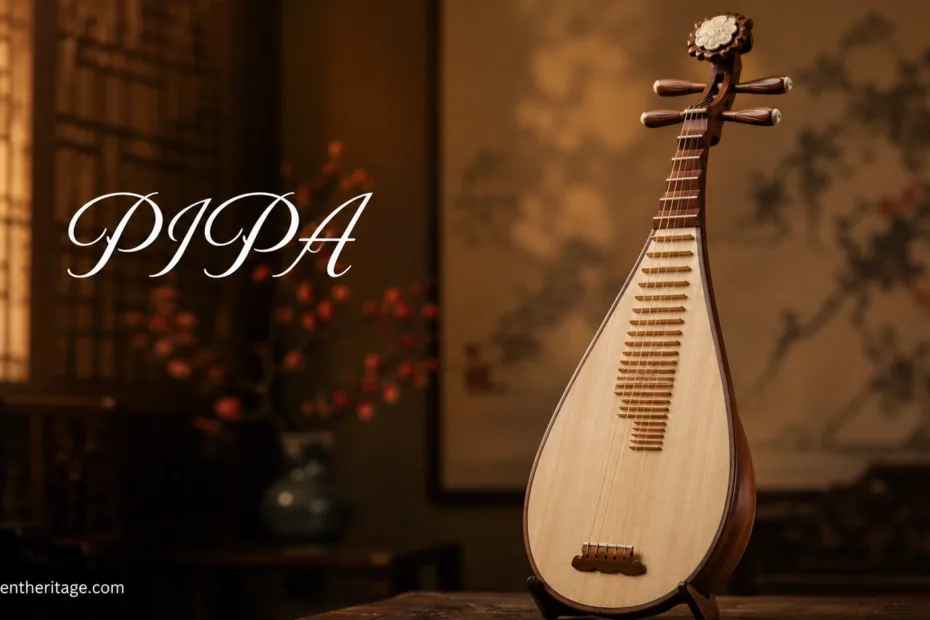
The pipa is a four-string Chinese lute with a pear-shaped wooden body, a bright plucked voice, and a history that reaches back roughly two thousand years. It can whisper like silk being rubbed between the fingers, then snap into sharp, percussive strokes a second later. That mix of delicacy and bite is why the pipa feels so alive: it is not only a melody instrument, but also a small orchestra in the player’s lap.
| Feature | Pipa Details | Why It Matters |
|---|---|---|
| Instrument Type | Short-necked plucked lute, often called the Chinese lute | Its design sits between a melodic string instrument and a percussive storytelling voice. |
| Body Shape | Pear-shaped wooden resonator with a flat front and curved back | The shape helps focus the tone forward while keeping the sound quick and clear. |
| Strings | Traditionally silk; modern instruments often use nylon-wrapped steel | String material changes the feel, volume, sustain, and brightness of the instrument. |
| Common Modern Tuning | A–D–E–A is widely used in modern concert playing | This tuning gives the player strong drones, fast melodic movement, and flexible fingering. |
| Frets | Modern pipas are often listed with about 29 or 31 frets, though designs vary by maker and tradition | High frets allow bends, slides, ornaments, and clear notes across a wide range. |
| Playing Position | Modern pipa is usually held upright on the thigh; older forms were often held more horizontally | The shift changed right-hand technique and helped shape the fast finger style heard today. |
| Sound Character | Bright, dry, agile, ringing, and percussive | The pipa can sound lyrical, playful, sharp, or dramatic without needing many extra effects. |
| Musical Settings | Solo music, chamber ensembles, opera, storytelling traditions, regional music, and new composition | It is both a historical instrument and a living concert instrument. |
What Is the Pipa? 🪕
The pipa is a plucked chordophone, which simply means its sound comes from stretched strings being plucked. Its body is usually described as pear-shaped, but that phrase can feel a bit too neat. A good pipa looks more like a carved wooden teardrop: narrow at the top, rounded at the lower body, and built to throw sound outward with a clean attack.
Unlike a guitar, the pipa has a short neck and a deep set of raised frets running down onto the body. Those frets are not just markers. They give the left hand room to press, bend, slide, and color the pitch. The right hand, often fitted with small finger picks in modern playing, can strike the strings with a wide range of motion. The result is a voice that can be soft one moment and sharply etched the next.
The name itself is tied to movement. Traditional explanations connect pi with a forward plucking stroke and pa with a backward stroke. The Metropolitan Museum of Art notes this forward-and-back idea while tracing the Chinese pipa to West and Central Asian lute prototypes that appeared in China during the Northern Wei period.Reference-1✅
A Lute, But Not a Guitar
Calling the pipa a Chinese lute is useful, but it can also hide what makes the instrument special. A guitar often leans on chords, strumming, and long resonance. The pipa is more pointed. It loves fast note shapes, sudden accents, rolling tremolo, pitch bends, and tiny ornaments that make one note feel like it has several colors inside it.
Think of it as a brush rather than a pencil. The player does not only place notes. They shade them.
A 2,000-Year Story Without a Straight Line
The pipa’s history is old, but it is not a tidy museum label. Early Chinese sources used the word pipa for more than one kind of plucked instrument. Over time, the name narrowed toward the pear-shaped four-string lute most players know today. This is normal in instrument history. Names travel. Shapes change. Players keep what works.
Early forms connected with the pipa family moved along trade routes that carried musicians, materials, ideas, and playing habits across Asia. By the Sui and Tang eras, the pear-shaped lute had become deeply rooted in Chinese musical life. The Tang period is especially tied to the pipa’s image: elegant court ensembles, lively professional performers, painted musicians, and carved figures holding the instrument across the body.
One of the most interesting changes was physical. Older pipas were often held more horizontally, closer to the way someone might hold a guitar. Later, players shifted toward the more upright position now associated with modern pipa performance. That small change mattered. It opened the door to a different right-hand approach, with fingernails and later finger picks replacing the large plectrum in many settings.
So the modern pipa did not simply “arrive.” It was shaped by migration, court taste, regional practice, maker skill, and player technique. Wood and strings changed. Frets multiplied. The right hand became more agile. The instrument kept adapting while still carrying older gestures in its body.
The Tang-Era Shift
The Tang period gave the pipa a public identity that still echoes today. The move from plectrum to fingernail playing made the instrument less like a single-strike lute and more like a flexible, finger-led voice. The right hand could now create rapid rolls, repeated notes, flicks, and layered textures. That is a big reason the pipa feels so animated in solo music.
The older horizontal posture did not vanish completely. In some regional traditions, especially certain southern ensemble settings, a pipa-like instrument may still be held closer to the older style. These details matter because they remind us that “the pipa” is not one frozen object. It is a family of habits, shapes, and sounds.
How a Pipa Is Built 🪵
A pipa looks simple from across a room: body, neck, frets, strings, pegs. Up close, it becomes a lesson in controlled tension. The maker has to balance wood thickness, neck angle, fret height, string pull, bridge pressure, and the player’s need for speed. Too heavy, and the tone loses breath. Too light, and the voice can become thin or unstable.
The front soundboard is usually made from a resonant wood chosen for clarity and response. The back may be harder or denser, giving the body strength and helping reflect vibration forward. Traditional decorative work can be plain or highly ornate, depending on period, maker, and purpose. Some old instruments carry carved plaques, inlay, symbolic motifs, and carefully shaped finials. One Ming-dynasty pipa in The Met collection is described with more than 110 carved hexagonal plaques on its back and sides, a reminder that some pipas were also works of visual craft.Reference-2✅
The Body: A Small Wooden Chamber
The pipa body works like a compact sound chamber. Its rounded lower shape gives the sound room to bloom, while the flatter front keeps the attack clear. Many listeners notice the pipa’s first edge before they notice its sustain. The note speaks fast. It has a little spark on the front of the sound.
That quick response is useful because pipa music often asks for clean articulation. A player may run through ornaments, repeated strokes, sudden pauses, and ringing harmonics in a few seconds. The body must answer quickly, without turning every note into a blur.
Frets: The Pipa’s Raised Landscape
The frets are one of the pipa’s most visible features. Early instruments had fewer stops, while the modern concert pipa usually has a much larger fret system. Britannica describes the modern pipa as having 29 or 31 frets, with some on the neck and the rest continuing across the body; it also notes the move from silk strings to nylon-wrapped steel on many present-day instruments.Reference-3✅
Raised frets let the left hand do more than stop a string. They create space for pressing behind the pitch, sliding into notes, bending tones upward, and shaping small ornaments. On a pipa, a note is rarely just a dot on a line. It can lean, shimmer, or curl.
Strings: From Silk Warmth to Modern Projection
Older pipas used silk strings. Silk gives a softer, rounder, more intimate tone, with less metal brightness and a gentler touch under the fingers. Modern concert pipas often use nylon-wrapped steel strings because they offer more volume, stronger projection, and stable response in larger rooms.
This change is not just technical. It changes the personality of the instrument. A silk-strung pipa can feel like a close conversation. A modern steel-and-nylon setup can cut through an ensemble with a clear, ringing edge. Both sounds have their own beauty.
Craft note: On plucked instruments, material choices are never neutral. Wood, string, fret height, and nail contact all shape the final voice. A small change in one place can be heard everywhere else.
The Pipa Sound: Bright, Fast, and Full of Edges 🎶
The pipa’s sound is easy to recognize once you know it. The attack is quick, almost like a bead tapping glass. Then the tone opens into a short ring. It does not usually float for a long time like a harp or a guitar with heavy sustain. Instead, the pipa speaks in detailed syllables.
That is why pipa playing can feel so close to speech. The instrument can chatter, sigh, flick, roll, and sing. A player can make one phrase sound smooth and vocal, then make the next one feel dry and rhythmic. That range of touch is one of the pipa’s greatest strengths.
Attack and Decay
Every plucked instrument has an attack and a decay. Attack is the front of the note; decay is how the sound fades. The pipa has a strong attack and a controlled decay. This gives the music definition. Fast passages stay readable. Repeated strokes stay crisp.
When the player wants a longer sound, the right hand can create tremolo, often by cycling fingers rapidly across one or more strings. The note then seems to continue, not because the string naturally sustains forever, but because the hand keeps feeding it. Like pouring water into a small bowl before it runs dry.
Color Comes From Both Hands
The right hand starts the sound, but the left hand gives it shape. Pressing the string can sharpen the pitch. Sliding can connect notes. Vibrato can make a tone pulse softly. Harmonics add bell-like flashes. Muted strokes add a dry wooden click. None of these effects is just decoration. They are part of the language.
On the pipa, technique and expression are tightly joined. The listener may hear beauty; the player feels mechanics. The best playing hides the hard work.
How the Pipa Is Played ✋
The modern pipa is usually placed upright on the player’s thigh. The left hand moves along the frets, while the right hand plucks, strikes, rolls, and brushes the strings. Many players use small artificial nails or finger picks, which help produce a clean, bright sound and protect the fingers during long practice.
Basic strokes may look small from the audience, but they are highly controlled. The hand does not simply “pluck.” It chooses direction, angle, pressure, speed, and release. A tiny change can turn a gentle note into a sharp accent.
Right-Hand Techniques
The right hand is famous for its speed and variety. A few common ideas appear again and again:
- Tan and tiao: paired outward and inward plucking motions, often taught early because they build right-hand balance.
- Lun: a rolling tremolo made by cycling fingers in quick order, creating a sustained ribbon of sound.
- Sweeping strokes: broader gestures across several strings, useful for bright accents and full-bodied phrases.
- Muted attacks: dry, short sounds that bring out the instrument’s percussive side.
- Harmonics: clear, bell-like tones made by touching the string lightly at certain points.
The Smithsonian’s National Museum of Asian Art describes the pipa as technically demanding and highlights the rolling finger technique often called run, where several fingers take turns striking the strings to create even tremolo.Reference-4✅
Left-Hand Techniques
The left hand gives the pipa its vocal feel. Because the frets are raised, the player can push the string after stopping it. This makes the pitch bend. It is not exactly like bending a guitar string, and not exactly like sliding on a violin. It has its own taste.
- Slides connect notes with a smooth, audible motion.
- Vibrato adds warmth and human breath to a held tone.
- Pitch bends let a note lean upward or settle into place.
- Grace notes give phrases a quick flick of movement.
- Position shifts help the player move across the wide fret layout without breaking the phrase.
This is where the pipa becomes more than fast fingers. A good player shapes a note after it is born. That tiny after-touch is often where the emotion lives.
Tuning, Range, and Musical Layout
The common modern tuning A–D–E–A gives the pipa a bright center and useful open-string relationships. Different schools, pieces, and teaching systems may describe tuning in relative pitch or use other practical adjustments, but the four-string layout keeps the instrument compact and efficient.
The pipa’s range is wide for its size. The high fret system lets the player climb far up the body, while the lower strings give enough depth for drones, open-string resonance, and grounded melodic shapes. The instrument can jump quickly between registers, almost like a dancer stepping between stones.
| Part of the Instrument | Musical Function | Typical Sound Result |
|---|---|---|
| Open strings | Provide drones, ringing accents, and tuning centers | Clear resonance and fast response |
| Lower frets | Support stable melodic playing and strong left-hand control | Warm, direct, easy-to-read notes |
| High frets on the body | Extend range and allow bright upper-register phrases | Sharp, singing, sparkling tones |
| Right-hand nail contact | Controls attack, speed, and color | From soft pluck to crisp snap |
| Left-hand pressure | Shapes pitch bends, slides, and vibrato | Voice-like movement inside the note |
Where the Pipa Lives in Music
The pipa is strongly associated with solo performance, but it has never belonged only to the solo stage. It appears in chamber ensembles, opera settings, storytelling traditions, regional music, and newer concert works. That flexibility makes sense. The instrument can lead a melody, support a singer, imitate rhythmic gestures, or add sparkling color to a group texture.
In solo music, the pipa often paints scenes through sound. Some pieces feel lyrical and flowing, with soft tremolo and gentle slides. Others are more rhythmic and energetic, using sharp accents, fast runs, and dramatic contrasts. The instrument is good at telling a story without words.
Regional and Ensemble Traditions
In Chinese chamber music, the pipa may sit beside bowed strings, flutes, zithers, and other plucked instruments. Its role depends on the tradition. Sometimes it gives rhythmic shape. Sometimes it thickens the melody. Sometimes it adds little flashes of ornament between longer tones from wind or bowed instruments.
One older southern tradition, Nanyin, keeps a connection with a more horizontal pipa posture. UNESCO describes Nanyin as a musical performing art of Minnan communities in southern Fujian, performed with instruments including the dongxiao flute and a crooked-neck pipa played horizontally.Reference-5✅
That older playing position is not just a visual detail. It changes touch, tone, and musical behavior. It also shows how historical layers can survive inside living practice, not as a museum pose, but as something musicians still use.
The Pipa in New Music
Modern composers have been drawn to the pipa because it gives them a huge palette in a small instrument. It can produce melody, rhythm, noise-like textures, harmonics, bends, tremolo, and sudden bursts of color. A composer does not have to force the pipa to be interesting. It already has many doors.
Players today may perform traditional repertory, chamber works, cross-cultural projects, and newly written solo pieces. The best new writing respects the instrument’s hands. It understands that the pipa is not a guitar with a different outline. Its logic comes from stroke direction, fret height, finger cycling, and tone shaping.
Why the Pipa Feels So Expressive
The pipa has a rare mix: fast attack, flexible pitch, short sustain, strong ornament, and clear rhythm. That means the player can shape time very closely. A phrase can breathe, stumble, sparkle, or tighten. Small motions matter.
Materials, Craftsmanship, and Player Feel 🧰
A pipa is not judged only by how it looks. Players care about how evenly it speaks across the strings, how stable the tuning feels, how cleanly the frets are placed, how the neck sits in the hand, and whether the soundboard responds without harshness. A beautiful instrument that fights the player is not truly successful.
Good craftsmanship shows up in quiet ways. The pegs should turn smoothly but hold firm. The frets should feel secure and accurate. The string height should allow clean tone without making the left hand work too hard. The body should vibrate freely, yet not feel fragile.
Wood and Resonance
Different woods can change the pipa’s response. Softer, more resonant soundboard woods tend to speak quickly, while harder woods in the back and sides can add focus and strength. The maker’s carving matters as much as the species name. Two pieces of the same wood can behave differently.
This is why old instrument makers often talk with their hands. They tap, flex, shave, listen, and adjust. The final sound is not hidden in one magic material. It comes from many small decisions working together.
Decoration and Meaning
Some pipas are plain and practical. Others carry carved ornaments, symbolic shapes, inlaid plaques, or decorated pegboxes. These details can reflect taste, region, workshop style, patronage, or ceremonial value. Decoration does not automatically make an instrument sound better, but it can tell us how much care people placed on the object itself.
The pipa has long been both a musical tool and a cultural object. It sits comfortably in both places. That is part of its charm.
Pipa and Similar Instruments
The pipa belongs to a wide family of plucked lutes. Some relatives share shape, some share playing history, and some share only a broad construction idea. Comparing them helps make the pipa clearer.
| Instrument | Region or Tradition | Main Similarity to Pipa | Main Difference |
|---|---|---|---|
| Ruan | China | Plucked lute with frets and a long Chinese history | Round body, longer neck, warmer and more open sound |
| Liuqin | China | Small pear-shaped plucked lute | Smaller, higher-pitched, often brighter and more piercing |
| Yueqin | China | Short-necked plucked lute | Round “moon” body and a different tone profile |
| Biwa | Japan | Historically related to older pipa forms | Often played with a large plectrum and has its own Japanese traditions |
| Oud | West Asian and Mediterranean traditions | Fretless lute with a rounded body and deep history | No frets, different tuning systems, warmer rounded tone |
| Guitar | Global | Plucked string instrument with frets | Different body, tuning, chord use, and right-hand logic |
The closest visual comparison is often the liuqin, which can look like a smaller pipa at first glance. The ruan, by contrast, feels more open and rounded. The biwa preserves a historical cousinhood with older pipa forms, especially in its plectrum tradition. The oud is more distant, but it helps explain the broader lute family: wooden body, neck, strings, and a long history of travel.
What to Listen for the First Time
For a first listen, do not try to catch every note. The pipa can move too quickly for that. Listen instead for layers of touch.
- The first edge of the note: Is it soft, sharp, dry, or ringing?
- The left-hand motion: Do notes bend, slide, or shake after being plucked?
- The tremolo: Does it feel like one long tone, or can you hear the small finger strokes inside it?
- The register changes: Notice how quickly the instrument jumps from low warmth to high sparkle.
- The pauses: Silence is part of pipa phrasing. A short gap can make the next note feel brighter.
Once you hear these details, the pipa stops being “an exotic lute” and becomes easier to understand as a hand-shaped sound machine. Wood, string, nail, pressure, and timing all speak at once.
Care, Strings, and Everyday Handling
A pipa is a crafted wooden instrument, so it responds to humidity, temperature, string tension, and handling. Players usually keep it in a proper case, avoid sudden climate changes, and check pegs and strings before playing. The raised frets and polished body also deserve gentle cleaning with a dry cloth after practice.
String choice affects both sound and feel. A student instrument with modern strings may feel stable and bright. A more traditional setup may reward a lighter touch. Neither is “better” in every setting. The right choice depends on the music, the room, the player’s hand, and the tone they want.
Player’s detail: The pipa rewards relaxed precision. Too much force can make the sound hard. Too little control can make fast passages messy. The sweet spot is a clean hand with a living wrist.
Pipa FAQ
Common Questions About the Pipa
Is the pipa the same as a lute?
The pipa is a type of lute, but it has its own structure and playing language. It is a short-necked, four-string Chinese plucked lute with a pear-shaped body, raised frets, and a highly developed right-hand technique.
How old is the pipa?
The pipa family is commonly described as having a history of around two thousand years in China, though the exact story includes several related lute forms and changing names over time. The modern pear-shaped pipa developed through long contact between imported lute designs and Chinese musical practice.
What is a pipa made of?
A pipa is mainly made of wood, with a resonant body, raised frets, tuning pegs, a string holder, and four strings. Older strings were silk. Modern concert instruments often use nylon-wrapped steel strings for brighter sound and stronger projection.
Why does the pipa sound so bright?
The brightness comes from several things working together: the plucked attack, modern string materials, the wooden body, the raised frets, and the use of nails or finger picks. The pipa’s sound starts quickly, so even soft notes can feel clear and focused.
Is the pipa difficult to learn?
Yes, it can be demanding, especially in the right hand. Basic melodies are possible for beginners, but the instrument’s famous tremolo, fast strokes, bends, slides, and tone colors take steady practice. The challenge is part of what makes the pipa so expressive.
What is the difference between pipa and liuqin?
The liuqin is smaller and higher-pitched, with a bright, sharp voice. The pipa is larger, has a wider range, and offers more depth in solo and ensemble music. They may look related, but they feel different in the hand and sit differently in a musical texture.
Is the Japanese biwa related to the pipa?
Yes. The biwa is historically related to older lute forms connected with the pipa, but it developed its own Japanese construction styles, repertories, and plectrum-based playing traditions. They are relatives, not copies of each other.
What kind of music uses the pipa today?
The pipa is used in solo performance, traditional ensembles, regional music, opera-related settings, storytelling traditions, chamber music, and new compositions. Many modern players move between older repertory and newly written works.
