
| Feature | Alphorn Detail | Why It Matters |
|---|---|---|
| Instrument family | Lip-vibrated aerophone, often grouped with brass instruments even though it is made of wood | The player’s lips create the vibration, much like a natural horn or trumpet. |
| Common length | Many Swiss alphorns are around 3.5 metres, with some traditional forms reaching about 4 metres | Length decides the basic pitch and the set of natural tones the horn can produce. |
| Usual material | Spruce, fir, or pine, with modern makers also using other woods and, rarely, carbon | Wood gives the alphorn its warm, round tone and light body. |
| Pitch system | No valves, no keys, no finger holes; only the natural harmonic series | The player changes notes through breath, lip tension, and ear control. |
| Bell shape | Long conical tube with an upturned bell, often inspired by naturally curved mountain trees | The bell helps project the sound across open air without making it harsh. |
| Mouthpiece | Usually a separate wooden cup-shaped mouthpiece | It helps the player form stable tones and move through the overtone series. |
| Cultural setting | Alpine herding, outdoor signals, folk ensembles, festivals, chamber music, and modern stage work | The alphorn is both a practical mountain horn and a living musical voice. |
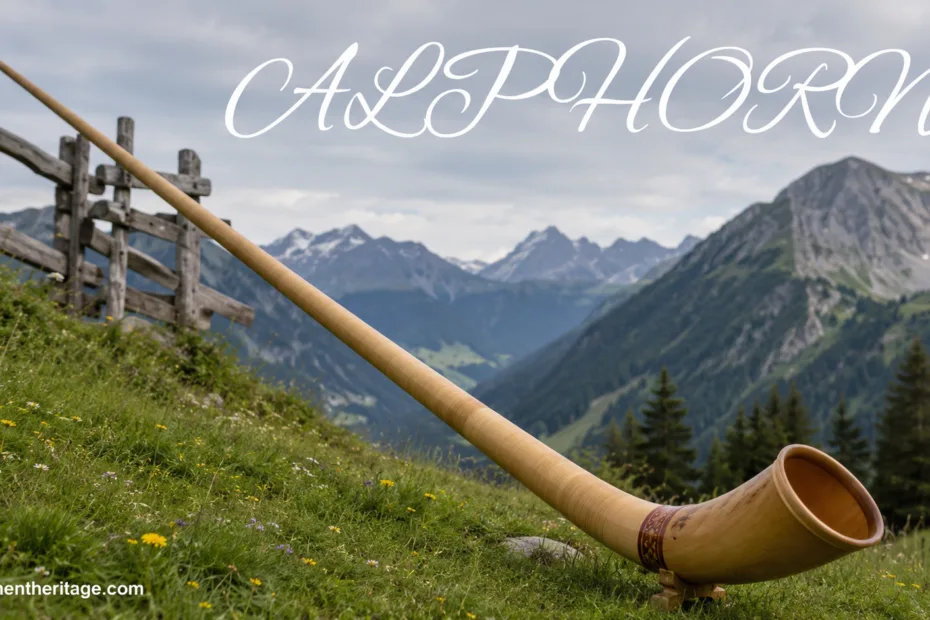
The alphorn is a long wooden natural horn with a curved bell, a small mouthpiece, and no valves or finger holes. Its notes come from the natural harmonic series, so the player controls pitch through breath, lip tension, and embouchure. The instrument is closely associated with Alpine music, but its construction and acoustics also make it useful for understanding how tube length, bore shape, and resonance affect pitch.
Known in German as Alphorn or Alpenhorn, and in French as cor des Alpes, this long wooden horn is closely tied to Alpine music culture, especially in Switzerland. The Swiss Federal Office of Culture describes alphorn and Büchel playing as a living tradition, placing it among performing arts and traditional craftsmanship.Reference-1✅ Yet the instrument is bigger than a postcard image. It belongs to the wider family of natural horns, signal instruments, pastoral music, and handmade wooden aerophones.
What Is an Alphorn?
An alphorn is a long, end-blown wooden horn played by vibrating the lips against a mouthpiece. It has no valves. No finger holes. No slide. The player cannot press a button to find the next note; the note has to be shaped by breath and embouchure. That gives the instrument a very direct feeling. It rewards patience.
Because the sound is made by the player’s lips, the alphorn is often treated like a member of the brass family. Because the body is wood, many listeners hear a soft edge that feels closer to a wooden flute or a low pastoral horn. Both ideas are useful. The alphorn sits between categories in a friendly way: a wooden body with a brass-style voice.
🎶 Plain-language definition: an alphorn is a very long wooden natural horn from the Alpine region, played with the lips and limited to natural overtones.
Encyclopaedia Britannica notes that alphorns were used by Alpine herdsmen and villagers for communication, daily ceremonies, and seasonal festivals, and that some examples can reach about 12 feet, or roughly 4 metres, in length.Reference-2✅ That length is not just for show. A longer tube means a lower fundamental pitch. It also means the player must control a wide, breathing column of air. The horn may look calm, but inside it is all moving pressure.
History of the Alphorn
The alphorn developed in a mountain setting where long-distance sound had practical value. In Alpine pastures, its tones could reach people, animals, and neighbouring herders across open terrain. Before it became a concert and festival instrument, it served signalling and pastoral functions.
Older alphorn history is not a neat straight road. Similar long horns appear in different mountain regions and pastoral cultures. The Swiss alphorn, though, became especially known because of its strong link with Alpine dairy culture, herding, and folk performance. Switzerland Tourism notes that the alphorn was documented in Switzerland in the mid-16th century by natural scientist Conrad Gesner and later gained new public life during the 19th-century revival of folklore and tourism.Reference-3✅
From pasture signal to musical instrument
In its older pastoral role, the alphorn could call cattle, mark parts of the day, and connect people across the landscape. It was not background decoration. It had a job. A single phrase, played in open air, could carry a mood and a message at the same time.
Later, as village life, tourism, and folk festivals changed the way people encountered Alpine music, the alphorn moved further into organized performance. Players began using it in solos, duos, trios, quartets, and larger alphorn choirs. Today, the instrument can appear with yodeling, church organ, brass groups, symphony orchestra, jazz players, and experimental folk musicians.
Why the alphorn survived
The alphorn remained part of Alpine culture after its older signalling role declined because it also worked as a musical instrument. Its natural harmonic series, strong outdoor projection, and recognizable wooden construction suited folk performance, festivals, and later concert use. Its tuning does not match equal temperament exactly, which remains one of its defining acoustic features.
How an Alphorn Is Built
An alphorn begins with wood. Traditionally, makers could look for a tree with a natural curve near its base, especially on steep mountain slopes. That curved section could help form the upturned bell. Modern makers can reproduce the shape through controlled cutting, joining, hollowing, and shaping rather than depending on naturally curved timber.
Modern alphorns are often made in several detachable sections. This is practical. A one-piece horn over three metres long is not easy to carry through doors, cars, trains, or narrow backstage spaces. A three-piece alphorn can be assembled before playing and taken apart after use, while still keeping the long conical shape needed for the sound.
Wood, bore, and wall thickness
Spruce is common because it is light, resonant, and familiar to instrument makers. Pine and fir also appear in historical and regional making. The maker shapes a long cone, hollows the inside, joins the halves or sections, and finishes the outside. The internal bore profile directly affects resonance, tuning, and response, so small changes in taper can change how the instrument behaves.
Switzerland Tourism describes the alphorn as a long conical tube and notes that handwork can be demanding, with gouging continuing until the walls are only a few millimetres thick in some instruments.Reference-3✅ Thin walls help the wood respond. Too thin, and the horn becomes fragile. Too thick, and it may feel stiff. The maker is always balancing strength and resonance.
Main parts of the alphorn
- Mouthpiece: the small wooden cup where the player’s lips vibrate.
- Hand tube: the narrow upper section closest to the player.
- Middle tube: the long central body that keeps the cone expanding.
- Tailpipe: the lower tube that leads toward the bell.
- Bell: the wide, curved end that projects and opens the tone.
- Foot or support: a small rest that keeps the bell stable on the ground.
The outside is often wrapped with rattan or another protective material. Earlier makers used bark, linen, strips of wood, or metal rings. Decoration varies from plain finishes to painted flowers, carved details, and regional patterns. These treatments affect appearance and protection, while the internal bore remains central to the instrument’s acoustic behavior.
How the Alphorn Makes Sound
The alphorn makes sound through lip vibration. The player buzzes into the mouthpiece, the air column inside the long wooden tube begins to resonate, and the horn selects notes from the natural harmonic series. There are no valves to lengthen the tube and no holes to shorten it. The player moves from note to note by changing breath speed, lip tension, and mouth shape.
A physics teaching document from the Paul Scherrer Institute describes the alphorn as a lip-reed wind instrument, usually between 3 and 4 metres long, with fixed pitch defined by its length and only its natural tones available to the player.Reference-4✅ That one fact explains much of the instrument’s personality. It cannot play every note easily. It plays the notes the tube allows.
The natural harmonic series
The harmonic series is a sequence of pitches produced by one fixed tube length. Lower harmonics are spaced farther apart, while higher harmonics lie closer together. This is why alphorn melodies often use wide intervals in the lower register and can move more stepwise as the player reaches higher harmonics.
One famous pitch is the alphorn Fa, a natural harmonic that falls between notes in modern equal temperament. To ears trained on piano tuning, it can sound slightly “in between.” The difference comes from the harmonic series rather than inaccurate playing. A piano divides the octave into equal semitones; the alphorn follows the resonance frequencies available from its fixed tube.
🎵 Listening note: if an alphorn phrase sounds a little wild around certain notes, that is often the natural scale at work. The sound is not out of tune in the usual careless sense; it belongs to a different tuning world.
Sound Character and Playing Feel
The alphorn has a broad, rounded sound. It can be soft and prayer-like. It can also be bright enough to travel outdoors. The lower notes feel grounded, almost like a low horn speaking through wood. The higher tones can become clear and ringing, but they still keep a natural edge.
Players need steady air. Not force. Steadiness. If the breath shakes, the note shakes. If the lips grip too hard, the tone tightens. Good alphorn playing often sounds simple because the player is doing difficult work quietly. A clean entrance on a long wooden horn is a small act of courage.
Why outdoor playing feels different
Open spaces allow alphorn sound to carry over long distances and produce audible reflections from surrounding terrain. Indoors, the same instrument can sound much louder because nearby surfaces return the sound quickly. Players therefore adjust dynamics, articulation, and spacing according to the performance environment.
Music, Ensembles, and Repertoire
Traditional alphorn music often uses call-like phrases, natural intervals, and a calm melodic line. The music is not crowded. It gives each tone room. In groups, several alphorns can create a warm chordal sound, especially when players tune carefully and match breath shape.
Modern alphorn repertoire extends beyond traditional folk settings. The instrument appears in alphorn choirs, classical arrangements, outdoor performances, jazz, and cross-genre projects. Composers generally write around its natural harmonic series rather than treating it as a fully chromatic trumpet.
Traditional settings
- Alpine festivals and open-air gatherings
- Yodeling events and folk music groups
- Solo calls in mountain landscapes
- Duos, trios, quartets, and alphorn choirs
Modern settings
- Chamber music with strings or organ
- Jazz and experimental folk projects
- Sound installations and outdoor concerts
- Educational demonstrations of natural harmonics
Similar Instruments and Close Relatives
Many cultures developed long horns for signalling, ceremony, or open-air music. Some are wooden, some are metal, and others use animal horn, bark, or related materials. Their construction and musical systems differ, but long projecting horns often developed where sound needed to carry over distance.
| Instrument | Material and Shape | Connection to the Alphorn |
|---|---|---|
| Büchel | Wooden natural horn, more compact and often trumpet-like in shape | Closely linked to Swiss alphorn tradition, especially in Central Switzerland. |
| Trembita | Long wooden horn used in Carpathian regions | Shares the mountain signal-horn idea, with a strong open-air voice. |
| Natural horn | Metal horn without valves in older forms | Uses the same basic principle of natural overtones controlled by the lips. |
| Lur | Long Scandinavian horn, often wooden or bronze depending on period and type | Another example of a long projecting horn linked to outdoor sound. |
| Didgeridoo | Long wooden drone instrument from Aboriginal Australian music cultures | Also a wooden aerophone, though its playing style, drone technique, and cultural setting are very different. |
The Büchel is the closest companion in the Swiss setting. It is shorter, more curved, and more portable, but it also relies on natural harmonics. The trembita belongs to a different mountain tradition. Comparing these instruments shows how long natural horns developed in several regions for signalling and musical use.
Craft Details That Shape the Tone
Two alphorns of the same length can still feel different. Wood density, bore accuracy, bell shape, mouthpiece size, and joint fit all matter. A small leak at a joint can make response weaker. A mouthpiece that feels too narrow can make the upper notes tense. A heavier bell may project differently from a lighter one.
The mouthpiece deserves special attention. It is small, but it controls the first contact between player and instrument. A deeper cup may feel rounder. A shallower cup may speak more quickly. The rim shape affects comfort. For beginners, a balanced mouthpiece is usually easier than an extreme one. The alphorn already asks enough from the lips.
- Conical bore
- The tube widens gradually from mouthpiece to bell, giving the horn its open, rounded projection.
- Natural tuning
- The player works with the overtone series, not a full chromatic key system.
- Section joints
- Modern detachable parts make transport easier, but the joints must seal cleanly.
- Bell curve
- The upturned bell helps the sound open outward and gives the alphorn its familiar silhouette.
Care and Handling of a Wooden Alphorn
An alphorn is large, but its wooden sections, joints, bore, finish, and mouthpiece still require careful handling. Heat, dryness, sudden moisture changes, impact, and poorly fitted joints can affect the instrument’s stability and response.
- Assemble sections gently: twisting too hard can stress the joints.
- Keep the mouthpiece clean: moisture and residue change both hygiene and response.
- Dry the horn after playing: breath moisture collects inside the tube.
- Avoid extreme heat: direct sun in a closed car can harm wood and glue.
- Store it supported: long sections should not be left where they can bend, fall, or be stepped on.
Regular drying, stable storage, and careful assembly help the alphorn respond consistently and reduce avoidable stress on its wooden sections and joints.
Common Misunderstandings About the Alphorn
The alphorn is not a simple beginner horn. Its design is simple, yes. Playing it well is not. Clean attacks, stable long tones, and accurate harmonics take practice.
It is not only a folk symbol. The alphorn carries strong Alpine identity, but it is also a serious acoustic instrument. Its natural scale makes it useful for teaching overtones, tuning, breath support, and the physical link between tube length and pitch.
It is not “out of tune” by accident. Some alphorn notes do not match equal-tempered piano tuning. That difference comes from the natural harmonic series. The horn follows its own map.
It is not always one piece. Many modern alphorns are made in detachable parts. This does not make them less authentic. It makes them playable in real life, where musicians have train stations, staircases, and small cars.
The Alphorn’s Place in Instrument Culture
The alphorn has a simple visible structure: a long conical tube, an upturned bell, and a mouthpiece, without valves or keys. Because there is no mechanism for changing tube length, pitch control remains closely tied to the player’s embouchure and to the instrument’s acoustic geometry.
Compared with chromatic keyboard or valved instruments, the alphorn offers a restricted set of notes. Players work within that limitation through articulation, dynamics, timing, register choice, and control of the natural harmonics.
Its continued use in traditional and contemporary music depends on the same basic acoustic system that shaped the instrument historically: a fixed tube, natural resonances, and direct control from the player’s lips and breath.
2026 Research: Can Machine Learning Optimize an Alphorn?
A preprint submitted to arXiv on July 24, 2026 asks whether the geometry of a Swiss alphorn can be optimized so that its resonance frequencies sit closer to selected target notes. The researchers built a geometric model from measurements and imaging data, then used a geometry-parametrized finite-element model of the Helmholtz equation to calculate how changes in shape affect the instrument’s resonances.Reference-5✅
Because running a full numerical simulation for every possible geometry would be expensive, the study combines the finite-element model with a Reduced Basis Method to generate resonance data more efficiently. Machine-learning models are then trained both to predict resonance frequencies from geometric parameters and to work in the opposite direction: estimating a geometry that should place resonances near specified target notes.
The paper is a preprint, so it should not be treated as peer-reviewed evidence that machine learning has produced a “perfect” alphorn. It is useful as an acoustic design study because it connects the traditional craft variables discussed above—especially bore geometry, tube shape, and resonance—with numerical modelling and inverse design.
