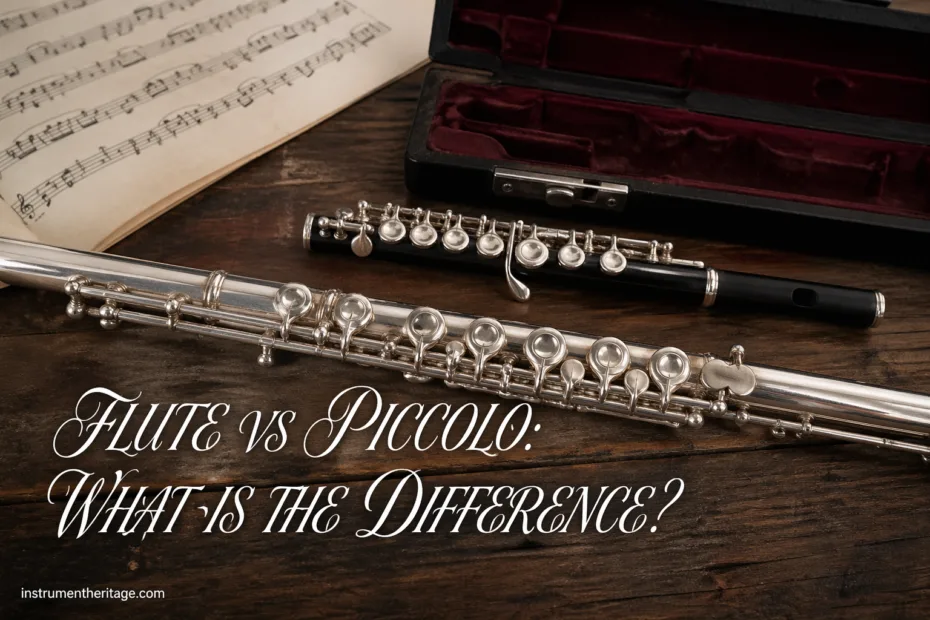
Flute and piccolo look like close relatives because they are. Both are side-blown woodwind instruments, both speak through a shaped stream of air, and both use a similar fingering system. Yet the moment they enter a piece of music, the difference is plain. The flute gives you a clear, flexible voice with warmth in the middle and shine at the top. The piccolo is smaller, higher, brighter, and much more concentrated — a tiny tube with a huge musical footprint.
| Feature | Concert Flute | Piccolo |
|---|---|---|
| Instrument family | Member of the flute family; a side-blown aerophone. | Smallest common member of the modern flute family; also side-blown. |
| Usual pitch | Sounds at written pitch in standard C flute parts. | Sounds one octave higher than written pitch. |
| Typical size | About 26 inches / 67 cm long, depending on footjoint. | Roughly half the length of a flute, often around 12–13 inches / 30–33 cm. |
| Range feel | Broad, flexible range from mellow low notes to bright upper notes. | High, piercing range with a focused top register. |
| Common materials | Silver, nickel silver, gold, platinum, wood, or mixed metal construction. | Grenadilla wood, resin, composite, silver-plated metal, or mixed materials. |
| Bore and build | Modern Boehm-style flute is usually cylindrical with a tapered headjoint. | Often cylindrical or conical depending on model and tradition. |
| Tone color | Clear, lyrical, agile, singing. | Bright, compact, sparkling, penetrating. |
| Main role | Melody, color, fast passages, chamber music, solo repertoire. | Upper color, brilliance, birdlike effects, octave doubling, dramatic high lines. |
| Learning curve | More forgiving for beginners because pitch and tone are easier to stabilize. | Less forgiving; tiny embouchure changes can shift pitch and tone quickly. |
🎼 The basic difference between flute and piccolo
The simplest answer: the piccolo is smaller than the flute and sounds one octave higher. That single octave changes nearly everything — tone color, tuning sensitivity, breath control, orchestral use, and the way the player shapes each note.
A concert flute has enough tube length to produce a fuller lower register. Its voice can feel rounded, airy, silver, woody, or glassy depending on the instrument and player. The piccolo has less tube. Less air column. Less room for the sound to bloom. So its tone becomes more concentrated, like light passing through a small lens.
That does not make the piccolo a “small flute” in the casual sense. It is a specialized high woodwind voice. It shares fingering ideas with the flute, but it asks for a smaller embouchure, finer air direction, and a very alert ear.
Plain answer
The flute is the broader, more flexible instrument. The piccolo is the higher, brighter, more piercing member of the flute family. A flute can sing, blend, float, or sparkle. A piccolo usually adds height, glitter, bite, and color above the ensemble.
🎵 Pitch and range: why the piccolo feels so high
The concert flute is normally a non-transposing instrument. If the player reads C, the listener hears C. The piccolo is different: it is written one octave lower than it sounds. If a piccolo player reads written C, the actual sound is the C above it. This notation keeps the part readable on the staff instead of forcing the music into a forest of ledger lines.
Britannica describes the piccolo as a small transverse flute fitted with Boehm-system keywork and pitched an octave higher than the ordinary concert flute.Reference-1✅
That octave lift is not just a number. It changes how the ear reads the instrument. A flute can sit inside a chord. A piccolo can sit above it like a thin bright edge. Even when played softly, it is easy to notice because high frequencies travel through the texture with less effort.
Written pitch vs sounding pitch
| Written note | What flute sounds | What piccolo sounds |
|---|---|---|
| Middle C | Middle C | C one octave higher |
| Written G above the staff | Same G | G one octave higher |
| Written high C | High C | Very high C, one octave above the written note |
This is why piccolo parts often look less frightening on paper than they sound in the room. The printed part may look tidy. The actual sound lives far above the flute line.
🌬️ Sound character: flute sings, piccolo flashes
The flute has a broad color palette. In the low register, it can be soft, breathy, and almost vocal. In the middle, it carries a clean melodic line beautifully. At the top, it turns bright and agile without losing its singing quality.
The piccolo is built for a different kind of presence. It can be sweet in the hands of a careful player, but its natural character is bright, narrow, and ringing. It is not “loud” in the same way a trumpet is loud. It is loud because the ear catches its frequency so easily.
Flute tone
- More body in the lower and middle registers
- Better suited to long lyrical phrases
- Can blend smoothly with strings, clarinet, oboe, and voice
- Wide dynamic control from soft color to brilliant top notes
Piccolo tone
- Sharper edge in the upper register
- Very easy to hear above an ensemble
- Strong sparkle in fast passages
- More exposed tuning and tone control
A good way to picture it: the flute is a clear stream of air shaped into music. The piccolo is the same stream passing through a narrower channel. Faster. Brighter. Less forgiving.
Why piccolo sound can feel more intense
The piccolo is short, so its vibrating air column is short. Shorter air columns produce higher pitches. The small bore and small embouchure hole also mean the player must aim the air with extra care. A tiny change in angle can make the note speak clearly, go sharp, thin out, or crack.
This is one reason piccolo playing can feel like focusing a camera lens. The image is either sharp or not. There is less middle ground.
🛠️ Construction and materials
Modern concert flutes are often made of silver-plated nickel silver, sterling silver, gold, platinum, or wood. Student flutes usually use durable plated metals. Professional flutes may use heavier or denser metals, handmade headjoints, different wall thicknesses, and carefully cut embouchure holes.
The piccolo is more varied than many beginners expect. Some piccolos are metal, some are wood, and many are made from resin or composite materials. Each material changes the feel, response, and practical use of the instrument.
| Material | Used on flute? | Used on piccolo? | Typical effect |
|---|---|---|---|
| Silver-plated metal | Very common on student and intermediate flutes. | Common on student piccolos, especially for marching or school use. | Clear response, durable, practical, usually brighter in feel. |
| Sterling silver | Common on higher-level flutes. | Less common for full piccolo bodies, but used in headjoints or metal models. | Can feel more resonant and flexible under the player. |
| Grenadilla wood | Used on some wooden flutes and historical-style instruments. | Very common on professional orchestral piccolos. | Warmer center, darker edge, refined blend in classical settings. |
| Resin or composite | Less common for standard concert flutes. | Common for durable piccolos. | Stable, weather-resistant, useful outdoors and for players who need reliability. |
| Gold or platinum | Used on high-end flutes. | Rare for piccolo bodies. | Changes weight, resistance, and response; often chosen by advanced players for feel. |
The headjoint matters more than people think
On both instruments, the headjoint is the first place where air becomes tone. The cut of the embouchure hole, the shape of the lip plate, the riser height, and the taper of the tube all affect response. A flute with a poor headjoint can feel dull even if the body is well made. A piccolo with a poor headjoint can feel like a locked door.
The flute’s headjoint gives the player more physical room to shape the air. The piccolo’s smaller opening asks for a tighter focus. Not tension — focus. Those are different things. A tight face usually makes piccolo harder. A focused air stream makes it speak.
Boehm-system influence
The modern flute owes much of its present design to Theobald Boehm’s 19th-century work on bore profile, tone holes, and key mechanism. The Metropolitan Museum of Art notes that Boehm’s 1847 system helped create the modern flute, improving intonation, tone consistency, and volume.Reference-2✅
The piccolo also uses Boehm-style keywork in many modern forms, though its bore history is not a simple copy of the flute. Some older piccolos used conical bores and simpler key systems. The small body makes every design choice more noticeable: tone hole placement, pad height, key venting, and bore shape all affect the instrument’s speaking response.
🫁 Playing feel: same family, different discipline
A flutist can often pick up a piccolo and understand the fingerings quickly. That part feels familiar. The hands already know the neighborhood. The face and ear, though, need time.
Piccolo embouchure is smaller, the air angle is finer, and pitch can move with very little warning. On flute, a note might bend gently. On piccolo, the same kind of movement can become obvious right away. The instrument tells on you. Kindly, but clearly.
Embouchure size
The flute embouchure uses a wider air stream. The player can shape tone with lip movement, air speed, vowel feeling inside the mouth, and jaw placement. Piccolo uses the same basic idea, but everything is smaller. The aperture — the space between the lips — must be compact and steady.
That does not mean squeezing. Squeezing kills resonance. A good piccolo embouchure feels more like aiming a thin ribbon of air across the hole.
Breath support
The piccolo does not need huge air volume. It needs fast, controlled air. Many players blow too much at first. The sound gets sharp, glassy, and unstable. Flute playing often rewards a generous air column; piccolo playing rewards accuracy.
Tuning sensitivity
Tuning is one of the biggest differences. A flute can go sharp or flat too, of course, but piccolo pitch feels more exposed because the sound sits so high. In an ensemble, a slightly sharp piccolo note can stand out more than a much larger pitch issue in a lower instrument.
Player’s note: Flute pitch is shaped with air speed, direction, embouchure, and headjoint position. Piccolo uses the same tools, but the margin is smaller. Think of it as writing with a fine pen instead of a broad brush.
🎶 Musical role: melody, color, and ensemble balance
The flute often carries melody. It can play a tune, decorate a line, double another instrument, or soften a texture. In chamber music, it can act almost like a human voice: flexible, conversational, and expressive.
The piccolo usually works as an upper color. It brightens the top of the ensemble, reinforces climactic moments, adds shimmer to fast passages, or gives a line a birdlike edge. In skilled hands, it can also be gentle. A soft piccolo entrance can feel like a small light switched on at the back of the sound.
Where the flute is usually stronger
- Solo melody: The flute has more warmth and body for long lines.
- Chamber music: It blends well with strings, piano, harp, clarinet, and voice.
- Expressive color shifts: It can move from breathy to bright without sounding forced.
- Beginner study: It gives learners more room to build tone and finger technique.
Where the piccolo is usually stronger
- High sparkle: It adds brilliance above a full ensemble.
- Octave doubling: It can lift a flute, violin, oboe, or clarinet line into the top register.
- Color effects: It creates light, nimble, bright textures.
- Outdoor playing: Metal or composite piccolos can project well in open spaces.
The piccolo is not there because composers ran out of flute notes. It has its own color. Used well, it changes the ceiling of the music.
📜 A short history of the flute and piccolo
Flutes are among the oldest instrument types humans have made, but the modern Western concert flute is part of a narrower story: side-blown wooden flutes, Baroque one-keyed flutes, multi-keyed classical instruments, and then the Boehm-system flute that shaped the modern orchestral instrument.
Britannica’s flute summary describes the transverse flute as a side-held instrument known in Greece and Etruria by the 2nd century BC, with European boxwood flute families in use by the 16th century and keys added from the late 17th century onward.Reference-3✅
The piccolo’s story is tied to small high flutes used in ensemble and outdoor traditions. Older small flutes were not always built like today’s piccolo. Some were conical. Some had fewer keys. Some were connected to military band practice and open-air performance because a small high flute could carry above drums and winds without needing much physical size.
A late-19th-century piccolo in The Met collection is described as a conical flute with ring keys, with the note that cylindrical Boehm-designed piccolos from 1862 did not become the preferred form at that time; conical and simple-system piccolos continued to be used instead.Reference-4✅
Why history still matters to the sound
The flute became more even, powerful, and mechanically reliable as its design changed. Larger tone holes, better key placement, and more accurate bore design helped players move through difficult keys and fast passages. Piccolo design had to solve similar problems in a much smaller space.
That small space is the point. On the flute, there is physical room for the tone to round out. On the piccolo, instrument makers must balance bore, scale, key venting, headjoint cut, and material with very little margin. A tiny mechanical choice can change response across the whole instrument.
🪈 Similar instruments in the flute family
The flute and piccolo sit inside a larger family of edge-blown instruments. Some are close relatives. Others share the same sound principle but use different posture, bore shape, or cultural tradition.
| Instrument | How it relates | Sound character |
|---|---|---|
| Alto flute | Larger member of the modern flute family, usually pitched in G. | Darker, breathier, lower, often velvety. |
| Bass flute | Lower flute with a larger tube and curved headjoint on many models. | Soft, hollow, airy, intimate. |
| Recorder | End-blown fipple flute, not side-blown like the concert flute. | Clear, direct, sweet, with a different articulation feel. |
| Shakuhachi | Japanese end-blown bamboo flute with a notched blowing edge. | Breathy, flexible, deeply shaped by pitch bends and tone color. |
| Fife | Small transverse flute often linked with outdoor ensemble playing. | Bright, direct, penetrating, simpler in mechanism than modern piccolo. |
The piccolo is closest to the concert flute in playing layout, yet it also shares a practical spirit with the fife: small body, high voice, strong projection. The difference is refinement. A modern piccolo has the keywork and scale needed for advanced orchestral writing, not just simple outdoor melody.
🎯 Which one should a player learn first?
Most players should learn the flute first. Not because piccolo is lesser. It is not. The flute gives a player a wider training ground for breath, tone, posture, finger technique, articulation, and musical phrasing. After that foundation is steady, piccolo becomes much easier to approach.
A beginner who starts directly on piccolo may struggle with pitch and tone before building the basic habits that make those problems easier to solve. The piccolo is small, but it is not a shortcut. It is more like a close-up mirror.
Flute is usually better for
- New woodwind players
- Melodic playing
- Classical, folk, jazz, and chamber settings
- Learning breath control with more tonal room
- Players who want broad repertoire
Piccolo is usually better for
- Flutists ready for a high-register challenge
- Ensemble players who need extra color
- Orchestral and wind band writing
- Players with steady intonation habits
- Musicians who enjoy precise, exposed playing
🔎 Choosing between a flute and a piccolo
Choosing between flute and piccolo depends on purpose. A first instrument for general study? Choose flute. A second instrument for a flutist joining band, orchestra, or ensemble work? Piccolo makes sense. A collector or instrument lover comparing tone colors? Try both in the same room and listen from a few meters away, not only under the ear.
What to check on a flute
- Pad seal: Leaky pads make low notes weak and response uneven.
- Headjoint response: A good headjoint should speak cleanly without forcing.
- Mechanism feel: Keys should move smoothly and quietly.
- Intonation: Test low, middle, and high registers with a tuner and with the ear.
- Body options: Closed-hole models suit many beginners; open-hole models offer more advanced fingering options later.
What to check on a piccolo
- Material choice: Wood can sound warmer, while composite can be more stable in changing conditions.
- High-register response: Notes should speak without biting the lips or overblowing.
- Scale: Some piccolos have difficult notes that need extra adjustment.
- Headjoint fit: A tiny leak or poor fit can affect response.
- Use setting: Outdoor playing often favors durable resin, composite, or metal models.
For piccolo, the room matters. A model that sounds sweet in a small practice space may project very differently in a hall. A model that feels bright under the ear may blend beautifully from the audience side. Always listen from both positions when possible.
🧰 Care and maintenance differences
Both instruments need regular cleaning, careful handling, and pad protection. Moisture is the daily enemy. It collects inside the tube, affects pads, and can slowly change how the instrument seals.
Flutes are usually easier to swab because the tube is larger. Piccolos are smaller, so cleaning rods, cloths, and pad care need a lighter touch. Wooden piccolos also need more care with temperature and humidity. Sudden changes can stress the wood.
Useful habit: After playing, swab the instrument, wipe the keys gently, and let the case stay open briefly in a safe place before closing it. This helps moisture leave instead of sitting around pads and joints.
Wooden piccolo care
A wooden piccolo can offer a beautiful centered tone, but it asks for respect. Avoid sudden heat, dry air, and long playing sessions when the instrument is new or has not been played for a while. Many players “break in” a wooden piccolo gradually so the wood adjusts to moisture and vibration.
Metal and composite piccolo care
Metal and composite piccolos are usually more stable in outdoor or changing conditions. They still need pad care, mechanism checks, and gentle cleaning. Durability does not mean indestructible. Small instruments can be knocked out of adjustment easily.
⚙️ Common misunderstandings about flute and piccolo
The piccolo is not easier because it is smaller
Its small size can make it harder. The tone hole spacing is compact, the embouchure is less forgiving, and the pitch reacts quickly to tiny changes.
The piccolo is not only for loud playing
It can play delicately, especially in softer orchestral colors. The challenge is control. Soft piccolo playing needs steady air and calm fingers.
The flute is not just a beginner step before piccolo
The flute has its own deep solo, chamber, orchestral, folk, and contemporary traditions. Many great players spend a lifetime refining flute tone alone.
Similar fingerings do not mean identical playing
The hands may recognize the layout, but air speed, pitch placement, articulation, and tone production feel different on piccolo.
🎻 Where each instrument fits best
The flute fits almost anywhere. It can be a solo instrument, a chamber voice, a color inside a large ensemble, or a lead melody in many traditions. Its tone can lean bright, dark, breathy, clean, woody, or metallic depending on the player and instrument.
The piccolo has a more specific musical job, but that job is not small. It lifts the ceiling of a piece. It adds shine where a flute might be too soft, and it cuts through textures where a normal melody would be buried. Used with care, it can make a whole ensemble feel lighter.
| Musical setting | Better fit | Reason |
|---|---|---|
| First woodwind lessons | Flute | More forgiving tone production and broader beginner repertoire. |
| Orchestral upper color | Piccolo | Adds bright top-register energy and clear projection. |
| Solo lyrical melody | Flute | Greater warmth and expressive range across registers. |
| Outdoor ensemble projection | Piccolo | Small high voice carries well, especially in durable materials. |
| Soft chamber blend | Flute | Blends more easily with strings, piano, harp, and other winds. |
| Bright doubling above a melody | Piccolo | Raises the line by an octave and adds sparkle. |
If the flute is a voice, the piccolo is a bright thread stitched above it. You do not always need that thread. When the music calls for it, nothing else sounds quite the same.
Flute vs piccolo FAQ
Common questions about flute and piccolo
Is the piccolo just a small flute?
The piccolo is a small member of the flute family, but it is not simply a mini flute. It sounds one octave higher than written pitch, uses a smaller embouchure, and has a brighter, more concentrated tone.
Can a flute player automatically play piccolo?
A flute player will understand many fingerings, but piccolo takes separate practice. The pitch is more sensitive, the air stream must be narrower, and the high register is more exposed.
Which is harder, flute or piccolo?
For most players, piccolo is harder after the basics because it gives less room for error. Flute is usually easier to start on, while piccolo demands finer embouchure control and stronger listening skills.
Why does the piccolo sound so loud?
The piccolo sounds intense because it plays in a very high frequency range. Even when the player is not using huge air volume, the ear catches those high notes easily above other instruments.
Is a wooden piccolo better than a metal piccolo?
Not always. Wooden piccolos often have a warmer, more blended sound, which many orchestral players like. Metal or composite piccolos can be more durable and stable, especially outdoors or in changing weather.
Should beginners buy a piccolo first?
Most beginners should start with flute. It gives a better foundation for tone, breath, posture, and reading music. Piccolo is usually a second instrument for players who already have some flute control.
Do flute and piccolo use the same fingerings?
Many fingerings are similar, especially on Boehm-system instruments. The playing feel is still different because the piccolo is smaller, higher, and more sensitive to small changes in air direction.
What is the biggest difference between flute and piccolo?
The biggest difference is pitch. The piccolo sounds one octave higher than the flute. That higher pitch also changes tone color, projection, tuning, and the role it usually plays in an ensemble.
