
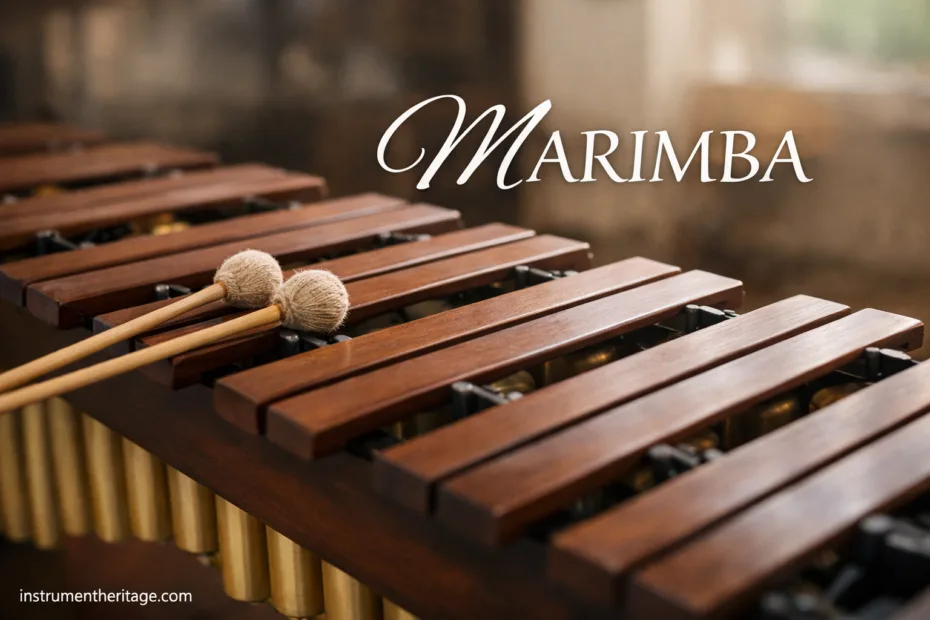
| Aspect | Details |
|---|---|
| Instrument family | A pitched percussion instrument with wooden bars laid out like a keyboard; each bar sits above a resonator that helps the note bloom. |
| Main sound source | The bar itself creates the pitch. The resonator does not “make” the note; it helps the fundamental speak more fully and gives the sound more body. |
| Typical materials | Rosewood remains the classic concert-bar material, while padauk and synthetic alternatives are also used for practice, climate stability, and outdoor durability. |
| Range | Student and ensemble instruments are often smaller, while concert marimbas commonly stretch into the low register where the instrument gets its dark, singing character. |
| Tone character | Round, warm, woody, and softly resonant. A marimba can whisper like felt on wood or speak with a bright, clear edge, depending on mallets, touch, and register. |
| Build details that matter | The underside of each bar is carved with care. That shaping changes both pitch and overtone balance, which is why marimba making feels half woodworking, half ear training. |
| Historic line | The marimba belongs to a long family of bar instruments linked to Africa, then reshaped in the Americas into local forms, ensemble traditions, and the concert instrument known today. |
| Closest relatives | Balafon, xylophone, vibraphone, and regional marimbas from Guatemala, Mexico, Colombia, and Ecuador. Similar layout. Very different feel. |
Marimba sound is easy to recognize and oddly hard to pin down. It has the attack of percussion, the length of a singing wooden tone, and a low register that feels almost architectural, as if the instrument were built from beams, air, and memory. Many pages stop at “it looks like a bigger xylophone.” That is true in the same way that a cello is just a bigger violin. It misses the point. A marimba is shaped by its bars, its resonators, its wood, its climate, the kind of mallet touching it, and the musical culture around it. All of that lives in the sound.
It also belongs to more than one story. There is the workshop story, where makers listen to grain, density, and ring. There is the acoustics story, where a little carved hollow under the bar changes far more than most listeners imagine. Then there is the human story: communal marimba traditions in Latin America, regional instruments with bamboo or gourd resonators, and the concert marimba that grew into a larger solo voice during the late twentieth century. Put those together and the instrument starts to come into focus.
🪵 A useful way to hear the marimba: think of the bar as the speaker and the resonator as the room. The note begins in the wood, then the air underneath gives it size.
🪚 How the marimba is built
The visual layout feels familiar because the bars follow a piano-like pattern. White-bar notes sit in front, accidentals rise behind them, and the whole frame fans out as pitches fall. Low bars get longer and wider. Much longer. That is why a serious marimba takes up real space and why the bass end looks almost like furniture made for sound rather than a simple percussion rack.
The bars are where the instrument really begins. Traditional concert models have long favored rosewood, a dense hardwood with a firm ring and a long, stable speaking tone. Padauk is also widely used and gives a slightly different color under the ear: still warm, still woody, often a bit more direct. Synthetic bars solve other problems. They handle weather better, they travel with less anxiety, and they make sense for schools or outdoor use, though many players still hear a gap in complexity when compared with good wood.
Good marimba wood is not chosen only by species name. Builders care about straight grain, density, internal damping, and how long the raw blank rings when struck. In other words, the best bar material is not just hard. It is musically hard. It holds shape, projects cleanly, and keeps enough life in the note that a phrase can breathe instead of drying out at the front edge.
The part many casual readers never see is underneath. Each bar is carved on its lower side, usually into a smooth arch or hollow. That carved cavity is not decoration. It is the place where pitch and color are nudged into place. Sand the wrong place, or sand a little too much, and the bar changes in ways that cannot be put back. Yamaha’s technical guide notes that makers lower pitch by removing more material from the center area, and that concert marimba bars are tuned not only for the main pitch but also for upper partials, with the low register often shaped so the first audible harmonic sits at roughly four times the fundamental and the next at about ten times.Reference-1✅
What that carving really does
- It lowers or raises the bar’s pitch by changing stiffness and mass.
- It changes how the bar’s upper partials line up with the main note.
- It shapes timbre, not just tuning.
- It helps separate a flat, wooden knock from a note that feels finished.
Then come the resonators. On most modern marimbas these are metal tubes under the bars, closed at one end and open at the other. Their lengths roughly follow the pitch map of the keyboard: lower note, longer tube. The low end can become awkwardly long, so makers curve, fold, or arch those tubes to fit the instrument into a playable form. Some arches are there for physics, some for layout, some for visual symmetry. Even the look of a concert marimba is tied to acoustic compromise.
🎼 Why the marimba sounds the way it does
The marimba’s voice lives in a neat tension. The bars produce a clear attack, but the note does not vanish like a woodblock. It opens. There is a soft halo after the strike, especially in the middle and low registers, and that halo is a mix of bar vibration, resonator support, and the player’s choice of mallet hardness and stroke placement.
A university acoustics study on marimba bars found that the resonators mainly strengthen the fundamental rather than the higher partials, which helps listeners hear a centered pitch instead of a cloud of competing overtones. The same study also shows that strike location matters: hits near the center favor the fundamental more strongly, while off-center playing lets more upper color into the sound.Reference-2✅
Center strike
Rounder, fuller, more settled. This is where the bar tends to speak with its main pitch front and center.
Off-center strike
More edge, more color, more bite. You hear extra sparkle in the note because the higher partials show themselves more clearly.
This is one reason good players sound so different from each other on the same instrument. They are not just “hitting the right notes.” They are choosing where the note blooms, how much edge the attack keeps, and how long the phrase should float. A marimba can sound almost vocal when lines are connected well, but it can also sound dry and speech-like if the player wants that. It has room for both.
Mallet choice pushes the sound even further. Soft yarn mallets round the attack and flatter the lower bars. Harder mallets bring articulation forward and help the upper register speak clearly. Very soft mallets on the high end can blur; very hard mallets on the bass can turn a note into too much click and not enough body. Players spend years balancing these trade-offs, and many carry several pairs for one performance.
Climate matters too. Wood absorbs and releases moisture. A bar that felt stable in one room can behave differently in another. That affects pitch drift, response, and ring. This is one of the least discussed parts of marimba culture online, yet every experienced player knows it. The instrument is made from living material, even after the tree is long gone.
🔔 The marimba’s warmth is not an accident. It comes from bar thickness, bar length, undercut carving, resonator tuning, and the softer contact of yarn-wrapped mallets.
🌍 Roots, routes, and the marimba’s many homes
The marimba is best understood as a family line rather than a single frozen invention. Oral history and instrument scholarship point to African ancestors in which wooden bars were sounded over pits in the ground and later over resonating gourds. In the Americas, those ideas were adapted into local instrument types, and modern marimbas eventually took on wooden and then metal resonators. Yamaha’s instrument history also notes that concert and conservatory marimbas commonly sit in the four-and-a-half to five-octave range, which shows how far the instrument has stretched from its earlier forms.Reference-3✅
That broad line matters because it keeps us from telling a thin story. The marimba did not simply appear as a ready-made concert instrument. It moved through communities, materials, climates, and performance habits. In some places it remained close to communal dance and ceremony. In others it became a salon instrument, an ensemble instrument, or later a recital instrument. Different marimba traditions kept different pieces of the family memory.
In Guatemala and southern Mexico, marimba traditions developed strong ensemble lives. Multi-player performance is not a side note there; it is part of the instrument’s social personality. The instrument can function almost like a shared table, with players occupying different registers and rhythmic roles. That changes the feel of marimba music completely. It becomes layered, social, and very physical. You do not just hear melody over accompaniment. You hear an interlocking wooden choir.
On the Pacific coasts of Colombia and Ecuador, regional marimbas live in another sound world again. Builders may use local woods and bamboo resonators, and the music breathes with drums, song, dance, and community ceremony. This is a helpful correction to a common internet habit: treating the concert marimba as the default version and everything else as a folk side branch. It is better to say that the concert model is one branch that became globally visible, while older and regional marimba cultures kept speaking in their own ways.
That is one of the instrument’s most beautiful traits. It can belong in a conservatory, a family celebration, a village feast, a school percussion room, or a chamber recital, and it does not lose itself in the move. The frame changes. The woods change. The repertory changes. The idea of struck bars over resonating air stays.
What many short articles leave out
- Marimba is not just “large xylophone.”
- The lower register, softer mallet culture, and carved overtone tuning give it another musical job entirely.
- Marimba is not one single design.
- Concert marimbas, Guatemalan ensemble marimbas, and Pacific regional marimbas may share family traits while sounding and functioning quite differently.
- Marimba history is not only about dates.
- It is also about migration, woodworking, communal use, and how local materials reshape the same basic idea.
🛠️ The turn toward the modern concert marimba
The modern solo marimba did not simply get louder or larger by accident. It was pushed forward by performers who needed more range, cleaner intonation, and a bass register that felt musically useful rather than merely present. One of the biggest changes came through the long collaboration between Keiko Abe and Yamaha. According to Yamaha’s history of the instrument, that partnership ran for sixteen years, led to the first five-octave concert marimba in 1984, and was followed by production in 1985. That shift widened the repertoire and helped make the five-octave layout the serious study standard many players now expect.Reference-4✅
This matters musically, not just historically. Once the bass grew downward, composers could write lines that felt less like decorated treble percussion and more like full-bodied counterpoint. Chords opened up. Transcriptions became more convincing. Solo writing could lean into resonance instead of always racing away from it. That is part of why the concert marimba today can carry Bach arrangements, contemporary solo works, chamber music, and large percussion ensemble writing without sounding misplaced.
🥁 How players shape the instrument in real time
Watching a marimbist from a few feet away changes how you hear the instrument. Four-mallet playing makes harmony possible, but it also turns the hands into little systems of spacing, weight, and rebound control. A player is constantly deciding how open the interval should be, how much vertical motion to use, and whether a note should speak and leave or stay and glow.
The instrument rewards clean motion. Heavy effort often sounds heavy. Efficient motion sounds larger. That sounds backwards until you feel it. The bars respond best when the stroke is organized, not forced. The low register especially likes patience. Push too hard and you hear attack before pitch. Let the mallet sink just enough and the bar gives back a full, rounded note.
What players listen for under the hands
- Attack shape: soft, centered, dry, bright, or pointed.
- Ring length: whether the note hangs in the air or drops quickly.
- Register balance: the bass can swallow detail; the top can turn glassy.
- Mallet blend: mixed hardness setups help one instrument behave like several.
- Bar response: some notes feel eager, others need coaxing.
A good marimba almost teaches phrasing back to the player. Long lines need breath points because the instrument does not sustain like bowed strings or wind instruments. Players create the illusion of sustain with touch, timing, roll speed, pedal-free resonance management, and smart mallet choice. That is part of the marimba’s charm. It sings, but it sings through repeated contact, not one endless exhale.
🎶 Marimba and similar instruments
It helps to place the marimba beside its relatives, because that is where its personality sharpens. The easiest comparison is the xylophone, but that is only the start. The balafon keeps older family traits alive in a different material world, while the vibraphone shares the keyboard layout but lives in metal and sustained shimmer rather than carved wood and air-column warmth.
| Instrument | Main material | Typical sound | What feels different |
|---|---|---|---|
| Marimba | Wooden bars with resonators below | Warm, deep, rounded, vocal in the middle and low range | Best for lyrical lines, rolled harmony, and a broad wooden color palette |
| Xylophone | Hard wooden bars, usually shorter and brighter in response | Dryer, brighter, sharper, more cutting | Speaks fast and clean; less bloom, more edge |
| Balafon | Wooden bars with gourd resonators | Earthy, buzzing, rhythmically alive | Closer to older West African bar traditions; the buzz itself is part of the voice |
| Vibraphone | Metal bars with resonators and motor-driven discs | Smooth, metallic, sustained, shimmering | Uses pedal sustain; phrases float very differently from marimba lines |
If the xylophone is clean ink on paper, the marimba is more like ink on wood grain. The line still reads clearly, but the surface talks back. That is why marimba writing often leans into resonance, rolled chords, and spacing across registers. The instrument enjoys room. It likes notes that can stand near each other without crowding.
One last thing worth noticing: the marimba’s identity is shared between craft and culture. Take away the woodworking and you flatten the sound. Take away the regional traditions and you flatten the history. Keep both in view, and the instrument becomes much more interesting: not just a concert percussion staple, but a living family of wooden voices shaped by makers, players, and places.
FAQ
Why does a marimba sound warmer than a xylophone?
The marimba usually speaks with softer mallets, longer and broader bars, and a lower register. Its bars are also carved and tuned for a more blended overtone profile. That gives the note more body and less snap. A xylophone tends to sound brighter and drier because its setup favors quicker, harder attack and a tighter response.
What wood is most associated with concert marimbas?
Rosewood is the classic concert-bar material because of its density, projection, and ringing quality. Padauk is also common and respected. Synthetic bars are practical for schools, outdoor use, and changing weather, though many players still prefer the more layered sound of fine wood.
Do the resonators create the pitch?
No. The wooden bar creates the pitch. The resonator mainly supports and strengthens what the bar is already doing, especially the main pitch your ear locks onto. That support is a big part of why the note feels fuller and more settled than a bare struck bar.
Is the marimba African or Latin American?
Both ideas matter. The instrument belongs to a longer family of African bar instruments, and in the Americas it developed into distinct local marimba traditions with their own materials, tuning habits, ensemble roles, and repertories. The concert marimba used in conservatories is one later branch of that wider history.
Why do marimba players use yarn mallets?
Yarn wrapping softens and shapes the attack. It helps the bar speak with tone rather than too much click, especially in the lower range. Hardness still varies a lot, so players switch mallets depending on register, hall, articulation, and the color they want from the phrase.
What changed when the five-octave marimba appeared?
The extra bass notes changed the instrument’s musical reach. Composers could write fuller harmony, deeper bass motion, and more convincing large-form solo music. It also helped the marimba step forward as a recital instrument rather than staying mostly in a supporting or coloristic role.
