
| Museum concern | Why instruments are vulnerable | Examples | Typical storage response |
|---|---|---|---|
| Relative humidity | Wood, skin, gut, adhesives and some decorative materials change as moisture levels change. | Violins, lutes, drums, harps, pianos, wooden winds | Stable environmental control, monitoring and slower transitions between different spaces |
| Structural load | Necks, bells, bridges, keys, membranes and projecting parts may not safely carry the instrument’s weight. | Guitars, long flutes, horns, drums | Custom cradles, padded supports and carefully chosen resting positions |
| Corrosion | Moisture, salts, pollutants and fingerprints can alter metal surfaces. | Brass instruments, metal keys, strings, tuning hardware | Controlled humidity, clean handling and chemically suitable storage materials |
| Mechanical damage | Historic instruments may contain delicate springs, levers, valves, jacks and other moving parts. | Woodwinds, pianos, harpsichords, organs, accordions | Restricted operation, condition checks and support that does not press on mechanisms |
| Light and dust | Paint, textiles, labels, skins, coatings and delicate surfaces may fade, abrade or collect contaminants. | Decorated instruments, cases, drums, keyboards | Low-light storage, enclosures, dust control and careful surface cleaning |
| Loss of historical evidence | Cleaning, replacement or restoration may remove tool marks, old repairs, wear or original components. | Any historic instrument | Documentation first, minimal intervention and specialist assessment |
A museum rarely stores a fragile musical instrument by simply placing it in a case and closing the door. A historic violin, flute, drum or keyboard can combine wood, metal, skin, gut, bone, ivory, textiles, adhesives and surface coatings in one object, and each material responds differently to moisture, temperature, light, pollutants and physical stress. The storage method has to protect the instrument’s structure while also preserving evidence of how it was made, repaired, played and altered during its working life.
This is why musical instruments occupy an unusual place in museum conservation. They are cultural objects, pieces of craftsmanship and functional sound-producing devices at the same time. A part that looks worn or unusable may still preserve maker’s marks, tool traces, original materials or evidence of performance. Replacing it can solve a mechanical problem while removing information that cannot be recreated later.
Why Musical Instruments Are Difficult Museum Objects 🎻
A musical instrument often behaves as a composite object. Different materials are joined tightly together even though they respond differently to the same room conditions. The spruce soundboard of a violin reacts to moisture differently from its maple ribs. Metal strings react differently from gut. A drum may combine wood, animal skin, adhesives, cord, metal fittings and painted decoration.
That combination matters because deterioration rarely respects material boundaries. If a wooden soundboard changes dimension while a bridge, brace or glued joint restricts that movement, stress can concentrate around the connection. If moisture reaches iron fittings attached to wood, corrosion products can expand and affect nearby material. If a skin membrane changes tension, the force transferred to its shell also changes.
One instrument can contain several preservation problems
- Wood: dimensional movement, cracking, warping and failed joints
- Metal: corrosion, bending, surface abrasion and mechanical wear
- Skin and parchment: tension changes, deformation and sensitivity to moisture
- Gut: changing tension and dimensional response to humidity
- Ivory and bone: cracking, distortion and sensitivity to rapid environmental change
- Textiles and felt: dust retention, pest activity, abrasion and deterioration
- Historic coatings: flaking, scratching, staining or accidental removal during cleaning
Museums therefore assess the whole instrument and the relationships between its materials, rather than treating the wood, metal or skin as unrelated pieces.
Wear is not automatically damage to be erased
Historic musical instruments often preserve evidence that would disappear during an aggressive restoration. Finger wear on a neck, old string marks at a bridge, an early repair, tool marks inside a body or patina around frequently handled parts may help explain manufacture and use. Even a component that no longer works can retain information about an earlier construction method.
The International Committee of Musical Instrument Museums and Collections has long drawn attention to the value of original material and historical evidence when conservation decisions are made. Reference-1✅
Conservation and repair do not always have the same goal. A repair may aim to make an instrument work again. Museum conservation may instead retain an original but non-functioning part because its material, wear or construction contains historical information.
Storage Begins With a Condition Assessment 🔎
Before a fragile instrument receives a shelf position, drawer, cradle or enclosure, museum staff need to know what can safely support weight and what should not be touched. A visual examination creates a baseline for later comparison.
Structural weaknesses are mapped before the instrument is moved
The examination may record open seams, soundboard cracks, loose ribs, unstable bridges, distorted necks, damaged bells, weak membranes, loose decorative inlay and detached components. Mechanical instruments need another layer of inspection because keys, valves, springs, levers and linkages may appear complete while remaining too fragile to operate.
- Identify the materials and major components.
- Record existing cracks, losses, corrosion and distortion.
- Note previous repairs and replacement parts.
- Check whether detachable pieces are secure.
- Mark areas that must not carry weight.
- Photograph vulnerable details before storage or transport.
- Record the intended storage orientation and handling restrictions.
Condition photography is especially useful for slow changes. A small corrosion spot, lifting varnish edge or hairline crack can be compared with later photographs instead of relying on memory.
Documentation can reduce handling
A clear collection record allows staff to find an instrument without repeatedly moving neighboring objects. Storage data can include the accession number, drawer or rack location, dimensions, materials, detached accessories, condition notes, previous treatment, safe lifting points and restrictions on playing or mechanical operation.
This administrative detail has a physical effect: fewer unnecessary movements mean fewer opportunities for impact, abrasion and accidental stress.
Climate Control Is About Stability, Not One Universal Number 🌡️
Wooden and organic instrument parts exchange moisture with the surrounding air. When relative humidity falls, wood loses moisture and contracts. When it rises, wood gains moisture and expands. The movement is not equal in every direction of the grain, which is one reason soundboards, ribs, braces and glued structures can develop stress as conditions change.
The Metropolitan Museum of Art describes approximately 68°F ±2°F (about 20°C ±1°C) and 50% ±5% relative humidity as suitable conditions for many instruments made mainly from wood and organic materials in its care. The same guidance warns that repeated humidity changes can contribute to cracking, warping and glue-joint failure, while sustained conditions above about 65% RH can encourage mould and create problems for metal parts. These figures should be read as a museum practice reference, not a universal setting for every instrument. Reference-2✅
There is no single museum humidity setting for every musical instrument. Material composition, previous environment, condition, corrosion risk and intended use all affect the decision. An instrument made almost entirely from metal may need different treatment from a wooden lute decorated with ivory and fitted with gut strings.
Fast changes can matter as much as the average
An instrument can spend months in a stable room and then encounter stress when moved rapidly into a much drier or more humid space. Thick and thin wooden parts may respond at different rates. Glue lines and cross-grain construction can restrict movement. Tensioned skins and gut strings react differently again.
- Falling RH
- Wood may shrink, joints may open, some membranes tighten and brittle materials may become less tolerant of movement.
- Rising RH
- Wood may swell, organic materials may soften or deform, metal corrosion risk can rise and mould becomes a concern when damp conditions persist.
- Repeated cycling
- Expansion and contraction can place repeated stress on joints, veneers, soundboards and mixed-material assemblies.
Microclimates can protect unusually sensitive objects
A museum does not always need to change an entire storage room for one unusual object. A well-designed enclosure can buffer short-term environmental change around a particularly sensitive instrument. This approach may be useful for objects containing ivory, unstable organic material, corrosion-prone metal or combinations of materials with narrow tolerances.
The enclosure itself must also be suitable. A tightly closed box made from a problematic material can trap pollutants next to the object, so enclosure materials and internal air quality matter as much as the seal.
Custom Supports Keep Weight Away From Fragile Parts
A museum shelf is flat. Musical instruments often are not. Curved bodies, bells, necks, bridges, pegs, keywork and membranes create contact points that can be damaged if the instrument rests in the wrong position for years.
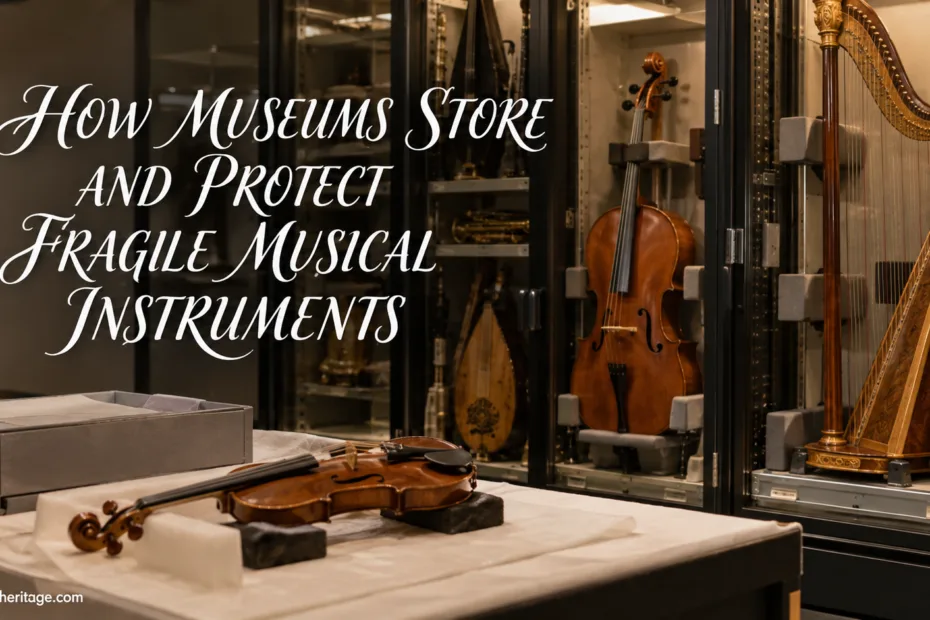
For this reason, museum storage often uses custom cradles, padded blocks, shaped foam supports, trays or compartmented drawers. The aim is to distribute weight across structurally stronger areas while preventing rolling, tipping and pressure on projecting details.
A good support answers three physical questions
- Where can the instrument safely carry its own weight?
- Which parts must remain completely unloaded?
- Can staff lift it without first removing several fragile components?
Long, slender objects such as flutes or pipes may need support at several points so their weight is not concentrated only at the ends. A horn may need a shaped cradle that prevents rolling without pressing on valves or thin tubing. A string instrument may require body support that leaves the bridge, neck and pegbox free from unintended load.
Storage materials must be selected too
Museum supports commonly use conservation-compatible materials such as suitable polyethylene foams, neutral papers, boards and barrier layers. The exact choice depends on contact surface, object weight, chemical compatibility and the expected storage period.
Soft does not automatically mean safe. Some foams, adhesives, fabrics, paints and wood products can age poorly or release compounds that affect nearby surfaces. A support has to be mechanically useful and chemically appropriate.
An original case may be historic without being ideal storage
Instrument cases can be valuable collection objects in their own right. They may preserve maker labels, ownership marks, travel history, fittings and original accessories. Yet an old case can also contain degraded padding, acidic board, unstable foam, worn fabric or adhesives that no longer hold safely.
When a case remains physically suitable, it may provide useful support and environmental buffering. Canadian Conservation Institute guidance for wind instruments recommends checking that padding and lining remain in good condition and that the instrument fits properly; it also advises storing reeds, mouthpieces and other supplementary devices carefully rather than leaving them fitted where they can become stuck. Reference-3✅
Historic case does not automatically mean conservation-grade storage. Museums can preserve the original case while giving the instrument a separate support or barrier when the old lining, fit or construction presents a risk.
How Storage Needs Change Between Instrument Families
The same preventive-conservation principles apply across a collection, but the physical weak points differ sharply between instrument types. A drum membrane, violin bridge and piano action cannot be treated as interchangeable structures.
| Instrument group | Parts most vulnerable in storage | Main environmental concern | Support concern |
|---|---|---|---|
| Bowed and plucked strings | Soundboard, bridge, neck, ribs, pegs, strings and glue joints | Humidity-driven wood movement and changing string tension | Keep long-term weight away from bridge, pegbox and projecting fittings |
| Woodwinds | Long wooden bodies, keywork, pads, reeds and joints | Wood movement, corrosion and deterioration of pads or organic accessories | Support long bodies evenly and avoid pressure on keys |
| Brass instruments | Thin tubing, bells, valves, slides and surface finishes | Corrosion, fingerprints and moisture | Prevent rolling, dents and contact pressure on valve assemblies |
| Drums and membrane instruments | Skins, hoops, lacing, shells and painted surfaces | Membrane tension changes with moisture | Do not place long-term loads on the membrane or delicate rims |
| Harps and zithers | Soundboards, bridges, tuning systems and many tensioned strings | Wood movement combined with string load | Stable structural support without forcing the frame |
| Keyboard instruments | Actions, jacks, hammers, strings, soundboards, felts and leather | Mixed organic materials, dust, humidity and mechanical aging | Large-object support plus protection of delicate internal mechanisms |
| Free-reed instruments | Reeds, bellows, valves, leather and internal linkages | Humidity, corrosion and deterioration of flexible materials | Avoid compressing bellows or operating stiff mechanisms without assessment |
| Historic electronic instruments | Wiring, insulation, switches, capacitors, contacts and plastic parts | Material aging, heat, dust and electrical component deterioration | Protect controls and prevent cable strain; operation requires technical assessment |
String instruments carry stored mechanical tension
A violin, guitar, lute, harp or zither is not merely a wooden shell. Strings apply force through the bridge, neck, tuning system and body. That load can interact with weakened glue joints, old repairs or distorted wood.
There is no reliable rule that every museum string instrument should be fully tuned or that every instrument should have its strings completely loosened. The decision depends on construction, string material, current setup, structural condition and whether altering tension could itself move the bridge, soundpost or other components. Tension changes on a fragile historic instrument are conservation decisions, not routine tuning.
Wind instruments combine long bodies with delicate mechanisms
Historic flutes, clarinets, oboes and related instruments may have thin walls, separate joints, fragile keys and pads. Metal instruments add the possibility of dents and corrosion. Reeds and mouthpieces can be particularly vulnerable because they are small, detachable and easy to misplace.
Long instruments should not be supported in a way that creates persistent bending stress, while keywork should remain clear of direct load. Storage trays can also keep detached components associated with the correct accessioned object.
Membranes can change even when nobody touches them
Drumheads and other tensioned skins react to moisture. As the material changes, the tension transferred to hoops, lacing and shells may change too. This is why a museum does not treat a drumhead as a convenient flat surface for supporting the instrument or placing another object.
The same reasoning applies to gut strings and other tensioned organic components. Their condition depends on both the material itself and the structure carrying the tension.
Moving Parts May Be More Vulnerable Than the Outer Case ⚙️
A closed piano, organ or harpsichord can look stable while concealing hundreds or thousands of individual parts. A key press transfers motion through a mechanism containing wood, cloth, felt, leather, wire, pivots, springs or adhesives. Age affects each material differently.
The Canadian Conservation Institute notes that a modern piano action can contain more than 40 individual pieces for each note and advises against sounding a keyboard instrument unless its working condition is known. Historic pump organs and other keyboard systems also contain fragile mechanisms that can deteriorate while unused. Reference-4✅
A key that still moves is therefore not proof that the whole action can be operated safely. The same applies to a stiff brass valve, woodwind key, tuning mechanism or free-reed assembly.
Mechanical parts that need extra attention
- Piano actions
- Harpsichord jacks
- Organ trackers and bellows
- Woodwind keywork
- Brass valves and slides
- Accordion reeds and bellows
- Mechanical music mechanisms
- Tuning machines and geared pegs
- Pedals and linkages
- Historic electrical switches and contacts
Dust, Pollutants, Light and Pests Still Matter in a Closed Store
Storage protects instruments from ordinary public contact, but it does not remove environmental risks. Dust can settle in mechanical assemblies and textured surfaces. Pollutants can react with metals and coatings. Light can alter dyes, paper labels and some surface finishes. Organic materials can attract insects when suitable food sources and conditions are present.
Dust removal has to respect unstable surfaces
A soft brush and controlled vacuuming may be appropriate for some stable surfaces, yet loose paint, deteriorated felt, fragile textile, reeds or mechanical parts require more care. Direct suction can remove small detached components before anyone realizes they were loose.
Cleaning also raises an interpretive question. Dirt, rosin, wear and residue are not always equivalent. Some deposits may relate to use history, while others simply accelerate deterioration. Museum cleaning is therefore based on examination rather than a goal of making an old instrument look new.
Storage furniture can introduce pollutants
Cabinets, boards, foams, paints, fabrics and adhesives are part of the storage environment. Materials that emit reactive compounds can be especially problematic inside a small enclosure where air exchange is limited. Metal fittings, silvered surfaces, copper alloys, coatings and some organic materials may be affected by unsuitable storage products.
This is one reason museum storage is planned around material compatibility rather than softness, appearance or convenience alone.
Pest monitoring is preventive conservation
Wood, felt, leather, horn, feathers, natural fibres and other organic materials can create insect risks within instrument collections. Museums commonly use an integrated approach based on inspection, traps, housekeeping, isolation of suspect objects and treatment chosen for the affected material.
Signs worth recording include fresh exit holes, powdery debris, shed insect skins, webbing, damaged fibres, new surface loss or unexpected material collecting beneath an instrument.
Low light protects more than decoration
Painted drumheads, dyed textiles, paper labels, decorated cases and some historic coatings can be light-sensitive. Storage areas are therefore commonly kept dark when staff are not working in them. This also avoids adding unnecessary heat from lighting near sensitive objects.
Handling Is Planned Before the Instrument Leaves Its Support 👐
Many museum accidents occur during movement rather than while an object is resting undisturbed. Large instruments may be heavy but locally fragile. Small instruments may have projecting keys, tuning pegs or decorative parts that catch easily on clothing or packing material.
Before a move, staff can plan the route, clear doors and work surfaces, identify lifting points, secure or separately pack loose accessories and prepare a padded cart or transport support. A long object may require two people even if its weight is modest because controlling both ends reduces bending and collision risk.
- Check the current condition.
- Identify safe lifting and supporting areas.
- Secure detachable components without forcing them.
- Clear the route and receiving surface.
- Use a tray, cradle or cart suited to the object’s shape.
- Move slowly enough to control vibration and clearance.
- Check the object again after arrival.
Gloves are chosen according to the object
Clean hands can provide better grip on some surfaces, while suitable gloves can protect polished metal, varnish or sensitive finishes from oils and salts. Loose or poorly fitting gloves can reduce tactile control and catch on projecting parts.
The choice depends on the material and handling task. The objective is simple: protect the surface without making the object harder to hold safely.
Why Museums Do Not Test Fragile Instruments by Simply Playing Them
A musical instrument was made to produce sound, but producing that sound requires physical action. Strings are displaced. Keys and levers move. Air carrying moisture passes through wind instruments. Drum membranes flex. Bows add friction and rosin. Tuning changes mechanical load.
On a modern working instrument those actions are normal. On an accessioned object with old glue, brittle leather, weakened springs or an unstable surface, the same actions can create damage that is disproportionate to the few seconds of sound produced.
“Playable” and “safe to play” are different assessments
An instrument may produce a note while still being structurally unsuitable for performance. A piano key can descend even when deeper action parts are degraded. A flute key can move while its pad, spring or axle is unstable. A string can sound while the bridge or soundboard beneath it is already under excessive stress.
For that reason, museums may restrict casual plucking, key pressing, valve movement, blowing through reeds and other informal tests. If performance is considered, the instrument can first receive a condition assessment, structural review and a decision about whether tuning, adjustment or cleaning would remove original material.
Some instruments are preserved without being returned to performance
An original instrument can retain construction details that would have to be altered to make it dependable on stage. Old strings, reeds, action cloth, bridges, electrical parts, leather components or earlier repairs may no longer function as intended, yet they can still tell researchers how the object was made and maintained.
In those situations, a museum may preserve the original instrument primarily as historical material evidence. A reconstruction, replica, modern instrument or recorded example can provide access to a related sound without requiring the surviving object to absorb repeated performance wear.
Instruments retained for performance need another level of care
Some museum collections do allow selected instruments to be played. That decision changes the conservation routine. Environmental conditions in the performance space need to be considered, tuning and adjustment may require specialist oversight, and the instrument should be checked before and after use.
- Check structural stability before tuning or operation.
- Keep performance and storage environments reasonably compatible.
- Watch for condensed moisture in wind instruments.
- Remove appropriate performance residues only when the surface permits it.
- Record mechanical or structural changes after use.
- Return detached accessories to their documented storage locations.
Storage and Exhibition Place Different Demands on an Instrument
| Issue | Museum storage | Gallery display |
|---|---|---|
| Light | Can remain very low or off for long periods | Needs enough light for visitors to see the object |
| Access | Mainly trained staff and approved researchers | Public viewing requires barriers or cases |
| Support | Can prioritize physical stability without concern for appearance | Mount must combine stability with clear viewing |
| Space | Efficient shelving, drawers and compact storage may be used | Objects usually receive more visual space |
| Environment | Long-term stability is easier to prioritize | Lighting, visitors, case design and gallery operation add variables |
| Handling | Repeated movement can often be minimized | Installation and exhibition rotation create additional handling events |
This difference explains why a beautiful display mount is not automatically the right long-term storage support. A storage cradle can be wider, more protective and less visually discreet because its purpose is physical stability rather than presentation.
Museum Storage Is Monitored After the Door Is Closed 📊
Long-term preservation depends on detecting change early. Museums can use temperature and RH data loggers, environmental alarms, pest traps, routine inspections and collection records to identify patterns that are difficult to notice during a single visit.
Environmental data needs interpretation
A data logger does not protect an instrument by itself. It records what happened. Staff then compare the readings with object condition, seasonal patterns, building operation and the needs of the collection.
For example, a room with an acceptable monthly average RH may still have rapid daily swings that deserve attention. A second room may have slightly different average conditions but remain much steadier. The pattern matters.
Regular inspection catches changes that sensors cannot
Environmental sensors cannot see a loose bridge, fresh insect debris, a spreading corrosion spot or a new crack. Periodic visual checks remain necessary, particularly for instruments kept inside closed boxes, drawers or cases.
Environmental monitoring
- Relative humidity
- Temperature
- Water leaks
- Unusual dampness
- Light exposure where relevant
Object monitoring
- Cracks and open joints
- Corrosion
- Loose parts
- Mould
- Pest evidence
- Surface lifting or flaking
Water, Heat and HVAC Failure Need Instrument-Specific Responses
Emergency planning is especially important for mixed-material instruments because one incident can trigger several types of change at once. Water can swell wood, weaken adhesives, stain textiles, deform skins and accelerate corrosion. Heat can affect coatings, glues, plastics and tensioned organic materials. Loss of environmental control can expose instruments to rapid humidity movement.
A wet string instrument, for example, should not simply be forced back to normal tuning as it dries. A soaked historic case should not automatically remain closed around the instrument. A damp mechanical instrument may contain hidden metal and textile components that need separate assessment.
Emergency response therefore begins with stabilization and documentation, followed by treatment suited to the object’s materials and condition. Fast action is useful; uncontrolled action is not.
What a Well-Planned Museum Storage System Protects
Physical survival is only one part of instrument preservation. Museum storage also protects information. Original stringing arrangements, old repairs, construction marks, labels, decorative surfaces, worn finger positions and unusual components can all help future researchers understand how an instrument was made and used.
The process is connected: identify the materials → record the condition → choose the environment → support the structure → control handling → monitor change → reassess when needed.
This approach works across very different instruments because it starts with the object rather than forcing every instrument into the same storage rule. A seventeenth-century lute, nineteenth-century keyed flute, skin-headed drum, early piano and electronic instrument may share a museum room, yet each can need a different support, handling method and environmental interpretation.
Questions About Museum Instrument Storage
What humidity do museums use for musical instruments?
There is no single RH value for every instrument. Many wooden and organic instruments are kept near a stable middle range, while metal-rich or unusually sensitive objects may need different conditions. Material composition, previous environment and current condition all affect the decision. Avoiding sharp fluctuations is often as important as the target value itself.
Do museums keep violins and guitars fully tuned in storage?
Not by a universal rule. String tension interacts with the bridge, soundboard, neck, joints and previous repairs. Some instruments may remain under controlled tension; others may need reduced load. Changing the setup of a fragile historic instrument should follow a condition assessment rather than routine tuning practice.
Are original instrument cases safe for museum storage?
Sometimes. A well-fitting historic case with stable padding can provide useful physical protection, but old foam, fabric, board, adhesives or fittings may have deteriorated. Museums assess the case as an object in its own right and may use an additional barrier, support or separate storage system when needed.
Why are museum instruments placed on custom foam supports?
Custom supports distribute weight across stronger areas and keep pressure away from bridges, keys, valves, bells, pegboxes, membranes and other vulnerable parts. They also prevent irregularly shaped objects from rolling or tipping. The foam or other support material must itself be suitable for museum use.
Why do museums sometimes remove mouthpieces and reeds before storage?
Small accessories can become stuck, distorted, damaged or lost when left fitted for long periods. Separating them can reduce mechanical stress and make inspection easier, provided each component remains clearly associated with the correct instrument in the collection record.
Can a museum play a historic instrument to check whether it still works?
A casual sound test can move fragile mechanisms, change string load, introduce moisture or place force on weakened parts. Museums may allow selected instruments to be played after specialist assessment, but producing a note is not by itself proof that an instrument is safe for performance.
Why would a museum preserve an instrument that can no longer be played?
The surviving materials may preserve original construction, repairs, wear and maker practices that could be lost during restoration. For some objects, retaining that evidence has more long-term research value than returning the instrument to regular performance.
How are large instruments such as pianos stored?
Large instruments need stable floor support, enough clearance for safe access and protection for legs, pedals, casters, lids and internal mechanisms. Their size does not make them mechanically simple. Moving them also requires planning because heavy outer cases can contain delicate soundboards, actions, strings, felts and linkages.
How often are stored instruments checked?
Inspection frequency depends on material, condition, environment and institutional practice. Instruments with active corrosion, pest concerns, unstable surfaces or recent environmental change may require closer observation than stable objects in well-controlled storage. Environmental data and visual inspection are used together.
