
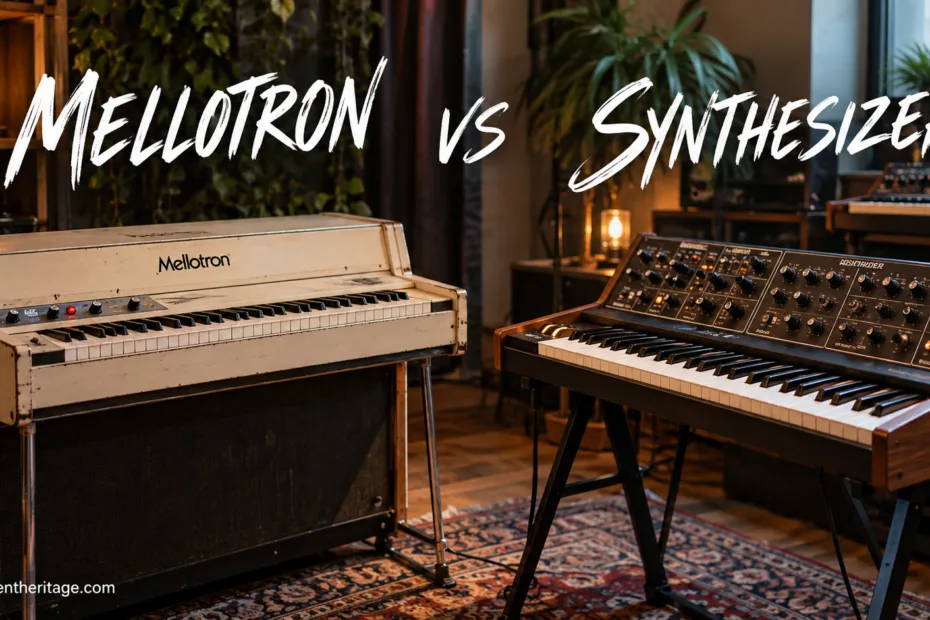
| Feature | Mellotron | Synthesizer |
|---|---|---|
| Classic sound source | Recorded performances on magnetic tape | Oscillators, digital algorithms, samples, wavetables, physical models, or combinations of these |
| Basic sound process | Tape playback controlled from a keyboard | Electronic or digital sound generation and shaping |
| Timbre editing | Limited on classic tape instruments | Often extensive, depending on the synthesis method |
| Classic note duration | About eight seconds on an M400-style tape mechanism | Can be very short, sustained while a key is held, or programmed to evolve over time |
| Envelope control | Much of the attack and development is already captured in the recording | Frequently editable with ADSR envelopes and modulation |
| Pitch character | Tape speed, motor behavior, recording pitch, and mechanical setup all matter | Depends on oscillator, sample, tuning, modulation, and synthesis architecture |
| Note-to-note variation | Strong because individual pitches can contain separate recorded performances | Ranges from highly consistent to deliberately varied |
| Polyphony | Classic models can play multiple tape recordings at once | Model-dependent: monophonic, paraphonic, or polyphonic |
| Modern versions | Analog tape instruments and digital Mellotrons both exist | Analog, digital, sample-based, software, and hybrid designs |
| Main musical strength | Recorded instrumental texture with tape-replay character | Flexible tone creation, shaping, and modulation |
A Mellotron and a synthesizer may both have piano-style keys, sit in the same keyboard rig, and produce strings, choirs, brass, or unusual electronic textures. The resemblance becomes much smaller once the sound-making process is examined. A classic Mellotron plays prerecorded performances from magnetic tape. A synthesizer uses an electronic or digital sound system that can create, combine, process, or reshape its source material. Modern instruments make the boundary less tidy, because synthesizers can use samples and current Mellotrons can use digital playback.
The useful distinction is therefore not simply “tape versus electronics.” It is the relationship between the sound source, the playback or synthesis architecture, and the controls given to the performer.
A classic Mellotron starts with a recording that already contains a performance. A traditional subtractive synthesizer starts with an oscillator waveform and gives the player tools such as filters, envelopes, and modulation to construct the final tone. A sample-based synthesizer sits between those simple descriptions because its starting material may also be recorded audio.
🎹 Mellotron and Synthesizer Start With Different Sound Sources
The original Mellotron belongs to the family of electro-mechanical tape-replay keyboards. Its familiar flute, violin, cello, brass, choir, and other voices began as recordings. Pressing a key does not instruct an oscillator to calculate or generate a flute-like tone. It starts playback of recorded material associated with that pitch.
That detail changes almost everything about the instrument. Breath noise from a flute player, bow attack from a string player, vibrato, pitch movement, microphone coloration, and differences between separate recorded notes can remain inside the finished Mellotron sound.
A synthesizer is a much broader category. A classic subtractive instrument may begin with sawtooth, square, pulse, triangle, or other oscillator waveforms, mix them, filter their harmonic content, and control their level over time. FM synthesis, wavetable synthesis, additive synthesis, granular systems, physical modeling, and sample-based synthesis follow other routes.
For that reason, saying that every synthesizer “creates its sound from an oscillator” is too narrow. Many digital synthesizers use recorded samples as part of their tone generation. What separates them from a classic Mellotron is the larger sound-design system around that source material.
📼 What Happens After a Key Is Pressed?
The mechanical sequence inside a tape Mellotron is one of the clearest ways to understand the difference.
Inside a Classic Mellotron
- The player depresses a key.
- A pinch roller associated with that key presses the tape against a rotating capstan.
- A pressure pad holds the magnetic tape against the playback head.
- The moving tape carries the recorded note across the head.
- The magnetic recording becomes an electrical audio signal.
- When the key is released, tape contact ends and a spring returns the strip to its starting position.
The National Music Centre documents the M400 as a 35-note polyphonic instrument with a removable frame holding 35 sets of three-track 3/8-inch magnetic tape. Its mechanism includes the motor, capstan, rubber pinch rollers, pressure pads, playback system, and return springs. Reference-1✅
Inside a Typical Subtractive Synthesizer
- An oscillator or another tone source supplies the starting waveform.
- A mixer may combine several oscillators or noise sources.
- A filter removes or emphasizes parts of the harmonic spectrum.
- An amplifier stage controls level.
- Envelopes can change amplitude, filter cutoff, pitch, or other parameters over time.
- LFOs and other modulation sources can move parameters automatically while the note plays.
Two Sound Paths
Classic Mellotron: recorded musician → magnetic tape → mechanical transport → playback head → amplification → output
Subtractive synthesizer: oscillator or tone source → mixer → filter → amplifier → output, with envelopes and modulation controlling parts of the path
🎧 A Mellotron Note Contains a Recorded Performance
One of the most useful distinctions is easy to miss. A Mellotron recording does not merely contain a pitch. It may contain the way a musician produced that pitch.
- A flute recording may include breath and a natural attack.
- A violin recording may contain bow noise, vibrato, and a particular bow speed.
- A choir recording contains vowel shape, human pitch movement, and the blend of recorded voices.
- A brass recording can carry the articulation and timbral change of the original performance.
Neighboring Mellotron notes can therefore differ slightly. The player recorded for one pitch did not necessarily begin the next pitch with exactly the same timing, intensity, vibrato, or tuning. Tape transport adds another layer of variation.
On many synthesizers, several notes played from the same patch share the same sound-design instructions. Their pitches differ, and voice circuitry or programming may introduce variation, but they are usually generated from one coordinated patch rather than from dozens of independently performed acoustic notes.
🎻 Why Mellotron Strings and Synth Strings Behave Differently
String sounds make the difference especially clear because both instruments can produce a sustained orchestral texture while reaching that result through very different processes.
| Detail | Mellotron Strings | Synth Strings |
|---|---|---|
| Starting material | Recordings of string players or ensembles | Often oscillators, samples, or a combination |
| Attack | Partly determined by the recorded bow attack | Can often be adjusted with an envelope |
| Vibrato | May already be contained in the original performance | Can be generated or controlled with modulation |
| Pitch variation | Recording differences plus tape-speed behavior | Oscillator behavior, sample tuning, detune, modulation, or programming |
| Sustain | Finite on classic tape models | Can often continue while the key remains depressed |
| Tone shaping | Relatively limited after the recording is selected | Filters, envelopes, modulation, effects, layering, and other controls may be available |
A conventional analog-style string patch might use several sawtooth oscillators, slight detuning, a low-pass filter, a slower amplitude attack, and chorus or ensemble modulation. The result can serve a similar musical role to Mellotron strings, but it is not reproducing the same process.
A sample-based synthesizer can come much closer because it may begin with recorded strings. If its samples were taken directly from a Mellotron, the audible distance becomes smaller still. The distinction then moves away from the original source recording and toward playback behavior, parameter control, mapping, looping, and emulation of the tape mechanism.
⏱️ The Eight-Second Limit Changes Mellotron Technique
A classic Mellotron does not normally use an endless tape loop for each sustained note. In an M400-style mechanism, the tape travels forward while the key is held and returns after the key is released. The playable recording is therefore limited to roughly eight seconds. The National Music Centre identifies this finite tape travel as one of the defining operating limits of the instrument. Reference-1✅
This is not just a specification. It affects phrasing.
- Long chords have to be released and retriggered before the tapes reach the end.
- Individual notes can be reset at different moments so an entire chord does not disappear together.
- Chord changes naturally give the tapes time to return.
- Parts written as indefinitely sustained pads require a different playing approach on a tape Mellotron.
A synthesizer with a conventional sustain stage has no equivalent mechanical tape length. A patch can decay immediately, remain at a fixed level while the key is held, or continue changing for a long period. Duration becomes a programmable parameter rather than a fixed length of recording medium.
〰️ Recorded Dynamics vs Programmable Envelopes
On a classic Mellotron, much of a sound’s natural shape was captured during the recording session. If a flute note contains a soft breathy beginning, that attack is part of the tape. If a string recording already contains vibrato, pressing a control on the Mellotron does not remove the original player’s vibrato and replace it with a newly programmed one.
A synthesizer often separates those jobs. An ADSR envelope can define attack, decay, sustain, and release for amplitude, while another envelope may control a filter. Some instruments provide many more stages, loopable envelopes, velocity response, aftertouch routing, step modulation, or modulation matrices.
Mellotron Note
Recorded attack → recorded body and articulation → finite tape travel
The recording itself carries much of the musical detail.
Synth Note
Tone source → programmable amplitude and timbral movement → programmed release
The player or sound designer can often rebuild the note’s behavior.
🎛️ The Control Panels Reveal Different Priorities
A classic Mellotron gives the performer a prepared collection of recorded sounds and controls related to playing those recordings. A typical synthesizer provides controls for changing the structure of the tone itself.
| Control or Function | Classic Mellotron | Typical Programmable Synthesizer |
|---|---|---|
| Choose sound | Yes | Yes |
| Blend sound sources | Available on some Mellotron designs | Common on multi-oscillator or layered instruments |
| Oscillator waveform selection | No conventional oscillator section | Common on many synthesis types |
| Filter cutoff | Not a central part of the original architecture | Common |
| Filter resonance | No conventional synth filter section | Common on subtractive designs |
| ADSR editing | No conventional programmable ADSR | Common |
| LFO routing | No conventional synth modulation system | Common |
| Pitch adjustment | Yes; tape speed is closely related to pitch behavior | Yes; implementation varies widely |
| Create a new timbre from basic tone sources | Very limited in the classic design | A normal function of many synthesizers |
The word typical matters here. Synthesizer design is diverse. A small preset instrument may expose only a few parameters, while a modular synthesizer can offer hundreds of possible connections.
🎼 Polyphony, Pitch, and Tuning Are Different Questions
A Mellotron Is Not Automatically Monophonic
The age of the Mellotron sometimes causes an incorrect assumption that it behaves like an early monophonic synthesizer. Classic Mellotrons are polyphonic tape-replay instruments. Multiple keys can engage multiple tape paths at the same time, which allows chords.
Synthesizers vary. Some classic and current synths are monophonic and provide one voice at a time. Others are paraphonic or polyphonic. Digital instruments may provide many simultaneous voices.
Pitch Movement Comes From Different Places
On a tape Mellotron, the audible pitch can reflect the original recorded musician, tape condition, transport speed, roller contact, head setup, and motor behavior. Small variations in tape speed can produce wow and flutter.
An analog synthesizer can also drift in pitch, but for another reason: its oscillators and electronic components determine stability. Digital synthesizers can be extremely stable, yet their designers can deliberately add detuning, random variation, drift, or modulation. It would therefore be inaccurate to reduce the comparison to “Mellotron unstable, synthesizer stable.”
🔊 Can a Synthesizer Make a Mellotron Sound?
Yes, but there are several different levels of resemblance.
1. Synthesized Approximation
A subtractive synthesizer can produce slow string pads, choir-like tones, flute-like leads, and other sounds associated with Mellotron arrangements. Detuned oscillators, filtering, gentle modulation, softened attacks, and restricted high-frequency content can move the result toward a vintage character.
It still does not contain the individual acoustic performances recorded for the Mellotron. It is an approximation built through synthesis.
2. Mellotron Samples in a Sampler or Sample-Based Synth
If an instrument plays recordings captured from real Mellotron tapes, it can reproduce the familiar tonal material much more closely. The original note attacks, recorded vibrato, tape coloration, and pitch differences can all be preserved in the samples.
3. Detailed Digital Emulation
Software and hardware can go farther by recreating behavior associated with tape playback, such as pitch drift, tape-speed changes, noise, saturation, limited bandwidth, and mechanical variation. A carefully made emulation can sound very close in a finished recording.
Sound similarity and instrument architecture are separate questions. A synthesizer or sampler may reproduce a Mellotron recording convincingly while still using a completely different playback and control system.
💾 Is a Digital Mellotron Still a Mellotron?
This is where the comparison becomes more interesting. Modern Mellotron instruments are not limited to one technology.
Modern Analog Tape Mellotron
Streetly Electronics continues the physical tape approach with the M4000. Its specification lists eight stations and 24 sounds, using an analog tape system and a cycling mechanism that places several banks of recordings in one instrument. Reference-2✅
Digital Mellotron
The Mellotron M4000D removes the physical tape transport. The manufacturer specifies 100 Mellotron and Chamberlin sounds captured from original tape sources in uncompressed 24-bit form, along with A/B sound banks, mixing, pitch adjustment, and normal or half-speed playback. Reference-3✅
The digital model therefore preserves the historic sound library and a Mellotron-oriented playing concept without moving a magnetic tape strip under every key. “Mellotron” now describes both a historic tape-replay design and a continuing instrument family built around those recorded sounds.
This also explains why “Mellotron versus synthesizer” cannot be reduced to a simple physical-material test. A digital Mellotron and a sample-based synthesizer may both use digital audio playback, yet the Mellotron is organized around its dedicated archival sound identity and Mellotron-style controls, while the synthesizer may provide a much wider tone-generation and modulation system.
🧩 Mellotron vs Sampler vs Rompler vs Synthesizer
The terminology becomes easier when each instrument is classified by what happens to its source audio.
| Instrument Type | Starting Material | Typical Behavior | Main Distinction |
|---|---|---|---|
| Classic Mellotron | Recorded performances on magnetic tape | Mechanical playback controlled by individual keys | Finite tape travel and limited post-recording sound shaping |
| Digital Mellotron | Digitized Mellotron and related tape sources | Digital sample playback with controls modeled around Mellotron use | Historic sound library without physical tape transport |
| Sampler | Recorded digital audio | Loads, maps, edits, pitches, loops, layers, or processes recordings | Designed around flexible sample playback and manipulation |
| Rompler | Prepared samples stored in internal memory | Plays a supplied library, often with filters, envelopes, and effects | Usually centered on factory sample content rather than user recording |
| Subtractive Synthesizer | Oscillator waveforms or oscillator-like digital sources | Filters and envelopes shape harmonic content and level | Tone construction is a primary part of performance and programming |
| Sample-Based Synthesizer | Digital samples | Samples feed a broader synthesis system | Recorded sources can be transformed with synth-style modulation and processing |
The boundaries can overlap. A modern workstation may contain sample playback, virtual analog oscillators, wavetable synthesis, filters, envelopes, effects, and sequencing in one keyboard. Classification is most useful when it describes how a particular sound is being produced, rather than forcing the entire instrument into one narrow category.
🎶 Why the Same Chord Can Feel Different
Play a simple three-note chord on a tape Mellotron and three recorded notes begin together. Each can carry a slightly different attack, tuning relationship, articulation, and tape behavior. Those small differences remain audible inside the chord.
Play the same chord on a polyphonic synthesizer and three synth voices are normally assigned to notes using the same patch design. They may have separate oscillators, random phase, analog component differences, velocity response, or programmed variation, but the instructions that create the voices are related.
A sample-based synth can behave more like the Mellotron if every key has its own recording. A virtual analog synth can behave very differently. This is why the word “synthesizer” alone does not describe one single sound character.
🛠️ Materials and Maintenance Also Separate the Instruments
A tape Mellotron contains parts that are absent from an ordinary digital keyboard. Its tone and playing response depend partly on physical alignment and moving components.
Tape Mellotron
- Magnetic tape
- Playback heads
- Rubber pinch rollers
- Pressure pads
- Return springs
- Motor and capstan
- Metal tape frame
- Wood or wood-based cabinet parts
- Audio electronics
Synthesizer
- Oscillator or digital processing circuitry
- Filters and amplifier stages on applicable designs
- Control potentiometers, encoders, switches, or touch interfaces
- Keyboard contacts and scanning electronics
- Power supply
- Digital memory and processors on digital models
- Audio and MIDI connections
Tape instruments can require attention to head alignment, tape condition, rollers, springs, transport speed, and mechanical adjustment. An analog synthesizer has its own service concerns, including controls, contacts, power supplies, capacitors, and oscillator calibration. A digital synth usually has far fewer sound-producing mechanical parts.
🎚️ When Their Musical Roles Overlap — and When They Do Not
Mellotron and synthesizer parts often occupy similar positions in an arrangement. Both can provide sustained harmony, orchestral color, pads, melodic lines, or unusual background textures. The amount of control available to the player is different.
A Mellotron Fits Naturally When the Part Needs
- Recorded strings, flute, choir, brass, cello, or other prepared voices
- Audible note-to-note differences
- Tape coloration and gentle pitch movement
- A fixed recorded articulation
- Finite phrases rather than indefinitely sustained tones
- A recognizable tape-replay keyboard character
A Synthesizer Fits Naturally When the Part Needs
- Custom bass, lead, pad, percussion, or effect sounds
- Filter movement
- Editable envelopes
- Oscillator interaction
- Tempo-linked modulation
- Long evolving tones
- Detailed performance routing with velocity, aftertouch, wheels, pedals, or modulation sources
Using both can also make sense. A Mellotron layer can provide the recorded acoustic detail, while a synthesizer supplies low frequencies, a changing filter layer, extra sustain, or movement unavailable from the tape recording itself.
🎹 Instruments Related to the Mellotron–Synthesizer Comparison
The Mellotron makes more sense when placed beside other keyboards that replay recordings rather than being treated simply as an unusual synthesizer.
| Instrument | Sound Medium | Relationship |
|---|---|---|
| Chamberlin | Magnetic tape | Earlier tape-replay keyboard family closely connected to the development of the Mellotron |
| Mellotron | Magnetic tape on classic models | Keyboard-controlled replay of individually recorded notes and other prepared sounds |
| Birotron | Continuous tape cartridges | Uses repeating tape playback and can sustain material differently from an M400-style Mellotron |
| Optigan | Optical discs | Replays recorded musical material from rotating optical media |
| Orchestron | Optical discs | Another keyboard-based optical playback approach |
| Digital sampler | Digital memory | Provides much more flexible recording, mapping, looping, editing, and playback |
| Sample-based synthesizer | Digital samples plus synthesis processing | Uses recordings as source material while adding filters, envelopes, modulation, and other synthesis functions |
The Chamberlin is especially close to the Mellotron because both belong to the same broad tape-replay tradition. The Optigan and Orchestron solve recorded-sound playback with optical media instead. A modern sampler performs the same general task of assigning recordings to playable notes without requiring magnetic tape to move beneath the keyboard.
A useful way to identify an unfamiliar keyboard is to ask three questions: Where does the original sound come from? What happens to it after a key is pressed? Which parts of its timbre can the player change? Those questions separate a classic Mellotron from most synthesizers more accurately than appearance, age, or musical genre.
A classic Mellotron is therefore best understood as a keyboard-controlled recorded-sound instrument with an electro-mechanical tape transport. A synthesizer is centered on a synthesis system that creates or transforms tone through electronic or digital processes. They can produce similar musical textures, and modern digital instruments can narrow the audible difference considerably, but their original operating ideas remain distinct.
Questions About Mellotrons and Synthesizers
Common Questions
Is a Mellotron a synthesizer?
A classic Mellotron is better classified as an electro-mechanical tape-replay keyboard. It plays recordings stored on magnetic tape rather than generating a conventional synth patch with oscillators, filters, and envelopes. Modern digital Mellotrons use digital playback, so the hardware distinction is less simple today.
Is a Mellotron an analog sampler?
It is often described that way because it maps prerecorded sounds across a keyboard using an analog recording medium. The term is useful as a comparison with later digital samplers, although the Mellotron lacks the flexible recording, editing, looping, and mapping functions associated with a modern sampler.
Does a Mellotron use tape loops?
Classic M400-style Mellotrons use straight lengths of tape rather than endless loops. The tape moves across the playback head while a key is held and is pulled back to its starting position after release. Other tape keyboards, such as the Birotron, use a different continuous-loop approach.
Why can a classic Mellotron note only last about eight seconds?
The playable duration is determined by the physical length and travel of the tape. Once the usable recorded section has passed the playback head, the player must release the key so the tape can return before the note can be played again.
Can a synthesizer reproduce Mellotron strings?
Yes. An oscillator-based synth can approximate the general texture, while a sampler or sample-based synthesizer loaded with Mellotron recordings can reproduce the tonal source much more closely. Detailed emulations may also model tape pitch movement, noise, saturation, and other playback behavior.
Are digital Mellotrons synthesizers?
They use digital audio technology, but models such as the M4000D are designed specifically around Mellotron and Chamberlin recordings and Mellotron-oriented playback controls. They can therefore be described more precisely as digital Mellotron instruments or dedicated sample-playback keyboards rather than conventional programmable synthesizers.
What is the biggest practical difference when playing them?
On a tape Mellotron, the performer works with prepared recordings, finite tape duration, and limited tone-shaping controls. On many synthesizers, the performer can alter the source tone, envelope, filter, modulation, pitch behavior, and other parameters. That gives a synthesizer far more control over how a sound develops after a key is pressed.
Can a Mellotron and synthesizer be used together?
Yes. They often complement each other because they provide different kinds of control. Mellotron recordings can supply strings, choir, flute, or other prepared textures, while a synthesizer can add bass, longer sustain, filter movement, modulation, or newly designed tones.
