
| Aspect | Detail |
|---|---|
| Origin | Born in Trinidad and Tobago, shaped by Carnival culture, street performance, and steelband craft. |
| Preferred name | Steelpan, often shortened to pan. “Steel drum” remains a widely recognized popular term. |
| Official status | Declared the national musical instrument of Trinidad and Tobago under the National Musical Instrument Act, 2024. |
| Instrument type | Acoustic definite-pitch percussion instrument in the idiophone class; each note area is individually tuned. |
| Main material | Usually formed from steel associated with the 55-gallon drum tradition, then sunk, tempered, and tuned by hand. |
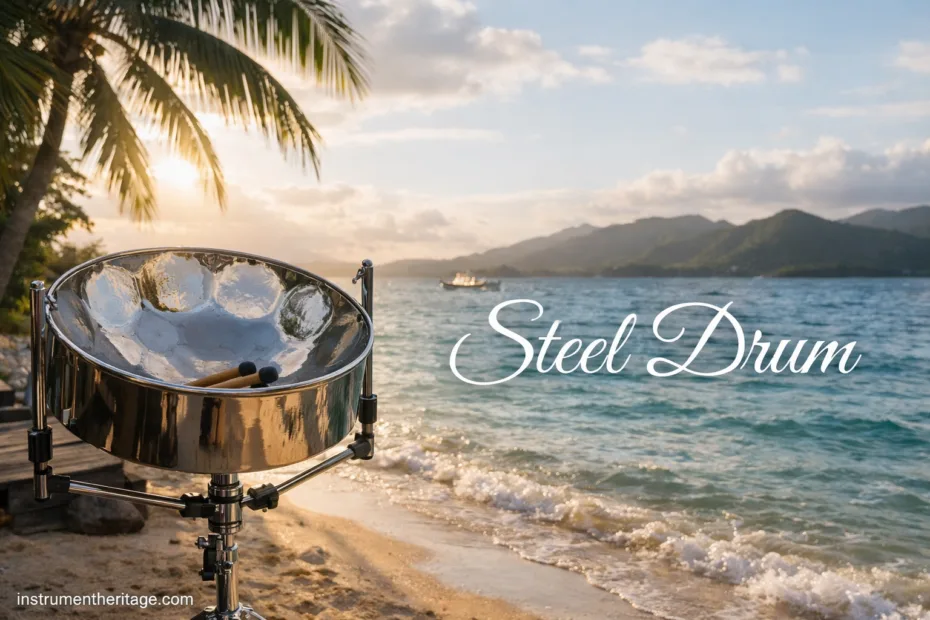
| Playing surface | A concave bowl with isolated note fields, surrounded by a skirt that helps shape resonance. |
| How it is played | Most pans are struck with rubber-tipped sticks; touch, rebound, and damping change the tone considerably. |
| Main family members | Tenor, double seconds, guitar pans, cello pans, and bass pans, supported by the engine room. |
| Sound character | Bell-like attack, singing sustain, bright upper color, and a resonant body shaped by the tuned shell. |
| Musical use | Calypso, soca, jazz, concert arrangements, folk repertory, film themes, church music, school bands, and solo performance. |
- 🥁 Acoustic percussion
- Trinidad & Tobago
- National instrument since 2024
- Tuned steel shell
- Melody, harmony, bass
- Steelband family
Steel drum is the name many readers know first, yet the instrument makes more sense once you hear it as part of the steelpan family: tuned steel notes shaped into a bowl-like surface and shared across a full band of melody, harmony, and bass. It was first made in Trinidad and Tobago around 1939, grew out of Carnival music-making, and reached its first public appearance in 1940.Reference-1✅ In Trinidad and Tobago, steelpan is also the formal term now used in national law.
🥁 Steel drum or steelpan?
Steel drum and steelpan are often used for the same instrument, but they do not carry exactly the same cultural weight. “Steel drum” became a familiar international label because the instrument developed through the use of steel containers and drum-shaped shells. In Trinidad and Tobago, players, steelbands, cultural institutions, and official usage generally favor steelpan, commonly shortened to pan.
The distinction also avoids a musical misunderstanding. A steelpan is not an ordinary drum used mainly for unpitched rhythm. Its concave playing surface contains individually tuned note areas, allowing performers to play melodies, chords, countermelodies, and bass lines. The term can refer to an individual pan, while steelband describes the larger ensemble and its family of differently ranged instruments.
Terminology: “steel drum” remains understandable and widely used, especially outside Trinidad and Tobago. Steelpan is the preferred cultural and official term when referring precisely to the Trinidad and Tobago instrument.
🇹🇹 Official National Status Since 2024
The steelpan’s place in Trinidad and Tobago moved from longstanding cultural recognition into statute in 2024. The National Musical Instrument Act, 2024 (Act No. 13 of 2024) declares the Steelpan to be the national musical instrument of Trinidad and Tobago. The Act received presidential assent on 19 July 2024 and was published in the Legal Supplement to the Trinidad and Tobago Gazette on 23 July 2024.Reference-2✅
The wording of the law is useful because it also defines what is being recognized. It describes Steelpan as a definite-pitch percussion instrument in the idiophone class, with tuned notes formed on a concave playing surface. The definition allows a pan to have a skirt or no skirt and recognizes the separate tuned sections formed across the steel surface.
What the 2024 law changed
- Legal designation: the Steelpan is expressly declared the national musical instrument of Trinidad and Tobago.
- Official terminology: the Act itself uses the single-word form Steelpan.
- Instrument definition: the law identifies it as a definite-pitch percussion idiophone with individually tuned note sections on a concave surface.
- Ongoing reporting: the responsible minister must report to Parliament every two years on the Steelpan’s recognition, status, promotion, development, and impact.
The law did not create the steelpan tradition or establish its cultural importance for the first time. Steelpan had long been treated as a national symbol. The Act gave that status a formal legal basis and made Steelpan the terminology used in the statutory declaration.
🕰️ How the instrument took shape
From bamboo rhythm to tuned steel
The steel drum did not arrive fully formed. It came through experiment. Carnival music in Trinidad and Tobago already had a living pulse, and bamboo ensembles had shown how everyday material could become organized sound. Steel changed the possibilities. It could take harder blows, hold pitch areas more clearly, and keep opening new paths every time makers pushed a little further with hammer, heat, and ear.
That history is not only about repertoire or famous performers. It is also a history of trial, touch, and listening. A maker hears a note wobble, reshapes the metal, checks it again, then chases a cleaner center. Another player asks for a layout that feels faster under the hands. A band wants deeper bass or lighter tenor response. The instrument develops through the exchange between players and builders.
Pioneers changed the shell and the musical idea
Early pan pioneers were not just inventors in the narrow sense. They were also arrangers, tuners, organizers, and problem-solvers. Some shaped the bowl more effectively. Some refined note placement. Some improved sticks. Some expanded the pitch range so the steelband could move beyond short melody lines into fuller harmony and more ambitious arrangements. The development came through many individual changes rather than one isolated invention.
This gradual shaping explains why the steelpan remains closely tied to specialist handcraft while also supporting dense jazz voicings, lyrical ballads, and arranged concert music. Craft remains part of the instrument’s musical identity.
🛠️ Build, materials, and why the shell matters
Most people know the headline version: the steelpan came from the 55-gallon drum tradition. The finished instrument, however, is a carefully controlled metal surface where bowl depth, note borders, local curvature, skirt length, and heat treatment work together. Small changes in one area can alter the response of the shell.
The basic process involves sinking the steel surface into a concave form, defining individual note areas, stabilizing the worked metal, and tuning each note field. The apparent simplicity of the raw material hides the precision involved in producing stable pitches and useful overtones.
What the builder is really controlling
- Bowl depth. A deeper sink changes the way the shell flexes and how the note fields respond.
- Note shape and border. The outline helps separate one vibrating pitch area from the next.
- Metal tension. Tuning involves both pitch and the way each worked area responds after the strike.
Material choice matters too. Pan makers need steel that can be worked extensively and still hold the stresses created during shaping and tuning. The finished shell has to respond freely enough to vibrate while keeping each note field stable under repeated playing.
The skirt also influences the instrument. Shorter skirts are generally associated with higher-range pans, while lower instruments use deeper shells. Dimensions vary across the steelpan family because each register places different demands on resonance and note size.
A useful way to picture the build
The playing surface is divided into individually shaped note fields. Their dimensions, curvature, position, and relationship with the surrounding shell affect pitch and resonance. Tuning therefore involves physically shaping the steel rather than simply attaching separate pre-tuned notes.
🎼 Why the steelpan has such a recognizable tone
A steelpan note begins with a clear percussive attack, followed by a pitched resonance that can sustain well beyond the initial strike. Upper partials contribute much of the instrument’s characteristic brightness, while differences in note size, tuning, stick hardness, and playing force alter the resulting tone.
Pan tuners do not work only with a single fundamental frequency. They also adjust important vibration modes within a note field so that the upper resonances support a stable musical pitch. This is one reason a well-tuned pan can combine a clear attack with sustained melodic tone.
The shell also radiates sound in more than one direction. Research presented through the Acoustical Society of America notes that the skirt vibrates too, and that sound from the back side of the pan tends to emphasize the second harmonic, making it brighter than the sound heard from the front.Reference-3✅ Microphone position and listener position can therefore change the balance of frequencies that reaches the ear.
What gives the tone its identity
- The strike point changes the attack.
- Stick hardness changes brightness and edge.
- Muting or letting ring changes phrase shape.
- The shell and skirt contribute vibration beyond the individual note field.
- Nearby note areas can respond sympathetically, adding extra resonance.
🎶 The steelband family and how the parts fit together
The steelpan is easiest to understand as an instrument family. Smithsonian Folkways describes the steelband as a family of tenors, seconds, cellos, and basses, accompanied by an engine room of bells, irons, shakers, and other percussion.Reference-4✅
| Section | Main job | What it usually brings to the sound |
|---|---|---|
| Tenor / lead pan | Melody, fast runs, featured lines | Clear attack, nimble phrasing, bright upper register |
| Double seconds | Harmony, countermelody, inner movement | Fuller mid-high texture and rhythmic chord color |
| Guitar and cello pans | Strumming patterns, chord support, moving inner parts | Midrange harmonic body |
| Bass pans | Root motion, low punctuation, melodic bass lines | Depth and low-register support |
| Engine room | Time, groove, propulsion | Rhythmic drive and additional percussion color |
High pans commonly carry melody, but the middle and bass voices can remain active throughout an arrangement. Double seconds, guitars, cellos, and basses supply chord voicings, countermelodies, rhythmic patterns, and moving bass lines, while the engine room establishes the rhythmic foundation.
Listen to the middle voices. Lead pan is often the first section a listener notices, but much of a steelband arrangement’s harmonic movement comes from the double seconds, guitars, and cellos between the lead and bass ranges.
🖐️ What playing one actually feels like
A steelpan rewards economical motion. The sticks are relatively light, the rebound is fast, and excessive force can reduce tonal control. On a lead pan, the hands move across a note layout that differs from a piano keyboard, so players learn spatial patterns specific to the instrument.
Rebound is part of the technique, and so is control over how long notes are allowed to ring. Some passages use overlapping resonance; others need cleaner releases. Stick height, force, placement, and damping all affect articulation.
- Rebound keeps the tone open.
- Compact motion helps speed and accuracy.
- Control of ring shapes phrasing as much as pitch does.
Players also become familiar with the physical response of individual instruments. Small differences in tuning, note placement, stick choice, and shell response can make two pans of the same range feel noticeably different under the hands.
🔔 Steelpan and related steel instruments
Steelpan, handpan, and steel tongue drum all use resonant steel and defined pitch areas, but they come from different instrument traditions and use different acoustic structures.
| Instrument | Surface design | How it is played | Typical tone | Usual setting |
|---|---|---|---|---|
| Steelpan / steel drum | Concave shell with individually tuned note fields and, usually, a resonant skirt | Mostly rubber-tipped sticks | Bright attack, definite pitch, sustained resonance, ensemble projection | Steelband, solo pan, jazz, arranged ensemble music |
| Handpan | Two joined steel shells with a central ding and surrounding tone fields | Hands and fingers | Rounded attack and sustained resonance | Solo playing and small acoustic settings |
| Steel tongue drum | Slit tongues cut into a steel body | Hands or soft mallets | Gentle attack and sustained pitched resonance | Solo playing, education, and informal music-making |
Steelpan differs especially in its development as an orchestral family. Its range system, layouts, tuning practices, arranging traditions, and ensemble roles developed around steelband performance as well as solo playing.
🔧 Tuning, repair, and the long life of a pan
A steelpan can move out of tune through repeated playing, transport, impact, environmental changes, and long-term changes in the stressed metal. Well-made instruments can remain stable for long periods, but professional maintenance and retuning remain part of steelpan practice.
Retuning addresses more than whether a note is simply sharp or flat. A tuner listens to the note center and important resonances within each field, then makes controlled adjustments to the steel. Measuring equipment can assist the process, but experienced listening remains central to the craft.
Older instruments can also preserve evidence of changing construction and tuning practices. Wear patterns, earlier layouts, repairs, and modifications can reveal how individual pans were played and maintained over time.
❓ FAQ
Common questions about the steelpan
Is steel drum the same thing as steelpan?
The terms often refer to the same instrument, but steelpan is the preferred cultural and official term in Trinidad and Tobago. “Steel drum” remains widely understood internationally. The National Musical Instrument Act, 2024 also uses the term Steelpan.
Is steelpan officially the national musical instrument of Trinidad and Tobago?
Yes. The National Musical Instrument Act, 2024 legally declares the Steelpan to be the national musical instrument of Trinidad and Tobago. The Act received presidential assent on 19 July 2024.
Why does a steelpan not sound like an ordinary drum?
Each note field is tuned to a definite pitch. The instrument therefore functions as pitched percussion rather than as a membrane drum used mainly for unpitched rhythm.
What is a steelpan usually made from?
Historically and often still today, the tradition is closely associated with 55-gallon steel drums. The metal surface is sunk, shaped, stabilized, and tuned so that separate areas produce definite musical pitches.
Can one steelpan play chords?
Yes, depending on the pan type and layout. Lead pans are often melody-focused, while double seconds, guitar pans, and cello pans are especially useful for harmonic playing and chordal texture.
Is steelpan only used for Caribbean music?
No. It is rooted in Trinidad and Tobago and remains central to Caribbean musical culture, but steelpan is also used in jazz, concert arrangements, school ensembles, worship music, pop, and solo repertory.
What is the difference between a steelpan and a handpan?
They are both tuned steel instruments, but they use different designs and playing techniques. Steelpan is normally played with sticks and developed within Trinidad and Tobago’s steelband tradition. Handpan uses two joined steel shells and is played primarily with the hands.
