
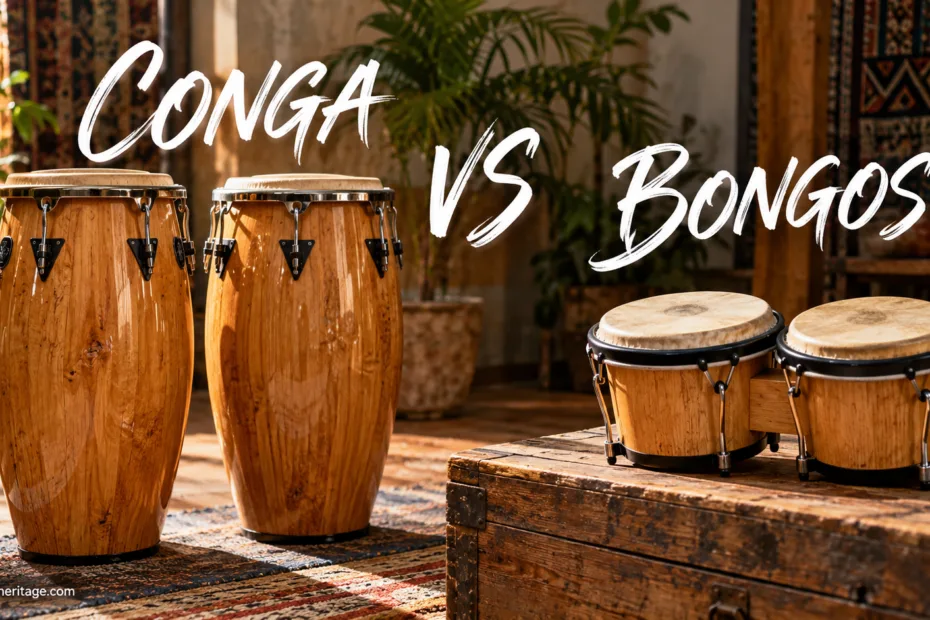
Congas and bongos belong to the same broad Afro-Cuban percussion tradition, but they are different instruments with different structures, playing techniques, sounds, and ensemble jobs. Bongos form a connected pair of small drums; a conga is a much taller individual drum that can be played alone or combined with other congas. The difference is not simply a matter of making the same drum larger or smaller.
The contrast becomes even clearer when they are played. Bongos favor finger-led articulation and two closely spaced pitches, while conga technique uses more of the hand to produce bass, open, muted, slap, heel, and tip sounds. Their best-known rhythmic vocabularies differ too: martillo is closely associated with bongo, while tumbao and marcha are central to conga playing.
| Feature | Conga | Bongos |
|---|---|---|
| Basic form | One tall, single-headed drum | Two small, single-headed drums joined together |
| Drum arrangement | One drum or a set of several independent drums | A fixed pair: macho and hembra |
| Relative size | Large and tall | Small and shallow |
| General pitch range | Lower, with a wide tonal range | Higher and more cutting |
| Playing surface | One larger head per drum | Two smaller heads with different pitches |
| Typical hand use | Fingers, palm, heel and other parts of the hand | Strong emphasis on fingers, fingertips and compact hand motions |
| Core sounds | Bass, open tone, slap, muted tone, heel and tip strokes | Open tones, muted tones, slaps and varied finger articulations |
| Rhythmic association | Tumbao and marcha | Martillo |
| Traditional seated position | One or more drums positioned in front of the player | Pair commonly held between the knees |
| Shell | Usually tall, open at the bottom | Two short shells, normally open at the bottom |
| Modern materials | Wood or composite shells; natural or synthetic heads | Wood or composite shells; natural or synthetic heads |
| Portability | Bulkier, especially as a multi-drum setup | Compact and easy to carry |
| Related ensemble role | Often maintains a recurring hand-drum layer | May move from bongo to a hand-held bell in some arrangements |
🥁 Bongos Are a Pair; a Conga Is an Individual Drum
The most basic structural difference is easy to see. A bongo consists of two drums permanently joined as a pair. A conga does not. Each conga is a separate instrument with its own shell, drumhead, tuning hardware, and pitch.
Macho and hembra form the bongo pair
The smaller bongo is called the macho, while the larger drum is the hembra. The macho is normally tuned higher. The hembra supplies the lower voice of the pair.
A rigid connecting block, often described as a bridge or yoke, holds the two shells together. Traditional playing places the connected pair between the player’s knees, although stands are also used. Smithsonian documentation of a twentieth-century bongo set describes the small joined drums, their open-ended shells, the larger hembra and smaller macho, and the instrument’s association with eastern Cuba. Reference-1✅
A conga can stand alone
A single conga is a complete playable instrument. Adding more drums expands the available pitch range rather than completing an otherwise incomplete instrument. Players commonly arrange two or three congas together, and larger professional setups may use more.
Names such as quinto, conga, tumba or tumbadora, and sometimes requinto or super tumba, identify different parts of the conga family or different size ranges. These labels are not perfectly standardized across every maker and musical setting. A name should therefore not be treated as an exact diameter specification.
Useful distinction: bongos contain two pitches within one joined instrument. With congas, additional pitches are usually created by placing several independent drums beside one another.
Size Changes How the Instruments Respond
Congas are much taller and their heads are much wider than bongo heads. Full-size modern bongos often use heads in the neighborhood of roughly 6 to 9 inches across the pair, while professional conga heads commonly occupy a range around 10 to 13 inches or more. Exact measurements vary by maker and model.
The larger vibrating membrane and much greater shell volume of a conga help it produce fuller low-frequency energy and longer resonance. A bongo head is smaller and usually held at relatively high tension, producing a fast, focused attack with less low-end weight.
Diameter alone does not determine pitch. Membrane tension, head thickness, head material, shell dimensions, bearing edge, tuning, and the point where the player strikes all affect the result. So the useful generalization is that bongos normally occupy a higher register than congas, not that physical size fixes a single pitch.
🔊 Conga and Bongo Sound Compared
Conga sound
- Deeper bass response
- Full, ringing open tones
- Sharp slap sounds
- Muted and closed articulations
- Large contrast between center and edge strokes
- Additional pitch movement when several drums are used
Bongo sound
- Higher overall register
- Short, clear attacks
- Bright open tones
- Dry muted notes
- Sharp finger slaps
- Immediate contrast between macho and hembra
Bongos can remain audible within a busy percussion section without occupying much low-frequency space. Congas cover more tonal ground on each drum: a center bass stroke can sound very different from an open tone near the edge, even before another conga is added.
✋ Why the Hand Technique Feels So Different
Both instruments are hand drums, and both can produce open tones, muted notes, and slaps. The similarity ends quickly once the player starts working on established technique.
Conga technique uses a larger playing area
The conga head gives the hands enough space to create clearly separated sound zones. The center can support a bass stroke, while the area closer to the rim produces open tones and slaps. Heel-and-tip movements also let the player create a continuous rhythmic texture without lifting both hands far from the head.
- Bass tone: a fuller hand contact toward the center excites the head differently and emphasizes lower frequencies.
- Open tone: the fingers strike near the outer playing area and rebound so the membrane can ring.
- Slap: a shaped hand motion creates a brighter, sharper attack.
- Muted tone: contact is controlled so resonance is shortened.
- Heel and tip: alternating parts of the hand can maintain subdivisions and connect accented strokes.
An academic study of Cuban bass and conga performance describes a recurring conga tumbao in terms of heel, toe/tip, slap, and open strokes, showing how different parts of the hand create different tonal functions inside one repeating rhythm. Reference-2✅
Bongo technique is more concentrated
Bongo heads give the player much less surface area. Finger placement therefore matters a great deal. Open strokes, muted touches, slaps, thumb movements, and finger combinations happen within a compact space, and the hands travel constantly between the higher macho and lower hembra.
Calling bongo technique “finger playing” should not imply that the palm is never involved. It can be. The more useful distinction is that bongo playing depends more heavily on fine finger articulation, while conga vocabulary makes extensive use of the larger hand surface and broader zones of the drumhead.
🎵 Martillo and Tumbao Do Different Jobs
The clearest musical difference is heard in their recurring patterns. Bongos are strongly associated with martillo, a Spanish word meaning “hammer.” Congas are strongly associated with tumbao and with patterns often described as marcha.
Bongo: martillo
Martillo creates a repeating pulse using contrasting sounds from the two bongo heads. The pattern can contain open and muted articulations, accents, and subtle variations. Experienced players do not have to repeat one rigid version unchanged; fills and responses can be worked around the underlying rhythmic shape.
Conga: tumbao or marcha
A conga tumbao combines hand motion, tonal contrast, and accents into a repeating part. Heel and tip movements may fill subdivisions while slaps and open tones mark stronger points. With two or more congas, the player can also move accented tones between drums of different pitches.
These patterns should not be treated as interchangeable formulas. Cuban percussion vocabulary contains many variants, and terminology can change with style, teacher, ensemble, and region. The useful distinction is functional: martillo organizes characteristic bongo articulation across a paired instrument, while conga patterns exploit a broader stroke vocabulary and, often, several drums.
The Bongo Player May Switch to a Bell
One of the less obvious differences appears when bongos and congas are heard in the same ensemble. A bongosero may stop striking the bongos during a montuno section and change to a large hand-held bongo bell, also called a campana in many musical settings.
The Smithsonian’s National Museum of American History describes the hand-held cow bell as part of Cuban son montuno and salsa instrumentation and notes that it is typically played by the bongo player during the montuno. Reference-3✅
This is an ensemble role, not a rule for every piece. Instrumentation and arrangement vary. The useful point is that a bongosero’s musical responsibility can extend beyond the two drumheads, while the conga part may continue as a separate rhythmic layer.
Shells, Heads, Hardware, and Tuning
Modern bongos and congas share several construction ideas. Both are normally single-headed drums with open lower ends. Wooden examples may use shells assembled from multiple staves, while other instruments use molded composite or fiberglass-type shells.
Drumheads
Natural hide remains common on both instruments, but synthetic heads are also available. Natural skin can respond to changes in temperature and humidity, so its tension may shift as conditions change. Synthetic material is generally more stable across changing environments, though players may prefer one material or another for feel and tone.
Mechanical tuning
Most modern professional bongos and congas use metal rims, tension rods, lugs, and other hardware that let the player raise or lower membrane tension with a wrench. Older instruments can use different head-fastening systems. The historical bongo held by the Smithsonian, for example, uses tacks as part of its head attachment rather than representing the lug-tuned construction now familiar on many commercial sets.
Why exact size names need care
Conga nomenclature is useful, but it is not a universal engineering standard. One maker’s drum sold under a certain size name may not match another maker’s exact diameter. Quinto, conga, tumba, and related terms are best read as musical and size-family labels rather than guaranteed measurements.
Their Afro-Cuban Histories Overlap Without Being Identical
Bongos and congas are both strongly connected with Afro-Cuban musical development, yet their histories should not be collapsed into a single origin story.
The Smithsonian places the emergence of the bongo double drum in eastern Cuba around the beginning of the twentieth century, with roots in African drumming traditions. Its compact paired form became closely connected with Cuban popular music, especially traditions related to son.
The modern professional conga took shape through another path. Earlier Afro-Cuban drums and rumba traditions fed into the development of what became the modern tumbadora/conga. The Metropolitan Museum of Art describes the modern conga form as developing in the mid-twentieth century from earlier Afro-Cuban instruments and notes that professional players commonly use sets of two or three drums. Reference-4✅
- Bongo or bongos?
- In English, “bongos” is very common for the paired instrument. In percussion terminology, “bongo” can also refer to the complete two-drum instrument.
- Conga or tumbadora?
- “Conga” is widely used in English. Tumbadora is an established term in Cuban and Spanish-language percussion vocabulary and may refer to the instrument or, depending on context, a particular drum within a set.
Why Congas and Bongos Are Often Played Together
“Conga vs bongos” sounds like an either-or choice, yet the instruments frequently occupy different layers of the same percussion section. Their contrasting pitch ranges and articulation allow them to coexist without simply duplicating one another.
In ensembles drawing from son, salsa, Latin jazz, and related traditions, the percussion section may combine congas, bongos, timbales, bells, güiro, maracas, and claves. The exact lineup changes with repertoire and arrangement.
- Congas can supply a sustained recurring hand-drum layer with low, open, muted, and slap tones.
- Bongos occupy a higher register and allow compact articulation, martillo-based accompaniment, fills, and other variations.
- Bells can alter the texture when an arrangement moves into a different section.
- Timbales and smaller percussion add further rhythmic layers without making either conga or bongo redundant.
Can You Play Bongo Rhythms on Congas?
The timing of a rhythm can be transferred from one instrument to another. Its instrument-specific sound and movement cannot be copied perfectly.
A player can reproduce the pulse of a martillo-inspired rhythm on a conga, for example, but a single conga does not provide the same immediate relationship between a high macho and lower hembra. The finger response is different too.
The reverse is also true. A bongo player can imitate the timing of a conga pattern, but small, tightly tensioned heads do not reproduce a conga’s center bass tone, broad open tone, heel-tip mechanics, or movement across several full-size drums.
Rhythm transfers more easily than technique. Learning one instrument can improve coordination and rhythmic awareness for the other, but good conga tone does not automatically produce good bongo articulation, and vice versa.
Is Conga or Bongo Easier to Learn?
Neither instrument has a reliable claim to being universally easier. Bongos are smaller and more portable, but the tight heads and compact playing zones demand precise finger control. A steady martillo that remains relaxed and even takes practice.
Congas provide more physical room for the hands, yet producing a clean separation between bass, open tone, slap, muted tone, heel, and tip can take time. Slaps in particular may sound dull or uncontrolled until the player’s hand shape, timing, and rebound become consistent.
| Learning area | Conga | Bongos |
|---|---|---|
| Early coordination | Alternating hands across one broad head | Moving accurately between two small heads |
| Tone production | Several strongly differentiated hand sounds | Precise finger articulation and pitch contrast |
| Physical demand | Larger hand motions and a larger instrument | Compact, repetitive finger and hand movements |
| Expanding the setup | Additional drums introduce more pitch choices | The two-pitch layout is already present |
| Rhythmic study | Tumbao, marcha and their variations | Martillo and its variations |
Which One Fits What You Want to Play?
The choice makes more sense when based on sound, technique, space, and musical role rather than assuming one instrument is a beginner version of the other.
Bongos may suit you if…
- You want a compact paired drum.
- You prefer a bright, high-register sound.
- Finger-oriented articulation interests you.
- You want to study martillo and bongo vocabulary.
- Easy transport and limited storage space matter.
Conga may suit you if…
- You want deeper resonance and stronger bass response.
- You want to develop open, slap, bass, muted, heel, and tip strokes.
- Tumbao and marcha technique interest you.
- You want the option to expand from one drum to several.
- A larger floor or stand-mounted setup is practical for you.
A percussionist interested specifically in Afro-Cuban ensemble playing may eventually study both. Their musical functions overlap enough to inform one another, yet their technique and sound remain clearly distinct.
Common Conga and Bongo Mix-Ups
They differ in basic architecture, traditional technique, pitch organization, and rhythmic vocabulary. A change in scale alone does not turn one into the other.
One conga is fully playable. Sets of two, three, or more expand the pitch and orchestration options.
Not necessarily. In some son- and salsa-related arrangements, the bongosero moves to a hand-held bell during the montuno.
Both instruments have slap-like articulations, but the membrane size, tension, hand contact, response, and resulting tone differ.
Tumbadora is widely used in Cuban percussion terminology for the drum family commonly called congas in English. Exact naming can also depend on which drum within a set is being discussed.
Other Hand Drums and Percussion That Sit Nearby
Visual similarity can make unrelated percussion instruments seem closer than they are. A few instruments commonly mentioned beside congas and bongos have very different construction or playing methods.
| Instrument | How it differs |
|---|---|
| Timbales | Shallow metal-shell drums normally played with sticks; their role and technique differ sharply from hand-struck congas and bongos. |
| Djembe | A single goblet-shaped West African hand drum with a different shell profile, tuning tradition, tonal system, and musical background. |
| Ashiko | A tapered single-headed hand drum. Its body can appear closer to a conga than a bongo does, but its construction history and playing contexts differ. |
| Cajón | A box-shaped percussion instrument whose front panel is struck directly; it does not use a stretched drum membrane like congas and bongos. |
Conga vs Bongos: Detailed Comparison
| Comparison point | Conga | Bongos |
|---|---|---|
| Instrument format | Independent drum | Connected two-drum instrument |
| Main pitch organization | Different strokes on one head; more pitches by adding drums | Built-in high and low relationship between macho and hembra |
| General sound | Fuller, lower, broader tonal spread | Higher, bright, compact attack |
| Bass stroke | Important part of the instrument’s vocabulary | Does not function like a conga center bass stroke |
| Open tones | Yes | Yes |
| Slap-type sounds | Yes | Yes, with a different physical response |
| Heel-tip motion | Closely associated with conga technique | No direct equivalent with the same function and feel |
| Pattern strongly associated with instrument | Tumbao / marcha | Martillo |
| Position | In front of the player, seated or standing depending on setup | Traditionally between the knees; stands are also used |
| Number of heads used at once | One per drum | Two within the joined pair |
| Setup expansion | Add separate congas | The core instrument remains the two-drum pair |
| Bell relationship | No equivalent instrument switch built into the basic role | Bongosero may switch to bongo bell in some ensemble sections |
| Portability | Moderate to low as the setup grows | High |
| Cultural setting | Afro-Cuban traditions, rumba-related practice, son/salsa contexts, Latin jazz and wider contemporary use | Afro-Cuban traditions, especially son-related practice, salsa, Latin jazz and wider contemporary use |
Frequently Asked Questions
Are bongos and congas the same instrument?
No. Bongos are a joined pair of small drums, while each conga is an individual tall drum. Their dimensions, pitch ranges, established techniques, and rhythmic roles also differ.
Are bongos just small congas?
No. Shrinking a conga would not produce the paired macho-and-hembra structure or the characteristic playing layout of bongo. The two instruments developed with different playing vocabularies.
What are the two bongo drums called?
The smaller, normally higher-pitched drum is the macho. The larger, normally lower-pitched drum is the hembra.
Which is bigger, a conga or a bongo?
A conga is much larger. It has a taller shell and a wider head than either drum in a typical bongo pair.
Which sounds lower, congas or bongos?
Congas generally occupy the lower register. Bongos are normally tuned higher and have a brighter, shorter attack. Individual tuning and head construction still affect the actual pitch.
Can you play one conga by itself?
Yes. A single conga supports bass, open, muted, slap, heel, tip, and other articulations. Additional congas expand the available pitches rather than making the first drum playable.
Why do bongo drums come in two sizes?
The two sizes create contrasting pitches within the same instrument. The smaller macho normally provides the higher voice and the larger hembra the lower one, giving bongo patterns immediate tonal movement.
What is the difference between conga and tumbadora?
They are often two terms connected with the same drum family. Conga is widespread in English, while tumbadora is established in Cuban and Spanish-language usage. Naming can become more specific when individual sizes within a multi-drum set are discussed.
Do bongos and congas use the same hand technique?
No. They share some broad concepts such as open and muted tones, but conga technique uses a larger surface and a broader range of whole-hand motions. Bongo technique places more emphasis on compact finger articulation across two small heads.
Can bongos and congas be played together?
Yes. They are often used together because their ranges and musical functions complement one another. The conga can maintain its own recurring pattern while bongo occupies a higher rhythmic layer.
Which is easier for a beginner, bongos or congas?
It depends on the player. Bongos are smaller and easier to transport but demand accurate finger control. Congas offer a larger target area, yet producing cleanly separated bass, open, muted, and slap tones takes practice.
Do congas and bongos always use animal-skin heads?
No. Natural hide is common, but synthetic drumheads are also available for both instrument families. The two materials differ in feel, response, and sensitivity to environmental changes.
