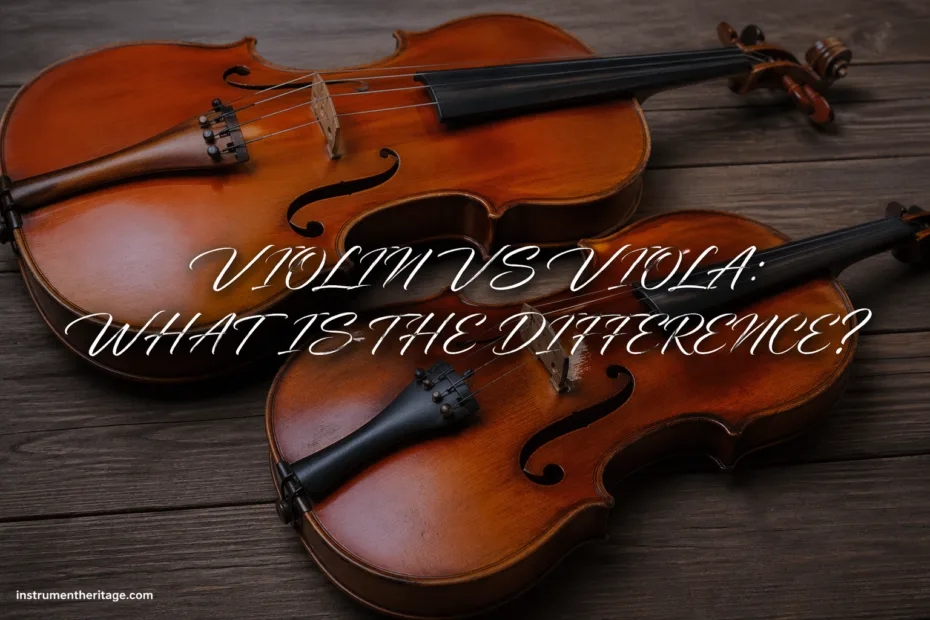
Place a violin and a viola on a table and they look like close relatives. They are. Same curved body, same four-string layout, same bowing family. Pick them up, though, and the difference becomes physical very quickly: the violin feels lighter and speaks higher, while the viola has a broader body, lower tuning, and darker middle voice. One cuts like a fine silver line. The other glows closer to the chest.
| Feature | Violin | Viola |
|---|---|---|
| Instrument family | Violin family, highest common bowed string voice | Violin family, alto voice between violin and cello |
| Common tuning | G–D–A–E, from lowest to highest | C–G–D–A, a fifth lower than the violin Reference-1✅ |
| Typical body length | Full-size violin is commonly about 14 inches / 35 cm | Adult violas often sit around 15 to 16.5 inches / 38 to 42 cm, with more variation |
| Sound character | Bright, focused, singing, quick to respond | Warm, darker, woody, more veiled in the middle range |
| Written clef | Mostly treble clef | Mostly alto clef, with treble clef in higher passages |
| Orchestral role | Melody, upper harmony, fast passagework, brilliant color | Inner harmony, counter-melody, rhythmic texture, rich middle register |
| String feel | Thinner strings, slightly faster response under the bow | Thicker strings, often asking for more bow weight and patience |
| Best first impression | Clear and direct | Rounded and earthy |
🎻 Size: The Viola Is Larger, But Not Just “A Big Violin”
The easiest visible difference is size. A full-size violin has a fairly settled body length, while the viola lives in a looser world. Many adult violas are around 15, 15.5, 16, or 16.5 inches, and some players choose larger or smaller models depending on arm length, hand span, shoulder comfort, and the sound they want.
This matters because the viola is asked to speak a fifth lower than the violin while still being held under the chin. If a maker enlarged the violin perfectly in proportion to that lower range, the result would be awkward to play for many people. The instrument has to make a trade: enough body volume for a low C string, but not so much body that the player feels trapped around the upper bout.
The viola is shaped by a useful compromise: acoustic depth versus human reach. That is why two good violas can feel quite different in the hand while still belonging clearly to the same instrument family.
Yamaha’s instrument guide notes that violas are not held to strict size standards and explains the familiar maker’s problem: the acoustically “ideal” viola would be too large for normal arm-and-shoulder playing, so real violas are built smaller than that theoretical size. Reference-2✅
Body shape and proportions
Both instruments use the familiar hourglass outline: upper bouts, narrow waist, lower bouts, arched plates, f-holes, bridge, soundpost, bass bar, neck, fingerboard, pegbox, and scroll. The difference is in proportion. A viola usually has a wider body, deeper ribs, and a longer string length. It can feel broader across the shoulder and slightly slower to turn under the left hand.
That extra size is not decoration. It helps the lower strings breathe. A violin’s body is built to let the E string shine without sounding thin. A viola’s body has to give the C string a place to bloom. Small change, big effect.
🎼 Tuning: One Fifth Changes the Whole Personality
The violin is tuned G–D–A–E. The viola is tuned C–G–D–A. Three strings overlap by name: G, D, and A. The difference is at the edges. The violin has a high E string. The viola has a low C string.
That single swap changes almost everything. The violin’s top string gives it brilliance, projection, and a clean upper line. The viola’s C string gives it a low, textured color that feels closer to the cello family without becoming a cello. It is still an under-the-chin instrument. It just speaks from a lower floor.
Violin open strings
- G — lowest violin string, warm but still focused
- D — rounded middle string
- A — clear and singing
- E — bright, high, and penetrating
Viola open strings
- C — lowest viola string, dark and grainy
- G — warm, stable, full
- D — open and expressive
- A — closest to violin color, but usually broader
The shared strings can fool the ear. A note played on a violin’s G string and the same pitch played on a viola may not carry the same color. The viola’s longer string length, thicker strings, larger plates, and body resonance change the way overtones gather around the note. The pitch may match. The skin of the sound does not.
🔊 Sound: Bright Line vs Warm Middle Voice
Many people describe the violin as bright and the viola as warm. That is useful, but a little too flat. The violin often feels like a clean beam of light. It can sing above an ensemble, carry a melody across a hall, and respond quickly to fast bow changes. The viola is less about sparkle and more about grain. It has a woody, human, middle-register color that can make a harmony feel settled.
The Philharmonia describes the viola as the alto voice of the string family, larger than the violin, with its lowest note a perfect fifth below the violin. It also points out that the viola blends especially well with instruments such as clarinet and bassoon, which says a lot about its color: soft-edged, reedy, and comfortable in the middle of the texture. Reference-3✅
Why the viola sounds darker
A bowed string does not make a note by itself in the way a singer’s vocal folds do. The string vibrates, the bridge rocks, the soundpost and bass bar help transfer motion, and the hollow wooden body moves air through and around the f-holes. The final tone is a whole-body event.
The viola’s lower tuning needs heavier strings and a larger resonating body. Since the instrument is still small enough to hold on the shoulder, its design lives in a slightly compressed acoustic space. That is part of its charm. The tone can feel shaded, a little smoky, sometimes nasal in a beautiful way, especially on the C and G strings.
The violin, by comparison, often has a more immediate edge. Its body size suits its tuning very efficiently, and the high E string gives it a direct upper voice. In a string quartet, the first violin may seem to speak first. The viola often makes you notice what the harmony is made of.
- Best word for the violin sound
- Focused. It carries a line clearly.
- Best word for the viola sound
- Textured. It thickens the musical fabric.
- Best way to hear the difference
- Listen to the lowest string on each instrument. The violin’s G has depth, but the viola’s C has a darker floor underneath it.
🏛️ Shared History: Same Family, Different Voice
The violin and viola grew out of the same bowed-string craft tradition. The modern four-string violin is generally traced to northern Italy around the mid-16th century, drawing features from earlier bowed instruments such as the rebec, Renaissance fiddle, and lira da braccio. The tuning in fifths became one of the family’s lasting traits. Reference-4✅
Early makers did not treat “viola” as one perfectly fixed object. There were alto and tenor sizes, and the names could be fluid. Some instruments were built for higher inner parts, others for lower lines. Over time, the modern viola settled into its current role: not as a failed violin, not as a small cello, but as the alto member of the violin family.
Why the violin became more familiar
The violin’s high range made it naturally suited to melodies that listeners could follow. It also worked beautifully in dance music, vocal accompaniment, chamber music, and later concert music. Its size was practical, its projection strong, and its voice easy to place at the top of an ensemble.
The viola had a quieter public story for a long time. It often lived inside the harmony, filling the space between the violin and cello. That does not make it lesser. It means its beauty is built differently. The viola often works like the warm wood under a polished table: you may not notice it first, but the whole object feels weaker without it.
🪵 Materials and Making: Same Woods, Different Demands
Violin and viola makers use many of the same traditional materials. The top plate is usually spruce, chosen for its lightness and lively vibration. The back, ribs, and neck are commonly maple, valued for strength, beauty, and a clear reflective quality. Ebony is often used for the fingerboard, pegs, and fittings because it resists wear under fingers and strings.
The parts look small, but each one affects the voice.
- Spruce top: the main vibrating surface; it helps turn string motion into air movement.
- Maple back and ribs: add structure, reflection, and tonal shape.
- Bridge: a carved maple filter between strings and body; tiny changes alter response.
- Soundpost: a small internal post under the treble side; it helps balance brightness, support, and projection.
- Bass bar: a long internal brace under the bass side; it supports lower-string energy.
- Varnish: protects the wood, but also influences how freely the surface vibrates.
A good maker does not simply “make the viola bigger.” The arching, rib depth, plate thickness, bridge cut, neck angle, and string choice all need to work with the player’s body. Comfort and tone are tied together.
String materials and response
Older bowed strings were made from gut. Modern violin and viola strings may use synthetic cores, steel cores, gut cores, and different metal windings. Violas often need heavier-gauge strings than violins because of the lower tuning. That extra mass helps produce the lower pitch, but it can also make the response feel slower if the setup is not well matched.
On violin, a clean bow stroke can speak almost instantly, especially on the A and E strings. On viola, the player may need to let the bow sink a little more into the string. Not force. Weight. There is a difference.
✋ Playing Feel: The Difference Is in the Hands and Shoulder
A violinist switching to viola often notices the left hand first. The spaces between notes are wider. Finger patterns feel stretched. Shifts need a slightly different map. The instrument also sits a little differently under the chin because the body is wider and sometimes deeper.
The bow arm notices next. Viola strings are thicker, and the instrument often likes a slower bow with more natural arm weight. A light violin stroke may sound thin on viola. A heavy, pressed stroke may choke it. The sweet spot is broad but specific, like walking on firm sand near the waterline.
Viola bow vs violin bow
A viola bow is usually a little heavier than a violin bow. The frog may also feel slightly broader. This helps the player draw sound from thicker strings, especially the C string. A violin bow can make sound on a viola, of course, but a proper viola bow often gives more grip and a fuller start to the note.
| Playing area | What changes | What the player feels |
|---|---|---|
| Left-hand spacing | Viola has a longer string length | Fingers spread more; intonation needs fresh listening |
| Bow pressure | Viola strings are thicker and lower | More arm weight, less scratchy surface pressure |
| Response time | Viola often speaks a touch slower | The note may need a calmer start |
| Reading music | Viola uses alto clef often | The middle line is C, which feels new to many violinists |
| Physical comfort | Viola body is wider | Shoulder rest, chin rest, and setup matter a lot |
For younger players or adults with smaller hands, viola size should never be treated like a badge of honor. A slightly smaller viola that plays freely is better than a large one that causes tension. The right instrument is the one that lets the player make a full tone without fighting the wood.
📖 Clef and Reading: The Viola Has Its Own Written Language
The violin mostly reads treble clef. The viola mostly reads alto clef. That alone gives the viola a different mental feel. In alto clef, middle C sits on the center line of the staff. For a violinist, it can feel like the furniture has been moved during the night.
Why use alto clef? Because the viola lives in the middle register. If viola music were written only in treble clef, many normal notes would sit awkwardly below the staff. If it were written in bass clef, higher passages would climb too far above it. Alto clef keeps much of the viola’s daily work centered and readable.
Clef difference in plain words
Violin notation sits naturally in the upper register, so treble clef works well.
Viola notation sits in the middle register, so alto clef keeps the notes from drifting too high or too low on the page.
🎶 Role in Ensembles: Melody, Inner Voice, and Blend
In a string quartet, the violin often carries the top line. The cello often holds the bass or sings in a lower register. The viola lives between them. That middle position is not a waiting room. It is where harmony thickens, rhythm gets its grain, and inner melodies quietly move the music forward.
The viola can play melody beautifully, especially when the line sits on the C, G, or D string. It can sound intimate rather than showy. The violin can play inner harmony too, but its bright upper nature often pulls attention. The viola blends more easily, which is why composers use it for color, warmth, and motion inside the ensemble.
In an orchestra
Violins are usually divided into first and second violin sections. First violins often carry high melodic lines. Second violins may share melody, harmony, rhythm, or echo figures. Violas sit lower, often near the center of the string sound. Their job may be a pulsing accompaniment, a counter-line, a warm pad under woodwinds, or a sudden dark solo phrase.
When the viola section is strong, the orchestra feels less hollow. You may not always point to it. You feel it.
🪕 Similar Instruments and Close Relatives
The violin and viola sit inside a larger bowed-string family. Looking at their relatives helps make the difference clearer.
| Instrument | Basic position | Typical voice | How it relates |
|---|---|---|---|
| Violin | Under the chin | High soprano-like string voice | The smallest and highest common member of the violin family |
| Viola | Under the chin | Alto middle voice | Larger, lower, and darker than the violin |
| Cello | Between the knees | Tenor to bass range | Much larger body; tuned C–G–D–A, an octave below viola |
| Double bass | Standing or seated upright | Lowest orchestral string voice | Different tuning system in fourths; deeper, larger, and structurally distinct |
| Viola d’amore | Under the chin | Soft, ringing, sympathetic color | Related by playing position and bowed technique, but built with sympathetic strings |
| Viola da gamba | Held between the legs | Gentle, reedy, old bowed-string color | A separate viol-family instrument with frets and a different tuning tradition |
The name “viola” can confuse beginners because it appears inside older instrument names. A modern viola is not the same as a viola da gamba or a viola d’amore. The modern viola belongs to the violin family: arched body, four main strings, no frets, held under the chin, and tuned in fifths.
🎯 Which One Should a Player Choose?
Choose the violin if you love high melodies, quick response, bright projection, and a large solo tradition. The violin has a huge body of music across folk, classical, film, chamber, and experimental styles. It is agile. It likes to fly.
Choose the viola if your ear is pulled toward darker colors, middle harmonies, inner lines, and a sound that feels close to the human speaking range. The viola rewards patience. It asks you to listen into the note rather than skim over it.
Violin may feel right if…
- You enjoy a bright upper voice.
- You like fast, clear passagework.
- You want to read mostly treble clef.
- You prefer a smaller under-the-chin instrument.
- You are drawn to a large solo and ensemble repertory.
Viola may feel right if…
- You like a warmer, darker sound.
- You enjoy harmony and inner movement.
- You are comfortable learning alto clef.
- You want a bigger physical feel under the hand.
- You enjoy blending, supporting, and then surprising the listener with a rich solo line.
There is no better instrument here. Only a different kind of listening. Some players start on violin and move to viola later because the sound feels more like their own voice. Some stay with violin because they love the clean lift of the E string. Both choices are musically honest.
🔧 Setup Details That Change the Difference
Two violins can sound different. Two violas can sound even more different. Setup is a quiet part of the story: bridge height, string brand, soundpost position, tailpiece length, chin rest shape, shoulder rest fit, and bow choice can all change the response.
On violin, a setup may aim for clarity, brilliance, and evenness across the four strings. On viola, a maker or luthier may work harder to balance the C string against the A string. Too much darkness and the sound becomes cloudy. Too much brightness and the viola loses its center. The best viola setup keeps the low string open while letting the A string speak without strain.
- Bridge cut: affects string height, bow clearance, and tonal response.
- Soundpost fit: can make the instrument feel open, tight, bright, or mellow.
- String choice: can add warmth, focus, speed, or stability.
- Bow match: can decide whether the viola feels heavy or alive.
- Player comfort: chin rest and shoulder rest can change technique more than people expect.
A viola that feels hard to play is not always a “difficult instrument.” Sometimes it is simply the wrong size, wrong setup, or wrong bow for that player. The same is true of a violin that sounds thin or stiff. Wood needs help from good adjustment.
👂 How to Hear the Difference Without Seeing the Instrument
Start with register. If the line climbs high and shines above the texture, it is likely violin. If the sound sits in the middle and carries a dark, rounded edge, it may be viola. Then listen to attack. The violin often starts with a more immediate point. The viola may speak with a slightly wider front to the note.
Listen for the low C. That is the viola’s home territory. A violin cannot play that note in standard tuning. When a bowed string sound drops below the violin’s G and still has that under-the-chin bowing character, you are probably hearing a viola.
One simple ear test: violin often draws the outline; viola often colors the inside. That is not a rule for every piece, but it helps when you are first learning the sound.
Questions Players Often Ask
Violin vs Viola FAQ
Is the viola harder than the violin?
Not harder in a simple sense. The viola has wider finger spacing, thicker strings, more use of alto clef, and a slightly slower response under the bow. The violin has its own challenges, especially in high positions, fast passagework, and exposed upper-register playing.
Can a violinist play viola?
Yes, many violinists can learn viola. The bowing and left-hand basics are related, but the player must adjust spacing, bow weight, listening habits, and reading in alto clef. A good violinist does not automatically sound like a good violist on day one.
Why does the viola use alto clef?
The viola spends much of its time in the middle register. Alto clef keeps those notes centered on the staff, so the music does not need too many ledger lines above or below.
Is a viola just a larger violin?
No. It looks similar, but the viola has lower tuning, thicker strings, a larger body, different written clef, and a different role in ensemble sound. Its design is shaped around the low C string and the alto register.
Which sounds better, violin or viola?
Neither one is better. The violin is brighter and more direct, while the viola is darker and warmer. The better choice depends on the color a player wants to make and the role they enjoy in music.
Can a viola play violin music?
Some violin music can be adapted for viola, but it may need transposition, finger adjustment, or a different register. The viola’s lower tuning and larger size can make certain violin passages less natural, while some melodies gain a warmer color on viola.
